靠批判自己,永远无法长久改变|TED 演讲
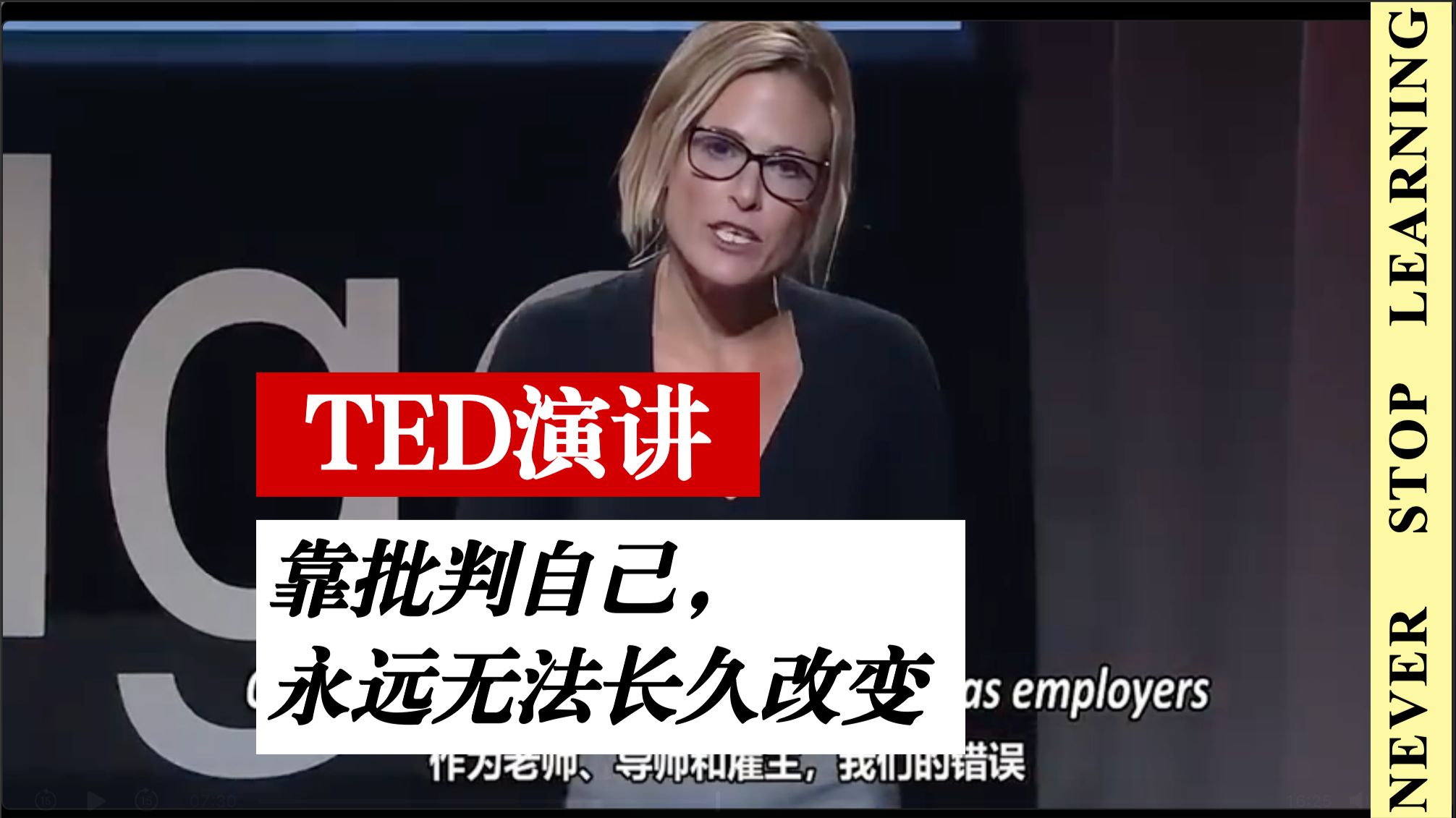
字幕摘录
| 时间 | 英文 | 中文 |
|---|---|---|
| 0:00 | So we all have some behavior that we would like to change about ourselves and we certainly | 所以,我们都有一些行为 我们想改变我们自己,我们当然 |
| 0:06 | all want to help someone else change their behavior in a positive way. | 他们都想帮助别人以积极的方式改变他们的行为。 |
| 0:10 | So maybe it's your kid, your spouse, your colleague. | 也许是你的孩子 你的配偶 你的同事 |
| 0:14 | So I want to share some new research with you that I think reveals something really | 所以我想和你们分享一些新的研究 我认为这些研究揭示了一些 |
| 0:18 | important about what gets people to change their behavior. | 很重要的是什么 让人们改变他们的行为。 |
| 0:23 | But before I do that, let's zoom in on one strategy that I think you probably use a lot. | 但在我这样做之前,让我们放大 一个策略,我认为你可能 使用了很多。 |
| 0:29 | So let's say you're trying to stop yourself from snacking. | 所以,让我们假设你试图阻止自己吃零食。 |
| 0:32 | What do you tell yourself? | 你怎么告诉自己? |
| 0:34 | Well, most people in a monologue will say, beware, you'll be fat. | 好吧,大多数人在独白会说, 小心,你会很胖。 |
| 0:40 | And if this was your kid, you would probably tell him that smoking kills and by the way, | 如果这是你的孩子, 你可能会告诉他,吸烟杀死了,顺便说一句, |
展开字幕全文(240 条)
| 序号 | 英文 | 中文 |
|---|---|---|
| 1 | So we all have some behavior that we would like to change about ourselves and we certainly | 所以,我们都有一些行为 我们想改变我们自己,我们当然 |
| 2 | all want to help someone else change their behavior in a positive way. | 他们都想帮助别人以积极的方式改变他们的行为。 |
| 3 | So maybe it's your kid, your spouse, your colleague. | 也许是你的孩子 你的配偶 你的同事 |
| 4 | So I want to share some new research with you that I think reveals something really | 所以我想和你们分享一些新的研究 我认为这些研究揭示了一些 |
| 5 | important about what gets people to change their behavior. | 很重要的是什么 让人们改变他们的行为。 |
| 6 | But before I do that, let's zoom in on one strategy that I think you probably use a lot. | 但在我这样做之前,让我们放大 一个策略,我认为你可能 使用了很多。 |
| 7 | So let's say you're trying to stop yourself from snacking. | 所以,让我们假设你试图阻止自己吃零食。 |
| 8 | What do you tell yourself? | 你怎么告诉自己? |
| 9 | Well, most people in a monologue will say, beware, you'll be fat. | 好吧,大多数人在独白会说, 小心,你会很胖。 |
| 10 | And if this was your kid, you would probably tell him that smoking kills and by the way, | 如果这是你的孩子, 你可能会告诉他,吸烟杀死了,顺便说一句, |
| 11 | he's in big, big trouble. | 他麻烦大了 |
| 12 | So what we're trying to do here is we're trying to scare ourselves and others into changing | 所以,我们想做的是 我们试图吓唬自己和其他人 改变 |
| 13 | their behavior. | 他们的行为。 |
| 14 | And it's not just us. | 不仅仅是我们 |
| 15 | Warnings and threats are really common in health campaigns, in policy. | 警告和威胁在卫生运动和政策中确实很常见。 |
| 16 | It's because we all share this deep rooted belief that if you threaten people, if fear | 因为我们都有这种根深蒂固的信念 如果你威胁人们,如果恐惧 |
| 17 | is induced, it will get them to act. | 被诱导,会让他们采取行动。 |
| 18 | And it seems like a really reasonable assumption, except for the fact that the science shows | 这似乎是一个非常合理的假设 除了科学显示 |
| 19 | that warnings have very limited impact on behavior. | 警告对行为的影响非常有限。 |
| 20 | So graphic images on cigarette packets, for example, do not deter smokers from smoking. | 例如,香烟包上的图片并不能阻止吸烟者吸烟。 |
| 21 | And one study found that after looking at those images, quitting actually became a lower | 一项研究发现,在看完这些图像后, 退出实际上变成了一个较低的 |
| 22 | priority for smokers. | 对吸烟者优先。 |
| 23 | So I'm not saying that warnings and threats never work. | 所以我不是说警告和威胁是行不通的。 |
| 24 | But what I'm saying is that on average, they seem to have a very limited impact. | 但我想说的是,平均来说,它们的影响似乎非常有限。 |
| 25 | And so the question is, why? | 所以问题是 为什么? |
| 26 | Why are we resistant to warnings? | 为什么我们拒绝警告? |
| 27 | Well, if you think about animals, when you induce fear in an animal, the most common | 好吧,如果你想到动物, 当你诱发恐惧 在动物,最常见的 |
| 28 | response you will see is freezing or fleeing, fighting not as much. | 你会看到的反应是冷冻或逃跑, 战斗没有太多。 |
| 29 | And so humans are the same. | 故众生亦如是. |
| 30 | So something scares us. | 所以有些东西会吓到我们 |
| 31 | We tend to shut down and we try to eliminate the negative feelings. | 我们倾向于关闭 并试图消除负面的感情。 |
| 32 | So we might use rationalization. | 所以我们可以使用合理化。 |
| 33 | So for example, you might tell yourself, my grandpa smoked, he lived to be 90. | 比如说,你可以告诉自己, 我爷爷抽烟, 他活到90岁。 |
| 34 | So I have really good genes and absolutely nothing to worry about. | 所以我有非常好的基因 绝对不用担心。 |
| 35 | And this process can actually make you feel more resilient than you did before, which | 这个过程可以让你比以前更有弹性 |
| 36 | is why warnings sometimes have this boomerang effect. | 警告有时会产生这种繁荣效应。 |
| 37 | And other times, we simply put our head in the ground. | 而有时,我们只是把头放在地上。 |
| 38 | Take the stock market, for example, do you know when people pull their head out of the | 以股票市场为例,你知道当人们把头抽出来 |
| 39 | ground to look at their accounts, not to make a transaction, just to log in to check their | 查看他们的账户,而不是交易,只是登录他们 |
| 40 | account? | 账户? |
| 41 | So what you're seeing here in black is the S&P 500 over two years. | 所以,你在这里看到的黑色的 是S&P500 在两年。 |
| 42 | And in gray is a number of times that people logged into their account just to check. | 灰色是人们登录账户的几倍。 |
| 43 | And this is data from Carlston, Lewinstein and Seppi. | 这是来自卡尔斯顿,莱温斯坦和塞皮的数据。 |
| 44 | It's control for all the obvious confounds. | 这是对所有明显混乱的控制。 |
| 45 | So what do we see? | 那我们看到什么了? |
| 46 | So when the market is high, people log in all the time because positive information makes | 因此,当市场高, 人们总是登录 因为积极的信息使得 |
| 47 | you feel good. | 你感觉很好。 |
| 48 | So you seek it out. | 所以,你寻找出来。 |
| 49 | And when the market is low, people avoid logging in because negative information makes us feel | 当市场低,人们避免伐木 因为负面信息让我们觉得 |
| 50 | bad. | 糟透了,我还没说完 |
| 51 | So we try to avoid it altogether. | 所以,我们尽量避免它。 |
| 52 | And all this is true as long as bad information can reasonably be avoided. | 只要可以合理地避免坏消息,所有这一切都是真的. |
| 53 | So what you don't see here is what happened a few months later in the financial collapse | 你看不到的是几个月后 金融崩溃时发生的事 |
| 54 | of 2008 when the market went drastically down. | 2008年市场大幅下跌。 |
| 55 | And that's when people started logging in frantically, but it was a bit too late. | 这时人们开始疯狂地伐木, 但已经太迟了。 |
| 56 | So you can think about it like this. | 所以你可以这样想 |
| 57 | It's not just finance. | 不仅仅是金融 |
| 58 | In many different parts of our life, we have warning signs and bad behaviors now. | 在我们生活的很多不同部分,我们有警告迹象和不良行为。 |
| 59 | And they could potentially lead to all these bad outcomes later. | 它们可能会在以后导致所有这些不良结果。 |
| 60 | But not necessarily so, because there's different routes from your present to your future, right? | 但不一定,因为有不同的路线 从你的现在到你的未来,对不对? |
| 61 | It can go this way, it can go that way. | 可以走这条路,也可以走这条路. |
| 62 | And as time passes, you gather more and more information about where the wind is blowing. | 随着时间的流逝, 你收集了越来越多的信息 关于风在哪里吹。 |
| 63 | And at any point, you can intervene. | 你可以随时介入 |
| 64 | And you could potentially change the outcome. | 你可能会改变结果 |
| 65 | But that takes energy. | 但这需要精力。 |
| 66 | And you might tell yourself, well, what's the point about worrying about something that | 你可以告诉自己 担心什么有什么意义 |
| 67 | might happen? | 会不会发生? |
| 68 | It might not happen. | 这也许不会发生。 |
| 69 | Until we reach this point, at which time you do jump into action, but sometimes it's a | 直到我们到达这个点, 那时你确实跳进行动, 但有时这是一个 |
| 70 | little bit too late. | 有点太迟了 |
| 71 | So we wanted to know, in my lab, what type of information does leak into people? | 所以我们想知道,在我的实验室里, 什么样的信息会泄露给人们? |
| 72 | So we conducted an experiment where we asked approximately 100 people to estimate the likelihood | 于是我们进行了一个实验, 我们请了大约100人 来估算可能性 |
| 73 | of 80 different negative events that might happen to them in the future. | 未来可能发生的80起负面事件。 |
| 74 | So for example, I might ask you, what is the likelihood that you will suffer hearing loss | 例如,我可能会问你, 什么是你可能会遭受 听力损失 |
| 75 | in your future? | 在你的未来? |
| 76 | And let's say you think it's about 50%. | 假设你认为这是50%左右。 |
| 77 | Then I give you the opinion of two different experts. | 然后,我给你两个不同专家的意见。 |
| 78 | So expert A tells you, you know, for someone like you, I think it's only 40%. | 所以,专家A告诉你,你知道, 对于像你这样的人, 我认为这只是40%。 |
| 79 | So they give you a rosier view of your future. | 所以他们会给你一个更加美好的未来 |
| 80 | Expert B says, you know, for someone like you, I actually think it's about 60%. | B专家说,对像你这样的人来说, 我认为是60%左右。 |
| 81 | It's worse. | 更恶. |
| 82 | So they give you a bleaker view of your future. | 因此,他们给你一个更暗淡的 展望你的未来。 |
| 83 | What should you do? | 怎么办? |
| 84 | Well, you shouldn't change your beliefs, right? | 你不应该改变你的信仰,对吧? |
| 85 | Wrong. | 错. |
| 86 | What we find is that people tend to change their beliefs towards a more desirable opinion. | 我们发现,人们往往会改变他们的信仰,以形成更可取的意见。 |
| 87 | In other words, people listen to the positive information. | 即众生谛听正觉. |
| 88 | Now this study was conducted on college students. | 现在,这项研究是针对大学生进行的。 |
| 89 | So you might say, well, college students are delusional, right? | 所以你可以说 大学生是妄想症 对吧 |
| 90 | We all know that. | 我们都知道这一点。 |
| 91 | And surely as we grow older, we grow wiser. | 随着年龄的增长,我们更聪明 |
| 92 | So we said, okay, let's test that. | 所以我们说,好吧,让我们测试一下。 |
| 93 | Does this really generalize? | 这真的概括了吗? |
| 94 | Does it generalize to your kid? | 对你的孩子概括了吗? |
| 95 | Does it generalize to your parent? | 它对你父母是概括性的吗? |
| 96 | Does it generalize to your spouse? | 对你配偶来说是普通的吗? |
| 97 | And so we tested people from the age of 10 until the age of 80. | 所以我们从10岁到80岁都测试过人 |
| 98 | And the answer was yes. | 而答为是. |
| 99 | In all these age groups, people have taken information they want to hear, like someone | 在所有这些年龄组里,人们已经收集了他们想听到的信息,就像某人 |
| 100 | telling you you're more attractive than you thought, than information that they don't | 告诉你你比你想的更有吸引力 比他们不知情的信息 |
| 101 | want to hear. | 想听吗? |
| 102 | And the ability to learn from good news, it remained quite stable throughout the lifespan. | 从好消息中吸取教训的能力, 在整个生命期内一直相当稳定。 |
| 103 | But the ability to learn from bad news, that changes as you age. | 但从坏消息中学习的能力,随着年龄的增长而改变。 |
| 104 | So what we found was that kids and teenagers, they were the worst at learning from bad news. | 所以,我们发现, 孩子们和青少年, 他们是最糟糕的学习坏消息。 |
| 105 | And the ability became better and better as people aged. | 而能力随着老年人的老化而变得越来越好。 |
| 106 | But then around the age of 40, around midlife, it started deteriorating again. | 但后来在40岁左右,中年左右,它又开始恶化. |
| 107 | So what this means is that the most vulnerable populations, kids and teenagers on the one | 因此,这意味着,最脆弱的人口, 儿童和青少年, |
| 108 | hand, and the elderly on the other hand, they're the least likely to accurately learn from | 而老年人最不可能准确学习 |
| 109 | warnings. | 警告! 警告你们! |
| 110 | But what you can see here is that it doesn't matter what age you are. | 但你能在这里看到的是, 它并不重要你是什么年龄。 |
| 111 | You can be 20, 30, 40, 50, or 60. | 你可以是20,30,40,50,或60。 |
| 112 | Everyone takes in information they want to hear more than information that they don't. | 每个人都在收集他们想听到的信息 而不是他们不想听到的信息 |
| 113 | And so we end up with a view like this of ourselves. | 因此我们最终会看到自己这样的景色。 |
| 114 | And our mistake as teachers, as mentors, as employers, is that instead of working with | 而我们错误的老师,导师,雇主, 与其与 |
| 115 | this positive image that people so effortfully maintain, we try and put a clear mirror in | 我们试图把清晰的镜子放进 |
| 116 | front of them. | 在他们的前面。 |
| 117 | We tell them, you know, the image is just going to get worse and worse and worse, and | 我们告诉他们,你知道, 图像只是会越来越糟糕, |
| 118 | it doesn't work. | 没用的 |
| 119 | It doesn't work because the brain will frantically try to distort the image using Photoshop and | 它不起作用,因为大脑会疯狂地 试图用Photoshop和 |
| 120 | fancy lenses until it gets the image it's happy with. | 漂亮的镜片,直到它得到它喜欢的图像。 |
| 121 | But what will happen if we went along with how our brain works and not against it? | 但是如果我们同意我们的大脑如何运作而不反对它,会怎样呢? |
| 122 | Take hand washing, for example. | 比如说洗手 |
| 123 | So we all know that hand washing is the number one way to prevent the spread of disease, | 我们都知道洗手是防止疾病蔓延的第一方法 |
| 124 | and this is really important in hospitals. | 这在医院里很重要 |
| 125 | So in a hospital here in the United States, a camera was installed to see how often medical | 所以在美国的一家医院里 安装了一台摄像机 以观察医疗的频率 |
| 126 | staff do, in fact, sanitize their hands before and after entering a patient's room. | 事实上,工作人员在进入病人房间之前和之后,都会对双手进行消毒。 |
| 127 | Now, the medical staff, they knew a camera was installed. | 现在,医疗人员, 他们知道安装了摄像机。 |
| 128 | Nevertheless, only one in ten washed their hands before and after entering a patient's room. | 尽管如此,只有十分之一的人在进入病人房间前后洗手. |
| 129 | But then an intervention was introduced, an electronic board that told the medical staff | 但后来引入了干预, 一个电子板告诉医务人员 |
| 130 | how well they were doing. | 他们表现得很好 |
| 131 | Every time you washed your hands, the numbers went up on the screen, and it showed you the | 每次你洗手 屏幕上的数字都上升了 它显示 |
| 132 | rate of your current shift and the rate of the weekly staff. | 现时轮班率和每周员工率。 |
| 133 | And what happened? | 发生了什么事? |
| 134 | Boom, compliance raised to 90%, which is absolutely amazing. | 砰,遵守率提高到90%,这是绝对惊人的。 |
| 135 | And the research staff were amazed as well, and they made sure to replicate it in another | 研究人员也感到惊讶, 他们确保复制到另一个 |
| 136 | division in the hospital, again, the same results. | 在医院,同样的结果。 |
| 137 | So why does this intervention work so well? | 那么,为什么这种干预这么有效? |
| 138 | It works well because instead of using warnings about bad things that can happen in the future, | 效果很好,因为与其用警告来警告未来可能发生的坏事, |
| 139 | like disease, it uses free principles that we know really drive your mind and your behavior. | 和疾病一样,它使用自由的原则 我们知道真正驱动你的思想和行为。 |
| 140 | Let me explain. | 让我解释一下 |
| 141 | So the first one is social incentives. | 所以第一个是社会激励。 |
| 142 | In the hospital study, the medical staff could see what other people are doing, right? | 在医院研究中,医护人员可以看到其他人在做什么,对不对? |
| 143 | They can see the rate of the shift, the rate of the week. | 他们可以看到轮班的速度,一周的速度. |
| 144 | We're social people. | 我们是社会人士。 |
| 145 | We really care what other people are doing. | 我们真的很在乎别人在做什么 |
| 146 | We want to do the same, and we want to do it better. | 我们想做同样的事情,我们想做得更好。 |
| 147 | This is an image from a study that we conducted, led by PhD student Micah Adelson, and what | 这是我们在博士生Micah Adelson带领下进行的一项研究的图像, |
| 148 | it's showing you, it's a signal in the emotional center of your brain when you hear about the | 它显示你,这是一个信号 在你大脑的情感中心 当你听到 |
| 149 | opinion of others. | 对他人的意见。 |
| 150 | And what we found was that this signal can predict how likely you are to conform at a | 我们发现的是 这个信号可以预测 你是多么有可能在 |
| 151 | later time, how likely you are to change your behavior. | 以后你会改变你的行为 |
| 152 | So the British government are using this principle to get people to pay taxes on time. | 因此英国政府正利用这一原则让人们按时纳税. |
| 153 | In an old letter that they sent to people who forgot to pay taxes on time, they simply | 他们寄给那些忘记按时交税的人的一封老信, |
| 154 | stressed how important it was to pay taxes, and that didn't help. | 强调交税有多重要,这没有帮助. |
| 155 | So then they added one sentence, and that sentence said, nine out of ten people in Britain | 然后他们加了一个句子, 这句话说,英国的10个人中有9个 |
| 156 | pay their taxes on time. | 按时交税 |
| 157 | And that one sentence enhanced compliance within that group by 15%, and is thought to | 而这一句使该群体内的遵守率提高了15%,被认为 |
| 158 | bring into the British government 5.6 billion pounds. | 给英国政府带来56亿英镑 |
| 159 | So highlighting what other people are doing is a really strong incentive. | 所以强调其他人正在做的是一个非常强大的激励。 |
| 160 | The other principle is immediate rewards. | 另一个原则是立即奖励。 |
| 161 | So every time the staff washed their hand, they could see the numbers go up in the board, | 所以每当工作人员洗手, 他们可以看到数字上升 在董事会, |
| 162 | and it made them feel good. | 这让他们感觉很好。 |
| 163 | And knowing that in advance made them do something that they otherwise may not want to do. | 并且知道事先让他们做一些 否则他们可能不愿意做的事。 |
| 164 | Now, this works because we value immediate rewards, rewards that we can get now more | 现在,这工作,因为我们珍视 立即的回报,奖励,我们可以得到更多 |
| 165 | than rewards that we can get in the future. | 而不是我们将来能得到的回报 |
| 166 | And people tend to think it's because we don't care about the future, but that's completely | 人们往往认为是因为我们不在乎未来,但这是完全的 |
| 167 | wrong. | 错 |
| 168 | I mean, we all care about our future, right? | 我的意思是,我们都关心我们的未来,对不对? |
| 169 | We want to be happy, we want to be healthy in the future, we want to be successful. | 我们想要快乐,希望将来健康,希望成功. |
| 170 | But the future is so far away. | 但未来远矣. |
| 171 | I mean, maybe you'll behave badly now, and you'll be fine in the future, and maybe you'll | 我的意思是,也许你现在会 表现不好, 你会很好在未来, 也许你会 |
| 172 | be altogether dead. | 彻底死掉。 |
| 173 | So the here and now you would rather have that tangible drink, that tangible tea bone, | 所以这里,现在你宁愿 有有形的饮料, 有形的茶骨, |
| 174 | rather than something that's uncertain in the future. | 而不是未来不确定的事 |
| 175 | If you think about it, it's not altogether irrational, right? | 想想看,这不是完全不合理,对吧? |
| 176 | You're choosing something sure now, rather than something that's unsure in the future. | 你现在选择的是肯定的东西,而不是未来不确定的东西. |
| 177 | But what will happen if you reward people now for doing actions that are good for them | 但是,如果你现在奖励人们 做有益于他们的行为,将会发生什么 |
| 178 | in the future? | 未来? |
| 179 | So studies show that giving people immediate rewards makes them more likely to quit smoking, | 因此,研究表明,给予人们立即的奖励使他们更有可能戒烟, |
| 180 | more likely to start exercising, and this effect lasts for at least six months. | 这种效应至少持续六个月。 |
| 181 | Because not smoking becomes associated with a reward, and exercising becomes associated | 因为不吸烟与奖励有关 锻炼也与报酬有关 |
| 182 | with a reward, and it becomes a habit, it becomes a lifestyle. | 和奖励, 它成为习惯, 它成为一种生活方式。 |
| 183 | So we can reward ourselves and others now for behaving in ways that are good for us | 所以我们现在可以奖励自己和其他人 以对我们有利的方式行事 |
| 184 | And that's a way for us to bridge the temporal gap. | 这是我们弥合时间差距的方法。 |
| 185 | And the first principle is progress monitoring. | 第一个原则是进展监测。 |
| 186 | So the electronic boards focus the medical staff attention on improving their performance. | 因此电子板将医疗人员的注意力集中在提高他们的性能上. |
| 187 | This is an image from a study that we conducted that shows you brain activity suggestive of | 这是来自我们进行的一项研究的图像 显示你的大脑活动暗示 |
| 188 | efficient coding of positive information about the future. | 有效编码关于未来的积极信息。 |
| 189 | And what we found was that the brain does a really good job at this, but it doesn't | 我们发现大脑在这件事上做得很好 但是它没有 |
| 190 | do such a good job at processing negative information about the future. | 做好处理关于未来的负面信息的工作。 |
| 191 | So what does this mean? | 这是什么意思? |
| 192 | It means that if you're trying to get people's attention, you might want to highlight the | 意思是,如果你想引起人们的注意,你也许想突出 |
| 193 | progress, not the decline. | 进步,而不是下降。 |
| 194 | So for example, if you take that kid with a cigarette, you might want to tell them, | 举例来说,如果你带那小子抽烟, 你可能会想告诉他们, |
| 195 | you know, if you stop smoking, you'll become better at sports. | 你知道,如果你停止吸烟, 你会变得更好在运动。 |
| 196 | Highlight the progress, not the decline. | 突出进步,而不是下降. |
| 197 | Now before I sum up, let me just share this small anecdote with you. | 在我总结之前,让我跟你分享这个小传闻。 |
| 198 | So a few weeks ago, I got home and I found this bill on my fridge. | 几周前,我回到家,在冰箱上发现了这个账单。 |
| 199 | And I was really surprised because there's never any bills on my fridge. | 我很惊讶 因为我的冰箱里从来没有账单 |
| 200 | So I was wondering why my husband decided to put that on our fridge. | 所以我在想 为什么我丈夫要把这个放到冰箱上 |
| 201 | And so looking at the bill, I could see that what this bill was trying to do is get me | 所以看这个法案,我可以看到 这个法案试图做的是让我 |
| 202 | to be more efficient with my electricity use. | 更有效率 我的电力使用。 |
| 203 | And how was it doing it? | 怎么样? |
| 204 | Social incentives, immediate rewards, and progress monitoring. | 社会奖励,即时奖励,进度监督. |
| 205 | Let me show you. | 让我告诉你。 |
| 206 | So here's the social incentives. | 这就是社会激励。 |
| 207 | So in gray is the energy use, the average energy use of people in my neighborhood. | 所以用灰色是能量的利用, 也就是我附近人们的平均能量使用。 |
| 208 | And in blue is my energy use. | 蓝色的是我的能量使用。 |
| 209 | And in green is the most efficient neighbor. | 绿色是最有效的邻居 |
| 210 | And my reaction to this was, my immediate reaction was, I'm a little bit better than | 我的反应是,我立即的反应是,我比 |
| 211 | average, a tiny bit, but still. | 平均,一点点,但仍然。 |
| 212 | And my husband was the same, exactly the same, same reaction. | 我的丈夫是同样的, 完全相同的,同样的反应。 |
| 213 | And I want to get to the green bar. | 我想去绿色酒吧 |
| 214 | And then I got a smiley face. | 然后,我有一个笑脸。 |
| 215 | That was my immediate reward. | 那是我眼前的回报 |
| 216 | And it was telling me, you're doing good. | 它告诉我,你做得很好。 |
| 217 | And it made me want to put this on my fridge. | 这让我想把这个放在冰箱上。 |
| 218 | And also, I have this one smiley face. | 还有,我有一个笑脸。 |
| 219 | I can see the opportunity there to get two smiley faces. | 我可以看到有机会 得到两个笑脸。 |
| 220 | So there's an opportunity for progress. | 故有进步之机. |
| 221 | And it's showing me my progress throughout the year, how my energy use changes | 它显示我全年的进步, 我的能量如何使用改变 |
| 222 | throughout the year. | 整个一年。 |
| 223 | And the last thing this bill gave me, it gave me a sense of control. | 该法案给我的最后一件事, 它给了我一种控制感。 |
| 224 | So it gave me a sense that I was in control of my use of electricity. | 因此,它给了我一种感觉,我控制了我的用电。 |
| 225 | And that is a really important thing if you're trying to get people to change | 如果你是想让别人改变 |
| 226 | their behavior, because the brain is constantly trying to seek ways to | 他们的行为,因为大脑 不断试图寻找方法 |
| 227 | control its environment. | 控制它的环境。 |
| 228 | It's one of the principles of what the brain is actually doing. | 这是大脑实际工作的原则之一。 |
| 229 | And so giving people a sense of control is a really important motivator. | 因此,赋予人们一种控制感是一个非常重要的推动者。 |
| 230 | OK, so what am I not saying? | 好吧,那我又没说什么? |
| 231 | I'm not saying that we do not need to communicate risks. | 我不是说我们不需要传达风险 |
| 232 | And I'm not saying that there's one solution fits all. | 我不是说有一个解决方案适合一切。 |
| 233 | But I am saying that if we want to motivate change, we might want to | 但我想说的是,如果我们想要推动变革,我们也许想要 |
| 234 | rethink how we do it. | 重新思考我们怎么做到的 |
| 235 | Because fear, the fear of losing your health, the fear of losing money, | 因为恐惧,害怕失去健康,害怕失去金钱, |
| 236 | induces inaction, while the thrill of a gain induces action. | 导致无所作为,而收益的刺激则导致行动。 |
| 237 | And so to change behavior in ourselves and in others, we may want to try these | 为了改变我们自己和其他人的行为 我们也许想试试这些 |
| 238 | positive strategies rather than threats, which really capitalize on the human | 积极战略而不是威胁,它们真正利用了人类 |
| 239 | tendency to seek progress. | 倾向于寻求进步。 |
| 240 | Thank you. | 谢谢 |
该视频共有字幕 241 条。解锁更多字幕为会员功能,请移动到 价格