TED 演讲|如何高效学会一门语言!打破低效学习误区
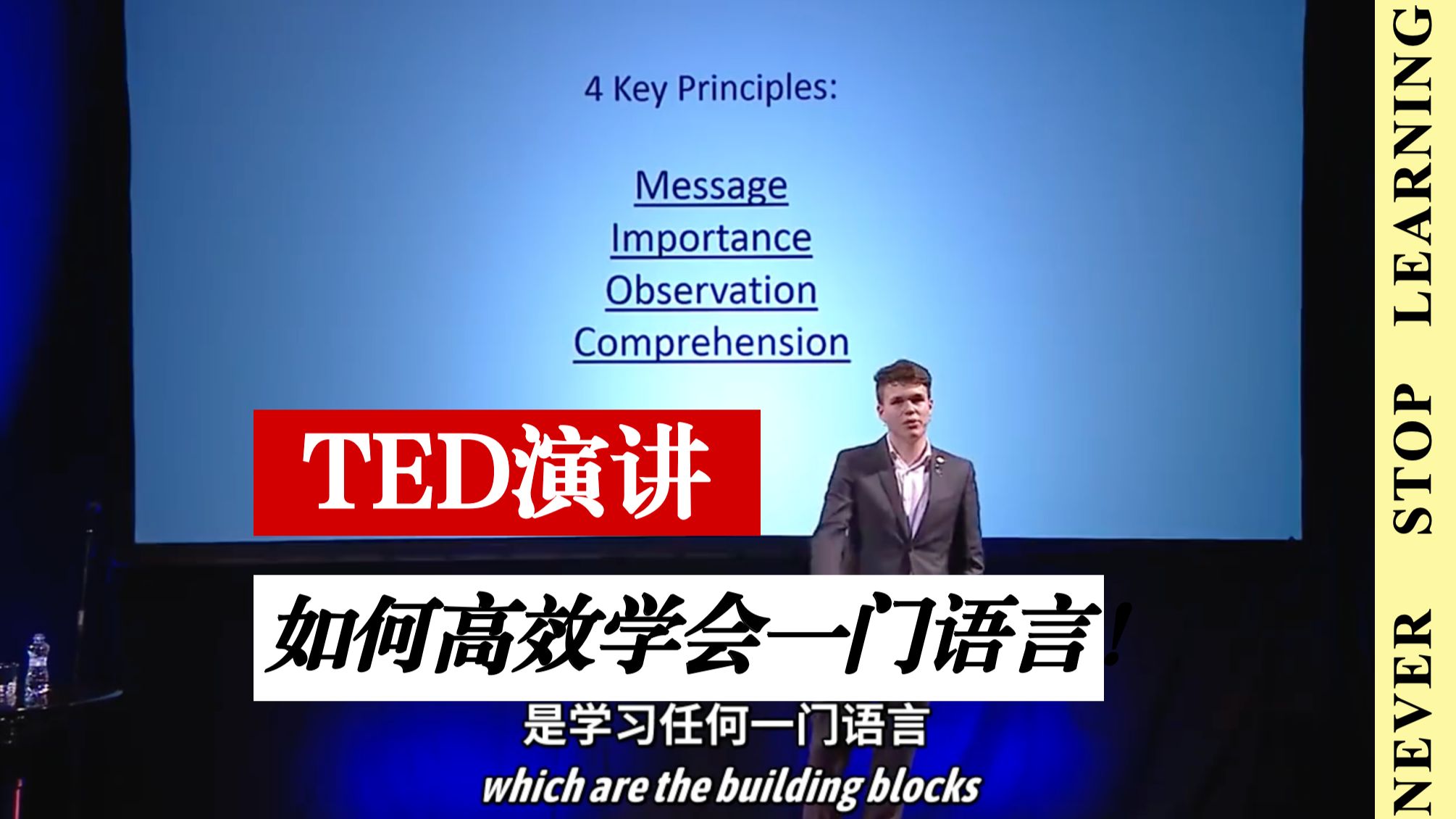
字幕摘录
| 时间 | 英文 | 中文 |
|---|---|---|
| 0:03 | Last summer when I was alone in Tallinn, Estonia, I had to face a challenge. | 去年夏天,我在爱沙尼亚塔林独自一人时,不得不面对挑战。 |
| 0:09 | This challenge was this simple phrase and many others like it, territory most. | 这一挑战就是这个简单的短语,还有许多其他类似的话,就是领土。 |
| 0:14 | I presume none of you speak Estonian. | 我猜你们都不会说爱沙尼亚语 |
| 0:17 | I take that as a no. | 我认为这是不。 |
| 0:19 | So and I was in the same situation as you are right now back in the last summer | 所以去年夏天我和你的情况一样 |
| 0:24 | because I never spoke Estonian, never read an Estonian book, never watched an Estonian movie, | 因为我从不说爱沙尼亚语,从不读爱沙尼亚书,从不看爱沙尼亚电影, |
| 0:27 | never actually listened to an Estonian song or met anybody from Estonia. | 从未真正听过爱沙尼亚的歌曲 也从未见过爱沙尼亚人 |
| 0:31 | Yet I had to act quickly. | 但我得快点行动 |
| 0:32 | I had to be able to at that one single spot be able to understand what the barista was saying | 我不得不在那个单一的地方 能够理解女律师在说什么 |
| 0:37 | when I was ordering my coffee, be able to understand what the passport security person | 我点咖啡的时候 能够理解护照安全人员 |
展开字幕全文(228 条)
| 序号 | 英文 | 中文 |
|---|---|---|
| 1 | Last summer when I was alone in Tallinn, Estonia, I had to face a challenge. | 去年夏天,我在爱沙尼亚塔林独自一人时,不得不面对挑战。 |
| 2 | This challenge was this simple phrase and many others like it, territory most. | 这一挑战就是这个简单的短语,还有许多其他类似的话,就是领土。 |
| 3 | I presume none of you speak Estonian. | 我猜你们都不会说爱沙尼亚语 |
| 4 | I take that as a no. | 我认为这是不。 |
| 5 | So and I was in the same situation as you are right now back in the last summer | 所以去年夏天我和你的情况一样 |
| 6 | because I never spoke Estonian, never read an Estonian book, never watched an Estonian movie, | 因为我从不说爱沙尼亚语,从不读爱沙尼亚书,从不看爱沙尼亚电影, |
| 7 | never actually listened to an Estonian song or met anybody from Estonia. | 从未真正听过爱沙尼亚的歌曲 也从未见过爱沙尼亚人 |
| 8 | Yet I had to act quickly. | 但我得快点行动 |
| 9 | I had to be able to at that one single spot be able to understand what the barista was saying | 我不得不在那个单一的地方 能够理解女律师在说什么 |
| 10 | when I was ordering my coffee, be able to understand what the passport security person | 我点咖啡的时候 能够理解护照安全人员 |
| 11 | was asking me at the airport when I was coming to Estonia and was leaving Tallinn. | 我在机场问我 当我来到爱沙尼亚 并离开塔林。 |
| 12 | I had to be able to comprehend the language, to comprehend it at that very single moment. | 我必须能够理解语言, 在那一刻理解它。 |
| 13 | And this experience raised the question, | 这段经历提出了一个问题, |
| 14 | how can one learn a language in a very limited amount of time, | 如何在非常有限的时间内学习语言, |
| 15 | comprehend it, be able to act with it, be able to work with it, to meet people with it | 理解它, 能够与它一起行动, 能够与它合作, |
| 16 | and most of all to progress in it. | 最重要的是要进步 |
| 17 | I attended a talk last September, which was right above this issue. | 去年9月,我参加了一个演讲,这正好高于这个问题。 |
| 18 | It was held by a polyglot. | 由多块块块所持. |
| 19 | She was from Slovakia and was willing to talk about how she is learning, | 她来自斯洛伐克 并愿意谈论 她是如何学习, |
| 20 | how she was learning and is still learning to this day new languages. | 她是如何学习的,至今仍在学习新的语言。 |
| 21 | She told us of people that speak six, ten, twelve, sixteen languages even. | 她告诉我们那些会说六、十、十二、十六种语言的人 |
| 22 | They devote their whole lives to this idea of being able to comprehend every single one of them | 他们毕生致力于这个想法 能够理解他们每一个人 |
| 23 | or as many as they could. | 或尽量多 |
| 24 | And if you were thinking that there is some magical way, some magical secret, | 如果你认为有神奇的方法 一些神奇的秘密 |
| 25 | which she told me, I have to disappoint you. | 她告诉我,我不得不让你失望。 |
| 26 | There is no single super method. | 没有单一的超级方法。 |
| 27 | What if the polyglots, all of them worldwide, agree on one thing? | 如果全世界所有的多胞胎都同意一件事呢? |
| 28 | It is that there is no way, one fastest way how to learn language. | 这是没有办法的, 一个最快的方法如何学习语言。 |
| 29 | It has to be personal. | 必须是个人的。 |
| 30 | You have to be able to choose a personal way and find it | 你必须能够选择一个个人的方法 找到它 |
| 31 | and find your language through a personal way and modify it | 通过个人方式找到自己的语言并修改 |
| 32 | as much as you possibly can to suit you, to suit your type of learning. | 尽可能适合你的学习类型 |
| 33 | Some people prefer to stuff their head full of vocabulary | 有些人喜欢把头装满词汇 |
| 34 | and to fill it with words and phrases until their head bursts. | 并用言语和言语填满它,直到他们的头晕。 |
| 35 | Some of us prefer to watch a movie, to talk with a person at a pub | 我们有些人更喜欢看电影 在酒吧和一个人聊天 |
| 36 | or like me, when going back from the library, working on an essay for six hours | 或喜欢我,当回到图书馆, 做一篇论文6小时 |
| 37 | till dying morning, meet a drunken Frenchman and talk to him in French | 直到早上死, 遇到一个醉酒的法国人 用法语跟他说话 |
| 38 | and practice as much as I can. | 尽我所能练习 |
| 39 | There are many ways. | 有许多方法。 |
| 40 | Some people even prefer those video games that you know, your phones, | 有些人甚至更喜欢那些电子游戏 你知道,你的手机, |
| 41 | you know, the memorises and those kind of things. | 你知道,回忆和这些事情。 |
| 42 | I'm not much a fan of that, but that's a personal thing again. | 我不太喜欢这个,但又是私人恩怨 |
| 43 | Today, what I'll be presenting to you is something different. | 今天,我要向你们展示的是不同的东西。 |
| 44 | It is or these are the four points which are intrinsic to our learning, | 是我们学习的内在四点 |
| 45 | which are the building blocks of any learning of any language you will ever do. | 这些是学习任何语言的基础。 |
| 46 | Doesn't matter if it's Chinese, if it's Arabic, it is Hebrew, | 不管是中文还是阿拉伯文,都是希伯来文 |
| 47 | Estonian, French, Spanish, any language whatsoever. | 爱沙尼亚语、法语、西班牙语、任何语言。 |
| 48 | These four things, message, importance, observation, comprehension, | 这四件事,信息,重要性,观察,理解, |
| 49 | all amount to the same thing, the same goal, learning a language effectively. | 都等于是同一东西,同一目标, 有效地学习一种语言。 |
| 50 | And they all are, as you'll soon find, interconnected. | 而且,你们很快会发现,它们都是相互联系的。 |
| 51 | You cannot just focus on one of them. | 你不能只关注其中之一。 |
| 52 | You cannot just focus on importance and hope that you will, | 你不能仅仅专注于重要性,希望你会, |
| 53 | through this relevance to who you are, you'll be able to learn quickly. | 通过这种与你身份的关联,你就能很快地学会. |
| 54 | Or similarly, you cannot just focus on comprehension. | 同样,你不能只专注于理解。 |
| 55 | As we do in our schools nowadays, we focus too much on memorising vocabulary | 就像我们现在的学校一样 我们过于关注记忆中的词汇 |
| 56 | or learning phrases about whatever thing that there is prescribed by the booklets. | 或学习关于任何事物 小册子规定的短语。 |
| 57 | But that's not how you learn a language. | 但你不是这么学语言的 |
| 58 | I'll get into them more later once I progress through the talk. | 我待会再谈 |
| 59 | The first one is message. | 第一个是信息。 |
| 60 | Some of you, this might seem bizarre about what I mean by message. | 你们中有些人,这似乎很奇怪 关于我所说的信息。 |
| 61 | It is, well, you'll see yourselves. | 这是,好了,你会看到自己。 |
| 62 | This sentence is in Estonian. | 此句在爱沙尼亚语中. |
| 63 | Since you know how to speak Estonian, I'm not going to be asking what it actually means. | 既然你知道怎么说爱沙尼亚语 我不会问它到底是什么意思 |
| 64 | But does anybody or rather, let me read it. | 但是,任何人或宁可, 让我读它。 |
| 65 | I'm not fluent in Estonian, so just like, be ready with me. | 我不流利的爱沙尼亚语,所以就像, 准备好和我在一起。 |
| 66 | So, | 这么说 |
| 67 | Now, still, you have no clue what this actually means. | 现在,尽管如此,你完全不知道这到底意味着什么。 |
| 68 | I don't presume that from some magic learning of some broken Estonian, | 我不认为从一些神奇的学习 一些破碎的爱沙尼亚, |
| 69 | you magically speak or learn, understand this one phrase. | 你神奇的说话或学习, 理解这个短语。 |
| 70 | But already you can see that there is yaw twice. | 但你已经看到有两遍了 |
| 71 | And because language is logically structured, you are able to deduce that | 因为语言是逻辑结构的 你可以推断 |
| 72 | probably because also these two words have the same endings, this one and this one, | 可能是因为这两个词的结局都一样,这个和这个 |
| 73 | and then these two, then maybe that means end. | 然后这两个,然后也许这意味着结束。 |
| 74 | And already, in less than 30 seconds, you understand one word and language | 30秒内你就会明白一个字和语言 |
| 75 | that you've never seen in your whole life. | 你这辈子从未见过 |
| 76 | And through progressing like this, through making these small steps, | 通过这样的进步, 通过这些小步骤, |
| 77 | you're able to actually learn it. | 你能够真正学习它。 |
| 78 | What if I put another sentence here in a language that some of you speak, | 如果我用你们中有些人会说的语言 再说一句 |
| 79 | maybe more than some of you, maybe all of you, but certain that it's more | 也许比你们中的一些人,也许你们所有人, 但肯定它更多 |
| 80 | familiar because we are in an Anglophone, Francophone society. | 因为我们在英语、法语社会中 |
| 81 | So most of us, presumably. | 因此,大部分我们,大概。 |
| 82 | And what if I put another one, which all of us speak in English? | 如果我再放一个,我们用英语讲哪个呢? |
| 83 | This is how you learn language. | 这就是你学习语言的方式。 |
| 84 | Once you find the meaning, the message behind a sentence, | 一旦你找到意义和句子背后的信息 |
| 85 | you are able to acquire the language. | 您可以获取语言。 |
| 86 | There are signifiers in a language which all help you to build a logical | 有一种语言的符号 帮助您构建逻辑 |
| 87 | structure of this said language. | 这一语言的结构。 |
| 88 | When you understand the message, you unconsciously acquired language. | 当你理解信息时,你无意识地获得语言. |
| 89 | This doesn't mean that by understanding one phrase from the Charter of Human | 这并不意味着通过理解《人类宪章》中的一句话 |
| 90 | Rights from the United Nations, you understand Estonian or French or | 来自联合国的权利,你懂爱沙尼亚语或法语或 |
| 91 | English for that matter. | 英文是这方面的。 |
| 92 | It simply means that you will have the building blocks with | 它只是意味着,你会有 构件与 |
| 93 | which you can build the learning. | 你可以建立学习。 |
| 94 | You have the logical structure, which builds on this language. | 你有逻辑结构,它建立在这种语言之上。 |
| 95 | Then you have importance, every language, no matter what it is, has to be useful | 那你有重要的意义,每种语言,不管是什么,都必须有用 |
| 96 | to you, has to be relevant to you, has to be something you enjoy. | 对你来说,必须和你有关, 必须是你喜欢的东西。 |
| 97 | When I was in school many years ago in my very elementary school, I was | 当我在很多年前的学校 在我非常的小学,我是 |
| 98 | forced to study Spanish. | 被迫学习西班牙语。 |
| 99 | I hated it. | 我讨厌它。 |
| 100 | I couldn't stand it. | 我无法忍受 |
| 101 | Nothing against Spanish, nothing against that. | 没有反对西班牙语,也没有反对西班牙语。 |
| 102 | It was simply, I just didn't enjoy it. | 很简单,我只是不喜欢它。 |
| 103 | I couldn't learn a single sentence. | 我一个句子都学不好 |
| 104 | When I was in Italy for my Duke of Edinburgh residential trip, I was, I | 我在意大利参加爱丁堡公爵的住宿旅行时 我... |
| 105 | decided to study Italian and I was just like, yes, I'm going to learn this | 我决定学习意大利语,我就想,是的,我要学会这个 |
| 106 | language and then I failed because I was not able to enjoy it because I | 语言,然后我失败了 因为我无法享受它,因为我 |
| 107 | just didn't enjoy it. | 只是不喜欢它。 |
| 108 | And actually from that one trip, I had more from Swedish because I met a | 实际上从那一次旅行中 我得到了更多的瑞典语 因为我遇到了一个 |
| 109 | Swedish friend that I'm still in contact to this day. | 瑞典朋友,我今天还在联系 |
| 110 | It is this enjoyment, this relevance to you that is important. | 正是这种享受,这种与你们的相关性才是重要的。 |
| 111 | It has to be relevant to your education, something that you want to learn because | 它必须与你的教育有关, 一些你想学习的,因为 |
| 112 | you want to progress in your life, has to be relevant because of family or | 你想在你的生活中进步, 必须有相关性 因为家庭或 |
| 113 | friends, if you find enjoyment in it, it has to be relevant because of your job. | 朋友们,如果你在其中找到乐趣, 它必须是相关的 因为你的工作。 |
| 114 | Maybe you have a job in, I don't know, Ireland or Stockholm and you need to | 也许你在爱尔兰或斯德哥尔摩有份工作 |
| 115 | learn the language to be able to work with it. | 学习语言才能与之合作。 |
| 116 | And like me, maybe it's relevant to your travels because being international, | 和我一样,也许这与你的旅行有关 因为做国际旅行 |
| 117 | this is what this whole day is about, means that you want to open yourself | 这就是这一整天的意义, 意味着你想打开自己 |
| 118 | to other opportunities, for me that means to see different cultures in | 对我来说,这意味着要看到不同的文化 |
| 119 | different worlds and as a part of that, you have to be able to speak the | 不同的世界,作为其中的一部分, 你必须能够说话 |
| 120 | language to at least some degree. | 语言至少达到某种程度。 |
| 121 | Languages are tools, just like any other part of our lives. | 语言是工具,就像我们生活中任何其他部分一样。 |
| 122 | They can be used in some meaningful way. | 它们可以用某种有意义的方式使用。 |
| 123 | Once you find this, what this meaningful way is, you're able to learn much | 一旦你找到这个,你就能学到很多 |
| 124 | faster and therefore choose a language that's useful to you. | 更快,因此选择一种对你有用的语言. |
| 125 | Now onto observation, and this is probably the part that I think might be | 现在观察, 这可能是 我想可能是 |
| 126 | one of the most important, simply because it can be done so easily. | 最重要的一个, 仅仅因为它可以如此容易地做到这一点。 |
| 127 | This photo was taken when I was also, last summer, walking the Tour de Montblanc | 这张照片是去年夏天我走蒙勃朗之旅时拍的 |
| 128 | in between France, Italy and Switzerland. | 在法国、意大利和瑞士之间 |
| 129 | And when I took it, I was just crossing the Italian-French border. | 当我拿走它时,我刚刚越过了意大利和法国的边界。 |
| 130 | I just came from a little, a little refugio on the French side and was | 我刚刚从法国那边的 一点点,一点点的复古。 |
| 131 | walking up the mountain to cross the Italian side and in the same day, I | 走上山去穿越意大利一侧 同一天,我 |
| 132 | spoke both French and Italian. | 讲法语和意大利语。 |
| 133 | My French is by no means good, but I'm able to talk with it. | 吾法门虽不善,但能与其谈. |
| 134 | Italian is much harder, but still I was able to comprehend the people, ask for a | 意大利语更难,但我还是能理解人民,要求 |
| 135 | And in a dire situation, not be forced to sleep outside in wind and freezing cold, | 在严峻的形势下,不要被迫在风和寒冷中睡在外面, |
| 136 | because that would not be enjoyable at all. | 因为这根本不是一件好事 |
| 137 | And from it, I realized that there are two key things that you have to be | 从它,我意识到 有两件关键的事情你必须 |
| 138 | actually immerse yourself in the language to some degree. | 实际上你在某种程度上沉浸在语言中。 |
| 139 | You cannot just stand, sit at home and hope that language will come to you, | 你不能只是站着,坐在家里 希望语言会来到你, |
| 140 | that the knowledge that you are able to do with it will actually come to you | 你所能做的知识,将降临你, |
| 141 | some like that, like that. | 有些是那样的 |
| 142 | You have to be actually able to put yourself there, to pay attention, to | 你必须能把自己放在那里, 注意,注意 |
| 143 | observe what people are doing, how they speak, how they emote, and hopefully from | 观察人们在做什么, 他们如何说话, 他们如何发出,希望从 |
| 144 | that build up your knowledge. | 积累你的知识 |
| 145 | And, and this is actually a key thing. | 而且,这其实是一个关键的事情。 |
| 146 | I think people should start doing this. | 我认为人们应该开始这样做。 |
| 147 | You should be looking for something called a parent speaker. | 你应该找一个叫家长演讲的人 |
| 148 | Now, this is what I learned during the talk about the polyglots back in September. | 这是我在9月讨论多块块时学到的。 |
| 149 | It is an idea that when you're a new, you speak a new language, you're like a baby. | 这是一个想法,当你是新人的时候,你会说新语言,就像婴儿一样. |
| 150 | You don't know how to actually operate language. | 你不知道如何操作语言。 |
| 151 | You're just plugged in a world where all adjuncts speak in a different language | 你刚刚插上了一个世界 世界上所有的副手都用不同的语言说话 |
| 152 | and you're just hoping to grab, grasp a meaning about it. | 你只是希望抓住, 抓住它的意义。 |
| 153 | Grasp something that you can know, a word that you can understand. | 一个你能理解的词 |
| 154 | What you need is a parent speaker. | 你需要的是一个家长演讲者。 |
| 155 | Somebody that will speak to you on a same level will help you learn new words | 跟你说话的人会帮你学新词 |
| 156 | and will actually correct you. | 并会真正纠正你。 |
| 157 | Will actually give you advice how to speak better and will not | 其实会给你建议 如何说话更好,不会 |
| 158 | diminish you in any sort of way. | 以任何一种方式削弱你。 |
| 159 | That is key because when you're able to practice your speaking, your | 这是关键,因为当你能够练习 你的演讲,你的 |
| 160 | learning in that sense, you learn faster because, and this is actually going to | 从这个意义上学习,你学得更快 因为,这实际上是 |
| 161 | be the very next slide, I think afterwards, so I'm going to quickly get to this. | 成为下一个幻灯片,我想之后, 所以我会很快得到这个。 |
| 162 | Sorry for that. | 对不起 |
| 163 | When you actually learn a language through comprehension, through observation, | 当你真正学习的语言 通过理解, 通过观察, |
| 164 | you are able to then speak the language. | 然后,你可以说出语言。 |
| 165 | And that is one of the most important things because how else would you want | 这是最重要的事情之一 因为你想要什么 |
| 166 | to communicate with people, especially like me, when you want to travel, you | 与人交流,特别是像我一样, 当你想要旅行,你 |
| 167 | need to be able to, on your knowledge, you have to be able to actually find | 需要能够,根据你的知识, 你必须能够找到 |
| 168 | somebody that you can talk to an equal sense and you have to be able to listen | 一个人,你可以说话 平等感,你必须能够听 |
| 169 | a lot, people don't want to listen. | 很多,人们不想听。 |
| 170 | They revert back to English. | 他们回到英语。 |
| 171 | They revert back to their natural tongue because they are scared. | 他们回到自然的舌头,因为他们害怕。 |
| 172 | Don't be scared. | 别害怕 |
| 173 | This is going to sound like a great cliche. | 这听起来像一个伟大的陈词滥调。 |
| 174 | Don't be scared to make mistakes, make them, they're going to be corrected | 不要害怕犯错,犯错,会得到纠正 |
| 175 | by people and you're going to learn from that. | 你会从中吸取教训 |
| 176 | And now to the thing that I was hoping to talk about comprehension. | 现在我要谈的是理解。 |
| 177 | And this thing can be split into two parts, memory and comprehension or knowledge. | 而这个东西可以分为两个部分,记忆和理解或知识. |
| 178 | And I feel like nowadays in schools, what we do is we just stuff our heads | 我觉得现在在学校里,我们做的就是把头塞进去 |
| 179 | with vocabulary until they explode. | 有词汇,直到爆炸。 |
| 180 | We shouldn't be doing that because memory or knowledge isn't comprehension. | 我们不应该这样做 因为记忆或知识是无法理解的。 |
| 181 | Like, for example, I know one sentence in Irish. | 例如,我懂爱尔兰语的一句话。 |
| 182 | Does it mean I speak Irish? | 意思是我说爱尔兰语吗? |
| 183 | By no means. | 绝对不行 |
| 184 | I don't even properly know what the sentence means, but I know it's Irish. | 我甚至不知道这句话的意思 但我知道是爱尔兰语 |
| 185 | I have that one piece of knowledge, but I couldn't say I comprehend the | 我有一个知识, 但我不能说我理解 |
| 186 | language by no means whatsoever. | 绝对不是语言 |
| 187 | And that's the issue. | 这就是问题所在。 |
| 188 | We force ourselves to learn complex vocabulary that is not relevant to us. | 我们强迫自己学习与我们无关的复杂词汇。 |
| 189 | We're forced to stuff our heads with words that don't bear any meaning and | 我们不得不用没有意义的话 来填满我们的脑袋 |
| 190 | that we'll never probably use ever in our lives yet we don't actually | 我们永远不会使用 永远在我们的生活,但我们没有 |
| 191 | focus on comprehending them to comprehending the structures and the | 重点在于理解它们,以理解结构以及 |
| 192 | sentences to actually using our existing knowledge from other languages, | 句子实际上使用 我们的现有知识 从其他语言, |
| 193 | from, from my modern tongues to actually progress further. | 从,从我的现代舌头 到实际进步。 |
| 194 | We should be doing that. | 我们应该这样做。 |
| 195 | We should be trying to learn with use of our existing languages. | 我们应该努力用我们现有的语言来学习。 |
| 196 | We should be using a native native tongues. | 我们应该用母语 |
| 197 | We should be using our abilities to speak from day one and we should be | 我们应该利用我们的能力 从第一天开始说话,我们应该 |
| 198 | looking at actions more than work or nouns. | 观察动作 不只是工作或名词。 |
| 199 | When you learn what it means, what it means the word to hurt, it's still | 当你知道它意味着什么, 它意味着伤害,它仍然是 |
| 200 | more useful than actually what it means. | 比实际意义更有用 |
| 201 | What the word arm is. | 臂之谓何. |
| 202 | It, you can be like hurt hurt, but what do we do with an arm? | 它,你可以像伤害, 但我们怎么办与手臂? |
| 203 | It doesn't work like that. | 岂不效哉. |
| 204 | Actions are more important than words. | 行动比言语更重要。 |
| 205 | And this sort of progress is something that's key for learning | 这种进步是学习的关键 |
| 206 | a language effectively. | 一种有效的语言。 |
| 207 | So what I presented to you today is four principles and some key points, | 我今天向你们介绍的是四项原则和一些要点, |
| 208 | some things that maybe you've heard, some things that maybe were new to | 有些事情也许你听说过, 有些事情也许是新来的 |
| 209 | you, the parent speaker, probably all these things are essential. | 你,家长演讲者, 可能所有这些事情都很重要。 |
| 210 | You cannot remove one and hope that the others will come with it or that | 你不能删除一个 希望其他人会带着它,或者 |
| 211 | you focus only on one of them and completely disregard the others. | 你只关注其中之一 完全无视其他。 |
| 212 | It is important to push yourselves to your limits, to go out there. | 重要的是要把自己逼到极限 出去 |
| 213 | And this is going to sound like a great cliche once again, but to | 这听起来就像一个伟大的陈词滥调 再次,但 |
| 214 | push yourself, go out there and actually experience the language firsthand. | 推自己,到那里去 亲身体验语言。 |
| 215 | No school, no institution, no book can ever give you that. | 没有学校,没有机构, 没有书可以给你。 |
| 216 | And just on the very end, I would like to dispel one last thing that I've | 最后,我想消除最后一件事 |
| 217 | been told in past that I've heard people tell me or people tell other | 过去我听说有人告诉我 或者有人告诉别人 |
| 218 | people that it's talent that's required. | 人们需要的是才华 |
| 219 | That for being able to learn language, you need talent. | 因为能够学习语言,你需要才能。 |
| 220 | You need to be able to have this magical skill within you that you're born with. | 你需要拥有你天生的神奇技能 |
| 221 | It's not true. | 非实非实. |
| 222 | Anyone can learn a language. | 任何人都可以学习一种语言。 |
| 223 | Anyone I've known when they push themselves hard enough, they're able to speak a language. | 任何我认识的人,当他们用力地推自己,他们能够说一种语言. |
| 224 | Some people are far superior to me and there are probably hundreds | 有人比我强得多 可能还有几百人 |
| 225 | and millions of like that, but it is that thing that you push yourselves | 和数百万这样的, 但这是的东西,你推自己 |
| 226 | that differentiates you from other people, this push. | 让你和别人不同 这推力 |
| 227 | So don't be scared to push. | 所以不要害怕推车。 |
| 228 | Thank you. | 谢谢 |
该视频共有字幕 228 条。解锁更多字幕为会员功能,请移动到 价格