TED演讲:以新的角度思考从女人到母亲的转变
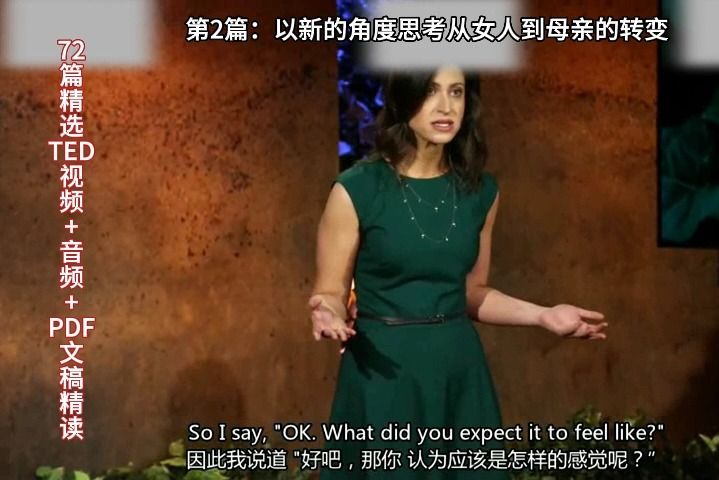
字幕摘录
| 时间 | 英文 | 中文 |
|---|---|---|
| 0:13 | Do you remember a time when you felt hormonal and moody? | 你还记得你曾经感觉到荷尔蒙和心情吗? |
| 0:17 | Your skin was breaking out, | 你的皮肤突然爆发 |
| 0:19 | your body was growing in strange places and very fast? | 你的身体生长在奇怪的地方 非常快? |
| 0:24 | And at the same time, | 同时, |
| 0:25 | people were expecting you to be grown up in this new way. | 人们期待你以这种新方式成长 |
| 0:29 | Teenagers, right? | 年轻人 对吧? |
| 0:31 | Well, these same changes happen to a woman when she's having a baby. | 那么,这些改变 发生在一个女人 当她有一个孩子。 |
| 0:36 | And we know that it's normal for teenagers to feel all over the place. | 而且我们知道,青少年们在各地的感觉是正常的. |
| 0:40 | So why don't we talk about pregnancy in the same way? | 我们为什么不以同样的方式讨论怀孕? |
| 0:45 | There are entire textbooks | 全部都是课本 |
展开字幕全文(117 条)
| 序号 | 英文 | 中文 |
|---|---|---|
| 1 | Do you remember a time when you felt hormonal and moody? | 你还记得你曾经感觉到荷尔蒙和心情吗? |
| 2 | Your skin was breaking out, | 你的皮肤突然爆发 |
| 3 | your body was growing in strange places and very fast? | 你的身体生长在奇怪的地方 非常快? |
| 4 | And at the same time, | 同时, |
| 5 | people were expecting you to be grown up in this new way. | 人们期待你以这种新方式成长 |
| 6 | Teenagers, right? | 年轻人 对吧? |
| 7 | Well, these same changes happen to a woman when she's having a baby. | 那么,这些改变 发生在一个女人 当她有一个孩子。 |
| 8 | And we know that it's normal for teenagers to feel all over the place. | 而且我们知道,青少年们在各地的感觉是正常的. |
| 9 | So why don't we talk about pregnancy in the same way? | 我们为什么不以同样的方式讨论怀孕? |
| 10 | There are entire textbooks | 全部都是课本 |
| 11 | written about the developmental arc of adolescence. | 写关于青春期的发育弧。 |
| 12 | And we don't even have a word to describe the transition to motherhood. | 我们甚至连一个字都没有来描述向母性过渡. |
| 13 | We need one. | 我们需要一个。 |
| 14 | I'm a psychiatrist who works with pregnant and postpartum women, | 我是一名精神科医生 和孕妇和产后妇女一起工作 |
| 15 | a reproductive psychiatrist. | 一个生殖心理医生。 |
| 16 | And in the decade that I've been working in this field, | 十年来,我一直在这个领域工作, |
| 17 | I've noticed a pattern. | 我注意到一个模式。 |
| 18 | It goes something like this. | 像这样 |
| 19 | A woman calls me up, she's just had a baby, | 一个女人打电话给我 她刚生了个孩子 |
| 20 | and she's concerned. | 她很担心 |
| 21 | She says, I'm not good at this. | 她说,我不擅长这个。 |
| 22 | I'm not enjoying this. | 我不喜欢这样 |
| 23 | Do I have postpartum depression? | 我有产后抑郁症吗? |
| 24 | So I go through the symptoms of that diagnosis, | 所以我通过诊断的症状 |
| 25 | and it's clear to me that she's not clinically depressed, | 很明显她没有在临床上抑郁 |
| 26 | and I tell her that. | 我告诉她 |
| 27 | But she isn't reassured. | 但是她并不放心,她很担心 |
| 28 | It isn't supposed to feel like this, she insists. | 她坚持说,不应该有这种感觉 |
| 29 | So I say, OK, what did you expect it to feel like? | 所以我说,好吧,你期望它是什么感觉? |
| 30 | She says, I thought motherhood would make me feel whole and happy. | 她说,我以为母性会让我 感觉完整和快乐。 |
| 31 | I thought my instincts would naturally tell me what to do. | 我以为我的直觉自然会告诉我该怎么做 |
| 32 | I thought I'd always want to put the baby first. | 我以为我总想把孩子放在第一位 |
| 33 | This is an unrealistic expectation | 这是不切实际的期望 |
| 34 | of what the transition to motherhood feels like. | 向母性转变的感觉 |
| 35 | And it wasn't just her. | 不仅仅是她 |
| 36 | I was getting calls with questions like this from hundreds of women, | 我接到几百个女人的电话 |
| 37 | all concerned that something was wrong, | 都担心出事了 |
| 38 | because they couldn't measure up. | 因为他们不能衡量。 |
| 39 | And I didn't know how to help them, | 我不知道如何帮助他们, |
| 40 | because telling them that they weren't sick | 因为告诉他们他们没有生病 |
| 41 | wasn't making them feel better. | 也没让他们感觉好点 |
| 42 | I wanted to find a way to normalize this transition, | 我想找到一个办法 使这个过渡正常化, |
| 43 | to explain that discomfort is not always the same thing as disease. | 解释这种不适与疾病并不总是相同的. |
| 44 | So I set out to learn more about the psychology of motherhood, | 所以我开始学习更多关于母性心理学的知识 |
| 45 | but there actually wasn't much in the medical textbooks, | 但实际上医学教科书里没有太多 |
| 46 | because doctors mostly write about disease. | 因为医生大多写疾病。 |
| 47 | So I turned to anthropology, | 所以我转向人类学 |
| 48 | and it took me two years, | 我花了两年时间 |
| 49 | 但1973年Dana Raphael写的一篇散文中 | |
| 50 | I finally found a helpful way to frame this conversation. | 我终于找到一个有用的方法 来设定这个对话。 |
| 51 | Matressence. | 马崔森斯。 |
| 52 | It's not a coincidence that matressence sounds like adolescence. | 这不是巧合 成熟听起来像青春期。 |
| 53 | Both are times when body morphing and hormone shifting | 两者都是身体变形和激素转移的时候 |
| 54 | lead to an upheaval in how a person feels emotionally, | 导致一个人的情感感受的动荡 |
| 55 | and how they fit into the world. | 以及他们如何融入世界。 |
| 56 | And like adolescence, | 就像青春期一样 |
| 57 | matressence is not a disease. | 成熟不是一种疾病。 |
| 58 | But since it's not in the medical vocabulary, | 但既然不在医学词汇里 |
| 59 | since doctors aren't educating people about it, | 既然医生没教育别人 |
| 60 | it's being confused with a more serious condition | 与更严重的病症相混淆 |
| 61 | called postpartum depression. | 叫做产后抑郁症 |
| 62 | I've been building on the anthropology literature | 我以人类学文献为基础 |
| 63 | and have been talking about matressence with my patients, | 一直在跟我的病人谈论成熟 |
| 64 | using a concept called the push and pull. | 使用一个叫做推拉的概念. |
| 65 | Here's the pull part. | 这里的拉力部分。 |
| 66 | So as humans, our babies are uniquely dependent. | 所以作为人类 我们的婴儿是独一无二的依赖。 |
| 67 | Unlike other animals, our babies can't walk, | 不像其他动物 我们的孩子不能走路 |
| 68 | they can't feed themselves, | 他们不能养活自己, |
| 69 | they're very hard to take care of. | 他们很难照顾。 |
| 70 | So evolution has helped us out with this hormone called oxytocin. | 进化帮助我们解决了这个叫催产素的激素。 |
| 71 | It's released around childbirth and also during skin-to-skin touch. | 它在分娩和皮肤接触时释放出来。 |
| 72 | So it rises even if you didn't give birth to the baby. | 所以即使你没有生下孩子 也会上升 |
| 73 | Oxytocin helps a human mother's brain zoom in, | 氧气可帮助人类母亲的大脑放大 |
| 74 | pulling her attention in | 把她的注意力拉进来 |
| 75 | so that the baby is now at the center of her world. | 让孩子现在处于她世界的中心 |
| 76 | But at the same time, her mind is pushing away, | 但与此同时 她的心思在推开 |
| 77 | because she remembers there are all these other parts to her identity, | 因为她记得她的身份中还有其他部分 |
| 78 | other relationships, | 其他关系, |
| 79 | her work, | 她的事业, |
| 80 | hobbies, | 爱好, |
| 81 | a spiritual and intellectual life, | 精神和智力生活, |
| 82 | not to mention physical needs, | 更不要说身体需要, |
| 83 | to sleep, to eat, | 睡觉,吃饭, |
| 84 | to exercise, | 锻炼, |
| 85 | to have sex, | 做爱, |
| 86 | to go to the bathroom alone, | 一个人去洗手间 |
| 87 | if possible. | 如果可能的话。 |
| 88 | This is the emotional tug-of-war of matressants. | 这是美容师的情感拖拉。 |
| 89 | This is the tension the women calling me were feeling. | 这就是那些叫我女人的紧张感 |
| 90 | It's why they thought they were sick. | 是故以为病. |
| 91 | If women understood the natural progression of matressants, | 如果女人能理解成熟剂的自然进化 |
| 92 | if they knew that most people found it hard to live inside this push and pull, | 如果他们知道大多数人 都觉得很难生活在这种推拉中 |
| 93 | if they knew that under these circumstances, | 如果他们知道在这种情况下, |
| 94 | ambivalence was normal and nothing to be ashamed of. | 矛盾是正常的,没有什么可羞耻的。 |
| 95 | They would feel less alone, | 他们不会觉得孤单 |
| 96 | they would feel less stigmatized, | 他们不会觉得羞耻, |
| 97 | and I think it would even reduce rates of postpartum depression. | 我认为这会降低产后抑郁症的发病率。 |
| 98 | I'd love to study that one day. | 有一天我很想学习 |
| 99 | I'm a believer in talk therapy, | 我是一个相信谈话疗法的人, |
| 100 | so if we're going to change the way our culture understands | 因此,如果我们要改变 我们的文化理解 |
| 101 | this transition to motherhood, | 向母亲的过渡, |
| 102 | women need to be talking to each other, | 女人需要互相交谈 |
| 103 | not just me. | 不仅仅是我 |
| 104 | So mothers, talk about your matressants | 妈妈们,说说你们的美容师吧 |
| 105 | with other mothers, with your friends | 与其他母亲,与你的朋友 |
| 106 | and if you have one, with your partner, | 如果你有一个,与你的伴侣, |
| 107 | so that they can understand their own transition | 让他们了解自己的转变 |
| 108 | and better support you. | 并更好地支持你。 |
| 109 | But it's not just about protecting your relationship. | 但不只是保护你的关系 |
| 110 | When you preserve a separate part of your identity, | 当你保留你单独的一部分身份时 |
| 111 | you're also leaving room for your child to develop their own. | 也给你的孩子留下了自己的发展空间 |
| 112 | When a baby is born, so is a mother. | 子产时,母也. |
| 113 | Each unsteady in their own way. | 每一个不稳 以自己的方式。 |
| 114 | Matressants is profound, | 材料很深奥, |
| 115 | but it's also hard, | 但也很难 |
| 116 | and that's what makes it human. | 这就是它成为人类的原因。 |
| 117 | Thank you. | 谢谢 |
该视频共有字幕 117 条。解锁更多字幕为会员功能,请移动到 价格