TED演讲:你能流利地使用这种语言(甚至不知道它的存在)
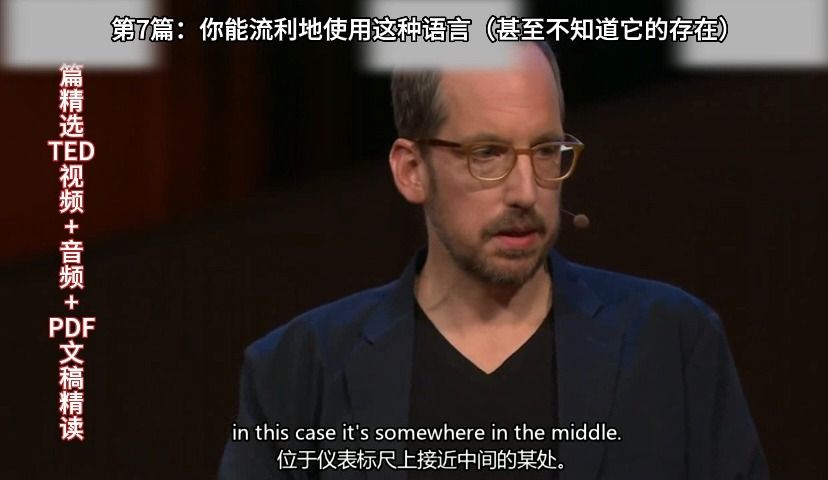
字幕摘录
| 时间 | 英文 | 中文 |
|---|---|---|
| 0:12 | I'm an artist. | 我是个艺术家。 |
| 0:15 | Being an artist is the greatest job there is. | 做艺术家是最伟大的工作 |
| 0:18 | And I really pity each and every one of you | 我真的同情你们每一个人 |
| 0:21 | who has to spend their days discovering new galaxies | 他们必须花自己的时间 发现新的星系 |
| 0:24 | or saving humanity from global warming. | 或拯救人类免受全球变暖的影响。 |
| 0:29 | But being an artist is also a daunting job. | 但当艺术家也是一件艰巨的工作。 |
| 0:33 | I spent every day, from nine to six, doing this. | 我每天从九点到六点都这样 |
| 0:39 | I even started a side career | 我甚至开始边干边干 |
| 0:41 | that consists entirely of composing and composing. | 完全由编组和编组组成。 |
| 0:43 | I was complaining about the difficulty of the creative process. | 我在抱怨创意过程的难度。 |
展开字幕全文(223 条)
| 序号 | 英文 | 中文 |
|---|---|---|
| 1 | I'm an artist. | 我是个艺术家。 |
| 2 | Being an artist is the greatest job there is. | 做艺术家是最伟大的工作 |
| 3 | And I really pity each and every one of you | 我真的同情你们每一个人 |
| 4 | who has to spend their days discovering new galaxies | 他们必须花自己的时间 发现新的星系 |
| 5 | or saving humanity from global warming. | 或拯救人类免受全球变暖的影响。 |
| 6 | But being an artist is also a daunting job. | 但当艺术家也是一件艰巨的工作。 |
| 7 | I spent every day, from nine to six, doing this. | 我每天从九点到六点都这样 |
| 8 | I even started a side career | 我甚至开始边干边干 |
| 9 | that consists entirely of composing and composing. | 完全由编组和编组组成。 |
| 10 | I was complaining about the difficulty of the creative process. | 我在抱怨创意过程的难度。 |
| 11 | But today, I don't want to talk about what makes my life difficult. | 但今天,我不想谈是什么让我的生活困难. |
| 12 | I want to talk about what makes it easy, | 我想谈谈是什么让事情变得简单 |
| 13 | and that is you | 这就是你 |
| 14 | and the fact that you are fluent in a language | 以能流利的语言发誓, |
| 15 | that you're probably not even aware of. | 你可能甚至不知道这一点。 |
| 16 | You're fluent in the language of reading images. | 阅读影像语言流利. |
| 17 | Deciphering an image like that takes quite a bit of an intellectual effort, | 破译这样的形象 需要很多的智力努力, |
| 18 | but nobody ever taught you how this works. | 但从来没有人教你如何运作。 |
| 19 | You just know it. | 你只是知道这一点。 |
| 20 | College, shopping, music. | 大学 购物 音乐 |
| 21 | What makes a language powerful | 是什么使语言强大 |
| 22 | is that you can take a very complex idea | 你可以接受一个非常复杂的想法 |
| 23 | and communicate it in a very simple, efficient form. | 并且以非常简单,高效的方式传达. |
| 24 | These images represent exactly the same ideas. | 这些图像代表着完全相同的思想. |
| 25 | But when you look, for example, at the college hat, | 但是,当你看,例如, 在大学帽子, |
| 26 | you know that this doesn't represent the accessory you wear on your head | 你知道这不代表你戴在头上的从犯 |
| 27 | when you're being handed your diploma, | 当你拿到文凭时 |
| 28 | but rather the whole idea of college. | 但整个大学的想法。 |
| 29 | Now, what drawings can do | 现在,画可以做什么 |
| 30 | is they can not only communicate images, | 他们不仅能传播图像, |
| 31 | they can even evoke emotions. | 他们甚至可以激起情绪。 |
| 32 | Let's say you get to an unfamiliar place and you see this. | 假设你到了一个陌生的地方 你可以看到这个 |
| 33 | You feel happiness and relief. | 你感到快乐和宽慰 |
| 34 | (*Laughter*) | (* 笑声*) |
| 35 | Or a slight sense of unease | 或者有点不安 |
| 36 | or maybe downright panic. | 也可能是直线恐慌 |
| 37 | (*Laughter*) | (* 笑声*) |
| 38 | Or blissful peace and quiet. | 或欢喜宁静. |
| 39 | But visuals, they're of course more than just graphic icons. | 但是视觉,它们当然不只是图形图标. |
| 40 | If I want to tell the story of modern-day struggle, | 如果我想讲述现代斗争的故事 |
| 41 | I would start with the armrest between two airplane seats | 我从两个飞机座位之间的扶手开始 |
| 42 | and two sets of elbows fighting. | 和两只肘斗。 |
| 43 | And what I love there is this universal law | 我爱的是这个普世法则 |
| 44 | that you have 30 seconds to fight it out, | 你还有30秒时间去抗争 |
| 45 | and once it's yours, you get to keep it for the rest of the flight. | 一旦它是你的,你就可以留着它 剩下的飞行。 |
| 46 | Now, commercial flight is full of these images. | 现在,商业飞行 充满了这些图像。 |
| 47 | If I want to illustrate the idea of discomfort, | 如果我想说明不适的想法, |
| 48 | there's nothing better than these neck pillows. | 没有比这些枕头更好的了 |
| 49 | They're designed to make you more comfortable, | 它们是为了让你更舒服 |
| 50 | except they don't. | 除非他们没有。 |
| 51 | (*Laughter*) | (* 笑声*) |
| 52 | So I never sleep on airplanes. | 所以我从来不睡在飞机上。 |
| 53 | What I do occasionally is I fall into a sort of painful coma. | 我偶尔会陷入痛苦的昏迷中 |
| 54 | And when I wake up from that, | 当我醒来的时候 |
| 55 | I have the most terrible taste in my mouth. | 我嘴里最难吃 |
| 56 | It's a taste that's so bad it cannot be described with words, | 这味道太糟糕了,不能用词形容 |
| 57 | but it can be drawn. | 但它可以画。 |
| 58 | (*Laughter*) | (* 笑声*) |
| 59 | The thing is, you know, I love sleeping. | 问题是,你知道,我喜欢睡觉。 |
| 60 | And when I sleep, I really prefer to do it while spooning. | 当我睡觉时,我更喜欢一边喝 |
| 61 | I've been spooning on almost a pro level for close to 20 years, | 差不多20年了,我几乎是顶级的 |
| 62 | but in all this time, | 但在这段时间里 |
| 63 | I've never figured out what to do with that bottom arm. | 我从来没想过怎么用那根下臂 |
| 64 | And the only thing that makes sleeping even more complicated | 唯一能让睡眠更复杂的事情 |
| 65 | and trying to do it on an airplane is when you have small children. | 试图在飞机上做到这一点 当你有小孩。 |
| 66 | They show up at your bed at around 4 a.m. | 他们4点左右出现在你的床上 |
| 67 | with some bogus excuse of, | 有一些假借口, |
| 68 | I had a bad dream. | 我做了个噩梦 |
| 69 | And then, of course, you feel sorry for them. | 然后,当然,你为他们感到难过。 |
| 70 | They're your kids, so you let them into your bed. | 他们是你的孩子 所以你让他们上你的床 |
| 71 | And I have to admit, at the beginning, they're really cute and warm and snuggly. | 我不得不承认,在开始的时候, 他们真的很可爱,温暖和柔软。 |
| 72 | The minute you fall back asleep, | 一旦你睡着了, |
| 73 | they inexplicably start rotating. | 令人费解地开始旋转。 |
| 74 | (*Laughter*) | (* 笑声*) |
| 75 | We like to call this the helicopter mode. | 我们称之为直升机模式。 |
| 76 | Now, the deeper something is etched into your consciousness, | 现在,深层的东西 刻在你的意识, |
| 77 | the fewer details we need to have an emotional reaction. | 更少的细节,我们需要有 情绪反应。 |
| 78 | So, why does an image like this work? | 那么,为什么这样的形象会起作用? |
| 79 | It works because we, as readers, | 它的工作,因为我们,作为读者, |
| 80 | are incredibly good at filling in the blanks. | 很擅长填空 |
| 81 | Now, when you draw, | 当你画画的时候 |
| 82 | there's this concept of negative space, | 有个负空间的概念 |
| 83 | and the idea is that instead of drawing the actual object, | 而想法是, 与其绘制实际对象, |
| 84 | you draw the space around it. | 你画周围的空间。 |
| 85 | So the bowls in this drawing are empty, | 所以这幅画里的碗是空的 |
| 86 | but the black ink prompts your brain to project food into a void. | 但黑墨水会促使你的大脑 将食物投射到一个空洞中 |
| 87 | What we see here is not an owl flying. | 我们看到的不是猫头鹰飞翔 |
| 88 | What we actually see is a pair of AA batteries | 我们实际上看到的是一对AA电池 |
| 89 | standing on a nonsensical drawing, | 站在无意识的画上, |
| 90 | and I animate the scene by moving my desk lamp up and down. | 我动动了场景,把桌子灯上下移动 |
| 91 | (*Laughter*) | (* 笑声*) |
| 92 | The image really only exists in your mind. | 图像实际上只存在于你的脑海里。 |
| 93 | So how much information do we need to trigger such an image? | 那么我们需要多少信息才能触发这样的图像? |
| 94 | My goal as an artist is to use the smallest amount possible. | 作为艺术家,我的目标是用最小的金额。 |
| 95 | I try to achieve a level of simplicity | 我尽量做到简单 |
| 96 | where if you were to take away one more element, | 如果你再拿走一个元素 |
| 97 | the whole concept would just collapse. | 整个概念会崩溃的 |
| 98 | And that's why my personal favorite tool as an artist is abstraction. | 这就是为什么我个人最喜欢的工具 作为一个艺术家是抽象的。 |
| 99 | I've come up with this system which I call the abstractometer, | 我发明了这个系统,我称之为抽象计, |
| 100 | and this is how it works. | 这就是它的工作原理。 |
| 101 | So you take a symbol, any symbol, for example, the heart and the arrow, | 所以,你取一个符号,任何符号, 例如心脏和箭头, |
| 102 | which most of us would read as a symbol for love, | 我们大多数人会读作爱的象征 |
| 103 | and I'm an artist, | 我是一个艺术家, |
| 104 | so I can draw this in any given degree of realism or abstraction. | 所以我可以用任何现实主义或抽象主义 来画这个 |
| 105 | Now, if I go too realistic on it, | 现在,如果我太现实了, |
| 106 | it just grosses everybody out. | 它只是令人毛骨悚然 每个人出。 |
| 107 | If I go too far on the other side and do very abstract, | 如果我走得太远 在另一边做非常抽象, |
| 108 | nobody has any idea what they're looking at. | 没人知道他们在看什么 |
| 109 | So I have to find the perfect place on that scale, | 因此,我必须找到 完美的地方在这个尺度上, |
| 110 | and in this case, it's somewhere in the middle. | 而在这种情况下,它是在某个中间。 |
| 111 | Now, once we have reduced an image to a more simple form, | 现在,一旦我们把一个图像简化成一个更简单的形式, |
| 112 | all sorts of new connections become possible. | 各种新的连接成为可能。 |
| 113 | And that allows for totally new angles in storytelling. | 这可以让故事呈现全新的角度。 |
| 114 | (*Laughter*) | (* 笑声*) |
| 115 | And so what I like to do is I like to take images | 所以我喜欢拍照片 |
| 116 | from really remote cultural areas and bring them together. | 从真正偏僻的文化地区 把他们聚集在一起 |
| 117 | Now, with more daring references, | 现在,随着更多的大胆的推荐, |
| 118 | (*Laughter*) | (* 笑声*) |
| 119 | I can have more fun, | 我可以玩得开心点 |
| 120 | but of course, I know that eventually things become so obscure | 当然,我知道 事情最终变得如此模糊 |
| 121 | that I start losing some of you. | 我开始失去一些你们 |
| 122 | So as a designer, | 所以作为一个设计师, |
| 123 | it's absolutely key to have a good understanding | 这绝对是关键 要有一个很好的理解 |
| 124 | of the visual and cultural vocabulary of your audience. | 观众的视觉和文化词汇。 |
| 125 | With this image here, a comment on the Olympics in Athens, | 关于雅典奥运会, |
| 126 | I assumed that a reader of the New Yorker | 我想是纽约客的读者 |
| 127 | would have some rudimentary idea of Greek art. | 对希腊艺术有一点初步的认识 |
| 128 | If you don't, the image doesn't work. | 若不修行则影像不通. |
| 129 | But if you do, you might even appreciate a small detail | 但是,如果你这样做, 你甚至可能欣赏一个小细节 |
| 130 | like the beer can pattern here on the bottom of the vase. | 就像瓶子底部的啤酒一样 |
| 131 | (*Laughter*) | (* 笑声*) |
| 132 | A recurring discussion I have with magazine editors, | 我和杂志编辑们反复讨论 |
| 133 | who are usually word people, | 他们通常是一个词人, |
| 134 | is that their audience, you, | 是他们的观众,你, |
| 135 | are much better at making radical leaps with images | 更擅长于用图像进行激进的飞跃 |
| 136 | than they're being given credit for. | 比他们得到的功劳。 |
| 137 | And the only thing I find frustrating is that | 我唯一感到沮丧的是 |
| 138 | they often seem to push me | 他们经常逼我 |
| 139 | {\fn黑体\fs20\shad2\2aH82\3aH20\4aH33\fscx95\3cH592001\be1}向着一小撮令人厌倦的视觉陈词滥调 | |
| 140 | that are considered safe. | 被认为是安全的。 |
| 141 | You know, like the businessman climbing up a ladder, | 就像那个商人爬上梯子 |
| 142 | and then the ladder moves and morphs into a stock market graph, | 然后,梯子移动 和变形成股票市场图表, |
| 143 | and anything with dollar signs, that's always good. | 任何带有美元标志的东西, 那总是好的。 |
| 144 | If there are editorial decision makers here in the audience, | 如果观众中有编辑决策者 |
| 145 | I want to give you a piece of advice. | 我想给你个建议 |
| 146 | Every time a drawing like this is published, | 每次这样画出来 |
| 147 | a baby panda will die. | 一只小熊猫会死的 |
| 148 | (*Laughter*) | (* 笑声*) |
| 149 | Literally. | 当然 |
| 150 | Now, when is a visual cliché good or bad? | 视觉陈词滥调什么时候好坏? |
| 151 | It's a fine line. | 细行. |
| 152 | And it really depends on the story. | 这真的取决于故事。 |
| 153 | So in 2011, during the earthquake and the tsunami in Japan, | 因此在2011年日本地震和海啸期间, |
| 154 | I was thinking of a cover. | 我在想一个封面。 |
| 155 | And I went through the classic symbols, the Japanese flag, | 我翻阅了经典符号,日本国旗, |
| 156 | the great wave by Hokusai, one of the greatest drawings ever. | 浩泽的大浪 有史以来最伟大的画作之一 |
| 157 | And then the story changed | 然后故事就变了 |
| 158 | when the situation at the power plant in Fukushima got out of hand. | 当福岛电厂的情况失控时 |
| 159 | And I remember these TV images of the workers in hazmat suits | 我还记得这些电视上 穿着浴衣的工人的照片 |
| 160 | just walking through the site, | 只是走在现场, |
| 161 | and what struck me was how quiet and serene it was. | 使我震惊的是,它是多么安静和安静。 |
| 162 | And so I wanted to create an image of a silent catastrophe. | 所以我想创造一个无声灾难的形象。 |
| 163 | And that's the image I came up with. | 这就是我想出来的形象。 |
| 164 | Thank you. | 谢谢 |
| 165 | What I want to do is create an aha moment for you, for the reader. | 我想做的是为你,为读者创造一个美好的时刻。 |
| 166 | And unfortunately, that does not mean that I have an aha moment | 不幸的是,这并不意味着我有一个哈的时刻 |
| 167 | when I create these images. | 当我创作这些图像时。 |
| 168 | I never sit at my desk with a proverbial light bulb going off in my head. | 我从不坐在桌子上 头上有灯泡 |
| 169 | What it takes is actually a very slow, unsexy process | 需要的其实是一个非常缓慢,无性的过程 |
| 170 | of minimal design decisions | 设计决定 |
| 171 | that then, when I'm lucky, lead to a good idea. | 那么,当我幸运的时候, 一个好主意。 |
| 172 | So one day, I'm on a train, | 所以有一天 我在火车上 |
| 173 | and I'm trying to decode the graphic rules for drops on a window. | 我试图解码 图形规则 滴在窗口。 |
| 174 | And eventually I realize, | 最后我意识到, |
| 175 | oh, it's the background, blurry, upside-down, contained in a sharp image. | 哦,这是背景,模糊,倒挂, 包含在一个尖锐的形象。 |
| 176 | And I thought, wow, that's really cool, | 我想,哇,这真的很酷, |
| 177 | and I have absolutely no idea what to do with that. | 我完全不知道该怎么办 |
| 178 | A while back, later, I'm back in New York, | 不久前,我回到纽约 |
| 179 | and I draw this image of being stuck on the Brooklyn Bridge in a traffic jam. | 我在布鲁克林大桥上被堵住了 |
| 180 | And it's really annoying, but also kind of poetic. | 它真的很烦人,但也有点诗意。 |
| 181 | And only later I realized, oh, I can take both of these ideas | 后来我才意识到 我可以接受这两个想法 |
| 182 | and put them together in this idea. | 把它们放在这个想法中。 |
| 183 | And what I want to do is not show a realistic scene, | 而我想做的是 不展示一个现实的场景, |
| 184 | but maybe like poetry, | 但也许喜欢诗歌, |
| 185 | make you aware that you already had this image with you, | 让你知道 你已经有这个形象与你, |
| 186 | but only now I've unearthed it | 但是现在我才把它挖出来 |
| 187 | and made you realize that you were carrying it with you all along. | 让你意识到你一直带着它 |
| 188 | But like poetry, this is a very delicate process | 但就像诗歌,这是一个非常微妙的过程 |
| 189 | that is neither efficient nor scalable, I think. | 我认为,这既不有效率,也不能够扩大。 |
| 190 | And maybe the most important skill for an artist | 也许是艺术家最重要的技能 |
| 191 | is really empathy. | 这是真正的同情。 |
| 192 | You need craft, | 你需要手艺 |
| 193 | and you need creativity | 你需要创造力 |
| 194 | to come up with an image like that. | 以得出一个像那样的形象。 |
| 195 | But then you need to step back | 但你必须退后 |
| 196 | and look at what you've done from the perspective of the reader. | 从读者的角度来看你所做的一切 |
| 197 | I've tried to become a better artist | 我试图成为一个更好的艺术家 |
| 198 | by becoming a better observer of images. | 成为更好的图像观察者 |
| 199 | And for that, I started an exercise for myself, | 为此,我为自己开始练习 |
| 200 | which I call Sunday sketching, | 我称之为周日的素描, |
| 201 | which meant on a Sunday, | 这意味着在一个星期天, |
| 202 | I would take a random object I found around the house | 我会拿一个随机物体 我发现在房子周围 |
| 203 | and try to see if that object could trigger an idea | 试着看看那个物体是否会触发一个想法 |
| 204 | that had nothing to do with the original purpose of that item. | 这与该项目的最初目的无关。 |
| 205 | And it usually just means I'm blank for a long while. | 它通常只是表示我 空白一段时间。 |
| 206 | And the only trick that eventually works is if I open my mind | 唯一能成功的办法就是打开心扉 |
| 207 | and run through every image I have stored up there | 翻遍我存储的每一个图像 |
| 208 | and see if something clicks. | 看看有没有东西点击。 |
| 209 | And if it does, just add a few lines of ink | 如果是的话,只要添加几行墨水 |
| 210 | to connect this or to preserve this very short moment of inspiration. | 来连接这个 或者保持这个短暂的灵感时刻 |
| 211 | And the great lesson there | 和伟大的教训在那里 |
| 212 | was that the real magic doesn't happen on paper, | 真正的魔法不是在纸上发生的 |
| 213 | it happens in the mind of the viewer. | 它发生在观众的脑海里。 |
| 214 | When your expectations and your knowledge | 当你的期望和知识 |
| 215 | clash with my artistic intentions, | 与我的艺术意图冲突, |
| 216 | your interaction with an image, | 您与图像的互动, |
| 217 | your ability to read, question, be bothered or bored or inspired by an image, | 你的阅读能力,质询能力,被烦恼或厌倦的能力,或者被形象启发的能力, |
| 218 | is as important as my artistic contribution. | 跟我的艺术贡献一样重要 |
| 219 | Because that's what turns an artistic statement | 因为这就是一个艺术声明 |
| 220 | really into a creative dialogue. | 真正进入一个创造性的对话。 |
| 221 | And so your skill at reading images is not only amazing, | 所以,你阅读图像的技能 不仅是惊人的, |
| 222 | it is what makes my art possible. | 才让我的艺术成为可能 |
| 223 | And for that, I thank you very much. | 为此,我非常感谢你。 |
该视频共有字幕 223 条。解锁更多字幕为会员功能,请移动到 价格