TED演讲:多语教育的力量
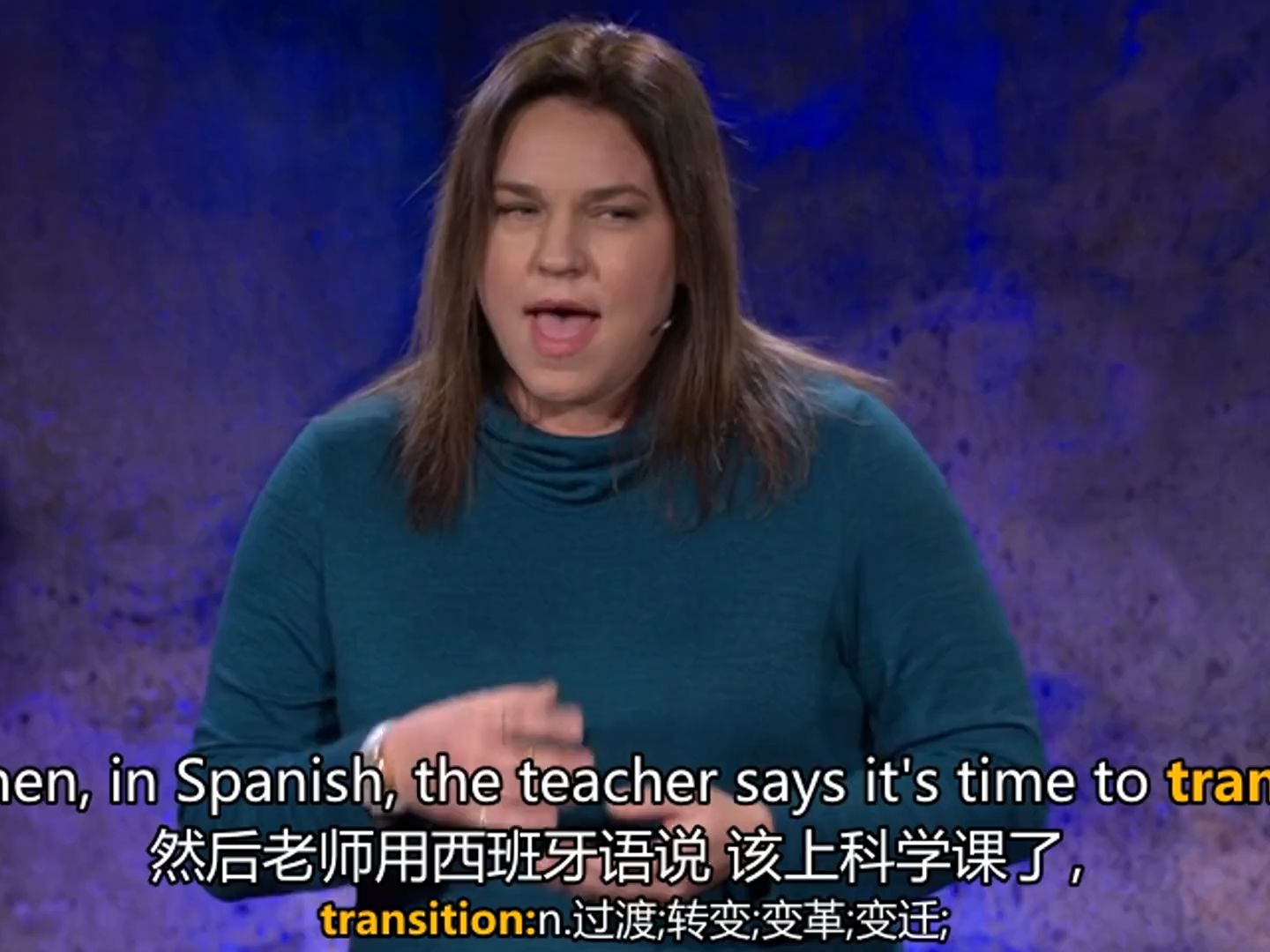
字幕摘录
| 时间 | 英文 | 中文 |
|---|---|---|
| 0:04 | Many years ago, I was finishing college and I was in that, so what's next phase of life? | 很多年前,我正在完成 大学,我在那个, 所以什么是下一阶段的生活? |
| 0:11 | And I decided I wanted to see the world. | 我决定我想看看世界 |
| 0:14 | And that was all well and good, but to do that, I needed money and a job. | 这一切都很好,但为了做到这一点, 我需要钱和工作。 |
| 0:19 | So I headed off to my college's advising center, thumbed through a Transitions Abroad magazine, | 于是我去了我大学的辅导中心 翻阅了一本《海外转型》杂志 |
| 0:26 | and there it was. | 就是这样 |
| 0:27 | It was this ad that said something like, | 是这个广告说 |
| 0:30 | Do you want to teach English abroad? | 你想在国外教英语吗? |
| 0:32 | And I thought, well, if that'll get me abroad, then yeah, I guess perhaps I do. | 我想,如果这能让我到国外去, 那么,我想我也许可以。 |
| 0:39 | So fast forward to several months later, I had a fellowship and I was off to Finland for a year | 几个月后,我有了研究金,去芬兰一年 |
| 0:45 | to teach English to elementary school students. | 向小学生教授英语。 |
展开字幕全文(111 条)
| 序号 | 英文 | 中文 |
|---|---|---|
| 1 | Many years ago, I was finishing college and I was in that, so what's next phase of life? | 很多年前,我正在完成 大学,我在那个, 所以什么是下一阶段的生活? |
| 2 | And I decided I wanted to see the world. | 我决定我想看看世界 |
| 3 | And that was all well and good, but to do that, I needed money and a job. | 这一切都很好,但为了做到这一点, 我需要钱和工作。 |
| 4 | So I headed off to my college's advising center, thumbed through a Transitions Abroad magazine, | 于是我去了我大学的辅导中心 翻阅了一本《海外转型》杂志 |
| 5 | and there it was. | 就是这样 |
| 6 | It was this ad that said something like, | 是这个广告说 |
| 7 | Do you want to teach English abroad? | 你想在国外教英语吗? |
| 8 | And I thought, well, if that'll get me abroad, then yeah, I guess perhaps I do. | 我想,如果这能让我到国外去, 那么,我想我也许可以。 |
| 9 | So fast forward to several months later, I had a fellowship and I was off to Finland for a year | 几个月后,我有了研究金,去芬兰一年 |
| 10 | to teach English to elementary school students. | 向小学生教授英语。 |
| 11 | Now, before I got to Finland, I already knew that it was a really cool place. | 在我到芬兰之前,我已经知道 这是一个非常酷的地方。 |
| 12 | But what I didn't realize was how linguistically diverse a place it was. | 但我没有意识到 这个地方在语言上是多么的多样化。 |
| 13 | Because I was on my way to teach elementary school students English. | 因为我正要去教小学生英语 |
| 14 | But those same students, unbeknownst to me, were already studying Finnish and Swedish | 但是,我不认识的那些学生 已经在学习芬兰语和瑞典语了 |
| 15 | and sometimes other languages in school. | 学校里有时还有其它语言 |
| 16 | At the time, I thought Finland must be some sort of multilingual anomaly. | 当时我认为芬兰一定是某种多语种的异常. |
| 17 | It couldn't be the norm for elementary school students to be learning multiple languages, | 这不可能是小学生学习多种语言的规范, |
| 18 | could it? | 可以吗? |
| 19 | Well, it turns out globally it often is. | 事实证明,它常常是全球性的。 |
| 20 | America really is more of a global standout and not for good reason in this case. | 美国确实更像是全球的突出人物, |
| 21 | The US stands out due to its monolingualism in schools, | 美国在学校中独占语言 |
| 22 | which is in sharp contrast to the fact that this country is an incredibly linguistically diverse place. | 这与这个国家在语言上的多样性大相径庭。 |
| 23 | So how do I know? | 我怎么会知道? |
| 24 | Well, I've been working with and studying multilingual learners for over 20 years. | 我和多语言学习者共事和学习了20多年。 |
| 25 | I've been a language learner. | 我学过语言 |
| 26 | I've taught English as a second language and English as a foreign language. | 教授英语为第二语言,英语为外语. |
| 27 | And I've carried out language policy research in several different countries. | 我在几个不同国家进行了语言政策研究。 |
| 28 | And this is what I've realized. | 这就是我意识到的。 |
| 29 | Here in the US, we're doing it wrong. | 在美国 我们做错了 |
| 30 | America is not tapping into what I see as our greatest asset, | 美国没有挖掘 我认为我们最大的资产, |
| 31 | which is our linguistic diversity. | 这就是我们的语言多样性。 |
| 32 | So you might be thinking, OK, but does this even matter? | 所以,你可能会想,OK, 但这甚至重要吗? |
| 33 | And if it matters, what do we do about it? | 如果这很重要,我们该怎么办? |
| 34 | So spoiler alert, it matters. | 所以,破坏者警报, 这很重要。 |
| 35 | And I'm going to talk about what we can do about it. | 且道如何是道. 师曰. |
| 36 | But first, I'd like you to come with me on a journey to an American public elementary school. | 但首先,我要你和我一起去美国公立小学 |
| 37 | Feel free to imagine your own from growing up or maybe one near where you currently live or maybe even one from TV. | 想象一下自己长大了 或者你现在住的地方附近 或者甚至电视上 |
| 38 | Now, let's go inside. | 现在,让我们进去。 |
| 39 | Once we step in, it's immediately evident that this is a multilingual place. | 一旦我们介入, 立即很明显, 这是一个多语言的地方。 |
| 40 | So how do you know? | 你怎么会知道? |
| 41 | Maybe there's posters and decor in multiple languages. | 也许有多种语言的海报和装饰. |
| 42 | Maybe you hear conversations happening with adults and students in different languages. | 也许你听到用不同语言与成人和学生交谈。 |
| 43 | And maybe there's even signs that explicitly say that multiple languages are welcomed and can be supported. | 可能甚至有迹象表明多种语言受到欢迎,并且可以得到支持. |
| 44 | Now, let's walk down the hall into a classroom. | 现在,我们从大厅走进教室 |
| 45 | Inside, students are doing a math lesson in English. | 里面,学生们正在用英语进行数学课. |
| 46 | They're working in small groups on word problems as the teacher walks around the class supporting the learning. | 当老师在课堂上走来走去支持学习时,他们分成几个小组来研究文字问题. |
| 47 | And then in Spanish, the teacher says it's time to transition to a science lesson. | 然后在西班牙语中,老师说现在是向科学课过渡的时候了. |
| 48 | She talks about the science content, hands out some papers for the day's assignment. | 她谈论科学内容, 发一些论文 白天的任务。 |
| 49 | The students attentively listen and then they begin to interact with each other and the new science content. | 学生们仔细聆听,然后开始相互交流,并开始新的科学内容. |
| 50 | All in Spanish. | 全用西班牙语 |
| 51 | So one subject in English and the next subject in Spanish. | 所以一个英文课,另一个西班牙文课。 |
| 52 | Whoa. | 珃 |
| 53 | How does this feel? | 这感觉如何? |
| 54 | Full disclosure, to me, this is like a school-based multilingual dream come true. | 完全公开,对我来说,这就像一个以学校为基础的多语种梦想成真。 |
| 55 | But I bet that this also might feel kind of unnerving or surprising or a little bit chaotic to some. | 但我敢打赌,这也可能 感觉有点不紧张 或令人惊讶 或有点混乱 一些人。 |
| 56 | And I think that those feelings may stem from the fact that this true embracing of multilingualism is very, very unusual in the U.S. | 我认为,这些感情可能源于这样一个事实: 这种真正接受多种语言的做法在美国是非常非常不寻常的。 |
| 57 | And it's very uncommon to see in American schools. | 在美国的学校里,这是非常罕见的。 |
| 58 | But here's the thing. | 但问题是 |
| 59 | Here in the U.S., we have tons of raw potential when it comes to language diversity. | 在美国,在语言多样性方面,我们有着大量的原始潜力。 |
| 60 | In fact, in 2022, Ethnologue ranked the U.S. fifth of all countries in the world in terms of language diversity, with 337 spoken languages. | 事实上,在2022年,Ethnologue在语言多样性方面排名美国世界第5位,拥有337种口语. |
| 61 | Similarly, nearly one quarter of students in American schools speak a home language other than English. | 同样,美国学校近四分之一的学生会说英语以外的母语。 |
| 62 | This means that millions of students possess rich language skills. | 这意味着数百万学生拥有丰富的语言技能。 |
| 63 | But we're not encouraging the development of those skills alongside the development of English. | 但我们不鼓励在发展英语的同时发展这些技能. |
| 64 | And therefore, we are not tapping into the linguistic diversity that exists among us and is already present. | 因此,我们没有利用存在于我们中间并且已经存在的语言多样性。 |
| 65 | When students enter schools, their language use and English proficiency is screened. | 当学生进入学校时,对其语言使用和英语熟练程度进行筛选. |
| 66 | And if they're in need of support, they're provided it. | 如果他们需要支持, 他们得到了它。 |
| 67 | But their home and heritage languages are often set aside due to longstanding policies and practices that focus heavily on English. | 但是,由于长期以来的政策和做法,他们的家园和传统语言往往被搁置一旁,这些政策和做法主要集中于英语。 |
| 68 | Now, don't get me wrong. | 别误会我 |
| 69 | I am not here to tell you that students educated in America shouldn't learn English. | 我不是来告诉你 在美国接受教育的学生不应该学英语的 |
| 70 | Well, there's no official language in this country. | 这个国家没有官方语言 |
| 71 | That's right. | 没错 |
| 72 | There is no official language in the U.S. | 美国没有官方语言. |
| 73 | English absolutely is a lingua franca, and it's an important sociocultural and economic tool for communicating in various settings. | 英语绝对是一种语言,是各种场合交流的重要社会文化和经济工具. |
| 74 | However, students' home and heritage languages are incredibly valuable, too. | 然而,学生的家语和传统语言也非常宝贵。 |
| 75 | And that is what we're missing. | 这就是我们缺少的。 |
| 76 | Students are entering schools with rich language backgrounds and cultural experience and knowledge. | 学生进入学校时具有丰富的语言背景和文化经验和知识. |
| 77 | And schools are often ill-equipped to support that, which means that these languages often go uncelebrated or even worse, over time, they're lost and forgotten. | 而学校也常常缺乏支持这些语言的能力,这意味着这些语言往往不会加速甚至更糟,随着时间的推移,它们会丢失和被遗忘. |
| 78 | So it's time that we stop leveraging dated policies and operating schools in a monolingual way. | 因此,我们该停止利用过时政策 以单一语言办学了。 |
| 79 | But there's good news here, because research shows that there's a language development program model called dual language | 但这里有好消息,因为研究表明 有一个语言开发程序模型叫做双重语言 |
| 80 | that is highly effective for all students. | 这对所有学生都非常有效。 |
| 81 | And by all, I mean all. | 说到底,我是说一切 |
| 82 | There are different kinds of dual language programs, but the general gist is that participating students receive instruction in two languages, meaning that over time they become bilingual. | 有不同种类的双重语言课程,但一般的要点是,参与的学生接受两种语言的教学,这意味着他们随着时间的推移成为双语. |
| 83 | Historically, in the U.S., language policies and programs have often been subtractive. | 历史上,在美国,语言政策与程序经常被删减. |
| 84 | But dual language programs are additive, which means that they're focused on developing, cultivating, and sustaining two languages. | 但双重语言程序是添加剂,这意味着它们专注于开发,培育,维持两种语言. |
| 85 | And research shows that these programs are really good for all kids. | 研究表明,这些计划对所有儿童都有好处。 |
| 86 | Not only are they the most effective type of instruction for students who speak a language other than English, | 不仅对讲英语以外的语言的学生来说,这些教学是最有效的。 |
| 87 | but they also benefit native English speakers and students from diverse racial and ethnic backgrounds and students with special education needs and exceptionalities. | 但他们也使讲英语的本地人和来自不同种族和族裔背景的学生以及具有特殊教育需要和特殊性的学生受益。 |
| 88 | Students enter these programs speaking one language and they come out of these programs speaking, listening, reading and writing in two languages proficiently. | 学生们用一种语言参加这些课程,他们用两种语言熟练地讲、听、读和写这些课程。 |
| 89 | Dual language programs work, and we could implement them around the country. | 双重语言方案行之有效,我们可以在全国各地实施这些方案。 |
| 90 | Because the fact of the matter is that being multilingual matters, both for the individual and for our society. | 因为事实上,无论是对个人还是对我们社会来说,都是多语种问题。 |
| 91 | Speaking multiple languages expands our worldview. | 说多种语言扩展了我们的世界观. |
| 92 | It connects us to our own identity and links us to our communities, our cultures and our families. | 它将我们与我们自己的身份联系起来,并将我们与我们的社区、文化和家庭联系起来。 |
| 93 | And research shows that there's these incredible cognitive benefits, too. | 研究表明,这些不可思议的认知好处也存在。 |
| 94 | Brains function better and can do more when they're multilingual. | 大脑功能更好,在多语种时可以做更多. |
| 95 | For instance, research indicates that bilingual brains are better than their monolingual counterparts at conflict management and at executive functioning activities like multitasking. | 例如,研究表明,在冲突管理和多任务等行政运作活动中,双语人才比他们的单一语言人才要好。 |
| 96 | I mean, the effects of this are incredibly far-reaching and impactful. | 我的意思是,它的影响 令人难以置信的深远和影响。 |
| 97 | It really is amazing, isn't it? | 这真的很棒,不是吗? |
| 98 | And it doesn't end there, because there's these economic and geopolitical benefits, too. | 它并没有在那里结束,因为这些经济和地缘政治利益也存在. |
| 99 | More and more jobs seek bilingual candidates, and being multilingual often leads to more lucrative job opportunities with global potential. | 越来越多的工作寻求双语候选人,而多语种往往带来具有全球潜力的更有利可图的工作机会。 |
| 100 | Around the world, schools are producing bi- and trilingual individuals, but that's notably uncommon here, | 在世界各地,学校都在培养双语和三种语言的个人, 但这里特别少见, |
| 101 | which means that students educated in America are at a disadvantage globally in this way. | 这意味着在美国受教育的学生在全球处于劣势。 |
| 102 | As technology shrinks our world and leads to faster communication and commerce and political action, | 随着技术缩小了我们的世界, 并导致更快的通信和商业以及政治行动, |
| 103 | being multilingual can lead to increased opportunities for travel, study, work and personal growth. | 多语种可增加旅行、学习、工作和个人成长的机会。 |
| 104 | So let's go back to that journey we took, because the fact of the matter is that doesn't have to be a figment of our imagination. | 所以,让我们回到我们所走的路程, 因为事实是, 事情的真相 不一定是虚构我们的想象力。 |
| 105 | That journey took us to a dual-language program, and what we need to do is build and grow these programs in order to build and grow multilingualism. | 这段旅程使我们走上了双语课程,我们需要做的是建立和壮大这些课程,以便建立和壮大多种语言。 |
| 106 | Through dual-language, we have the opportunity to cultivate languages, honor cultural and linguistic capital, and foster connections within schools and communities. | 通过双重语言,我们有机会培养语言,尊重文化和语言资本,促进学校和社区内部的联系。 |
| 107 | So instead of thinking of it as a journey, let's think of it as a foundation upon which to build better school programs that honor the language diversity that exists among us. | 因此,我们不要把它看作是一个旅程,而把它看作是一个基础,在此基础上建立更好的学校计划,尊重我们中间存在的语言多样性。 |
| 108 | It's the first step towards celebrating and elevating multilingualism. | 这是庆祝和提升多语制的第一步. |
| 109 | Together, we can help students develop skills in more than one language. | 我们可以一起帮助学生以多种语言发展技能. |
| 110 | Students who will then go on to be multilingual adults, workers, travelers, community members and global citizens. | 然后成为多语言的成年人、工人、旅行者、社区成员和全球公民的学生。 |
| 111 | Thank you. | 谢谢 |
该视频共有字幕 112 条。解锁更多字幕为会员功能,请移动到 价格