30个世界顶级视错觉,你的大脑在骗你!
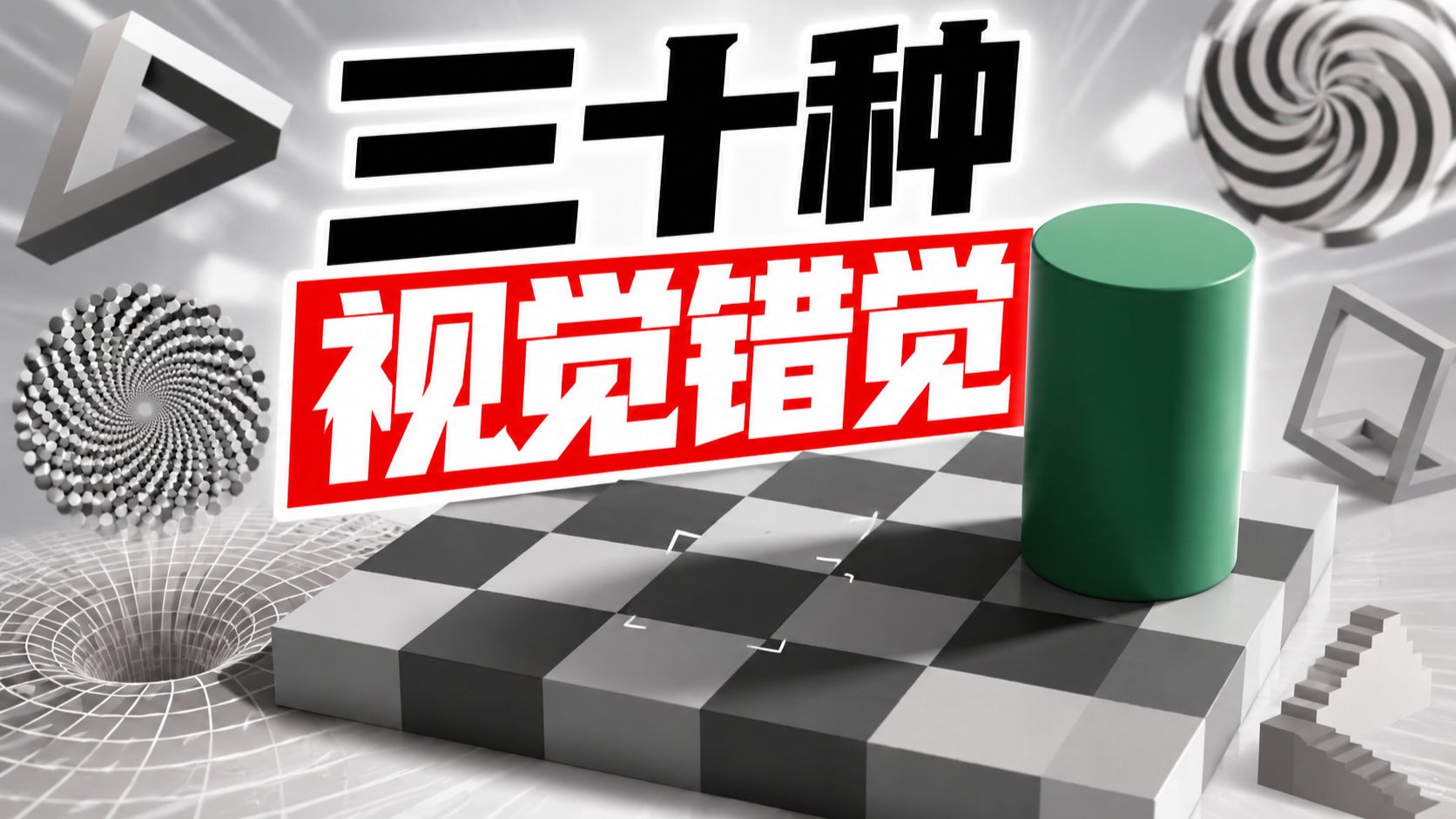
字幕摘录
| 时间 | 英文 | 中文 |
|---|---|---|
| 0:00 | My recent series on the brain included some of the world's best optical illusions. | 我最近关于大脑的系列包括一些世界上最好的光学幻觉. |
| 0:05 | They were probably the most popular bits. | 他们可能是最受欢迎的部分。 |
| 0:06 | So I've decided to bring them all together into one video. | 所以我决定把他们都集中到一个视频里。 |
| 0:09 | 30 optical illusions that have been discovered and devised by psychologists and others | 心理学家和其他人发现和设计的30种光学幻觉 |
| 0:15 | over the last 150 years. | 150年来 |
| 0:17 | Optical illusions fascinate me because they're an amazing demonstration | 光学幻觉让我着迷 因为它们是一个惊人的演示 |
| 0:21 | of the fact that we don't see the world how it is, | 事实,我们没有看到 世界是如何, |
| 0:24 | we see the world how our brain perceives it. | 我们看到世界 我们的大脑如何看待它。 |
| 0:26 | We instinctively trust our eyes, but of course it's our brain that does the processing of visual information. | 我们本能地相信我们的眼睛, 但当然是我们大脑 处理视觉信息。 |
| 0:31 | So please sit back and enjoy the experience of 30 of the world's best optical illusions. | 因此请坐,享受30种世界最佳光学幻觉的经验. |
展开字幕全文(233 条)
| 序号 | 英文 | 中文 |
|---|---|---|
| 1 | My recent series on the brain included some of the world's best optical illusions. | 我最近关于大脑的系列包括一些世界上最好的光学幻觉. |
| 2 | They were probably the most popular bits. | 他们可能是最受欢迎的部分。 |
| 3 | So I've decided to bring them all together into one video. | 所以我决定把他们都集中到一个视频里。 |
| 4 | 30 optical illusions that have been discovered and devised by psychologists and others | 心理学家和其他人发现和设计的30种光学幻觉 |
| 5 | over the last 150 years. | 150年来 |
| 6 | Optical illusions fascinate me because they're an amazing demonstration | 光学幻觉让我着迷 因为它们是一个惊人的演示 |
| 7 | of the fact that we don't see the world how it is, | 事实,我们没有看到 世界是如何, |
| 8 | we see the world how our brain perceives it. | 我们看到世界 我们的大脑如何看待它。 |
| 9 | We instinctively trust our eyes, but of course it's our brain that does the processing of visual information. | 我们本能地相信我们的眼睛, 但当然是我们大脑 处理视觉信息。 |
| 10 | So please sit back and enjoy the experience of 30 of the world's best optical illusions. | 因此请坐,享受30种世界最佳光学幻觉的经验. |
| 11 | Let's begin with the Lilac Chaser. | 让我们从利拉克·切斯开始。 |
| 12 | This illusion is over 20 years old and was created by Jeremy Hinton. | 这种幻觉已有20多年历史,由杰里米·欣顿创造. |
| 13 | It's a visual illusion that demonstrates colour adaptation. | 这是一种视觉幻觉,可以显示色彩适应. |
| 14 | If you follow the dots around, you'll notice that the discs are simply disappearing | 如果你跟着圆点走 你会发现圆盘正在消失 |
| 15 | for a split second. | 一分两秒 |
| 16 | But if you focus on the plus sign in the centre, | 但如果你专心于中央的加号 |
| 17 | you'll see that the gap has been replaced by an afterimage of the opposite colour, | 你会看到缺口已经被反面的图像所取代, |
| 18 | in this case green. | 这个案子是绿色的 |
| 19 | That image isn't actually there. | 那个画面其实并不存在。 |
| 20 | Our brain has made it up. | 我们的大脑已经创造了它。 |
| 21 | If you stare at the cross for over 20 seconds, | 如果你盯着十字架20多秒 |
| 22 | you may experience a phenomena called Troxler's fading, | 你可能会经历一种叫特洛斯勒的消失现象 |
| 23 | where all of the dots disappear, | 所有点消失的地方 |
| 24 | seemingly mopped up by the green dot which doesn't even exist. | 似乎被绿点所淹没 甚至根本不存在 |
| 25 | I'll leave it running for another 10 seconds. | 我会让它再运行10秒。 |
| 26 | Here's another example of Troxler's fading. | 下面是特罗克斯勒消失的另一个例子. |
| 27 | Stare at the dot in the centre, the blue ring will eventually disappear. | 在中央的圆点上,蓝色的环最终会消失. |
| 28 | This visual illusion affects visual perception. | 这种视觉幻觉影响视觉感知. |
| 29 | Part of this illusion is to do with the construction of the eye, | 这种幻觉的一部分 和眼睛的构造有关 |
| 30 | but part of the phenomena is due to misinterpretation by your brain. | 但部分现象 是由于你的大脑的误解。 |
| 31 | The spinning dancer. | 那个旋转的舞者 |
| 32 | It's one of the most stunning visual illusions. | 这是最惊人的视觉幻觉之一。 |
| 33 | Whether the spinning dancer is spinning clockwise or anti-clockwise | 旋转的舞者是顺时针还是逆时针旋转 |
| 34 | depends entirely on how your brain is interpreting the image. | 完全取决于你的大脑是如何解释图像的。 |
| 35 | This illusion derives from the lack of visual cues for depth. | 这种幻觉来源于缺乏视觉提示的深度. |
| 36 | The crazy thing about this illusion is that it can switch directions at any moment. | 这种幻觉的疯狂之处在于它随时可以改变方向. |
| 37 | Sometimes looking away and then back at the screen can trigger this switch. | 有时视而不见,然后回到屏幕上就可以触发这个开关. |
| 38 | But other than that, you've got no control over it. | 但除此之外 你无法控制它 |
| 39 | Once you see the spinning dancer switch directions, | 当你看到旋转的舞者 切换方向, |
| 40 | it's not the video that's done that, it's your brain. | 这不是录影带做的, 这是你的大脑。 |
| 41 | I'll keep it running for 20 more seconds. | 我会继续运行20秒。 |
| 42 | If it hasn't worked for you, rewind it and have another go. | 如果这对你没有用 倒回去再试一次 |
| 43 | Roger Shepard's tables. | 罗杰·谢泼德的桌子 |
| 44 | These tables by Roger Shepard are an example of geometrical illusion. | 罗杰·谢帕德的这些表格是几何错觉的例子. |
| 45 | They are stunning and the very best example of its type. | 它们是令人惊叹的,也是其类型的最佳例子。 |
| 46 | What would you say is the longest table? | 你说最长的桌子是什么? |
| 47 | The tabletops are a pair of identical parallelograms | 桌面是一对相同的平行图 |
| 48 | and our brain interprets them as objects in three-dimensional space. | 我们的大脑把它们解释为三维空间中的物体。 |
| 49 | This one clearly looks longer and thinner than this one. | 这个看起来显然比这个长而瘦. |
| 50 | They are, however, identical. | 但是,它们是一样的。 |
| 51 | I can show graphically by moving the large tabletop over | 我可以把大桌子翻过来 以图示显示 |
| 52 | and I can even use a ruler to show you that they are the same. | 我甚至可以用一个尺子来证明他们是一样的 |
| 53 | If you don't believe me, pause this video | 如果你不相信我,暂停这视频 |
| 54 | and compare the length of your finger to both examples. | 将手指的长度与这两个例子进行比较。 |
| 55 | Here's two examples of the Hermann grid. | 以下是赫尔曼网格的两个例子. |
| 56 | In this first one devised in 1870, | 在1870年设计的第一个 |
| 57 | your brain gets confused and puts blobs in the intersections. | 你的大脑变得很困惑 并且把blobs放在十字路口。 |
| 58 | If you look directly at any individual blob, it disappears. | 如果你直接看任何个体的blob,它就会消失. |
| 59 | The scintillating grid version was developed 120 years later. | 闪烁电网版本是在120年后开发的. |
| 60 | Dark dots pop up and disappear rapidly at random. | 暗点突然冒出来,随机迅速消失. |
| 61 | That's why they call it scintillating. | 故人称其 s. |
| 62 | This is an example of illusory motion. | 此是虚幻运动之例. |
| 63 | Stare at this image. | 盯着这张照片 |
| 64 | It's clearly moving. | 明显动静. |
| 65 | Now pick one individual dot and stare at it. | 现在挑一个个点 盯着它看 |
| 66 | You've made the image stop moving. | 你已经让图像停止移动。 |
| 67 | This is due to the cognitive effects of interacting colour contrasts | 这是因为相互作用的颜色对比的认知效应 |
| 68 | along with shapes and position. | 还有形状和位置 |
| 69 | This is a YouTube video that you can control with your eyes. | 这是一个YouTube视频,你可以用你的眼睛控制。 |
| 70 | Cafe wall illusion. | 咖啡馆墙壁幻觉. |
| 71 | These horizontal lines are perfectly level and straight, | 这些水平线是完美的水平和直线, |
| 72 | but that's not how your brain is interpreting it. | 但你的大脑不是这么解释的 |
| 73 | The crazy thing is though, | 但最疯狂的是 |
| 74 | if we use exactly the same image with colours of lower contrast, | 如果我们使用完全相同的图像 颜色的低对比度, |
| 75 | your brain can make sense of it. | 你的大脑可以解释它。 |
| 76 | It was named the cafe wall illusion by Richard Gregory in 1973. | 它于1973年被理查德·格雷戈里命名为咖啡馆墙幻. |
| 77 | A member of his laboratory team noticed the effect | 他的一个实验室成员注意到了这个效果 |
| 78 | on the wall tiles at their local cafe. | 在墙上的瓷砖 在他们的当地咖啡厅。 |
| 79 | Here's Richard in 2010 visiting that exact cafe. | 理查德2010年来那家咖啡馆 |
| 80 | The impossible trident. | 不可思议三叉戟. |
| 81 | It's got three legs at the bottom, | 底部有三条腿 |
| 82 | but that makes no sense when you look at the top of the object. | 但当你看着物体的顶部时,这是没有意义的。 |
| 83 | Our brains just can't make sense of this, | 我们的大脑是无法理解的, |
| 84 | which is why it's called the impossible trident. | 这就是为什么它被称为不可能的三叉戟。 |
| 85 | Canizar's triangle. | 卡尼扎尔的三角形. |
| 86 | How many triangles can you see? | 你能看见多少三角形? |
| 87 | I'll give you five seconds. | 我给你5秒钟 |
| 88 | The answer, of course, is zero. | 当然,答案是零。 |
| 89 | There's no triangles. | 没有三角形. |
| 90 | Our brain has just made them up. | 我们的大脑刚刚编出来的 |
| 91 | The checker shadow illusion was published in 1995 by Edward Edelson. | 检查者影子幻觉于1995年由爱德华·埃德尔森出版. |
| 92 | Your brain is telling you that tiles A and B are different colours. | 你的大脑告诉你,瓷砖A和B是不同的颜色。 |
| 93 | They are in fact exactly the same colour and shade. | 它们实际上是完全相同的颜色和阴影。 |
| 94 | Your brain can see the shadow | 你的大脑可以看到阴影 |
| 95 | and clearly expects a white tile to be in the space marked B. | 并清楚地期望一个白色的瓦片 在标有B的空间。 |
| 96 | I'm going to slide the B tile now out of the shadow | 我要把B牌从阴影中滑出来 |
| 97 | and put it next to A. | 放在A旁边 |
| 98 | I haven't changed the colour of that tile. | 我还没改变那瓷砖的颜色 |
| 99 | Your brain has. | 你的大脑有。 |
| 100 | Which is the longest horizontal line? | 哪条是最长的横向线? |
| 101 | I'll give you five seconds to work it out. | 我给你5秒时间去解决 |
| 102 | Yeah, you've guessed it. | 是啊,你已经猜到了。 |
| 103 | They're all the same. | 他们都是一样的。 |
| 104 | Motion blindness. | 运动失明. |
| 105 | Stare at the flashing green dot. | 盯着闪闪发光的绿点 |
| 106 | The yellow dots will eventually disappear. | 黄点最终会消失. |
| 107 | They're still there on the video, but your brain will be blind to them. | 视频里还有他们 但你的大脑会对他们视而不见 |
| 108 | Which is the longest yellow line? | 哪条是最长的黄线? |
| 109 | The one at the top or the one at the bottom? | 顶部的还是底部的? |
| 110 | I'll give you five seconds to work it out. | 我给你5秒时间去解决 |
| 111 | They're both the same. | 二者无异. |
| 112 | Your brain is making that top one bigger as it perceives it as further away. | 你的大脑正在使这个顶部更大,因为它认为它更远。 |
| 113 | Here's the Ebbinghaus illusion. | 这是艾比豪斯的幻觉 |
| 114 | Which orange circle is the largest? | 哪个橙色圆圈最大? |
| 115 | I'll give you five seconds to work it out. | 我给你5秒时间去解决 |
| 116 | Yeah, you guessed it. | 是啊,你猜到的。 - 是的,你猜到的。 |
| 117 | Our brain got it wrong again. | 我们的大脑又弄错了 |
| 118 | They're both the same size. | 两者大小相同. |
| 119 | The Sander illusion. | 桑德幻术. |
| 120 | Named after German psychologist Friedrich Sander who published it in 1926. | 以1926年出版的德国心理学家弗里德里希·桑德命名. |
| 121 | Which diagonal line is the longest? | 哪条对角线最长? |
| 122 | This one. | 这个 |
| 123 | Or this one. | 或此一门. |
| 124 | I'll give you 10 seconds to work it out. | 我给你们10秒时间 |
| 125 | You may not believe me, but the lines are in fact identical in length. | 你可能不相信我 但线条实际上是一样的 |
| 126 | Our brain is getting confused about these lines within the distorted parallelogram. | 我们的大脑在扭曲的平行图中 对这些线条感到困惑。 |
| 127 | To prove this, you can pause the video and measure it on screen, | 为了证明这一点,你可以暂停视频 并测量它在屏幕上, |
| 128 | but I'll also disassemble it for comparison. | 但我也会拆解它 比较。 |
| 129 | You do need to trust me here. | 你要相信我在这里。 |
| 130 | I have not changed the length of these lines. | 我并没有改变这些线的长度。 |
| 131 | Your brain has. | 你的大脑有。 |
| 132 | I'll leave it on screen for another 10 seconds to see if you can make any sense of it. | 我把它放在屏幕上再10秒 看能不能解释清楚 |
| 133 | This is the Fraser spiral illusion. | 这是弗雷泽的螺旋幻觉 |
| 134 | It's named after British psychologist Sir James Fraser who published it in 1908. | 它以1908年出版的英国心理学家詹姆斯·弗雷泽爵士命名. |
| 135 | Your brain is telling you that you're looking at a spiral, | 你的大脑在告诉你 你在看着螺旋形 |
| 136 | but it's getting confused because of the pattern around it and misaligned parts. | 但是由于周围的图案和错位部分,它变得很困惑. |
| 137 | You are in fact looking at complete and independent concentric circles. | 事实上,你们正在寻找完整和独立的同心圆。 |
| 138 | Your brain is making up that spiral. | 你的大脑在制造螺旋 |
| 139 | Try following the circles around if you don't believe me. | 你要是不信,就跟着转 |
| 140 | I'll give you 10 seconds to try to make sense of it. | 我给你10秒时间 试着解释清楚 |
| 141 | Going clockwise, you're always going downhill in one continuous loop. | 顺时针,你总是走下坡 在一个连续循环。 |
| 142 | This structure is impossible to recreate in three dimensions, | 这种结构不可能在三个维度重现, |
| 143 | but it well and truly fools our brain, which cannot make any sense of it. | 但是它确实在愚弄我们的大脑 这根本无法理解 |
| 144 | I'll give you another 10 seconds to imagine yourself walking down these never-ending steps. | 我再给你10秒钟 想象一下自己走进这些永无止境的台阶 |
| 145 | The Herring illusion was discovered by German physiologist Eald Herring in 1861. | 赫林幻觉是德国生理学家埃爾德·赫林在1861年发现的. |
| 146 | Are those red lines parallel or are they bowed? | 这些红线平行还是弯曲? |
| 147 | I'll give you five seconds to work it out. | 我给你5秒时间去解决 |
| 148 | They are, of course, perfectly parallel, but we see them as bowed. | 当然,它们是完全平行的,但我们认为它们是鞠躬的。 |
| 149 | When lines are presented in front of a radial background, | 当线条呈现在光圈背景前时, |
| 150 | our brain can't fully understand what's going on. | 我们的大脑无法完全理解发生了什么。 |
| 151 | The hollow face illusion perfectly demonstrates that we have an incredible in-built bias | 虚空的面部幻觉 完美地证明我们有一个不可思议的内在偏见 |
| 152 | for seeing faces as convex. | 把脸看成凸轮 |
| 153 | Over millions of years of human evolution, we've recognised faces as convex | 在数百万年的人类进化过程中, 我们认识到面孔是凸起的 |
| 154 | because they are, of course, convex. | 因为它们当然是凸轮 |
| 155 | But if a face is presented as concave, something kicks in. | 但是,如果脸被呈现为凸起, 东西踢入。 |
| 156 | We immediately convert it to convex, such as the strength of this deep-seated cognitive bias. | 我们立刻把它转换成凸轮, 比如这种深层认知偏差的强度。 |
| 157 | These computer-generated hollow faces play havoc with our brain. | 这些电脑生成的空心面孔 对我们的大脑造成破坏 |
| 158 | I'll leave this running for another 10 seconds. | 我会再离开10秒 |
| 159 | They're such fun to watch. | 他们很有趣看。 |
| 160 | The Jastroff illusion is named after Polish-American psychologist Joseph Jastroff. | 雅斯特罗夫幻觉以波兰裔美国心理学家约瑟夫·雅斯特罗夫命名. |
| 161 | Any parent watching that struggled to despair with wooden train tracks | 任何父母都用木制铁轨 看着那场挣扎着绝望 |
| 162 | knows exactly what I'm about to say. | 很清楚我要说什么 |
| 163 | Which piece of track is the longest? | 哪个轨道最长? |
| 164 | I'll give you five seconds to work it out. | 我给你5秒时间去解决 |
| 165 | They are, of course, exactly the same size, but that's not what our brain is telling us. | 它们当然是完全一样的大小, 但这不是我们的大脑告诉我们的。 |
| 166 | There is no universally accepted explanation here as to why our brain is getting this wrong. | 这里没有普遍接受的解释 关于为什么我们的大脑 得到这个错误。 |
| 167 | The most common theory is that the brain gets confused | 最常见的理论是大脑会变得困惑 |
| 168 | because of the comparisons with an inner and outer radius. | 因为与内外半径的比较 |
| 169 | I'll digitally overlay the pieces of track to prove that they are, in fact, the same size. | 我会数字化地覆盖轨道的碎片 来证明它们其实是相同的大小 |
| 170 | Now everything makes sense, until I put it back into its original place. | 现在一切都有道理了 直到我把它放回原来的位置 |
| 171 | And it all goes wrong again. | 这一切又错了 |
| 172 | Oskar Reutersvard created this 3D drawing in the 1930s, which does appear feasible. | 奥斯卡路透社(Oskar Reutersvard)在1930年代创作了这幅3D画,这看起来确实可行. |
| 173 | Initially, our brain seems to be only too happy to accept this image of triangles made up of cubes. | 最初,我们的大脑似乎太高兴了 无法接受这个三角形的画面 由立方体组成 |
| 174 | Nothing to see here, so let's move on. | 没什么好看的,我们继续吧 |
| 175 | But on closer inspection, we find that it plays havoc with our intuitive knowledge of physics. | 但是,经过更仔细的检查,我们发现它对我们直觉的物理知识造成了破坏。 |
| 176 | It cannot be physically recreated in the real world. | 它不能在现实世界中进行身体再造。 |
| 177 | I'll leave this on screen for a further 15 seconds to see if you can get your head around it. | 我会把这个放在屏幕上再15秒 看能不能把头绕过去 |
| 178 | This is the stepping-feet illusion. | 这是脚步幻觉。 |
| 179 | It's a motion perception phenomenon. | 这是一个运动感知现象. |
| 180 | These two objects are moving at an identical and constant speed, | 这两个物体以相同和恒定的速度移动, |
| 181 | but their speed appears to vary dramatically. | 但他们的速度似乎大不相同。 |
| 182 | When the blue object is over a white stripe, the contrast is high, | 当蓝色物体在一条白色的条纹上, 对比度很高, |
| 183 | so we perceive its speed to be faster. | 所以我们觉得它的速度更快 |
| 184 | Against black, it appears to go slower. | 与黑色相比,它似乎变慢了。 |
| 185 | The same process is repeated for the yellow image, but in reverse. | 黄色图像重复同样的过程,但反之. |
| 186 | I'll leave the incredible stepping-feet illusion playing for another 10 seconds. | 我会把不可思议的脚步幻术再玩10秒 |
| 187 | This is called White's illusion. | 这被称为怀特的幻觉. |
| 188 | It's a brightness illusion. | 明性幻觉. |
| 189 | We've got two grey bars interspersed with black and white stripes. | 黑白条纹交织着两个灰条. |
| 190 | Which grey bar is the brightest? | 哪个灰巴最亮? |
| 191 | I'll give you five seconds to work it out. | 我给你5秒时间去解决 |
| 192 | Both grey bars have, in fact, the same colour, luminance and opacity. | 两种灰色条实际上都具有相同的颜色,亮度和不透明度. |
| 193 | The black and white stripes have interfered with our colour perception. | 黑白的条纹干扰了我们的颜色感知. |
| 194 | The Zollner illusion was discovered by German astrophysicist Johann Zollner in 1860. | 佐尔纳幻觉由德国天体物理学家约翰·佐尔纳于1860年发现. |
| 195 | Are the long lines parallel? | 长线平行吗? |
| 196 | I'll give you 10 seconds to work it out. | 我给你们10秒时间 |
| 197 | The long lines are perfectly parallel. | 长线完全平行。 |
| 198 | The repeated short lines are either horizontal or vertical. | 重复的短线要么是水平线,要么是垂直线. |
| 199 | These short lines give the impression that the long lines are not parallel. | 这些短线给人的印象是,长线并不平行. |
| 200 | Your perception of even the short lines may also be distorted. | 你对短线的看法也可能被歪曲 |
| 201 | Let me take away the short lines. | 让我拿掉短线。 |
| 202 | Now your brain can make sense of it. | 现在你的大脑可以理解了 |
| 203 | Anyone that's watched an old spaghetti western will be familiar with the wagon wheel effect, | 任何看到老意大利面西部的人 都会熟悉马车轮效应 |
| 204 | where a spoked wheel appears to rotate in the opposite direction of its true rotation. | 声响的轮子似乎在真实旋转的相反方向旋转。 |
| 205 | The effect is caused because of the sample rate that our brain is using for processing. | 造成这种效应的原因是我们的大脑正在使用样品处理率。 |
| 206 | It's known as a form of temporal aliasing. | 它被称为一种时间别名的形式. |
| 207 | This is the Pogendorf illusion. | 这是波根多夫的幻觉 |
| 208 | It's a geometrical optical illusion. | 是一种几何光学幻觉. |
| 209 | Straight black and red lines are obscured by the grey shape. | 直立的黑线和红线被灰色的形状所模糊. |
| 210 | Does the black line connect with the blue line or the red line? | 黑线与蓝线还是红线相连?. |
| 211 | If we were to reveal the connection, I'll give you 10 seconds to work it out. | 如果我们要揭示这个联系,我给你10秒时间来解决这个问题. |
| 212 | The black line is connected to the red line. | 黑线与红线相连. |
| 213 | Your brain is making assumptions on where those lines are going and getting it wrong. | 你的大脑正在假设这些线的走向 并且弄错了。 |
| 214 | Your brain is perceiving an apparent position shift of the lower portion of the line. | 你的大脑能察觉到线下部的明显位置转移 |
| 215 | Hybrid images were developed in the 90s at MIT and Glasgow University. | 在麻省理工学院和格拉斯哥大学的90年代开发了混合图像. |
| 216 | You can perceive them in one of two ways, | 你可以从两个角度来看待他们 |
| 217 | depending upon how far you are away from the image. | 取决于你离画面有多远 |
| 218 | They are made from different spatial frequencies, | 它们来自不同的空间频率, |
| 219 | causing your brain to interpret them differently. | 让你的大脑 以不同的解释。 |
| 220 | I'm going to shrink down each image to simulate the picture being far away, | 我要缩小每个图像 来模拟相片的距离 |
| 221 | and I'll gradually increase the size, simulating the image getting closer. | 我将逐渐增加尺寸, 模拟图像越来越接近。 |
| 222 | Viewing these images at full size will also work, | 完整地看这些图像也行 |
| 223 | but you would need to vary the distance you are away from your screen. | 但你需要改变你离屏幕的距离 |
| 224 | I'm not changing these images as they get closer to you. | 我不会改变这些图像 因为它们越来越接近你。 |
| 225 | Your brain is perceiving them differently based upon distance. | 你的大脑视距离而不同 |
| 226 | Thank you so much for watching this video, I really hope you enjoyed those amazing optical illusions. | 非常感谢你们观看这段视频, 我真的希望你们喜欢那些惊人的光学幻觉。 |
| 227 | If you did enjoy it, please click that like button, that way more people will see it. | 如果你确实喜欢,请点击这个按钮, 这样更多的人会看到它。 |
| 228 | And please consider subscribing, that way I might see you again. | 请考虑签署, 这样我可能会再次见到你。 |
| 229 | And please have a look at some of the other content on the channel. | 请看频道上的其他内容。 |
| 230 | There's lots of interesting things on there. | 上面有很多有趣的东西 |
| 231 | Well... | 这个... |
| 232 | Very nearly in time. | 时间快到了 |
| 233 | Interesting. | 有意思,这很有趣 |
该视频共有字幕 233 条。解锁更多字幕为会员功能,请移动到 价格