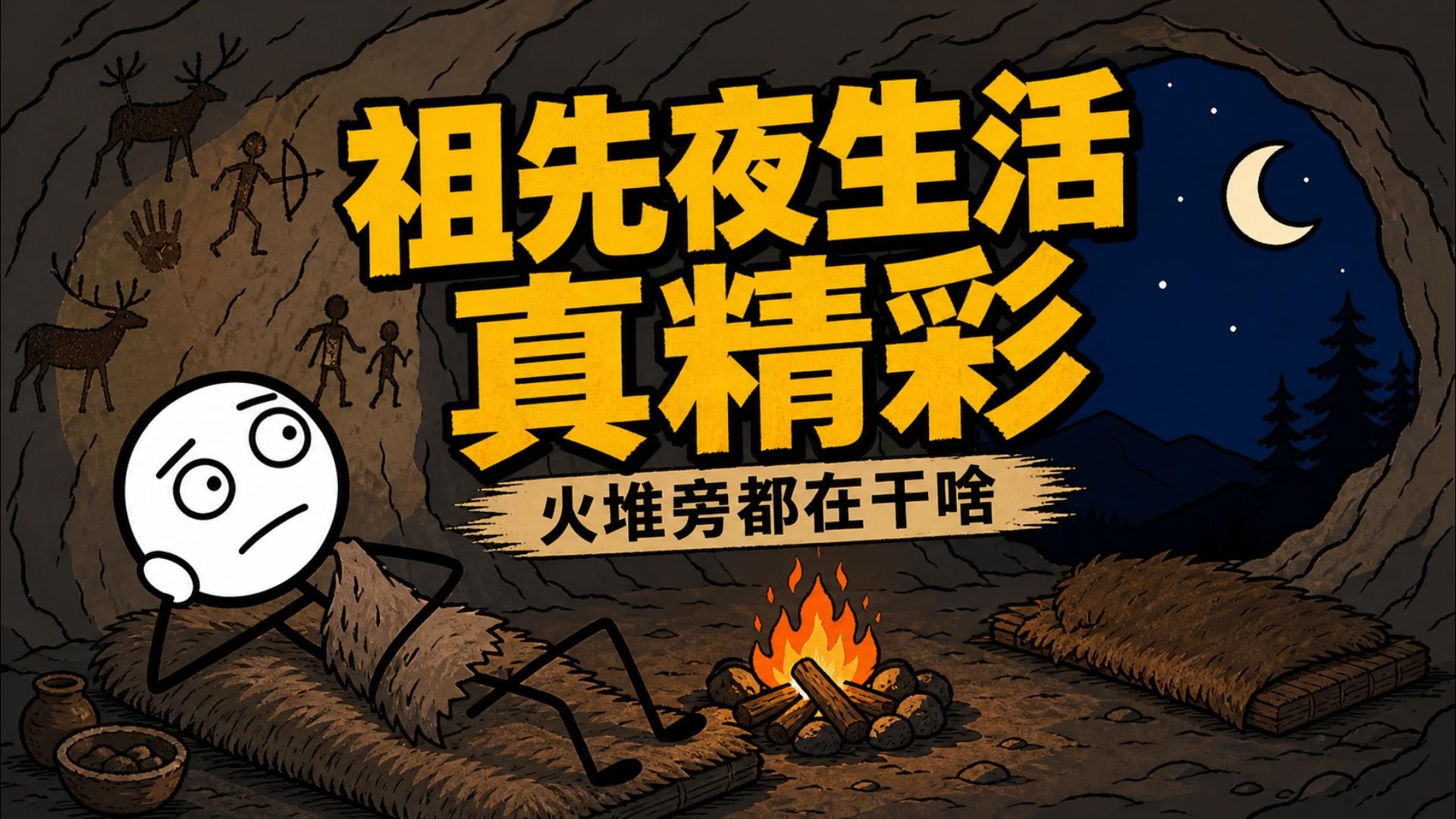
古人晚上都在干啥
字幕摘录
| 时间 | 英文 | 中文 |
|---|---|---|
| 0:00 | Tonight, when the sun goes down, you're going to flip a switch. | 今晚,当太阳下山时,你会翻开开关. |
| 0:02 | Light will flood the room, and you won't think twice about it. | 光会淹没房间,你也不会再想了. |
| 0:05 | But for 99.9% of human history, that switch didn't exist. | 但对于99.9%的人类历史来说,这个开关并不存在. |
| 0:09 | When the sun set, the world went dark. | 日落时,天下阴暗. |
| 0:12 | You couldn't even see your own hand in front of your face. | 你连自己的手都看不到 |
| 0:14 | But modern humans almost never experienced this. | 但现代人类几乎从未经历过这种情况. |
| 0:17 | For over 300,000 years, every single one of your ancestors spent roughly half their life | 30万年来,你每个祖先 都花费了大约一半的生命 |
| 0:23 | in near-total darkness. | 在几乎完全的黑暗中。 |
| 0:25 | They didn't even have candles for most of that time. | 大部分时间都没有蜡烛 |
| 0:27 | Just the black sky, the stars, and whatever fire they could keep alive. | 只有黑天 星星 以及他们能活着的火 |
展开字幕全文(173 条)
| 序号 | 英文 | 中文 |
|---|---|---|
| 1 | Tonight, when the sun goes down, you're going to flip a switch. | 今晚,当太阳下山时,你会翻开开关. |
| 2 | Light will flood the room, and you won't think twice about it. | 光会淹没房间,你也不会再想了. |
| 3 | But for 99.9% of human history, that switch didn't exist. | 但对于99.9%的人类历史来说,这个开关并不存在. |
| 4 | When the sun set, the world went dark. | 日落时,天下阴暗. |
| 5 | You couldn't even see your own hand in front of your face. | 你连自己的手都看不到 |
| 6 | But modern humans almost never experienced this. | 但现代人类几乎从未经历过这种情况. |
| 7 | For over 300,000 years, every single one of your ancestors spent roughly half their life | 30万年来,你每个祖先 都花费了大约一半的生命 |
| 8 | in near-total darkness. | 在几乎完全的黑暗中。 |
| 9 | They didn't even have candles for most of that time. | 大部分时间都没有蜡烛 |
| 10 | Just the black sky, the stars, and whatever fire they could keep alive. | 只有黑天 星星 以及他们能活着的火 |
| 11 | So what did they actually do for all those hours? | 那么这些小时他们都做了些什么? |
| 12 | The answer changes everything we think we know about sleep, storytelling, and what it | 答案改变了我们所知道的一切 关于睡眠,讲故事和它是什么 |
| 13 | means to be human. | 意思是成为人类 |
| 14 | Let's start with fire. | 从火起. |
| 15 | Because fire is the reason any of this was possible, the earliest solid evidence of humans | 因为火是这一切可能的原因 人类最早的确凿证据 |
| 16 | controlling fire comes from Wonderwerke Cave in South Africa, roughly one million years | 控制火灾来自南非的Wonderwerke洞穴,大约100万年 |
| 17 | ago. | 刚才 |
| 18 | But fire didn't just keep people warm. | 但火并不只是让人们温暖 |
| 19 | Fire completely restructured the human day. | 火彻底重组了人类日. |
| 20 | Before fire, our ancestors were like every other primate. | 在火灾发生之前 我们的祖先就像其他灵长类动物一样 |
| 21 | When the sun went down, you climbed a tree or found a sheltered spot and you stayed still. | 太阳下山的时候,你爬上一棵树 或者找到一个隐蔽的地方,你呆着。 |
| 22 | Moving at night meant becoming food. | 晚上搬家意味着成为食物。 |
| 23 | Our eyes are terrible in the dark compared to the predators that hunted us. | 和猎杀我们的掠食者相比,我们的眼睛在黑暗中是可怕的. |
| 24 | Leopards, hyenas, wolves, all of them could see just fine. | 豹, ,狼,他们都能看到 |
| 25 | Fire changed that equation overnight. | 火一夜之间改变了方程式 |
| 26 | Literally. | 当然 |
| 27 | A campfire creates a circle of safety roughly 30 feet in diameter. | 一场营火创造了一个直径约30英尺的安全圈. |
| 28 | Inside that circle, predators won't come. | 在那个圈子里,掠食者不会来 |
| 29 | Outside that circle, you die. | 在那个圈子外,你会死。 |
| 30 | This is not an exaggeration. | 这不是夸张。 |
| 31 | Anthropologists studying modern hunter-gatherer groups have documented that people who wander | 人类学家研究现代猎人-采集者群体 记录了游民 |
| 32 | away from the fire at night are significantly more likely to be killed by predators. | 远离夜间的火灾 更可能被掠食者杀死 |
| 33 | Even today. | 乃至今时. |
| 34 | But here's what's fascinating. | 但这里的吸引力。 |
| 35 | Fire didn't just protect humans at night. | 火不仅仅在夜间保护人类. |
| 36 | It gave them something they'd never had before. | 这给了他们一些以前从未有过的东西. |
| 37 | Extra hours. | 额外时间。 |
| 38 | Think about this. | 考虑一下 |
| 39 | Before fire, the useful day ended at sunset. | 火灾发生前,有用的一天在日落时结束. |
| 40 | That's maybe 12 hours in summer, as few as 8 in winter. | 夏天大概有12个小时,冬天只有8个小时。 |
| 41 | Fire suddenly added 2 to 4 usable hours to every single day. | 每一天火力突然增加2到4个可用小时. |
| 42 | And over thousands of generations, those extra hours changed our species. | 超过数千代,这些额外的时间 改变了我们的物种。 |
| 43 | In 2014, anthropologist Polly Wiesner published a study in the Proceedings of the National | 2014年,人类学家Polly Wiesner在"全国纪录"上发表了一份研究报告. |
| 44 | Academy of Sciences. | 科学院. |
| 45 | She spent years recording conversations among the Jew-slash-Huansi Bushmen of the Kalahari | 她花了数年时间 记录喀拉哈里的犹太人 - 什叶派 - 胡安西布什人之间的谈话 |
| 46 | Desert, one of the last groups on Earth still living something close to the original human | 沙漠,地球上最后一群人之一 仍然生活在靠近原始人类的地方 |
| 47 | lifestyle. | 生活方式。 |
| 48 | She found what was striking. | 她发现了惊人的东西。 |
| 49 | During the day, about 80% of conversations were practical. | 白天,约80%的对话是实用的. |
| 50 | Who's hunting where? | 谁在打猎? |
| 51 | Which plants are ready? | 什么植物准备好了? |
| 52 | Complaints. | 投诉 |
| 53 | Logistics. | 后勤. |
| 54 | Economic negotiations. | 经济谈判。 |
| 55 | Daytime talk was work. | 白天谈话就是工作 |
| 56 | But at night, around the fire, the entire character of conversation changed. | 但到了晚上,在火场周围,对话的整个角色都发生了变化. |
| 57 | At night, 81% of conversations were stories. | 晚上,81%的对话都是故事. |
| 58 | Tales of people in distant places. | 远处人的故事. |
| 59 | Myths about the origins of the world. | 关于世界起源的神话. |
| 60 | Jokes that made the whole camp laugh. | 笑话让整个营地都笑了 |
| 61 | Wiesner argued that fire-like conversation is where human culture was born. | 威斯纳认为,类似火的谈话是人类文化诞生的地方. |
| 62 | The campfire was the original theater, the original classroom, the original church. | 营火原为原剧场,原教室,原教堂. |
| 63 | It's where humans learned to think beyond the immediate present and imagine things that | 人类从这里学会思考 超越眼前的事物 |
| 64 | don't exist yet. | 还没有存在。 |
| 65 | It's where we became us. | 这是我们成为我们的地方。 |
| 66 | But the night wasn't just about stories around the fire. | 但夜晚不只是关于 围绕火灾的故事。 |
| 67 | There was something else happening, something that scientists only rediscovered in the last | 发生了一些其他的事 科学家在最后才发现的 |
| 68 | 30 years. | 30岁 |
| 69 | You were not designed to sleep the way you sleep right now. | 你被设计成不能像你现在这样睡觉 |
| 70 | In 2001, historian Roger E. Kirch published a paper that changed sleep science. | 2001年,历史学家罗杰·E·基什发表了一篇改变睡眠科学的论文. |
| 71 | He had spent 16 years digging through historical records, and he found something nobody expected. | 他花了16年时间挖掘历史记录,他发现了一些没人期待的东西. |
| 72 | Over 500 references, spanning centuries, prayer books from the 1400s, court records, | 五百多份参考书 历经几个世纪 一千四百年代的祷告书 法庭记录 |
| 73 | diaries, medical texts, letters from ordinary people, even passages in Homer's Odyssey. | 日记 医疗文本 普通人的信 甚至霍默的奥德赛的段落 |
| 74 | All of them mentioned the same thing, first sleep and second sleep. | 他们都提到了同样的事情,第一次睡眠和第二次睡眠. |
| 75 | Before the industrial age, people did not sleep in one continuous block. | 在工业时代之前,人们没有在一个连续的街区中睡觉. |
| 76 | They went to bed shortly after sunset, slept for about four hours, then woke up. | 他们日落后不久就上床睡觉,睡了大约四个小时,然后醒来. |
| 77 | They stayed awake for one to two hours in the middle of the night. | 他们半夜醒了一到两小时 |
| 78 | Then they went back to sleep for another four hours until dawn. | 然后他们又睡了四个小时 直到天亮 |
| 79 | This wasn't insomnia. | 这不是失眠。 |
| 80 | This was normal. | 这是正常的。 |
| 81 | This was how every human on the planet slept for thousands of years. | 地球上的每一个人都睡了几千年 |
| 82 | And what did people do during that wakeful period in the middle of the night? | 在半夜的觉醒期里 人们做了什么? |
| 83 | Everything. | 一切众生. |
| 84 | A 16th century French physician recommended that couples conceive children during this | 一位16世纪的法国医生建议夫妇在这期间生孩子 |
| 85 | window because they would do it better. | 因为它会做得更好。 |
| 86 | People visited neighbors, they interpreted their dreams while they were still fresh. | 人们拜访邻居,在新鲜的时候诠释自己的梦想. |
| 87 | They wrote. | 他们写了 |
| 88 | They simply lay in bed in the dark and thought. | 他们只是躺在床上 在黑暗和思考。 |
| 89 | A doctor's manual from the 1500s advised patients that the best time to study and reflect | 1500年代的医生手册告诉病人 最好的研究和思考时间 |
| 90 | was during the watch, as they called it. | 在表里,就像他们所说的。 |
| 91 | The quiet hours between first and second sleep, when the mind was calm and the world was still. | 第一次睡眠和第二次睡眠之间的静静时间,当时心灵平静,世界静静. |
| 92 | Now historians had been reading these references for centuries. | 现在历史学家已经读了这些参考文献几个世纪了. |
| 93 | But they kept translating first sleep as something else. | 但他们不停地翻译 第一次睡眠作为别的东西。 |
| 94 | Because they couldn't imagine that people ever slept differently than we do now. | 因为他们无法想象人们睡得跟我们现在不一样 |
| 95 | The assumption was so deep that translators literally mistranslated ancient Greek and | 这个假设非常深刻,以至于翻译者在字面上误译了古希腊语和古希腊语。 |
| 96 | medieval Latin to make it fit their modern experience. | 中世纪拉丁语使其符合他们的现代经验. |
| 97 | But then science confirmed what history had been saying all along. | 但后来科学证实了历史一直以来的说法. |
| 98 | In 1992, psychiatrist Thomas Ware at the National Institute of Mental Health ran an experiment. | 1992年,国家心理健康研究所的精神病医生托马斯·沃雷(Thomas Ware)进行了实验. |
| 99 | He took a group of volunteers and removed all artificial light from their lives. | 他带走了一批志愿者,并清除了他们生活中所有的人工光芒. |
| 100 | For one month, they experienced 14 hours of darkness every night, just like our ancestors | 一个月来 他们每晚都经历14小时的黑暗 就像我们的祖先一样 |
| 101 | would have before fire extended the evening. | 在火延时之前, |
| 102 | Within weeks, every single participant settled into the same pattern. | 几周内,每个参与者都步入同一模式。 |
| 103 | Four hours of sleep, one to three hours of quiet wakefulness, then four more hours of sleep. | 4小时的睡眠,1到3小时的静静觉醒,然后再4小时的睡眠. |
| 104 | Nobody told them to do this, nobody suggested it, their bodies just did it, as if some ancient | 没人叫他们这么做 没人建议他们这么做 他们的身体就是这么做的 好像有些古老的 |
| 105 | program had been waiting inside them the whole time, buried under centuries of artificial light. | 程序一直等待在他们体内 埋在几个世纪的人工光下 |
| 106 | Ware measured their hormone levels during the wakeful period and found something remarkable. | 怀尔在醒悟期测量了它们的激素水平,发现了一些令人瞩目的东西. |
| 107 | The participants were in a state unlike any normal waking state. | 与会者所处的状态与正常的觉醒状态不同。 |
| 108 | Their brains were producing elevated levels of prolactin, the same hormone released during | 他们的大脑正在产生高水平的亲乳素, 同样的激素释放 |
| 109 | meditation and after orgasm. | 冥想和高潮过后. |
| 110 | They described feeling peaceful, reflective, almost meditative. | 他们描述了和平、反省、几乎沉思的感觉。 |
| 111 | It wasn't just a gap in sleep, it was its own distinct state of consciousness, one that | 这不仅仅是睡眠的空隙, 它是它自己独特的意识状态, |
| 112 | most modern humans have never experienced. | 大多数现代人类从未经历过 |
| 113 | So what killed it? | 那是谁杀了它? |
| 114 | The answer is simpler than you'd think. | 答案比你想象的简单 |
| 115 | Light. | 轻. |
| 116 | In the 1600s, cities began installing street lamps. | 1600年代,城市开始安装街灯. |
| 117 | Paris was one of the first, under Louis XIV, who wanted to reduce crime. | 巴黎是路易十四领导下最早想要减少犯罪的国家之一. |
| 118 | London followed. | 伦敦紧随其后. |
| 119 | The night, which had been a place of danger and fear, slowly became navigable. | 曾经是危险和恐惧之地的夜晚慢慢变得可以航行. |
| 120 | Then came cheaper candles. | 然后是更便宜的蜡烛 |
| 121 | Then gas lamps in the 1800s. | 1800年代的煤气灯 |
| 122 | Then, in 1879, Thomas Edison commercialized the electric light bulb. | 随后在1879年,托马斯·爱迪生将电灯泡商业化. |
| 123 | And within a generation, the night as humans had known it for 300,000 years was gone. | 在一代人的时间里, 人类30万年来所知道的夜晚就消失了。 |
| 124 | And here's the part nobody talks about. | 这是没有人谈论的部分。 |
| 125 | The word curfew comes from the French couvre-feu. | 宵禁一词来源于法国的couvre-feu. |
| 126 | It literally means cover fire. | 它的字面意思是盖火。 |
| 127 | In medieval towns, a bell would ring at night signaling everyone to cover or extinguish | 在中世纪的城镇, 夜晚会响起警铃, 向所有人发出掩护或扑灭信号 |
| 128 | their fires. | 他们的火。 |
| 129 | Not because of safety, because night was supposed to be dark. | 不是因为安全, 因为夜晚应该是黑暗的。 |
| 130 | Night was when you slept. | 晚上是你睡觉的时候 |
| 131 | Night was when you were vulnerable. | 晚上是你脆弱的时候 |
| 132 | For most of history, being out at night was suspicious. | 在大部分历史中,晚上出门是可疑的. |
| 133 | In many medieval European cities, walking outside after dark without a lantern was literally | 在许多中世纪的欧洲城市, 黑暗后走出去,没有灯笼 |
| 134 | illegal. | 违法的。 |
| 135 | Night belonged to criminals and the supernatural. | 夜晚属于罪犯和超自然者 |
| 136 | People feared it in a way that's almost impossible for us to understand today. | 人们担心它的方式 几乎不可能 我们今天理解。 |
| 137 | And then we conquered it. | 然后我们征服了它。 |
| 138 | We flooded it with light. | 我们把它淹没了 |
| 139 | And we thought that was progress. | 我们认为这是进步。 |
| 140 | But here's what we lost. | 但这是我们失去的 |
| 141 | Modern humans are exposed to artificial light an average of 7 to 8 hours after sunset. | 现代人类平均在日落后7至8小时被人工光照射. |
| 142 | This light, especially the blue light from screens, suppresses your body's production | 这种光,特别是屏幕上的蓝光,压制了身体的制作 |
| 143 | of melatonin, the hormone that regulates sleep. | 控制睡眠的激素 |
| 144 | Your body doesn't know the difference between a light bulb and the sun. | 你的身体不知道灯泡和太阳的区别 |
| 145 | When light hits your retina at 11pm, your brain interprets it as daytime. | 当晚上11点光照到你的视网膜时 你的大脑会把它解释为白天 |
| 146 | It delays melatonin release. | 延缓了麦拉东宁的释放. |
| 147 | It fragments your sleep. | 它让你的睡眠破碎。 |
| 148 | It disrupts the circadian rhythm that evolved over millions of years. | 它扰乱了数百万年来演变的循环节奏. |
| 149 | Researchers have found that people who go camping for just one week with no artificial | 研究人员发现,人们去露营 仅仅一个星期,没有人工 |
| 150 | light at all have their melatonin cycles reset by nearly two hours. | 光线可以让它们的麦拉酮循环重置近两小时 |
| 151 | Their bodies start producing melatonin at sunset instead of hours after it. | 他们的身体在日落时开始生产梅拉托宁,而不是在之后数小时. |
| 152 | That's all it takes for 300,000 years of programming to reassert itself. | 30万年的节目编程 只能这样才能重现自我 |
| 153 | We didn't just change when we sleep. | 我们不只是在睡觉时变了 |
| 154 | We eliminated an entire phase of human consciousness. | 我们消灭了人类意识的整个阶段。 |
| 155 | That quiet, reflective state between first and second sleep, the state that wears subjects | 第一次睡眠和第二次睡眠之间的静静反射状态, 穿戴主体的状态 |
| 156 | described as peaceful and meditative, doesn't exist anymore for most people. | 被描述为和平和冥想, 对于大多数人来说已经不存在。 |
| 157 | Instead, we have insomnia. | 相反,我们有失眠。 |
| 158 | And we treat it like a disorder. | 我们把它当成一个障碍。 |
| 159 | But what if it's not a disorder at all? | 但如果这根本不是障碍呢? |
| 160 | What if waking up at 2am and lying there in the dark isn't your body malfunctioning? | 如果凌晨2点醒来 躺在黑暗中 你的身体是不是故障? |
| 161 | What if it's your body remembering what it was built to do? | 如果这是你的身体 记得它是用来做什么的? |
| 162 | For 300,000 years, your ancestors spent their nights in a rhythm that modern science is | 30万年来,你的祖先们 以现代科学的节奏度过他们的夜晚 |
| 163 | only beginning to understand. | 才刚开始明白 |
| 164 | They gathered around fires and told stories that built civilizations. | 他们聚集在大火周围,讲述建立文明的故事. |
| 165 | They slept in two phases with a window of quiet reflection in between. | 他们分两个阶段睡觉,中间有一个静静的反射窗口。 |
| 166 | They lived in darkness so complete that the Milky Way wasn't something you had to drive | 他们生活在黑暗中 如此完整 银河不是你必须驾驶的东西 |
| 167 | to a national park to see. | 去国家公园看看 |
| 168 | It was just the sky. | 这只是天空。 |
| 169 | And every night, when they woke in the dark between first and second sleep, they lay there | 每天晚上,当他们在第一次和第二次睡眠的黑暗中醒来时,他们就躺在那 |
| 170 | in silence and thought about their lives, their dreams, and the world they would wake | 默默地思考着他们的生活 他们的梦想 还有他们醒悟的世界 |
| 171 | up to in the morning. | 到早上为止 |
| 172 | We traded all of that for a light switch. | 我们把这些都换成了灯光开关 |
| 173 | And most of us never even knew it was gone. | 我们大多数人甚至不知道它不见了。 |
该视频共有字幕 176 条。解锁更多字幕为会员功能,请移动到 价格