弗朗西斯科•戈雅神秘《黑画》系列解读
字幕摘录
| 时间 | 英文 | 中文 |
|---|---|---|
| 0:00 | 14 works make up a series called the Black Paintings by the Spanish artist Francisco | 14部作品组成了西班牙艺术家弗朗西斯科的"黑色绘画"系列作品. |
| 0:05 | Goya. | 高亚. |
| 0:07 | They were massive murals depicting horrific scenes of decay, destruction, and suffering. | 这些是巨大的壁画, 描绘了腐朽、毁灭和痛苦的可怕场景。 |
| 0:13 | They were painted directly on the walls of the artist's home. | 他们直接被画在艺术家家的墙上. |
| 0:16 | Nobody was supposed to see the black paintings. | 没有人应该看到黑画。 |
| 0:19 | They were never intended for public view, they do not have titles, they were not commissioned | 从来不是给公众看的,没有标题,也没有委托 |
| 0:24 | by anyone. | 由任何人所为。 |
| 0:25 | Goya never spoke or wrote about them. | Goya从来没有谈到或写过他们。 |
| 0:27 | He never told any of his friends or family members about the paintings and there are | 他从来没有告诉过任何朋友 或家庭成员 关于画,有 |
| 0:31 | virtually no records of their existence from Goya's life. | 几乎没有记录 他们的存在 从戈雅的生活。 |
展开字幕全文(353 条)
| 序号 | 英文 | 中文 |
|---|---|---|
| 1 | 14 works make up a series called the Black Paintings by the Spanish artist Francisco | 14部作品组成了西班牙艺术家弗朗西斯科的"黑色绘画"系列作品. |
| 2 | Goya. | 高亚. |
| 3 | They were massive murals depicting horrific scenes of decay, destruction, and suffering. | 这些是巨大的壁画, 描绘了腐朽、毁灭和痛苦的可怕场景。 |
| 4 | They were painted directly on the walls of the artist's home. | 他们直接被画在艺术家家的墙上. |
| 5 | Nobody was supposed to see the black paintings. | 没有人应该看到黑画。 |
| 6 | They were never intended for public view, they do not have titles, they were not commissioned | 从来不是给公众看的,没有标题,也没有委托 |
| 7 | by anyone. | 由任何人所为。 |
| 8 | Goya never spoke or wrote about them. | Goya从来没有谈到或写过他们。 |
| 9 | He never told any of his friends or family members about the paintings and there are | 他从来没有告诉过任何朋友 或家庭成员 关于画,有 |
| 10 | virtually no records of their existence from Goya's life. | 几乎没有记录 他们的存在 从戈雅的生活。 |
| 11 | So why did the artist make them? | 那为什么是艺术家做的? |
| 12 | How did Goya go from painting idyllic works like this to works like this? | 歌雅怎么从绘画戏剧 像这样的作品变成这样? |
| 13 | Why would any individual choose to adorn their walls with paintings of cannibalism, witchcraft, | 为什么会有人选择用食人、巫术的画作装饰墙壁, |
| 14 | and sorrow? | 和悲伤? |
| 15 | The trajectory of Goya's work follows a well-trodden narrative about an artist descending into | 戈雅的作品的轨迹 沿循着关于一位艺术家的 |
| 16 | This is, but simply, a poor explanation for the Black Paintings. | 简而言之,这是对黑漆术的一个不好的解释。 |
| 17 | The descent into madness tale does not just do a disservice to Goya's paintings, but | 陷入疯狂的故事 不仅对戈雅的画作有害 |
| 18 | to art and perhaps even to humanity itself. | 艺术,甚至人类本身。 |
| 19 | We will get to that conversation, but for now, let's start with Francisco Goya. | 我们会谈到那个话题的 但是现在 先从弗朗西斯科·戈亚开始 |
| 20 | Francisco Goya was born in 1746 in Fuente Todos, Spain. | 弗朗西斯科·戈亚1746年出生于西班牙富恩特托多斯. |
| 21 | Although born into limited means, Goya found immense fame as a painter throughout his life. | 虽然出身于有限的手段,但戈雅在一生中作为画家发现了巨大的名声. |
| 22 | He was often commissioned by royals for portraiture, and as an artist, Goya was the subject of | 他经常被皇家人委托做肖像画,作为一名艺术家,戈雅是 |
| 23 | near-universal acclaim. | 近乎普遍赞叹。 |
| 24 | This video is about Goya's Black Paintings, but to understand these works, we must understand | 这段视频是关于Goya的"黑色绘画",但为了理解这些作品,我们必须理解 |
| 25 | how Goya arrived at them. | 戈雅是怎样到达他们的 |
| 26 | They were not created in a vacuum, but instead as a reaction to a myriad of circumstances. | 它们不是在真空中产生的,而是作为对众多情况的反应。 |
| 27 | As wonderfully as things were going within Goya's career, the same could not be said | 和戈雅的事业里发生的事情一样奇妙 也一样 |
| 28 | for his country. | 他的国家。 |
| 29 | In 1789, the French Revolution was sending shockwaves into Spain. | 1789年,法国大革命将冲击波传入西班牙. |
| 30 | The Spanish government attempted to stamp out these revolutionary ideas, and the Spanish | 西班牙政府试图消灭这些革命思想和西班牙人 |
| 31 | sympathizers were forced into hiding. | 同情者被迫躲藏。 |
| 32 | Goya himself sided with the left-leaning revolutionaries, but his life materially depended on commissions | 高雅本人支持左倾的革命者,但他的生命在物质上依赖于佣金 |
| 33 | from the Spanish crown. | 从西班牙王冠。 |
| 34 | This crisis of conscience did not create the Black Paintings, but it is perhaps the very | 这场良心危机并没有造成黑色画派,但也许是 |
| 35 | first straw on the camel's back. | 骆驼背上的第一吸管 |
| 36 | In 1793, a mysterious disease left Goya completely deaf. | 1793年,一场神秘的疾病使戈雅完全失聪. |
| 37 | Shortly after losing his hearing, Goya underwent an intense depressive episode. | 失去听力后不久,戈雅经历了强烈的抑郁症. |
| 38 | His work became darker and more pessimistic, focusing on human suffering and the cruelties | 他的作品变得更加黑暗和悲观,专注于人类的痛苦和残酷 |
| 39 | of the world. | 这个世界。 |
| 40 | 这在他的1794年的画中被完美地俘获,Yard with Lunatics. | |
| 41 | In the work, Goya depicts patience in a mental institution. | 在作品中,戈雅描绘了精神病院中的耐心. |
| 42 | Strikingly, the building seems to be outside. | 令人惊叹的是,这栋建筑似乎在外面。 |
| 43 | The sun is shining brightly in the entire upper portion of the canvas, and yet the figures | 整个帆布的上部 阳光闪耀着阳光 然而数字 |
| 44 | are all bathed only in darkness. | 只有在黑暗中沐浴 |
| 45 | Externally, the situation in Spain was worsening as well. | 在外部,西班牙的局势也在恶化。 |
| 46 | Ferdinand VII took power, and under his reign, Spain entered into a civil war. | 斐迪南七世掌权,在他的统治下,西班牙陷入内战. |
| 47 | Goya attempted to leave the capital city of Madrid on two occasions, but was both times | 戈雅曾两次试图离开首都马德里,但都是两次 |
| 48 | threatened with the seizure of his property and the loss of his job. | 威胁要没收他的财产和失去工作。 |
| 49 | So he stayed in the capital, where he held a unique and bizarre relationship to the conflict. | 于是他留在了首都,在那里他与冲突保持着独特和奇异的关系. |
| 50 | On one hand, he was painting for the new invading king. | 一方面,他为新入侵的国王画画. |
| 51 | On the other, Spanish generals invited Goya to document the struggles of their soldiers. | 另一方面,西班牙将领们邀请戈雅来记录他们的士兵们的斗争. |
| 52 | All the while, Goya witnessed first-hand the terror of the civil war. | 一直以来,戈雅亲眼目睹了内战的恐怖. |
| 53 | During this time, he produced a series called the Disasters of War, which are a direct precursor | 在此期间,他制作了一个名为"战争灾难"的系列,这是直接的前奏. |
| 54 | to the black paintings. | 黑漆黑的画。 |
| 55 | It's hard to say exactly when Goya began Disasters of War, but the earliest entry is | 很难确切地说 戈雅何时开始战争的灾难 但最早的条目是 |
| 56 | dated to 1810. | 日期为1810年. |
| 57 | The works are most obviously about the War of Independence, but they are also about war | 作品中最明显的是关于独立战争的,但也是关于战争的 |
| 58 | in its totality. | 整个过程 |
| 59 | Goya's Disasters omit references to real people, places, or events, much like his later | Goya的灾难忽略了真实的人,地点, 或事件, 和后来的他一样 |
| 60 | black paintings. | 黑色画作. |
| 61 | Instead, they portray the everyday sufferings of a population ripped apart by violence. | 相反,它们描绘了被暴力撕裂的民众的日常苦难。 |
| 62 | In the series, Goya is not interested in arguments over a just or unjust war. | 在系列中,戈雅对一场正义或不公正的战争的争论不感兴趣. |
| 63 | Rather, he seems to portray war as fundamentally wrong. | 相反,他似乎把战争描绘成根本错误。 |
| 64 | The war is not an error on the part of the Spanish or the invading forces, but error | 战争不是西班牙人或入侵部队的错误 而是错误 |
| 65 | on the part of humanity itself. | 人类本身。 |
| 66 | This philosophy, this pessimistic view of humankind, is the thread which carries Goya | 这种哲学,这种悲观的人类观点,是带着戈雅的线条. |
| 67 | through to his black paintings. | 穿过他的黑画。 |
| 68 | The horrors of war, the human suffering in his etchings, were not temporary, but rather | 战争的恐怖 人类的痛苦 在他的蚀刻,不是暂时的,而是 |
| 69 | quite permanent. | 相当永久。 |
| 70 | They became a hinge around which his creative process seemed to turn. | 他们成了他的创造过程似乎正在转向的锁链。 |
| 71 | With the political situation becoming more oppressive and his health continuing to decline, | 随着政局更加压迫,他的健康继续下降, |
| 72 | Goya purchased a house in the countryside. | 戈雅在农村购买了房屋. |
| 73 | By this time, Goya's creative voice had entirely entered a world of darkness. | 此时,戈雅的创作声音已完全进入黑暗世界. |
| 74 | This would soon culminate in the black paintings. | 这很快会以黑色的画作为高潮. |
| 75 | In 1819, Goya fell seriously ill once again. | 1819年,戈雅再次病重. |
| 76 | He recovered, but would live the rest of his days in severe mental anguish over a relapse | 他康复了,但终日会因复发而精神痛苦 |
| 77 | and the looming threat of death. | 和濒临死亡的威胁。 |
| 78 | It is likely that after his recovery, Goya began work on the black paintings. | 很可能在他康复后,戈雅开始创作黑色画作. |
| 79 | These paintings were applied directly to the walls of his home. | 这些画被直接应用到他家的墙上. |
| 80 | Modern x-rays have shown that beneath the black paintings, there were pleasant murals | 现代的X光显示 在黑漆底 有令人愉快的壁画 |
| 81 | of nature and country life. | 自然和国家生活。 |
| 82 | It's unclear if Goya painted these murals, but no matter the case, the black paintings | 不清楚戈雅是否画了这些壁画 但不管怎样 黑画 |
| 83 | represent a deliberate desire to cross out the idyllic with the macabre. | 代表着一种刻意的渴望 与阴道交叉 |
| 84 | These fourteen paintings do not depict flesh and blood events. | 这十四幅画没有描绘血肉事件. |
| 85 | They are not images of things occurring in the world as far as we know. | 据我们所知,它们并不是世界上发生的事物的影像。 |
| 86 | Instead, they are a reflection of mood, of Goya's own internal state of being. | 相反,它们是情绪的反映, 戈雅自身的内部状态。 |
| 87 | Amid the wars, political turmoil, and failing health, the black paintings offer a private | 在战争、政治动荡和身体衰弱的情况下 黑画提供了私人 |
| 88 | glimpse inside the mind of Francisco Goya. | 在弗朗西斯科·戈亚的脑海中 |
| 89 | Saturn Devouring His Son is likely the most famous of the black paintings, and subject | 土星毁灭他的儿子 很可能是最著名的 黑色画,和主题 |
| 90 | it depicts the myth of Cronos, who was later renamed to Saturn by the Romans. | 它描绘了后来被罗马人改名为土星的克罗诺斯神话. |
| 91 | In that story, Cronos believes one of his sons will usurp his throne and so Cronos devours | 在那个故事里,克罗诺斯相信 他的一个儿子会篡夺他的王位 所以克罗诺斯吞噬 |
| 92 | the infant at birth. | 婴儿出生时。 |
| 93 | The narrative is obviously interesting, but it is Goya's depiction which demands attention. | 叙述显然很有趣,但需要注意的是戈雅的描写。 |
| 94 | Earlier, more traditional depictions of this scene, like this one from Peter Paul Rubens, | 早些时候,更传统的 描绘这个场景, 像这个从彼得保罗鲁本斯, |
| 95 | show Saturn as cruel and malevolent. | 显示土星是残忍和恶毒的。 |
| 96 | For a more direct comparison, we can look to an earlier work by Goya himself. | 为了进行更直接的比较,我们可以看看戈雅本人先前的作品. |
| 97 | Years before creating the black paintings, Goya produced a chalk drawing of Saturn Devouring | 在创作黑色绘画之前的几年,戈雅制作了土星的粉笔绘画 |
| 98 | His Son. | 其子.. |
| 99 | In the drawing, Saturn looks every bit as violent as Rubens and he is depicted with | 在绘画中,土星看起来每一点都像鲁本斯一样暴力,他被描绘成 |
| 100 | two bodies as if his ruthlessness has a procedural quality to it. | 两具尸体仿佛他的残忍 具有程序上的质量 |
| 101 | But in Goya's later painting, it is hard to see any bit of cruelty on Saturn's face. | 但是,在戈雅后来的画中,很难看到土星脸上有任何一点残酷. |
| 102 | Instead, he looks afraid. | 相反,他看起来很害怕。 |
| 103 | Saturn stares at the viewer as if being caught in an act most deplorable. | 土星盯着观众看 好像被一个最可悲的行为抓住了 |
| 104 | We are afraid of the monster and the monster is afraid of us. | 我们害怕怪物 怪物害怕我们 |
| 105 | The damage is already done, the figure he holds is bloodied and headless. | 伤害已经做了, 他持有的身材是血和无头。 |
| 106 | Saturn, who we would see as the monster, is horrified by himself. | 土星,我们所看到的怪物, 被自己吓坏了。 |
| 107 | The bright lighting puts Saturn in a spotlight against the black background. | 明亮的灯光使土星在黑色背景下进入聚光灯. |
| 108 | It feels as if we have interrupted something. | 感觉好像我们打断了什么 |
| 109 | But when we examine the tale of Saturn against Goya's work, we find huge inconsistencies. | 但是,当我们研究土星与戈雅的作品作对的故事时,我们发现巨大的不一致之处. |
| 110 | In the story, Saturn is devouring a newborn child. | 在故事中,土星正在吞噬一个新生的孩子. |
| 111 | The body being eaten in Goya's painting, though, is quite clearly an adult. | 不过,戈雅画中被吃掉的尸体显然是成年人. |
| 112 | The shape of the body could even suggest that it is a woman as well, rather than a son. | 身体的形状甚至可以表明,它也是一个妇女,而不是一个儿子。 |
| 113 | The Titan Cronos is also representative of time. | 泰坦克罗诺斯号也是时间的代表. |
| 114 | Perhaps Goya's Saturn is time, the passing of time, and all of mankind's machinations | 也许戈雅的土星是时间 时间的流逝和人类的阴谋 |
| 115 | devouring humanity itself. | 吞噬人类本身 |
| 116 | But the painting lacks the typical iconography that would be associated with Saturn. | 但是这幅画缺乏典型的与土星相关的偶像画. |
| 117 | Constellations, hourglasses, and scythes are conspicuously absent. | 星座、时镜和圆柱明显缺失。 |
| 118 | Artists are inclined to take creative liberties, certainly. | 当然,艺术家倾向于接受创作自由。 |
| 119 | But one possible explanation for these inconsistencies is also that the painting does not depict | 但是这些不一致的一个可能的解释是,画没有描绘 |
| 120 | Saturn. | 土卫六. |
| 121 | Goya did not title the painting. | Goya没有为这幅画题名。 |
| 122 | Historians today have given it that title and anointed it that subject matter, but this | 历史学家今天给了它这个头衔 并给它涂了这个主题,但这个 |
| 123 | is just a theory. | 只是一个理论。 |
| 124 | It's quite possible that Goya did not paint Saturn. | 很可能戈雅没有画土星 |
| 125 | So what did he paint? | 他画了什么? |
| 126 | Goya and his wife had between five and twenty children. | 戈雅与妻子育有5到20个孩子. |
| 127 | No one really knows the exact number, but only one survived beyond childhood, their | 没有人真正知道确切的数字, 但只有一个幸存下来过童年,他们的 |
| 128 | son Javier. | 儿子哈维尔。 |
| 129 | From Javier's earliest days, Goya doted over the boy. | 从哈维尔最早的年代开始,戈雅就对男孩做了点心. |
| 130 | Goya wrote poetic letters to his friends about his son. | 戈雅为朋友写了有关儿子的诗信. |
| 131 | When his wife died, Goya gave virtually all of his belongings and paintings to Javier. | 他的妻子去世后,戈雅将他几乎所有的财物和画作都交给了哈维尔. |
| 132 | After Javier married into a wealthy family, Goya still took financial responsibility for | Javier嫁给一个富裕的家庭后 Goya仍然承担着经济责任 |
| 133 | the child. | 孩子们 |
| 134 | Nearing the end of his life, Goya was spending all of his money on his son. | 临终之际,戈雅将全部钱花在儿子身上. |
| 135 | The father had grand hopes that Javier would devote himself to art, but that did not happen. | 父亲对哈维尔投入艺术事业抱有巨大的希望,但这并没有实现. |
| 136 | When we look at a portrait of the twenty-one-year-old Javier done by Goya, we perhaps see how Goya | 当我们看着戈雅的21岁Javier的肖像时, 我们也许可以看到戈雅是如何的 |
| 137 | viewed his child. | 看着他的孩子 |
| 138 | The boy is handsome, but he is childlike, pretty, and his expression is even aloof. | 男孩是帅气的, 但他是孩子般的,漂亮, 他的表情甚至被遗忘。 |
| 139 | The painting does not render Javier as strong or determined, but instead as a well-to-do, | 这幅画并没有让哈维尔变得坚强或坚定,而是作为一个好人, |
| 140 | unconcerned youth. | 不关心的青年。 |
| 141 | Perhaps Saturn is a reflection of Goya's own strained, disappointing relationship with | 也许土星是戈雅 自己紧张,令人失望的关系 |
| 142 | his son, or an allegory for the children Goya lost, but I think to prescribe such specific | 他的儿子, 或一个寓意的孩子 Goya失去了, 但我想规定这样的具体 |
| 143 | meaning to works of art is often a misled endeavor, and as we continue to look at the | 艺术作品的意义往往被误导,而当我们继续审视 |
| 144 | black paintings, this does become a good thesis on the works. | 黑色画作,这确实成为了作品上的好论文. |
| 145 | Witch's Sabbath is another iconic painting from the period, and the work, A Goat, likely | 女巫的安息日是这段时期的又一幅标志性的画, 作品,一只山羊,很可能 |
| 146 | Satan, presides over a coven of witches who look horrified and distraught at the scene. | 撒旦,主持一个巫师的集合,他们看起来惊恐不安,在现场惊慌失措. |
| 147 | The shortest of the witches sitting next to Satan has been suggested to be a child or | 坐在撒旦旁边的女巫中最短的 被暗示是一个孩子或 |
| 148 | an infant being prepared for some kind of ritual. | 一个婴儿正在准备某种仪式 |
| 149 | The witches are painted in unflattering forms, they are grotesque and twisted in their renderings. | 巫师们被描绘成不折不扣的形式,他们怪异,在渲染中扭曲. |
| 150 | Still though, the painting offers very little in the way of outright condemnation of witchcraft | 不过,这幅画对彻底谴责巫术的作用却很小 |
| 151 | specifically. | 特别的。 |
| 152 | Instead, it just shows some ritual, as Goya would have imagined it. | 相反,它只是展示了一些仪式,正如戈雅会想象的那样. |
| 153 | The setting is vague at very best, it seems clear that the events are occurring outside, | 环境充其量是模糊的, 似乎很清楚的事件发生在外面, |
| 154 | but the viewer knows little more than that. | 但观众只知道这些 |
| 155 | This was not the first time Goya painted witchcraft. | 这不是戈雅第一次画巫术。 |
| 156 | His arguably more famous work from several years prior shows a similar scene. | 他几年前的著名作品 也显示出类似的场景 |
| 157 | He depicted witches in a few other works. | 他在其他一些作品中描绘了女巫. |
| 158 | Goya was a staunch liberal, and he fiercely opposed the work of the Spanish Inquisition. | 戈雅是一个坚定的自由主义者,他强烈反对西班牙宗教裁判所的工作. |
| 159 | His paintings of witches are generally accepted as silent protests to the Inquisition. | 他的巫术画被普遍接受为对宗教裁判所的无声抗议. |
| 160 | This one is no exception. | 这个也不例外。 |
| 161 | In another famous piece from the black paintings, Goya's subject matter shifts from the cosmic | 在黑色画作的另一部著名作品中,戈雅的主题从宇宙中转移. |
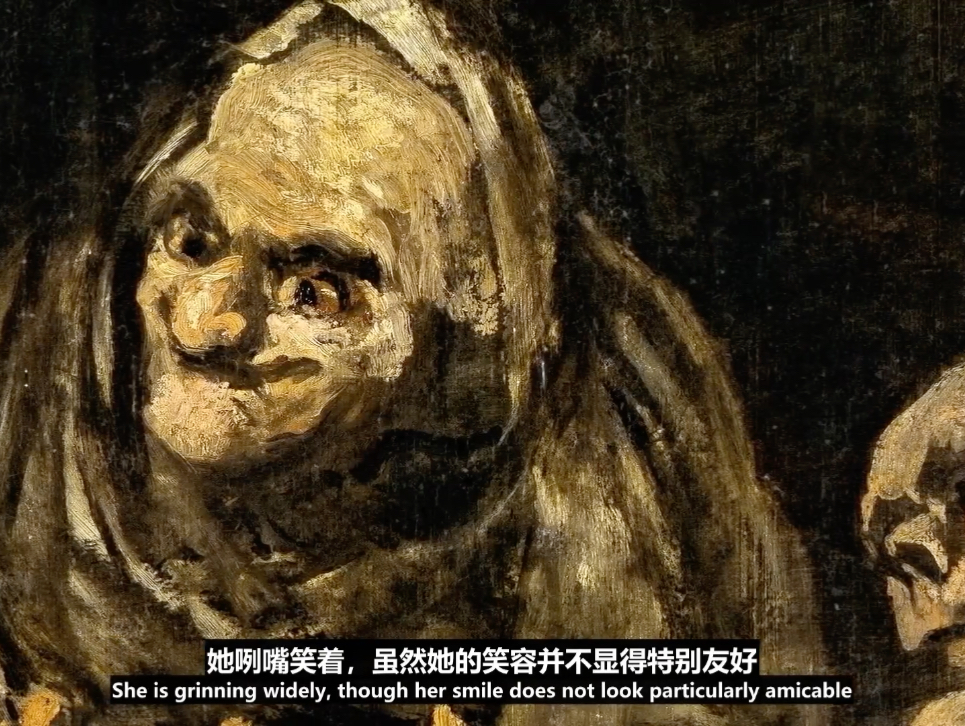
| 162 | and mythical to the mundane and even crass. | 和神话 对普通甚至疯狂。 |
| 163 | Two women and a man seems to depict a man masturbating to the mockery or humor of two | 两个女人和一个男人似乎 描绘一个男人自慰 嘲笑或幽默的两个人 |
| 164 | peasant women. | 农村妇女。 |
| 165 | Just like in Saturn and Sabbath, the painting is set against an ambiguous black background. | 和土星和安息日一样 画作的背景模糊不清 |
| 166 | The scene could be playing out anywhere at all. | 这个场景可能在任何地方游玩 |
| 167 | Goya has disfigured all of the faces. | 戈雅把所有的脸都毁容了 |
| 168 | Whether they are jovial, embarrassed, or something else entirely, they have become | 不管他们是快乐的,尴尬的,还是其他的, 他们变成了 |
| 169 | grotesque and horrific depictions of human emotion. | 人类情感的怪异恐怖描绘 |
| 170 | There is also two friars, which seems to depict a monk alongside some vaguely bestial figure. | 也有两只怪兽,它们似乎描绘了一位僧侣与一些模糊的骨骼人物。 |
| 171 | While the bearded figure looks contemplative and receptive in the painting as it exists | 虽然胡须的身材看起来很古板 并且能接受现存的画作 |
| 172 | today, this is a result of changes during the restoration process. | 今天,这是在恢复过程中变化的结果。 |
| 173 | In early photos of the paintings on Goya's walls, the bearded man seems dark, brooding, | 在戈雅墙上的画作的早期照片中, 胡子男看起来很黑,很结实, |
| 174 | and even standoffish. | 甚至是僵持。 |
| 175 | The whispering figure has been better preserved. | 耳语人物保存得更好. |
| 176 | He barely looks human. | 他几乎不像人类 |
| 177 | Some historians have suggested him as a metaphor for time or death itself. | 一些历史学家建议他作为时间或死亡本身的比喻. |
| 178 | One of the most mysterious paintings of the series is Two Old People Eating. | 该系列最神秘的绘画之一是"两老吃". |
| 179 | Historians do not know where this was painted in the home, nor do they entirely understand | 历史学家不知道这幅画是在哪里画的 他们也不完全明白 |
| 180 | what is going on in the painting. | 画里发生了什么 |
| 181 | The work shows two figures, one holding a spoon who seems to be a woman. | 作品显示两个数字,一个拿着一个似乎是一个女人的勺子. |
| 182 | She is grinning widely, though her smile does not look particularly amicable. | 虽然她的微笑看起来并不特别友好, |
| 183 | The other figure looks on if he is even alive at all. | 另一个人看他是否还活着 |
| 184 | Here we have what would be a charming domestic scene, two elderly people having dinner morphed | 在这里,我们有一个迷人的 家庭场景, 两个老人 吃晚饭 |
| 185 | into the grotesque. | 进入迷幻的境界。 |
| 186 | What is this lady pointing at? | 这位女士指什么? |
| 187 | Why is she smiling if she is accompanied by a dead body or a dying man? | 为什么她要笑,如果她被一个死尸或一个垂死的男人陪伴的话? |
| 188 | This work reflects Goya's tendency with the black paintings. | 本作反映了戈雅与黑画的倾向. |
| 189 | Where many artists look for the beautiful in the commonplace, Goya seemed obsessed with | 在很多艺术家寻找 美丽在常见, 戈雅似乎痴迷 |
| 190 | finding darkness in everyday minutia. | 发现黑暗的日常小屋。 |
| 191 | The Pilgrimage to San Ysidro is particularly compelling. | 朝圣至圣伊西德罗特别有说服力. |
| 192 | It shows a scene that Goya had already painted once in his life, but his previous depiction | 显示戈雅一生中已经画过一次的场景 但他之前的描绘 |
| 193 | of San Ysidro offered bright colors, beautiful fashions, and a sense of serenity. | 圣伊西德罗提供了明亮的颜色 美丽的时尚 和宁静的感觉 |
| 194 | There is anything but serenity in this one, however. | 然而,除了平静之外,还有任何其他事情。 |
| 195 | Historians believe the painting depicts a festival called Saturnalia. | 历史学家认为这幅画描绘了一个名为"土星利亚"的节日. |
| 196 | This festival, though, is a merry, bright occasion. | 这个节日,虽然,是一个快乐,光明的时刻。 |
| 197 | Goya has instead given it a characteristic, unrelenting bleakness. | 戈雅反而赋予它一个特征,无情的凄凉. |
| 198 | The figures in this painting do not show celebration, but instead immense despair and distress. | 这幅画中的数字并不表示庆祝,而是表现出巨大的绝望和痛苦。 |
| 199 | With an atropos, Goya returns to the heavenly. | 以阿tro多罗三藐三菩提回向天. |
| 200 | This painting depicts the three fates, Clotho, Lachesis, and Atropos. | 这幅画描绘了克洛索,拉切西斯,阿特罗波斯这三种命运. |
| 201 | These divine figures are daughters of the night, said to grant man access to good and | 这些神圣的人物是夜之女,据说是让人类获得善良, |
| 202 | evil. | 邪恶 |
| 203 | But Goya has not painted them with the reverence traditionally given towards the gods. | 但戈雅并没有用传统上对神的尊敬来描绘他们. |
| 204 | They are gnarled and disfigured as they carry away a fourth body through the sky. | 它们被咬伤和毁容 因为它们从天空中带走了第四具尸体 |
| 205 | Certainly, the most heartbreaking of the black paintings is The Drowning Dog, again only | 当然,最令人心碎的黑色绘画 是溺水狗,再次只有 |
| 206 | titled so much after Goya's death. | 戈雅死后 被冠名如此之多 |
| 207 | In fact, this particular painting has been assigned a number of titles. | 事实上,这幅特别的画被赋予了一些标题. |
| 208 | These include The Dog, Head of a Dog, The Buried Dog, The Half-Drowned Dog, and The | 其中包括"狗","狗的头","埋藏的狗","半醉的狗"和"狗". |
| 209 | Half-Submerged Dog. | 半淹狗(原变种). |
| 210 | I personally find this painting to be immensely distressing. | 我个人觉得这幅画令人非常痛苦。 |
| 211 | The more we stare at the scene, the harder it becomes to look. | 我们越是盯着现场看 就越难看 |
| 212 | Many art historians have taken the work as depicting a losing battle, the dog against | 许多艺术史学家认为这部作品描绘了一场输掉的战役,狗反对 |
| 213 | this sloped, large, dark mass. | 这个斜坡,大,暗的质量。 |
| 214 | The dog is perhaps human, futile, posed against humanity, the individual defeated by the world. | 狗或许是人,是徒劳的,是对人类,即被世界打败的个人提出的。 |
| 215 | I think of this painting as a thesis statement for the black paintings. | 我认为这幅画是黑画的论文 |
| 216 | Goya is the dog, isolated and nearing the end of his life and defeated by forces far, | 戈雅是狗, 孤立和接近他的末日 并被部队击败, |
| 217 | far outside of his control. | 远远超出他的控制。 |
| 218 | Death was coming. | 死亡即将来临。 |
| 219 | Goya knew this, and there was nothing he could do to stop it. | 高雅知道这一点,没有他能阻止的. |
| 220 | The forces of the world, the slopes, were unrelentingly pushing into him. | 世界的力量,斜坡, 无情地推进他。 |
| 221 | He was drowning. | 他淹死了。 |
| 222 | Although it is tempting to force blunt interpretations onto these or any paintings, the works are | 虽然强迫这些或任何绘画作上粗略的解释是诱人的,但作品是 |
| 223 | mysterious and vague. | 神秘而模糊 |
| 224 | The black paintings may not be one-to-one depictions of scenes, scenarios, or stories. | 黑画可能不是一对一描绘场景,情景,或故事. |
| 225 | They are instead reflective of Goya's spirit. | 相反,它们反映了戈雅的精神。 |
| 226 | Likewise, examining these paintings is more an act of the soul than one of the mind. | 同样,审视这些画作,与其说是一种心灵的行为,不如说是一种心灵的行为. |
| 227 | So perhaps we should turn to Goya's soul for our closest approximation at understanding | 所以也许我们该找Goya的灵魂 来做我们最接近的理解 |
| 228 | his work. | 他的功劳。 |
| 229 | The most blunt and shallow assessment of Goya weaves tales of a descent into madness. | 对Goya编织的疯狂故事 最直率和浅浅浅的评价 |
| 230 | But look at what this artist has given humanity. | 看看这位艺术家给人类带来了什么。 |
| 231 | Certainly Goya deserves a more nuanced conversation. | 当然,戈雅值得更细致的交谈。 |
| 232 | Certainly he deserves some empathy. | 当然他值得同情 |
| 233 | For this conversation, we can look to factors both external and internal. | 对于这次对话,我们可以研究内外因素。 |
| 234 | Ferdinand VII, the ruling monarch in Spain, would be a good place to start. | 斐迪南七世是西班牙的统治君主,这将是一个良好的开端. |
| 235 | Often called Spain's worst king, Ferdinand was a short-sighted tyrant who lacked courage, | 费迪南德经常被称为西班牙最差的国王, 是个短视的暴君,缺乏勇气, |
| 236 | constitution, and competence. | 宪法和权限。 |
| 237 | His reign was marked by oppression, specifically the oppression of ideas which Goya himself | 他统治的标志是压迫,特别是压迫戈雅本人的思想 |
| 238 | held dear to his heart. | 紧紧地抱着他的心 |
| 239 | Ferdinand had no interest in the well-being of his people, his court was rife with corruption, | 斐迪南对人民的福祉毫无兴趣 他的宫廷充满腐败 |
| 240 | and the king dreadfully mismanaged Spain's overseas colonies. | 国王对西班牙的海外殖民地管理不当 |
| 241 | As we already mentioned, Ferdinand ultimately plunged Spain into civil war. | 正如我们已经提到的那样,斐迪南最终使西班牙陷入内战. |
| 242 | Even if Goya could have shut out political turmoil from his mind, he would not have found | 即使戈雅能把政治动荡从他的思想中排除出来 他也不会发现 |
| 243 | a safe place to retreat. | 一个安全的地方撤退。 |
| 244 | Goya was never in great health, mentally or physically. | Goya在精神上或身体上都从未处于良好状态。 |
| 245 | Most specifically, we can point to four distinct episodes of illness in 1777, 1787, 1819, and | 最具体地说,我们可以指出1777年,1787年,1819年的四起不同的疾病事件, |
| 246 | 1828. | 1828 (英语). |
| 247 | All of these incidents have been the subject of a wide range of speculation without any | 所有这些事件都曾受到广泛的猜测,没有受到任何怀疑。 |
| 248 | definite conclusions. | 肯定的结论。 |
| 249 | Goya's symptoms throughout his life were remarkably disparate. | 戈雅一生的症状非常不同 |
| 250 | The artist was plagued with temporary paralysis, partial blindness, depression, nausea, dizziness, | 艺术家暂时瘫痪 部分失明 抑郁 恶心 眩晕 |
| 251 | pain, and a general sense of sorrow. | 痛苦,和一般的悲伤感。 |
| 252 | Amid the varying diagnoses historians have offered for Goya, Laura L. Casey points to | 在历史学家为戈雅提出的不同诊断中,劳拉·L·凯西指出: |
| 253 | Occam's razor in her paper, Goya in Sickness and in Health. | 奥卡姆的剃须刀在她的论文,Goya 在疾病和健康。 |
| 254 | She argues that we should accept the most obvious and most simple explanation. | 她认为,我们应该接受最明显和最简单的解释。 |
| 255 | All of these symptoms, with the sole exception of his deafness, are characteristic of somatic | 所有这些症状,除了他的耳聋之外,都是身体的特征 |
| 256 | depression. | 抑郁症。 |
| 257 | That is, depression which affects the body instead of only the mind. | 也就是说,抑郁症会影响身体,而不只是心灵。 |
| 258 | In one famous etching, entitled The Sleep of Reason Produces Monsters, we can find some | 在一个著名的刻画中, 题为“理性的沉睡”的怪物, 我们可以找到一些 |
| 259 | evidence for Casey's conclusion. | 凯西的结论的证据 |
| 260 | The work shows a figure, often believed to be Goya himself, plagued by beasts and demons | 这部作品展示了一个人物,经常被认为是戈雅本人,被野兽和恶魔所困扰. |
| 261 | as he leans onto a table, his hands attempting to shield himself from these torments. | 当他靠在桌子上时 他的双手试图保护自己免受这些折磨 |
| 262 | The work is likely an allegory for Spanish society at the time, but Goya's life also | 这部作品对当时的西班牙社会来说可能是一个寓意,但戈雅的一生也一样. |
| 263 | provides a number of incidents that could certainly catapult the individual towards | 造成一些事件,肯定会将个人推向 |
| 264 | severe depression. | 严重的抑郁症。 |
| 265 | In 1773 Goya married Maria Josefa, who was well connected to the royal family. | 1773年,戈雅嫁给了与王室关系良好的玛丽亚·何塞法. |
| 266 | Goya knew that he had political views the royals would see as troublesome, but he also | 高雅知道,他有 政治观点 皇室会认为麻烦, 但他也 |
| 267 | had no interest in abdicating his opinions. | 无意放弃他的意见。 |
| 268 | So today, historians believe his marriage carried ulterior motives. | 所以今天,历史学家相信他的婚姻带有别有用心的动机. |
| 269 | By having the support of a well-to-do family, Goya could paint and express his feelings | 戈雅可以画画表达他的感受 |
| 270 | without the immediate danger of retribution. | 没有立即报复的危险。 |
| 271 | Of course, such a marriage would create tension. | 当然,这种婚姻会造成紧张。 |
| 272 | Indeed, Goya and his wife had a lifelong relationship which was decidedly unhappy. | 事实上,Goya和他的妻子有一段终生的感情,这很不幸福。 |
| 273 | To compound this issue, Goya and his wife buried all but one of their children. | 使这个问题复杂化的是,戈雅和他的妻子除了一个孩子外,都埋葬了他们的孩子. |
| 274 | If the low estimates are true, Goya would have seen four of his children die. | 如果低估计是真实的,戈雅会看见他的四个孩子死去. |
| 275 | On the high end, as many as 19. | 在高端,多达19个。 |
| 276 | While Goya eventually arrived at a place of critical acclaim, this was not always the | 虽然Goya最终到达了一个备受赞誉的地方,但这并不总是 |
| 277 | case. | 案例。 |
| 278 | His early entries into the Spanish art world were met with rejection after rejection. | 他早期进入西班牙艺术界,在被拒绝后遭到拒绝. |
| 279 | The eventual arrival of Ferdinand VII would have also pushed the liberal Goya into disfavor, | 最终斐迪南七世的到来 也会让自由派的戈雅感到不满 |
| 280 | even if the king did not outwardly force any consequences on the artist. | 即使国王没有对艺术家施加任何后果 |
| 281 | All of these things were happening against a backdrop of devastating civil war. | 所有这些事情都是在毁灭性内战的背景下发生的。 |
| 282 | Civil war which was plaguing Goya's backyard, his day-to-day life. | 内战 困扰着戈雅的后院 他的日常生活 |
| 283 | These troubles would be enough to affect any given individual, surely, but as Casey points | 当然,这些麻烦足以影响任何个人 但正如凯西指出的 |
| 284 | out in her paper, an artist like Goya would have been uniquely sensitive to this turmoil. | 在她的报纸上,像Goya这样的艺术家 对这场动乱会特别敏感 |
| 285 | It is a safe generalization to say that artists are more susceptible to mood disorders than | 说艺术家更容易患上情绪紊乱,这很安全 |
| 286 | other members of the population. | 居民中的其他成员。 |
| 287 | Certainly the degree to which this is true ranges widely on a case-by-case basis. | 当然,在个案基础上,这种真实程度的范围很广。 |
| 288 | Artists are not always troubled and troubled people are not always artists, but as it so | 艺术家不是总有麻烦 麻烦的人不是总有艺术家,而是如此 |
| 289 | often happens, trouble and talent worked in tandem for Francisco Goya. | 经常发生,麻烦和才华为弗朗西斯科·戈亚协同工作. |
| 290 | Goya displayed an inherent and lifelong propensity towards heightened sensitivity. | 戈亚表现出一种固有的、终生的倾向,即提高敏感性。 |
| 291 | This enriched Goya's abilities as an artist, surely. | 这当然丰富了戈雅作为艺术家的能力. |
| 292 | Gifted with a greater awareness of his general environment and his own mind, Goya was inherently | 戈雅对自身环境及思想有了更深的认识 |
| 293 | better equipped to portray these landscapes, both mental and physical. | 更能描绘这些景观 无论是精神还是身体 |
| 294 | He could see colors of humanity that many of us cannot, but this talent was not always | 他可以看到人类的颜色 我们很多人都看不见 但这种才华并不总是 |
| 295 | to his well-being. | 为了他的福祉 |
| 296 | When Goya saw pain, he felt it magnified. | 当戈雅看到痛苦时,他感觉它放大了. |
| 297 | When he experienced pain, it fractured him. | 当他经历疼痛时,它使他骨折. |
| 298 | Goya's contemporaries recall that the artist regularly experienced bouts of violent outrage | Goya的同龄人回忆说,这位艺术家经常经历暴力暴行。 |
| 299 | after seeing injustices, suffering, and cruelties. | 在看到不公正、痛苦和残忍之后 |
| 300 | After his 1819 illness, Goya produced a painting called Self-Portrait with Dr. Arrieta. | 1819年病逝后,戈雅与阿里埃塔博士一起制作了一幅名为"自画像"的画. |
| 301 | This work shows his doctor holding Goya and offering him a tonic. | 这部作品显示他的医生持有戈雅,并给他提供通心粉. |
| 302 | The doctor here feels more like a priest offering Goya his last rites. | 这里的医生觉得更像是祭司祭祀戈雅的最后仪式. |
| 303 | While the painting was produced in a sort of thankful gesture, Goya long held disdain | 虽然这幅画是用一种感恩的姿态制作的,但戈雅长期以来一直持蔑视态度. |
| 304 | for medical professionals within Spain, and this was well justified. | 对西班牙的医疗专业人员来说,这是有道理的。 |
| 305 | During Goya's life there was a tradition of calling physicians matesanos, which translates | 在戈雅的一生中 有一种叫医生的传统 也就是翻译 |
| 306 | {\fn黑体\fs22\bord1\shad0\3aHBE\4aH00\fscx67\fscy66\2cHFFFFFF\3cH808080}对健康的杀手来说 {\fn黑体\fs22\bord1\shad0\3aHBE\4aH00\fscx67\fscy66\2cHFFFFFF\3cH808080}是的 | |
| 307 | Surgery in Spain took a form that basically resembled bloodletting. | 西班牙的外科手术形式 基本上类似于流血 |
| 308 | The Spanish Inquisition was also happening during Goya's life. | 西班牙宗教裁判所也发生在戈雅生前. |
| 309 | Within this context, physical maladies were caused not by physical conditions, but instead | 在这种情况下,身体疾病不是由身体条件造成的,而是由身体条件造成的。 |
| 310 | by spiritual, faith-based issues. | 由精神,信仰的问题。 |
| 311 | Any physician who divorced the physical from the metaphysical would have been essentially | 任何医生如果将身体与身体分离 基本上就是 |
| 312 | laughed out of their position. | 笑出他们的位置。 |
| 313 | And so towards the end of his days, Goya's life was in the hands of a system which he | 戈雅的性命就掌握在他手中了 |
| 314 | hated and which he rightfully saw as corrupt and misled. | 憎恶,而且公道地认为是堕落和迷误的。 |
| 315 | Consider this alongside a life which was marked by physical health crises. | 把这和身体健康危机一样 |
| 316 | With unending threats to his life and a medical system which seemed entirely incompetent, | 他的生命受到无休止的威胁 医疗系统似乎完全无能 |
| 317 | Goya's later years were marked by the looming threat of death. | 戈雅晚年的标志是濒临死亡的威胁. |
| 318 | He seemed certain that he would die if not Tuesday, then Wednesday, if not Wednesday, | 他似乎确信如果不是周二,如果不是周三,他会死 |
| 319 | then Thursday, that he had outlived his own life and that death would soon come to collect. | 然后周四 他活过了自己的生命 死亡很快就会降临 |
| 320 | When we consider these things, it is not just Goya's art that we unlock, but art itself | 当我们考虑这些事情时,不仅仅是戈雅的艺术 我们解锁,而是艺术本身 |
| 321 | and even humanity. | 甚至是人类 |
| 322 | At its very best, art is a direct communication from the soul. | 艺术是灵魂的直接交流 |
| 323 | It defies clumsy explanations. | 这违反了笨拙的解释。 |
| 324 | Goya's black paintings are perhaps the pinnacle of this. | 戈雅的黑色绘画或许是这个的顶峰. |
| 325 | We have no insight from the artist on the paintings. | 我们没有艺术家对画作的看法。 |
| 326 | They do not depict events which we can look to. | 它们没有描绘我们可以期待的事件。 |
| 327 | The material substance of the work is equally elusive. | 工作的实质同样难以捉摸。 |
| 328 | They are in horrible condition and have been editorialized almost shamelessly in places. | 他们处于可怕的状态,几乎无耻地被编辑。 |
| 329 | The black paintings defy mechanical explanation. | 黑色的绘画无视机械解释. |
| 330 | They always will. | 他们总是会的。 |
| 331 | With this in mind, it is very tempting to say that Goya just went mad in his countryside | 考虑到这一点,很诱人地说,戈雅刚在乡下发疯 |
| 332 | estate. | 资产。 |
| 333 | But this is incorrect. | 但这是不正确的。 |
| 334 | It is dismissive and for that, it is a cruel thing to say. | 这是一种冷酷无情的说法。 |
| 335 | When I was a child, I used to watch my grandfather build model airplanes. | 我小时候经常看爷爷造模型飞机 |
| 336 | These planes were the result of great care and labor and consideration and he used fine | 飞机是精心照顾、努力和体会的结果 他用得很好 |
| 337 | instruments and delicate tools to put them together. | 将这些文书和微妙的工具汇集在一起。 |
| 338 | Often when we classify people as crazy, we are just throwing parts into a pile and saying | 通常当我们把人归类为疯子时,我们只是把部分扔进一堆东西里说 |
| 339 | we've built an airplane. | 我们造了一架飞机 |
| 340 | We fail to realize that individual pieces have significance. | 我们未能意识到,个别作品具有意义。 |
| 341 | This plank is a wing, this glass is a cockpit, this plastic is the propeller. | 这个木板是翼,这个玻璃是驾驶舱,这个塑料是螺旋桨. |
| 342 | If we choose to neglect these significances and choose to think without care, certainly | 如果我们选择忽视这些意义 选择不小心思考,当然 |
| 343 | that is a fault of our own rather than of the model itself. | 那是我们自己的错,而不是模型本身的错。 |
| 344 | So too are the feelings and experiences of the individual. | 个人的感情和经验也是如此。 |
| 345 | Francisco Goya was a strong man, sensitive and strong. | 弗朗西斯科·戈亚是一个强壮的人,敏感而强壮. |
| 346 | Goya absorbed events in the world around him. | 戈雅吸收了他周围世界的事件. |
| 347 | He felt pain and he acted in a way that was honest to himself. | 他感到痛苦,他的行为方式是诚实的。 |
| 348 | Our inability to build this airplane, our inability to empathize, does not make Francisco | 我们无法建造这架飞机 我们无法同情弗朗西斯科 |
| 349 | Goya a crazy person. | 戈雅是个疯子 |
| 350 | His legacy should not be embellished by romantic vague notions of an artist driven to madness. | 他的遗产不应该被一个被逼疯的艺术家的浪漫模糊概念所装饰. |
| 351 | Instead, Goya and his work exist as profound reflections of the human condition, both internal | 相反,戈雅和他的作品是对人类状况的深刻反映,无论是内部还是内部的。 |
| 352 | and external. | 和外界。 |
| 353 | This is a gift he has given us and one that we would do well to repay. | 这是他赐给我们的礼物,也是我们该报答的礼物。 |
该视频共有字幕 353 条。解锁更多字幕为会员功能,请移动到 价格