海德格尔论焦虑与此在|Ellie Anderson
共 2 集
剧集目录
| 集 | 标题 | 时长 |
|---|---|---|
| P1 | 海德格尔论焦虑与此在|Ellie Anderson 上 | 5:49 |
| P2 | 海德格尔论焦虑与此在|Ellie Anderson 下 | 7:08 |
P1 · 海德格尔论焦虑与此在|Ellie Anderson p01 上 (P1)
字幕摘录
| 时间 | 英文 | 中文 |
|---|---|---|
| 0:00 | We're often encouraged to think about anxiety as a particular state of mind or even a disorder | 我们经常被鼓励 将焦虑视为一种特殊的精神状态 甚至一种障碍 |
| 0:06 | from which some people suffer. | 有些人会因此而受苦。 |
| 0:08 | The two readings from Heidegger this week offer a profoundly | 这周海德格尔的两篇读物 提供了深刻的 |
| 0:11 | different picture of anxiety. | 不同的焦虑画面。 |
| 0:14 | For Heidegger, anxiety is a fundamental mood that discloses | 对于海德格尔来说 焦虑是一种基本情绪 揭示 |
| 0:19 | us in our very being. | 我们身处其中 |
| 0:21 | It's through anxiety that we find out who we are. | 正是通过焦虑才发现自己是谁. |
| 0:26 | Now why is this the case? | 为什么这样? |
| 0:27 | Well, for Heidegger, who we are is what he calls Dasein. | 对海德格尔来说 我们就是达辛 |
| 0:32 | Now you've encountered this word in doing | 现在你在做这个时遇到过这个词 |
展开字幕全文(83 条)
| 序号 | 英文 | 中文 |
|---|---|---|
| 1 | We're often encouraged to think about anxiety as a particular state of mind or even a disorder | 我们经常被鼓励 将焦虑视为一种特殊的精神状态 甚至一种障碍 |
| 2 | from which some people suffer. | 有些人会因此而受苦。 |
| 3 | The two readings from Heidegger this week offer a profoundly | 这周海德格尔的两篇读物 提供了深刻的 |
| 4 | different picture of anxiety. | 不同的焦虑画面。 |
| 5 | For Heidegger, anxiety is a fundamental mood that discloses | 对于海德格尔来说 焦虑是一种基本情绪 揭示 |
| 6 | us in our very being. | 我们身处其中 |
| 7 | It's through anxiety that we find out who we are. | 正是通过焦虑才发现自己是谁. |
| 8 | Now why is this the case? | 为什么这样? |
| 9 | Well, for Heidegger, who we are is what he calls Dasein. | 对海德格尔来说 我们就是达辛 |
| 10 | Now you've encountered this word in doing | 现在你在做这个时遇到过这个词 |
| 11 | the reading and if you haven't read Heidegger before, you're probably pretty confused about | 如果你以前没读过海德格尔的书 你可能会很困惑 |
| 12 | what it means. | 这是什么意思? |
| 13 | Dasein, D-A-S-E-I-N, is a German word that means existence. | 达塞因(Dasein,D-A-S-E-I-N)是一个德语单词,意为存在. |
| 14 | It's an interesting | 这很有趣 |
| 15 | word, however, and one that translators usually keep in German because it's a combination of two | 但是,一个词, 翻译通常用德语,因为它是两个的组合 |
| 16 | other German words. | 其他德语词。 |
| 17 | Da, which means there, and Sein, which means being. | 达,意思是那里 盛,意思是存在 |
| 18 | So Dasein is this word | 所以达辛是这个词 |
| 19 | for existence that literally means being there. | 因为存在意味着存在 |
| 20 | This is essential for Heidegger. | 这对海德格尔至关重要 |
| 21 | He plays a lot | 他经常弹琴 |
| 22 | with the literal meaning of this word because for him it shows that being is always being in the world, | 和这个词的字面意义 因为对于他来说,它显示 永远在世界上, |
| 23 | being in an environment, being there, being somewhere. | 在一个环境, 在那里,在某处。 |
| 24 | Existence is always already outside | 存在总是在外头 |
| 25 | of itself. | 自己来。 |
| 26 | To exist means to stand outside oneself in the sense that we have the capacity | 存在意味着我们有能力 站在自己之外 |
| 27 | to distance ourselves from our own existence and reflect on it. | 远离我们自己的存在,并思考它。 |
| 28 | I am able to ask questions such as | 我可以问诸如 |
| 29 | Who am I? | 我是谁? |
| 30 | and Why am I here? | 为什么我在这里? |
| 31 | But this ability to distance myself is rooted in my situatedness | 但这种自我疏远的能力 根植于我的定位 |
| 32 | in the world. | 在这个世界。 |
| 33 | I'm never fully distant or fully separate from my environment. | 我从来没有完全远离 或完全脱离我的环境。 |
| 34 | I'm always in | 我总是在 |
| 35 | relation to it. | 与此有关。 |
| 36 | Now anxiety discloses a fundamental way of relating to my environment and to my world. | 现在,焦虑揭示了一种与我的环境和世界有关的基本方式。 |
| 37 | And this way of relating is the mode of nothingness. | 这种联系方式是虚无模式。 |
| 38 | You may have sometimes found | 你有时会发现 |
| 39 | yourself going about your daily life, you know, doing your random activities, doing your work, | 自己去你的日常生活, 你知道,做你的随机活动, 做你的工作, |
| 40 | talking with friends, etc. | 与朋友交谈,等等。 |
| 41 | And then having a moment of catching yourself wondering Why am I here? | 然后,有一个时刻 抓住自己想知道为什么我在这里? |
| 42 | Or you find yourself suddenly experiencing a familiar word appearing unfamiliar, | 或者你突然发现自己 经历了一个熟悉的字 似乎不熟悉, |
| 43 | or you enter a place you've been to many times before but suddenly it seems different. | 或者你进入一个你去过很多次的地方 但突然间它似乎不同了 |
| 44 | It seems off. | 似乎脱了 |
| 45 | In these situations we get jolted out of our almost robotic habitual way of living | 在这种情况下,我们从我们几乎是机器人的 习惯生活方式中被唤醒 |
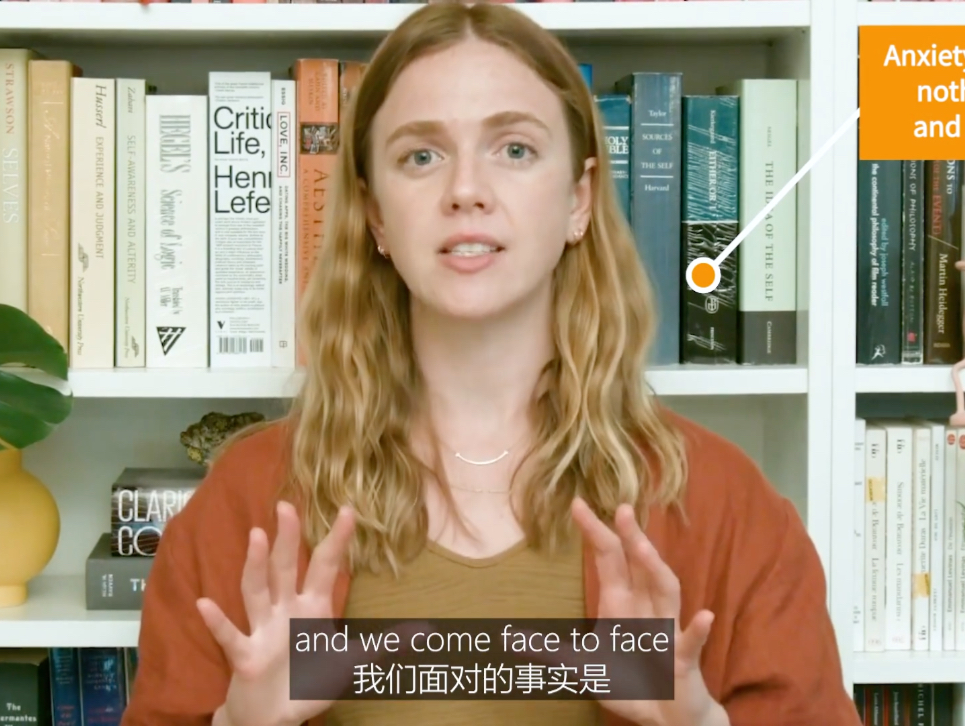
| 46 | and we come face to face with the fact that we exist in relation to that world, that we exist | 我们面对现实,即我们存在于这个世界中, |
| 47 | as freedoms in relation to that world. | 作为与世界相关的自由。 |
| 48 | This is the disclosure of the nothing for Heidegger. | 这是为海德格尔透露的 |
| 49 | So anxiety is that moment of being jolted out of your everyday way of living and seeing | 所以,焦虑是那一刻 被唤醒 从你的日常生活和看到 |
| 50 | that things are kind of funny. | 事情有点好笑。 |
| 51 | Oh, I'm expected to go to this meeting at 4pm. | 我下午4点要参加这个会议 |
| 52 | But I could not | 但我无法 |
| 53 | go to that meeting and it's up to me to go to that meeting and only me to go to that meeting. | 参加那次会议 得由我去参加那次会议 只有我去参加那次会议 |
| 54 | That is anxiety for Heidegger. | 这是海德格尔的焦虑 |
| 55 | Now, anxiety, he knows is something that it's not like we're | 现在,焦虑,他知道的东西 它不是我们 |
| 56 | experiencing it all the time, right? | 经常经历,对吧? |
| 57 | It's quite unpleasant to experience in many cases. | 在很多情况下都很难过 |
| 58 | And it's | 这是 |
| 59 | nice to go about our lives without a constant anxiety surrounding us, right? | 愉快地走过我们的生活 没有我们身边的持续焦虑,对不对? |
| 60 | There's a reason | 有个原因 |
| 61 | why people who experience anxiety constantly want to find some way to get out of that to resolve | 为何有焦虑经历的人 总是想想办法摆脱困境 |
| 62 | the州. | |
| 63 | And so it's not as if he's saying like, let's be anxious all the time. | 因此,这不是像他说, 让我们一直焦虑。 |
| 64 | He's acknowledging | 他承认 |
| 65 | that it only appears in certain contexts, but he says that certain contexts in which it appears | 但是他说,它出现在某些背景下 |
| 66 | actually reveal that anxiety was sort of there in a quiet, asleep state all along, because we are | 实际上,它揭示了 焦虑是那种 在一个安静的,睡眠状态 一直,因为我们是 |
| 67 | always free in relation to our environment. | 我们的环境总是自由的 |
| 68 | And we are always in a sense outside of ourselves, | 我们总是在某种意义上 我们自己之外, |
| 69 | having this unique relation to our world. | 与我们的世界有着独特的关系 |
| 70 | Anxiety for Heidegger is a peculiar experience | 对海德格尔的焦虑是一种特殊的经历 |
| 71 | of no longer feeling at home in the world. | 不再感觉 在家里的世界。 |
| 72 | But we can only no longer feel at home in the world if we | 但是,我们不能再感到 在世界上的家,如果我们 |
| 73 | already did feel at home in the world. | 已经感觉在世界上的家。 |
| 74 | So part of the beauty and anxiety is that by removing | 所以美和焦虑的一部分 就是通过去除 |
| 75 | our state of being at home in the world, we come to recognize that we were at home in the world to | 我们终于认识到 我们身处世界的家园 |
| 76 | begin with, in the same way that feeling a pinch in our shoe reveals to us and makes us appreciate | 开始,同样地, 感觉我们鞋里的一丝一毫 揭示给我们,让我们欣赏 |
| 77 | the comfort that we had before we had the pinch in our shoe. | 在鞋被捏伤之前的舒适感 |
| 78 | This state of not feeling at home | 这种感觉不在家里 |
| 79 | in the world is the German word Unheimlichkeit, which literally means unhomeliness, but is often | 世界上的德语词是 Unheimlichkeit, 字面意思是不体面,但往往是 |
| 80 | translated as uncanniness. | 译为无明. |
| 81 | When things feel uncanny, bizarre, strange, they are unhomely. | 当事物感到不可思议,奇异,奇异时,它们不在家。 |
| 82 | So you might reflect on an example in your own life of when you have felt the sort of dizziness | 所以,你可以思考一个例子 在你自己的生活,当你感觉 那种眩晕 |
| 83 | of nothingness, the dizziness of freedom, perhaps the dizziness of nothingness, the dizziness of | 无所事事 自由的眩晕 也许是无所事事的眩晕 |
该视频共有字幕 83 条。解锁更多字幕为会员功能,请移动到 价格
P2 · 海德格尔论焦虑与此在|Ellie Anderson p02 下 (P2)
字幕摘录
| 时间 | 英文 | 中文 |
|---|---|---|
| 0:00 | at home in the world to begin with. | 在家里的世界开始。 |
| 0:02 | In the same way that feeling a pinch in our | 同样的感觉 |
| 0:06 | shoe reveals to us and makes us appreciate the comfort that we had | 鞋向我们揭示 并让我们欣赏 我们的舒适 |
| 0:13 | before we have the pinch in our shoe. | 之前,我们有 夹在我们的鞋。 |
| 0:16 | This state of not feeling at home in the | 这种感觉 在家里 |
| 0:18 | world is the German word Unheimlichkeit which literally means unhomeliness but | 世界是德文词Unheimlichkeit 字面意思是不体面,但是 |
| 0:25 | is often translated as uncanniness. | 常被翻译为无魅力. |
| 0:29 | When things feel uncanny, bizarre, strange, | 当事情感到不可思议,奇怪,奇怪, |
| 0:34 | they are unhomely. | 他们不在家。 |
| 0:37 | So you might reflect on an example in your own life of when | 所以,你可以思考 在自己的生活中的一个例子 |
展开字幕全文(116 条)
| 序号 | 英文 | 中文 |
|---|---|---|
| 1 | at home in the world to begin with. | 在家里的世界开始。 |
| 2 | In the same way that feeling a pinch in our | 同样的感觉 |
| 3 | shoe reveals to us and makes us appreciate the comfort that we had | 鞋向我们揭示 并让我们欣赏 我们的舒适 |
| 4 | before we have the pinch in our shoe. | 之前,我们有 夹在我们的鞋。 |
| 5 | This state of not feeling at home in the | 这种感觉 在家里 |
| 6 | world is the German word Unheimlichkeit which literally means unhomeliness but | 世界是德文词Unheimlichkeit 字面意思是不体面,但是 |
| 7 | is often translated as uncanniness. | 常被翻译为无魅力. |
| 8 | When things feel uncanny, bizarre, strange, | 当事情感到不可思议,奇怪,奇怪, |
| 9 | they are unhomely. | 他们不在家。 |
| 10 | So you might reflect on an example in your own life of when | 所以,你可以思考 在自己的生活中的一个例子 |
| 11 | you have felt the sort of dizziness of nothingness, the dizziness of freedom. | 你感受到了虚无的眩晕 自由的眩晕 |
| 12 | Perhaps it came about when you realized that you could do things differently | 也许当你意识到 你可以做不同的事情 |
| 13 | than you have always done them. | 比你以前做过的还要多 |
| 14 | Perhaps you realize that the delimited set of | 可能你意识到 被划定的一组 |
| 15 | options that were given to you are not the only options there are and that you | 给您的选项并非唯一的选项 |
| 16 | could choose to do nothing or to do something entirely out of left field. | 可以选择什么都不做 或者做一些完全脱离左侧领域的事情 |
| 17 | In | 内 |
| 18 | a sense, the experience of nothingness that one encounters in anxiety is the | 一种感觉,一个人在焦虑中遇到的无所事事的经历是 |
| 19 | source of creativity. | 创造力的来源。 |
| 20 | Heidegger says that anxiety can evoke wonder and that it is | 海德格尔说,焦虑可以引起好奇,而且它是 |
| 21 | in alliance with creative longing and with cheerfulness even because that | 与有创意的渴望和欢乐结盟,即使因为 |
| 22 | moment of anxiety can cause us to sort of come into our own for the first time. | 焦虑的瞬间会让我们 第一次进入我们自己 |
| 23 | For Heidegger, anxiety is the fundamental mood of nothingness and | 对海德格尔来说 焦虑是无所事事的基本情绪 |
| 24 | nothingness paves the way for us to be able to become a self and to be able to | 虚无为我们成为自我和自我铺平了道路 |
| 25 | take up our own freedom. | 获得我们自己的自由。 |
| 26 | This is, for instance, one reason perhaps that a lot | 举例来说,这也许是很多 |
| 27 | of adolescents feel themselves anxious because they're emerging out of the | 青少年感到焦虑,因为他们正在走出 |
| 28 | acceptance of habitual ways of being in childhood but they're not yet at the | 接受在童年时期的习惯方式,但他们还没有进入 |
| 29 | place where they're accepting the status quo as adults. | 那里是他们接受现状的地方 |
| 30 | Those of you who've | 你们这些家伙 |
| 31 | studied existentialism before may hear some strong resonances with other | 在研究存在主义之前,可能听到一些与其他人的强烈共鸣 |
| 32 | thinkers and indeed even though Heidegger never called himself an | 虽然海德格尔从未自称 |
| 33 | existentialist, he is generally considered to be one. | 存在主义者,一般认为他是一个. |
| 34 | Those of you who | 你们这些 |
| 35 | studied existentialism will also know that practically nobody who was an | 研究的存在主义也会知道,实际上没有人是 |
| 36 | existentialist called themselves an existentialist except for Sartre and | 存在主义者自称存在主义者,除了萨特和 |
| 37 | Beauvoir. | 博沃伊尔。 |
| 38 | But in any case, this theme of nothingness as disclosing freedom and of | 但无论如何,这个无所事事的主题 揭示了自由 |
| 39 | anxiety as triggering that experience of nothingness is one that Heidegger takes | 海德格尔所经历的 |
| 40 | from previous existential thinkers such as Soren Kierkegaard, the 19th century | 19世纪的索伦·基尔凯加德 |
| 41 | Danish philosopher. | 丹麦哲学家. |
| 42 | Kierkegaard焦虑理论的一个要素 | |
| 43 | Heidegger picks up on in the text we're reading for today is the idea that | 海德格尔在今天我们阅读的文本中 提出这样的想法: |
| 44 | anxiety is different from fear. | 焦虑与恐惧不同。 |
| 45 | Fear has a determinant object. | 恐惧有一个决定性的物体。 |
| 46 | So I'm afraid of | 所以,我担心 |
| 47 | spiders or I'm afraid of heights or I'm afraid of vases. | 蜘蛛或者我怕高或者我怕花瓶 |
| 48 | In any case, those | 无论如何,这些 |
| 49 | determinant objects that fear has are what characterizes fear and we tend to | 恐惧的决定因素是恐惧的特征 我们倾向于 |
| 50 | flee things that we are afraid of. | 逃离我们害怕的东西。 |
| 51 | Anxiety has a very different relation to | 焦虑症与 |
| 52 | its object because anxiety doesn't have a determinant object. | 它的物体 因为焦虑没有决定性的物体。 |
| 53 | For Heidegger, it | 对于海德格尔来说 |
| 54 | doesn't actually make sense to say that you're anxious about something, right? | 说出你对某件事的焦虑是没有道理的 对吧? |
| 55 | To | 改为 |
| 56 | say you're anxious about an upcoming essay or about finding a job after | 说你很担心即将到来的论文 或者在之后找到工作 |
| 57 | college. | 大学。 |
| 58 | What you are actually anxious about is nothing. | 你其实很担心什么 |
| 59 | When you think you are | 当你觉得自己是 |
| 60 | anxious about finding a job after college, you are actually anxious about | 担心大学毕业后找工作 你其实很担心 |
| 61 | your own nothingness. | 你自己的虚无。 |
| 62 | The fact that you are a freedom. | 你是一个自由的事实。 |
| 63 | For Heidegger and for | 对于海德格尔和 |
| 64 | existentialists in general, freedom and nothingness are very closely interwoven. | 一般来说,自由与虚无是紧密交织在一起的。 |
| 65 | You are anxious about the fact that it must be you who takes on the task of | 你担心你必须承担 |
| 66 | finding the job, who gets the job, who shows up to the job. | 找到工作,谁得到工作,谁来上班。 |
| 67 | And so you're not | 所以你没有 |
| 68 | actually anxious about getting a job according to Heidegger so much as you | 和你一样急着找工作 |
| 69 | are anxious about your own nothingness in relation to the job. | 担心自己在工作上一无所有 |
| 70 | The fact that you | 你的事实 |
| 71 | could not find any job at all. | 根本找不到任何工作。 |
| 72 | The fact that you could not show up to the job on | 你无法来上班的事实 |
| 73 | the first day of work. | 工作第一天开始 |
| 74 | The fact that literally nothing is determining that | 事实上,什么也没有决定 |
| 75 | you will get a job. | 你会得到一份工作。 |
| 76 | You might have a lot of factors going in your favor, right? | 你可能会有很多因素 对你有利,对不对? |
| 77 | Graduating from an excellent college, having a couple of jobs and internships | 从一所优秀的大学毕业, 有一些工作和实习 |
| 78 | under your belt, having good grades, but none of those is determining that you'll | 在你的腰带下,有良好的成绩, 但没有一个 确定你会 |
| 79 | get a job. | 找个工作。 |
| 80 | They're just making it more likely. | 他们只是让它更可能。 |
| 81 | There is this profound gap or | 有一个巨大的差距,或者 |
| 82 | nothingness between the factors of yourself and your past history and your | 与你过去的历史和你的 |
| 83 | environment that are leading you towards getting a job and the actual job that | 环境 引导你找到工作 和实际的工作 |
| 84 | you may or may not get. | 你可能或不会得到。 |
| 85 | And that gap is nothingness. | 而那个差距是虚无的。 |
| 86 | It is your freedom, is the | 这是你的自由,是 |
| 87 | fact that nobody can live your life for you, can get the job for you. | 没有人能为你活下去 就能为你找到工作 |
| 88 | One way | 单程 |
| 89 | that Heidegger talks about this in other parts of being in time is that nobody | 海德格尔在其它时间里 谈论这个问题的是 没有人 |
| 90 | can die your own death for you. | 为你而死 |
| 91 | Even if somebody sacrifices themselves for you, | 即使有人为你牺牲自己 |
| 92 | they will still be dying their own death. | 他们仍然会自己死去 |
| 93 | Death individualizes us. | 死亡让我们个性化 |
| 94 | Anxiety | 焦虑 |
| 95 | individualizes us and it individualizes us not by making us into this entire | 使我们个性化,它让我们个性化 而不是把我们变成这个整体 |
| 96 | whole of here are all of your characteristics and qualities and you are | 这里的全部都是你的特质和品质 而你是 |
| 97 | defined by those, but it individualizes you by making you realize that you are | 由这些定义,但它使你个性化 通过让你意识到你是 |
| 98 | your own nothingness. | 你自己的虚无。 |
| 99 | You are your own freedom. | 你属于你自己的自由。 |
| 100 | And although this might sound | 虽然这听起来 |
| 101 | pretty scary, it involves quite a lot of responsibility, right? | 非常可怕,这涉及到很多责任,对不对? |
| 102 | Heidegger suggests | 海德格尔建议 |
| 103 | that anxiety brings with it a certain kind of calm because it means that we are | 焦虑带来某种平静 因为这意味着我们 |
| 104 | no longer fleeing. | 再也不会逃跑了 |
| 105 | When we come face to face with something that we're afraid of, | 当我们面对面面对 我们害怕的东西, |
| 106 | our instinct is often to flee it. | 我们的本能就是逃离它 |
| 107 | But because anxiety has no determinate object, | 但因为焦虑没有确定的目标, |
| 108 | if we rest in it, we're actually resting in nothingness. | 如果我们在其中休息, 我们实际上休息 在虚无。 |
| 109 | That for Heidegger can | 对于海德格尔可以 |
| 110 | bring about a sense of peace and repose and acceptance of the nothingness that we | 带来和平感 安息和接受 我们的虚无 |
| 111 | are. | 对 |
| 112 | Of the fact that as much as our environments are buoying us up and in some | 尽管我们的环境 正在把我们提升和一些 |
| 113 | cases pressing us down, they are also not the whole story. | 案件让我们失望, 他们也不是整个故事。 |
| 114 | Yes, we are Dasein. | 是的 我们是达辛 |
| 115 | We are being in the world, but we are also in a very important sense, nothing. | 我们正在世界,但我们在非常重要的意义上却一无所有。 |
| 116 | We are freedom. | 我们是自由。 |
该视频共有字幕 116 条。解锁更多字幕为会员功能,请移动到 价格