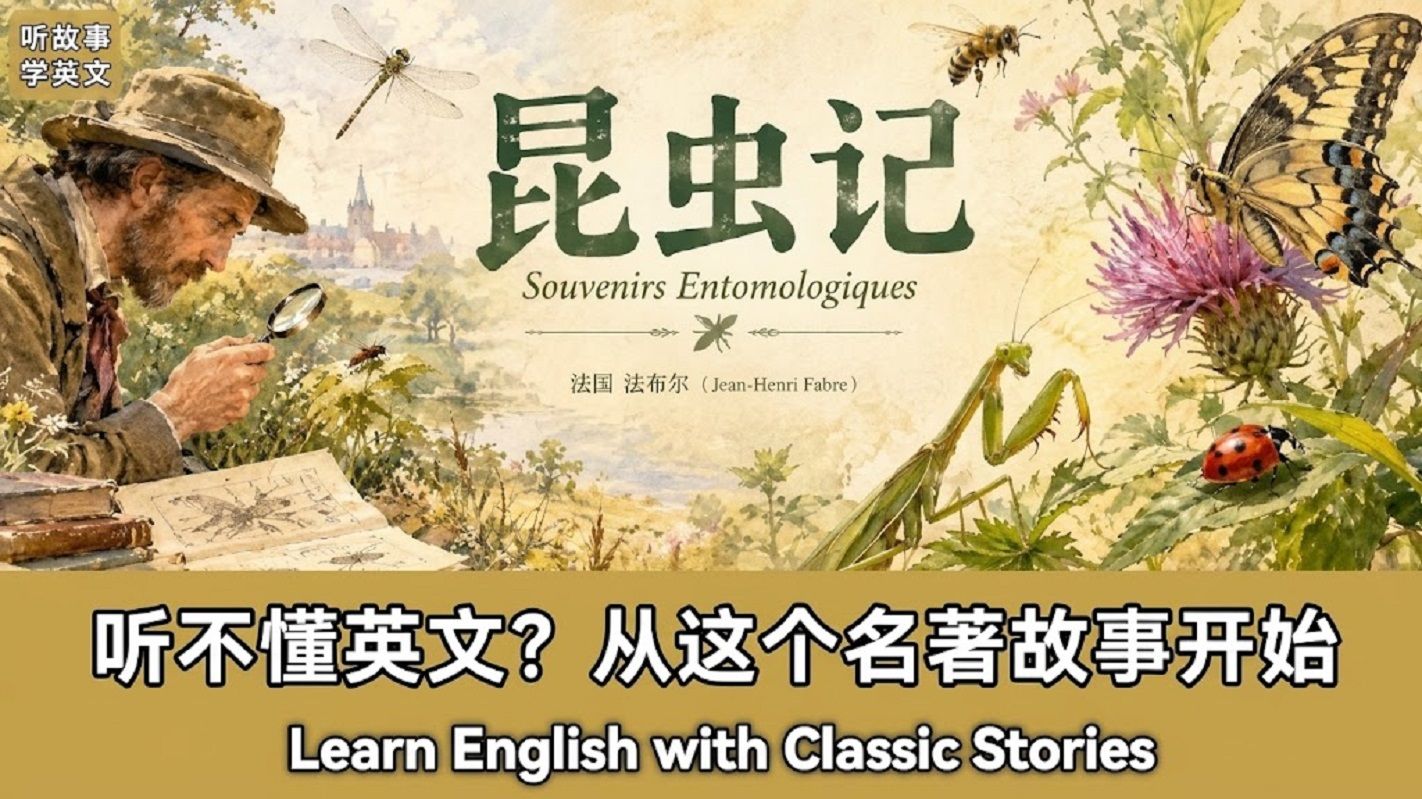
昆虫记|英文故事|听故事学英文|英文听力练习|睡前英文故事|
字幕摘录
| 时间 | 英文 | 中文 |
|---|---|---|
| 0:00 | The Story of Insects | 昆虫的故事 |
| 0:03 | In a quiet part of southern France, there was an old house surrounded by dry fields, | 在法国南部一个安静的地方, 有一个老房子被干燥的田地包围着, |
| 0:11 | bushes, trees, and wildflowers. | 灌木丛 树木 野花 |
| 0:16 | It was not a rich place, and it was far from the busy | 这不是一个富有的地方, 它远离繁忙 |
| 0:20 | streets of a large city. | 一个大城市的街道。 |
| 0:23 | But to a man named Jean-Henri Faubre, it was a wonderful world. | 但对于一个叫让-亨利·福布雷的人来说,这是一个美妙的世界. |
| 0:30 | Faubre loved insects. | 福布雷喜欢昆虫. |
| 0:33 | Other people might walk across the field and see only grass, | 其他人可能走过田野 只看到草, |
| 0:37 | stones, and a few flowers. | 石头和几朵花 |
| 0:40 | Faubre saw hundreds of small lives moving around him. | 福布雷看见数百条小生命围绕他移动. |
展开字幕全文(285 条)
| 序号 | 英文 | 中文 |
|---|---|---|
| 1 | The Story of Insects | 昆虫的故事 |
| 2 | In a quiet part of southern France, there was an old house surrounded by dry fields, | 在法国南部一个安静的地方, 有一个老房子被干燥的田地包围着, |
| 3 | bushes, trees, and wildflowers. | 灌木丛 树木 野花 |
| 4 | It was not a rich place, and it was far from the busy | 这不是一个富有的地方, 它远离繁忙 |
| 5 | streets of a large city. | 一个大城市的街道。 |
| 6 | But to a man named Jean-Henri Faubre, it was a wonderful world. | 但对于一个叫让-亨利·福布雷的人来说,这是一个美妙的世界. |
| 7 | Faubre loved insects. | 福布雷喜欢昆虫. |
| 8 | Other people might walk across the field and see only grass, | 其他人可能走过田野 只看到草, |
| 9 | stones, and a few flowers. | 石头和几朵花 |
| 10 | Faubre saw hundreds of small lives moving around him. | 福布雷看见数百条小生命围绕他移动. |
| 11 | A beetle was digging under the ground. | 有只甲虫在地底下挖东西 |
| 12 | A bee was looking for food. | 一只蜜蜂正在寻找食物。 |
| 13 | A cicada was singing from a tree. | 一只Cicada在树上唱歌 |
| 14 | A wasp was flying low over the grass, searching for a place to build its nest. | 一只黄蜂在草地上低飞 寻找筑巢的地方 |
| 15 | Faubre did not want to study insects only by looking at dead bodies in a box. | Faubre不想只通过在盒子里看死尸来研究昆虫. |
| 16 | He wanted to | 他想这样 |
| 17 | see how they lived. | 看看他们是怎么生活的。 |
| 18 | So he spent many hours outside. | 他在外面待了好几个小时 |
| 19 | He watched them closely. | 他密切注视着他们 |
| 20 | He waited quietly. | 他静静等待。 |
| 21 | Sometimes he waited for a whole morning just to see one small insect do something important. | 有时候他等了整整一个上午 才看到一只小昆虫做了重要的事 |
| 22 | One summer morning, Faubre was walking across a dry field when he noticed a black beetle | 一个夏天的早晨, 福布雷走过一个干燥的田地 当他注意到一只黑甲虫 |
| 23 | moving along the ground. | 沿着地面移动。 |
| 24 | It was a dung beetle. | 那是只粪便甲虫 |
| 25 | The beetle was working hard. | 这只甲虫很努力 |
| 26 | It found a piece of dung, | 它发现了一块粪便, |
| 27 | cut off a small part, and began to shape it. | 剪掉了一小部分,开始塑造它。 |
| 28 | Slowly the beetle made a ball. | 慢慢的甲虫做了一个球。 |
| 29 | Faubre watched with interest. | 福布雷很感兴趣地观看. |
| 30 | The beetle pushed the ball with its back legs. | 甲虫用后腿推球. |
| 31 | The ball was much | 球很厉害 |
| 32 | larger than the beetle itself, but the little animal did not stop. | 比甲虫本身大 但小动物并没有停止 |
| 33 | It pushed and pushed across | 它推和推过 |
| 34 | the hard ground. | 坚硬的地面。 |
| 35 | Sometimes the ball moved in a straight line. | 有时球会直线移动. |
| 36 | Sometimes it went the wrong way. | 有时走错路了 |
| 37 | The beetle would stop, climb onto the ball, look around, and then begin again. | 甲虫会停下来,爬上球,看看周围,然后重新开始。 |
| 38 | Faubre noticed something strange. | Faubre发现了一些奇怪的东西。 |
| 39 | The beetle often seemed to know where it was going, | 甲虫似乎经常知道它要去哪里, |
| 40 | even though there were no roads or signs in the field. | 即使田里没有道路和标志 |
| 41 | He continued watching. | 他继续监视。 |
| 42 | The beetle finally reached a good place. | 甲虫终于到达了一个好地方. |
| 43 | It began to dig a hole in the ground. | 它开始在地上挖洞. |
| 44 | Then | 礛 |
| 45 | it pushed the ball toward the hole and pulled it inside. | 它把球推到洞里 把它拉进去 |
| 46 | This was not simply a ball of food. | 这不仅仅是一个食物球。 |
| 47 | The beetle had a plan. | 甲虫有一个计划。 |
| 48 | Deep in the ground, the female would use the food to prepare a | 在地下深处,雌性会利用食物准备 |
| 49 | safe place for her young. | 安全的地方她年轻。 |
| 50 | She would make a small chamber and shape the dung carefully. | 她会做一个小房间 并精心塑造粪便。 |
| 51 | Then she would lay an egg there. | 然后她会在那里下蛋。 |
| 52 | When the young beetle came out, it would have food waiting for | 当小甲虫出来时,它会有食物等着 |
| 53 | it. | 这个 |
| 54 | Fabre was fascinated by this small world hidden beneath the ground. | 法布尔被隐藏在地下的这个小世界迷住了. |
| 55 | The beetle did not | 甲虫没有 |
| 56 | have human hands, tools, or words. | 有人类的手,工具,或言语。 |
| 57 | Yet it could build, carry, dig, and prepare a home for the | 然而,它可以建造、携带、挖掘和准备一个家园,供 |
| 58 | next generation. | 下一代。 |
| 59 | The more Faubre watched insects, the more he understood that their lives were not | Faubre越看昆虫 他就越明白他们的生活不是 |
| 60 | simple as people often imagined. | 就像人们常想的那样简单 |
| 61 | Another insect soon caught his attention. | 另一只昆虫很快引起了他的注意. |
| 62 | It was a cicada. | 是个卡达 |
| 63 | On hot summer days, the trees seemed to be full of their loud songs. | 在炎热的夏日,树似乎充满了他们的响亮的歌曲. |
| 64 | The sound was so strong that | 声音是如此强烈,以至于 |
| 65 | it filled the whole field. | 它填满了整个球场。 |
| 66 | But Faubre knew that the cicada's life did not begin in the trees. | 但是,福布雷知道西卡达的生活并没有从树上开始. |
| 67 | For a long time, the young cicada lived underground. | 在很长一段时间里,年轻的Cicada生活在地下. |
| 68 | One day, Faubre saw a small hole in the soil. | 一日,浮伯见土小洞. |
| 69 | He waited near it. | 他在附近等着 |
| 70 | After some time, a young cicada | 过了一段时间,一个年轻的Cicada |
| 71 | came out. | 出来 |
| 72 | It looked very different from the adult insect. | 它看起来与成年昆虫大不相同. |
| 73 | It slowly climbed up a plant. | 它慢慢爬上一个植物。 |
| 74 | Then it stopped. | 后来就停了 |
| 75 | Its back began to split. | 它的背部开始分裂. |
| 76 | A new cicada slowly came out of the old skin. | 一个新的cicada 慢慢地从老的皮肤中出来。 |
| 77 | The insect rested while its new body became stronger. | 昆虫休息,而它的新身体却变得更加强大。 |
| 78 | Faubre watched the change with great care. | Faubre非常小心地观看了这个变化. |
| 79 | The loud singer of summer had spent a long | 夏天的响亮歌手花了很长时间 |
| 80 | part of its life hidden beneath the earth. | 它的一部分生命隐藏在地下 |
| 81 | People usually noticed only the adult cicada. | 人们通常只注意到成年的cicada. |
| 82 | They heard its song and thought of hot summer afternoons. | 他们听到它的歌声,想到炎热的夏天下午. |
| 83 | But Faubre knew there was another | 但福布雷知道还有另一个 |
| 84 | life underneath their feet. | 他们脚下的生命 |
| 85 | A long and quiet life that most people never saw. | 长而安静的生活 大多数人从来没有见过。 |
| 86 | The field was full | 球场满了 |
| 87 | of such secrets. | 这些秘密。 |
| 88 | One afternoon, Faubre saw a large wasp flying close to the ground. | 一天下午,福布雷看到一只大型黄蜂在靠近地面的地方飞行. |
| 89 | It was searching carefully among the plants. | 它正在植物中仔细搜寻 |
| 90 | The wasp was not looking for flowers. | 黄蜂不是在找花 |
| 91 | It was hunting. | 这是狩猎。 |
| 92 | After a while, it found a grasshopper. | 过了一段时间,它发现了一只 grass. |
| 93 | {\fn华文楷体\fs16\1cHE0E0E0}但是黄蜂... | |
| 94 | fast. | 快点 |
| 95 | It attacked and used its sting. | 它攻击并使用了它的刺。 |
| 96 | Faubre knew that this was not simply an act of killing. | Faubre知道这不仅仅是杀人行为。 |
| 97 | The wasp needed the grasshopper for its young. | 黄蜂年轻时需要草hopper |
| 98 | The wasp carried the grasshopper away | 黄蜂把 grass子带走了 |
| 99 | and disappeared into the ground. | 并消失在地上。 |
| 100 | Faubre followed as closely as he could. | 福布雷尽可能的紧跟其后. |
| 101 | Inside the nest, the wasp had prepared a small underground room. | 在巢穴里 黄蜂准备了一个小的地下房间 |
| 102 | It placed the grasshopper there. | 它把 grass放在那里。 |
| 103 | Then it laid an egg beside the insect. | 然后在昆虫旁边产了一个鸡蛋 |
| 104 | The grasshopper was still alive. | 草庵犹在. |
| 105 | Faubre found this part especially interesting. | 福布雷觉得这个角色特别有趣. |
| 106 | The wasp did not kill its prey immediately. | 黄蜂没有立即杀死猎物。 |
| 107 | Instead, its sting affected the grasshopper so that the animal could no longer move normally. | 相反,它的刺影响了草hopper,使得动物不再能正常移动. |
| 108 | For the wasp's young, this was useful. | 对于黄蜂的年轻,这是有用的。 |
| 109 | When the egg hatched, | 当鸡蛋孵化, |
| 110 | the small larva would have fresh food waiting beside it. | 小幼虫在旁边有新鲜的食物 |
| 111 | The mother wasp then closed the nest and left. | 母黄蜂随后关闭巢穴离开. |
| 112 | She did not stay to care for her young. | 她没有留下来照顾她的年轻。 |
| 113 | The tiny larva would grow alone, eating the food prepared before it was born. | 细小的幼虫会独自生长,吃它出生前准备的食物. |
| 114 | Faubre watched similar wasps many times. | 福布雷多次观看类似的黄蜂. |
| 115 | Each time the small hunter seemed to follow a careful | 每次小猎人都小心翼翼 |
| 116 | method. | 方法。 |
| 117 | Yet insects were not always successful. | 然而昆虫并不总是成功的。 |
| 118 | Sometimes Faubre changed something in the | 有时福布雷会有所改变 |
| 119 | environment to see what the insect would do. | 以观察昆虫会做什么 |
| 120 | He wanted to know whether an insect truly understood | 他想知道昆虫是否真正理解 |
| 121 | what it was doing or simply followed a fixed instinct. | 它正在做什么或只是 遵循固定的本能。 |
| 122 | One of the most interesting insects | 最有趣的昆虫之一 |
| 123 | he observed was the specks, a kind of hunting wasp. | 他观察到的是斑点 一种猎蜂 |
| 124 | The specks could find prey, attack it, | 斑点可以找到猎物 攻击它 |
| 125 | carry it to a nest, and place it in exactly the right position. | 把它带到一个巢穴, 并把它放在正确的位置。 |
| 126 | Faubre once watched a specks dragging its prey toward its nest. | Faubre曾经看到一个斑点 将猎物拖向它的巢穴。 |
| 127 | When it reached the entrance, | 当它到达入口时, |
| 128 | it left the prey outside and went inside to check the nest. | 它把猎物留在外面 然后进去检查巢穴 |
| 129 | Then something unexpected happened. | 然后发生了意外 |
| 130 | Faubre moved the prey a short distance away. | 福布雷将猎物移动了很短的距离. |
| 131 | The specks came back. | 斑点回来了 |
| 132 | It found the prey and carried | 它发现猎物并携带 |
| 133 | it toward the entrance again. | 它又朝入口走来 |
| 134 | But when the insect reached the entrance, it again left the prey | 但是当昆虫到达入口时 它再次离开猎物 |
| 135 | outside and went inside. | 在外面,然后进去。 |
| 136 | Faubre moved the prey away once more. | 福布雷再次将猎物转移. |
| 137 | The specks returned and repeated | 光谱返回并重复 |
| 138 | the same action. | 同样的动作。 |
| 139 | Faubre tried this many times. | 福布雷试过很多次了 |
| 140 | The little wasp behaved as if it had a rule that | 小黄蜂的行为就像它有一个规则: |
| 141 | it could not change. | 它无法改变。 |
| 142 | It could hunt with great skill, but it did not seem able to understand | 它能以高超的技巧打猎 但似乎无法理解 |
| 143 | the strange situation Faubre had created. | 福布雷制造的奇怪局面 |
| 144 | This taught him something important. | 这教了他一些重要的东西。 |
| 145 | An insect could | 一个昆虫可以 |
| 146 | be extremely good at one task without thinking like a human being. | 在一个任务上表现得非常出色,而不象一个人那样思考. |
| 147 | Its behavior could be wonderfully | 它的行为可能很好 |
| 148 | exact, but that did not mean it understood the world in the same way people did. | 确切的,但这并不意味着它以人们一样的方式理解世界。 |
| 149 | Still, | 不过 |
| 150 | Faubre never stopped admiring these creatures. | 福布尔从未停止欣赏这些生物. |
| 151 | Near his house, another insect became one of | 在他家附近 又有一只昆虫成为 |
| 152 | his favorite subjects, the praying mantis. | 他最喜欢的科目,祈祷的蟑螂。 |
| 153 | The mantis looked almost like a small green branch. | 蟑螂看起来几乎像一个绿色的小树枝. |
| 154 | It could remain completely still for a long time. | 它可能在很长一段时间内完全不动。 |
| 155 | Then suddenly it moved. | 然后突然动了 |
| 156 | Its front legs were made | 它的前腿是制造出来的 |
| 157 | for catching prey. | 为了捕捉猎物 |
| 158 | When a fly or another small insect came close, the mantis could strike so | 当一只苍蝇或另一只小昆虫靠近时 蟑螂会撞到它 |
| 159 | quickly that the victim had almost no chance to escape. | 很快,受害者几乎没有机会逃脱。 |
| 160 | But the mantis had another surprising | 但蟑螂又吓了一跳 |
| 161 | part of its life. | 生命的一部分。 |
| 162 | After mating, the female produced a special egg case. | 交配后,雌鸟产生了一种特殊的卵壳. |
| 163 | Faubre watched | 福布雷看着 |
| 164 | females preparing these cases. | 女性为这些案件做准备。 |
| 165 | They placed a soft material on a plant or another safe surface. | 他们在工厂或另一个安全表面放置了软材料。 |
| 166 | The material slowly became hard, forming a protective case around the eggs. | 材料慢慢变硬,在卵子周围形成一个保护箱. |
| 167 | Inside were | 内部是 |
| 168 | many tiny eggs, protected from the outside world. | 许多小鸡蛋, 保护不受外界的影响。 |
| 169 | The mother would not raise the young | 母亲不会抚养孩子的 |
| 170 | after they came out. | 他们出来之后 |
| 171 | The little mantises would have to survive on their own. | 小螳螂必须靠自己生存 |
| 172 | For Faubre, | 对于福布尔, |
| 173 | this was one of the great mysteries of insect life. | 这是昆虫生命的一大谜团。 |
| 174 | A creature with such a short and simple | 这么短又简单的生物 |
| 175 | looking life could still perform actions that protected a future generation. | 寻找生命仍然可以采取保护后代的行动。 |
| 176 | There were also | 还有 |
| 177 | insects that seemed to build with remarkable skill. | 昆虫似乎以卓越的技巧生长 |
| 178 | Faubre watched bees and wasps carefully | 福布雷仔细看着蜜蜂和黄蜂 |
| 179 | as they made their nests. | 当他们筑巢的时候, |
| 180 | Some used mud. | 有些人用泥浆 |
| 181 | Some used pieces of plants. | 有些植物用过 |
| 182 | Others dug into the ground. | 其他人挖进地里 |
| 183 | A small insect could spend hours building a home that people might destroy without even noticing. | 一只小昆虫可以花几个小时建造一个人们可能破坏的房屋,甚至不注意。 |
| 184 | Faubre learned to walk slowly. | 福布雷学会了慢慢走路. |
| 185 | He no longer wanted to disturb the insects. | 他不再想打扰这些昆虫了 |
| 186 | He wanted to | 他想这样 |
| 187 | understand them first. | 先了解他们 |
| 188 | Sometimes he sat near a nest for hours without moving. | 有时他坐在巢附近数小时不动. |
| 189 | The sun crossed the sky. | 太阳跨天. |
| 190 | The air became hot. | 空气变得热。 |
| 191 | Birds flew over the field. | 鸟飞过田野. |
| 192 | Still, Faubre waited. | 然而,福布雷等待着。 |
| 193 | He knew that the most important moment might happen in only a few | 他知道,最重要的时刻 可能会发生在少数 |
| 194 | seconds. | 秒数。 |
| 195 | One day, he was watching a bee near a flower when he noticed how carefully it moved | 有一天,他看着一只蜜蜂靠近一朵花 当他注意到它多么小心地移动 |
| 196 | from one flower to another. | 从一朵花到另一朵花 |
| 197 | The bee was collecting food, but at the same time it was helping the | 蜜蜂正在收集食物 但与此同时它也在帮助 |
| 198 | flowers. | 鲜花。 |
| 199 | The bee carried pollen from one flower to another. | 蜂将花粉从一朵花带到另一朵花. |
| 200 | In this way, it helped plants produce | 这样,它帮助植物生产 |
| 201 | seeds. | 种子。 种子。 。 |
| 202 | The insect did not know that it was helping the flowers. | 昆虫不知道它在帮助花朵 |
| 203 | It was simply looking for food. | 它只是寻找食物。 |
| 204 | But the result was important for the whole garden. | 但结果对整个花园都很重要. |
| 205 | Faubre often found this kind of connection | 福布雷经常找到这种联系 |
| 206 | in nature. | 在自然界中。 |
| 207 | An insect might be doing one thing for itself while creating another result for the | 昆虫可能为了自己而做一件事 同时也为人类创造了另一个结果 |
| 208 | world around it. | 周围的世界 |
| 209 | Insects were small, but their lives were connected to plants, soil, birds, | 昆虫是小的,但他们的生活 与植物,土壤,鸟类, |
| 210 | animals, and people. | 动物和人 |
| 211 | As the seasons changed, Faubre continued his observations. | 随着季节的变化,福布雷继续观察. |
| 212 | Spring brought new insects. | 春天带来了新的昆虫。 |
| 213 | Summer filled the trees with sound. | 夏以声满树. |
| 214 | Autumn became quieter. | 秋气渐静. |
| 215 | Then | 礛 |
| 216 | winter came, and many insects disappeared. | 冬天来临,许多昆虫消失了. |
| 217 | But they had not all died. | 但他们并没有全部死亡。 |
| 218 | Some were hiding | 有人躲起来了 |
| 219 | underground. | - 地下的 - 地下的 |
| 220 | Others were protected inside nests, eggs, or cocoons. | 另一些则在巢穴、卵或茧内受到保护。 |
| 221 | Faubre understood that the quiet | 福布雷明白,安静 |
| 222 | winter field was still full of life. | 冬天的田野仍然充满了生命. |
| 223 | He also learned that observing nature required patience. | 他还了解到,观察性需要耐心。 |
| 224 | A book could tell him the name of an insect. | 一本书可以告诉他昆虫的名字 |
| 225 | A collection could show him its body. | 收藏可以让他看到它的身体。 |
| 226 | But neither | 但两个 |
| 227 | could tell him everything. | 可以告诉他一切 |
| 228 | To understand an insect, he had to watch it alive. | 为了了解一只昆虫,他不得不活着看着它。 |
| 229 | He had to see where it | 他必须看看在哪里 |
| 230 | went, what it ate, how it built its home, how it protected its young, and what happened when | 去了,它吃了什么, 它是如何建造家园, 它如何保护它的年轻, |
| 231 | something went wrong. | 出问题了 |
| 232 | Sometimes his experiments failed. | 有时他的实验失败. |
| 233 | Sometimes the insects surprised him. | 有时候昆虫会吓到他 |
| 234 | Sometimes he spent days watching something and learned only a small fact. | 有时他花了好几天看东西,只知道一个小事实. |
| 235 | But those small facts | 但那些小事实 |
| 236 | slowly became a much larger picture. | 慢慢地变成了一个更大的画面。 |
| 237 | The world of insects was not a simple world of good and bad, | 昆虫的世界并不是一个有善恶的简单世界, |
| 238 | strong and weak. | 强弱. |
| 239 | A wasp killed a grasshopper because its young needed food. | 一只黄蜂杀死了一只hopper鱼 因为它年轻时需要食物 |
| 240 | A beetle carried | 一只甲虫载着 |
| 241 | dung because it needed a place for its family. | 粪便是因为它需要一个家 |
| 242 | A bee visited flowers because it needed food, | 一只蜜蜂来看花 因为它需要食物 |
| 243 | while the flowers benefited from its visit. | 花从它的到来中获益。 |
| 244 | A mantis caught other insects because it had to | 蟑螂抓住了其他昆虫 因为它必须 |
| 245 | survive. | 幸存下来 |
| 246 | Every creature was following the needs of its own life. | 每个生物都在追求自己的生活需要。 |
| 247 | Faubre began to see nature as a | 福布雷开始将大自然视为一种 |
| 248 | huge living system. | 巨大的生命系统。 |
| 249 | Every small creature had its own place. | 每一个小生物都有自己的位置。 |
| 250 | One evening, he sat outside and watched | 有一天晚上,他坐在外面看着 |
| 251 | the field as the light began to disappear. | 随着光线的消失 |
| 252 | The insects became quieter. | 昆虫变得比较安静. |
| 253 | A few birds flew over the | 几只鸟飞过 |
| 254 | trees. | 树 |
| 255 | The grass moved gently in the wind. | 草木在风中轻轻移动. |
| 256 | Faubre looked at the ground beneath his feet. | 福布雷看着脚下的地面. |
| 257 | To most people, it was only dry earth. | 对大多数人来说,那只是干土。 |
| 258 | But he knew that beneath it were tunnels, nests, eggs, | 但他知道下面有隧道、巢穴、鸡蛋 |
| 259 | larvae, and countless tiny lives. | 幼虫和无数小生命 |
| 260 | He thought about the beetles pushing their balls through | 他考虑过甲虫会把球打穿 |
| 261 | the darkness, the wasps preparing food for their young, the cicadas growing underground. | 黄蜂们为幼年准备食物 黄蜂们在地下生长 |
| 262 | And the many insects that built homes no larger than a person's hand. | 和许多昆虫 建造家园 不大于一个人的手。 |
| 263 | The more he studied them, | 他越是研究他们 |
| 264 | the more he realized how little people knew about the natural world. | 他越意识到 很少有人知道自然世界 |
| 265 | A tiny insect could spend its | 一个小昆虫可以花掉它 |
| 266 | entire life doing things that humans had never noticed. | 做人类从未注意到的事 |
| 267 | Faubre did not believe that nature | 福布尔不相信大自然 |
| 268 | needed to be made more beautiful by imagination. | 需要让想象力变得更美 |
| 269 | It was already full of strange and beautiful | 它已经充满了奇怪和美丽 |
| 270 | things. | 东西。 |
| 271 | He only needed to watch. | 他只需要看着。 |
| 272 | That was why he kept returning to the fields. | 这就是为什么他一直回到田里。 |
| 273 | He watched the | 他看着 |
| 274 | insects not as objects in a collection, but as living creatures with their own ways of surviving. | 昆虫不是收藏中的物体 而是有自己生存方式的生物 |
| 275 | His work showed that even the smallest animals could have surprising lives. | 他的作品显示,即使是最小的动物也可能有惊人的生命. |
| 276 | And when people | 当人们 |
| 277 | looked carefully at these tiny creatures, they could begin to see something much larger. | 仔细观察这些细小的生物, 它们可以开始看到更大的东西。 |
| 278 | The natural world was full of order, struggle, mystery, and life. | 自然世界充满了秩序,斗争,神秘和生命. |
| 279 | The insects under Faubre's | 福布尔的昆虫 |
| 280 | eyes were small, but their stories were not. | 眼睛很小,但他们的故事不是。 |
| 281 | They showed him that there was always more to discover, | 他们告诉他, 总是有更多的发现, |
| 282 | even in a field that seemed quiet and ordinary. | 即使在一个看起来安静和普通的领域。 |
| 283 | All he had to do was stop, look closely, | 他要做的就是停下来,仔细看 |
| 284 | and wait. | 等着 |
| 285 | Thank you for watching. | 谢谢你的观看。 |
该视频共有字幕 285 条。解锁更多字幕为会员功能,请移动到 价格