美国国务卿鲁比奥在希腊雅典卫城演讲完整版 | 2026.10
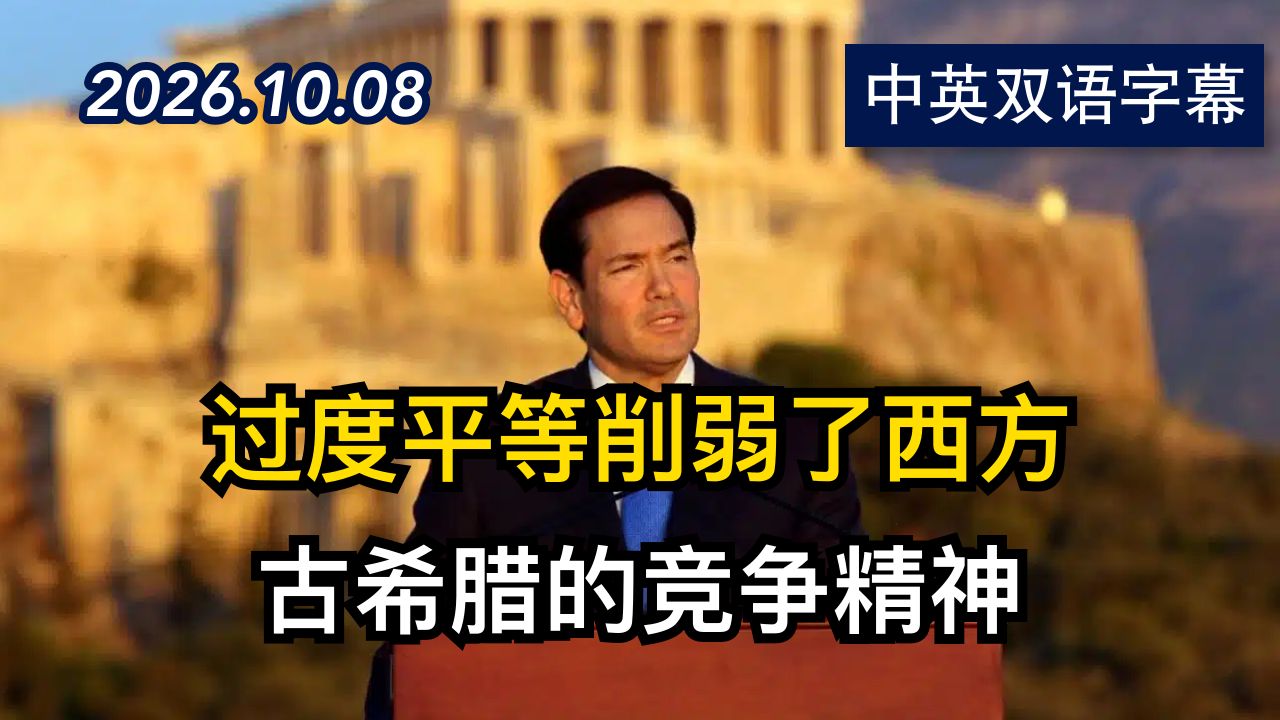
字幕摘录
| 时间 | 英文 | 中文 |
|---|---|---|
| 0:05 | His Excellency, the President of the Hellenic Republic, Ministers, Excellencies, Distinguished | 希腊共和国总统、部长、阁下阁下 |
| 0:11 | Guests, the Secretary of State of the United States of America, Marco Rubio. | 来宾:美国国务卿马可·鲁比奥. |
| 0:42 | There are great ruins all across the world. | 全世界都有巨大的废墟 |
| 0:45 | In many cases, they are places where history seems to have exhausted itself, remnants of | 在许多情况下,它们是历史似乎已经耗尽的地方, |
| 0:52 | distant cultures that have long passed, belong beyond a living memory. | 远方文化早已过去,属于活的记忆之外。 |
| 0:59 | But the Acropolis is different. | 但阿ro多罗三藐三菩提. |
| 1:02 | For thousands of years, the civilization that built what stands behind me has captivated | 几千年来 建造我身后的文明 一直吸引着 |
| 1:10 | the imagination of the Western world. | 西方世界的想象力。 |
| 1:13 | Generations of our statesmen, artists, and philosophers have looked to it with wonder | 一代又一代的政治家、艺术家和哲学家 都以奇异的眼光看待它 |
| 1:21 | and they've looked to it with awe. | 他们很敬畏地期待它 |
展开字幕全文(300 条)
| 序号 | 英文 | 中文 |
|---|---|---|
| 1 | His Excellency, the President of the Hellenic Republic, Ministers, Excellencies, Distinguished | 希腊共和国总统、部长、阁下阁下 |
| 2 | Guests, the Secretary of State of the United States of America, Marco Rubio. | 来宾:美国国务卿马可·鲁比奥. |
| 3 | There are great ruins all across the world. | 全世界都有巨大的废墟 |
| 4 | In many cases, they are places where history seems to have exhausted itself, remnants of | 在许多情况下,它们是历史似乎已经耗尽的地方, |
| 5 | distant cultures that have long passed, belong beyond a living memory. | 远方文化早已过去,属于活的记忆之外。 |
| 6 | But the Acropolis is different. | 但阿ro多罗三藐三菩提. |
| 7 | For thousands of years, the civilization that built what stands behind me has captivated | 几千年来 建造我身后的文明 一直吸引着 |
| 8 | the imagination of the Western world. | 西方世界的想象力。 |
| 9 | Generations of our statesmen, artists, and philosophers have looked to it with wonder | 一代又一代的政治家、艺术家和哲学家 都以奇异的眼光看待它 |
| 10 | and they've looked to it with awe. | 他们很敬畏地期待它 |
| 11 | Now, time has a tendency to dull the senses. | 现在,时间的倾向是 沉闷感官。 |
| 12 | Great victories and catastrophic defeats, they seem to shrink to becoming like a footnote | 伟大的胜利和灾难性的失败, 他们似乎收缩成像一个脚注 |
| 13 | in a textbook, another fact for our schoolchildren to memorize and forget. | 在教科书中,另一个事实 我们的学童 记住和忘记。 |
| 14 | But the Greeks of antiquity, they seem to have an almost mystical hold on our memory. | 但是,古希腊人, 他们似乎有一个几乎神秘的 持有我们的记忆。 |
| 15 | They call us back to them again and again, 480 years before Christ. | 他们一次又一次地召唤我们,比基督早480年。 |
| 16 | The armies of Xerxes arrived in this city and they put its sanctuaries to the torch. | 薛西斯的军队到达了这座城市,他们把它的圣物放在火炬上. |
| 17 | Most Athenians had by then evacuated by ship to a nearby island, but there was a handful | 大部分雅典人当时已经乘船疏散到附近的一个岛屿,但是有一小撮人 |
| 18 | of them that refused to leave their home. | 他们中拒绝离开家的人。 |
| 19 | So instead, they barricaded themselves in the rocky fortress of the Acropolis to fight | 于是,他们把自己挡在了 雅典波利斯的岩石堡垒上进行战斗 |
| 20 | an extraordinary last stand, heaving massive stones down the cliffs onto the Persian invaders | 向波斯入侵者的悬崖上 堆积着巨大的石头 |
| 21 | and holding the greatest empire of that age at bay for days. | 并且把那个时代最伟大的帝国控制了好几天 |
| 22 | They were eventually overwhelmed. | 他们最终不堪重负。 |
| 23 | The Persians plundered the temples, they burned the shrines, they razed the Acropolis to the | 波斯人掠夺神庙,烧毁神社,夷为平地 |
| 24 | ground. | 地面。 地面。 |
| 25 | But when the Athenians returned, they gathered the broken remains of the old Acropolis and | 但当雅典人回来时 他们收集了旧雅典波利斯的残骸 |
| 26 | buried them in the hill where it had stood. | 把他们埋在山上 |
| 27 | And decades later under Pericles, they razed the Parthenon. | 几十年后在佩里克斯下,他们夷平了帕台农神庙. |
| 28 | For 25 centuries since, the Parthenon has stood. | 此后的25个世纪里,帕台农神庙一直存在. |
| 29 | Empires have risen and fallen beneath its shadow. | 帝国在它的阴影下升降 |
| 30 | And the progeny of the men who built it, the sons of Athens and Rome, have carried their | 而建造它的人的后代,雅典和罗马的儿子, 已经携带他们的 |
| 31 | civilization with them to the ends of the earth. | 文明与他们一起走向地球尽头 |
| 32 | Two and a half centuries after the founding of the American Republic, halfway across the | 美利坚共和国成立两个半世纪后, |
| 33 | world from where I stand now, I stand here today as the Secretary of State of that Republic | 从我的立场出发,我今天以共和国国务卿的身份站在这里 |
| 34 | and as the great-grandson of settlers who arrived in the New World from Spain, I stand | 作为从西班牙来到新世界的定居者的曾孙,我站在 |
| 35 | here to testify to a debt that no lapse of time, no distance of space can ever extinguish. | 在这里证明债务 时间的流逝 空间的距离 永远无法消除 |
| 36 | The history of America, the history of my country, is covered with the fingerprints | 美国的历史,我国的历史, 被指纹覆盖 |
| 37 | of antiquity. | 古时的 |
| 38 | Greece is literally carved into the architecture of our government, in the towering columns, | 希腊被刻在我们的政府建筑里, 在高耸的柱子上, |
| 39 | in the domes and the monuments across our capital city. | 在我们首都的圆顶和纪念碑里 |
| 40 | The city where our Constitution was born, Philadelphia, is itself a Greek name. | 我国宪法诞生的城市费城本身就是希腊语名称. |
| 41 | The men who founded my country were fascinated by the heritage we inherited from yours. | 建立我国的人对我们继承的遗产很感兴趣。 |
| 42 | They were exceptionally well-read in history, they are vividly aware of their unique place | 他们从史上读得特别清楚 他们清楚地意识到自己的独特地位 |
| 43 | in it, but no other age of the past held their attention or their imagination quite like | 但过去没有其他的时代 让他们的注意力和想象 |
| 44 | that of antiquity. | 那个古老的 |
| 45 | Many people are surprised to learn that the most commonly cited author in the Federalist | 许多人惊讶地得知 联邦主义者最常引用的作者 |
| 46 | Papers was not an Enlightenment philosopher or a political theorist. | 论文不是启蒙哲学家,也不是政治理论家。 |
| 47 | The most commonly cited author in the Federalist Papers was Plutarch. | 联邦主义者论文中最常引用的作者是普鲁塔克. |
| 48 | The Greek biographer of Greece and Rome's great men. | 希腊传记作家希腊和罗马的伟人. |
| 49 | Now, much has been written and said about the influence of ancient Greece on the ideas | 现在,人们已经写了很多关于古希腊 对这些思想的影响 |
| 50 | of the American founders, and for that matter on all of the Western philosophers and statesmen | 以及所有西方哲学家和政治家 |
| 51 | that preceded them. | 在他们之前。 |
| 52 | Most of us are familiar with the basic history, Athens gave us democracy, Plato and Aristotle | 我们大多数人熟悉基本历史 雅典给我们民主 柏拉图和亚里士多德 |
| 53 | gave us Western philosophy, our ideas of law, of virtue, of citizenship and Republican government | 给了我们西方哲学,我们的法律思想,美德,公民权和共和政府 |
| 54 | were shaped in the Greek city-states. | 在希腊城邦被塑造 |
| 55 | Even much of our political vocabulary, words like democracy, tyranny, the word politics | 甚至很多政治词汇 比如民主 暴政 政治 |
| 56 | itself found its origins here. | 它的起源就在这里 |
| 57 | All of that is true, but the things we owe to this place as Americans and as Westerners | 这一切都是真的,但我们欠 这个地方作为美国人和西方人 |
| 58 | are actually far, far deeper. | 其实是远,更深。 |
| 59 | These institutions and ideas were the outward expression of more fundamental qualities we | 这些机构和思想是更根本的品质的外表表现 |
| 60 | see in the ancient Greeks, qualities that can't be reduced to any particular political | 古希腊人认为,不能归结为 任何特定的政治 |
| 61 | system or theory. | 系统或理论。 |
| 62 | Here in Athens, we found the first full realization of all the essential traits that would come | 在雅典,我们发现,我们第一次全面意识到了所有基本特征 |
| 63 | to define the West. | 以定义西方. |
| 64 | Fierce individuality and relentless ambition, daring exploration and invention, a yearning | 勇敢的个性 无情的野心 大胆的探索和发明 |
| 65 | for adventure, risk and glory, an insatiable curiosity about the world and the principles | 为了冒险、冒险和荣耀 对世界和原则的无厌好奇 |
| 66 | by which it operates, a hunger to know the mysteries of nature and grasp the secrets | 渴望了解自然的奥秘 并掌握秘密 |
| 67 | of the cosmos, and impatience with the notion of impossibility, chafing at all boundaries, | 并且对不可能的观念不耐烦, |
| 68 | at all limits, straining to peer into the depths of the unknown. | 在任何限制, 压力对等到未知的深度。 |
| 69 | These were not just the formulas or precepts of a particular school of philosophy, they | 不仅仅是哲学院的公式或戒律 |
| 70 | were the characteristic of a people, expressed in their tradition, their stories, their imagination | 是一个民族的特征 以传统、故事、想象来表达 |
| 71 | and the qualities that they demanded of their citizens and the things they lived and fought | 以及他们要求公民的品质 和他们生活和战斗的东西 |
| 72 | and died for. | 并因缘而死. |
| 73 | To know them is to know ourselves. | 了解他们就是了解我们自己。 |
| 74 | What blossomed here in this place was the Western desire to uncover all that ignorance, | 这里开花的 是西方人想揭开这些无知 |
| 75 | darkness and distance had kept hidden from the mind of man. | 黑暗和距离一直隐藏着人类的心灵。 |
| 76 | The Greeks did not just shape history, the Greeks gave us history itself. | 希腊人不仅塑造了历史,希腊人也给了我们历史本身. |
| 77 | Much of what we know about many ancient civilizations comes almost entirely from the records of | 我们对许多古代文明的了解 几乎完全来自于 |
| 78 | Greek explorers and historians, explorers and historians who didn't just chronicle | 希腊探险家和历史学家, 探险家和历史学家 他们不只是编年史 |
| 79 | the histories of their own people, but ventured outward to observe and record the sagas of | 他们自己人的历史,却敢于外表观察和记录 |
| 80 | peoples and cultures all across the world. | 各国人民和文化。 |
| 81 | Where others looked inward, the Greeks were the first to direct their focus outward to | 在其他人向内看的地方,希腊人首先将注意力引向外看。 |
| 82 | chase the thrill and glory of seeing all that was strange and new. | 追寻看到所有奇怪和新事物的刺激和荣耀。 |
| 83 | It was this trait, it was this trait that would push the West to create and build things | 正是这种特质,正是这种特质促使西方创造和建造东西 |
| 84 | that others could not, marking us out from so many other cultures and civilizations where | 其他人不能 把我们从如此众多的其他文化和文明中 |
| 85 | stability and subsistence were the highest ends of life. | 稳定和生存是生命的最高端。 |
| 86 | But it is not just the ambition to explore the unknown that we inherit from the Greeks, | 但是,探索我们从希腊人那里继承的未知事物不仅仅是野心, |
| 87 | it is the conviction that the unknown can be known. | 坚信未知者可以知晓 |
| 88 | The confidence that the world can be charted and measured and mapped and understood and | 相信世界能够被绘制、测量、绘制和理解,以及 |
| 89 | that there is a rational order to the cosmos governed by certain fundamental laws, laws | 宇宙有一个合理的秩序 受某些基本法律,法律的支配 |
| 90 | that men can observe and the mind can come to understand. | 男人可以观察, 和心灵可以开始理解。 |
| 91 | This was the foundation of the Western mind, our math, our science, our medicine, our philosophy, | 这是西方思想、数学、科学、医学、哲学的基础 |
| 92 | ethics and religion. | 伦理和宗教。 |
| 93 | It paved the way for the gospel of Jesus Christ to find fertile soil in Europe and flourish | 它为耶稣基督的福音铺平了道路 在欧洲找到肥沃的土壤和繁荣 |
| 94 | into the empire of Christendom. | 进入基督帝国 |
| 95 | It was the foundation of the riches of Christian theology, of Augustine and Aquinas and the | 这是基督教神学财富的基础 奥古斯丁和阿奎纳斯 |
| 96 | whole tradition of natural law. | 整个自然法的传统。 |
| 97 | It gave birth to a civilization marked not just by a common culture, it was marked by | 它诞生了一种文明 不只是一种共同的文化 它的标志是 |
| 98 | a common anthropology, a common view of man and of his place in the universe. | 一个共同的人类学, 一个人类的共同观点 和他在宇宙中的地位。 |
| 99 | Its descendants would share not just the idea of a natural order, but a distinctive understanding | 其后代不仅认同自然秩序的理念,而且认同独特的理解 |
| 100 | of virtue, of destiny, of fate, of truth, of goodness and beauty, of a code that dictates | 美德 命运 命运 真理 善良和美丽 |
| 101 | how men ought to live of objective standards and ideals to strive towards. | 男人应该如何生活在 客观的标准和理想 努力。 |
| 102 | For the Greeks of antiquity, the pursuit of excellence was the very principle of man's | 对于古希腊人来说 追求卓越是人类 |
| 103 | existence. | 存在。 |
| 104 | They organized all of civic life around contests and ambition and competition, in philosophy | 他们围绕比赛、野心和竞争 组织所有的公民生活 |
| 105 | and poetry and sculpture and drama, in athletics and art, in war and statescraft. | 以及诗歌、雕塑和戏剧、体育和艺术、战争和政治家 |
| 106 | The classical Greek city was an arena for great men to test and prove themselves, to | 古典的希腊城市是伟大的人测试和证明自己的竞技场 |
| 107 | hone their potential through perpetual struggle, to be the best, the strongest, the most beautiful, | 通过永恒的奋斗来挖掘他们的潜力 成为最好的,最强的,最美丽的 |
| 108 | straining to inch ever closer to perfection. | 磨练到越来越接近完美 |
| 109 | Now I know that to modern ears what I just described, this way of life may sound odd, | 现在我知道,在现代的耳朵,我刚刚描述的, 这种生活方式可能听起来很奇怪, |
| 110 | it may even sound cruel. | 它甚至可能听起来残忍。 |
| 111 | The ideal of many ideologies in our time has frankly become a world of perfect safety, | 我们这个时代许多意识形态的理想 坦率地说,已经成为一个完全安全的世界, |
| 112 | a world devoid of risk or failure, where neither the glory of victory nor the shame of defeat. | 一个没有风险或失败的世界,在这里,胜利的荣耀和失败的耻辱都没有. |
| 113 | Too often these days we build downwards. | 这些天我们经常向下建设。 |
| 114 | We design our standards to ensure that no one will lose. | 我们设计我们的标准是为了确保没有人会输。 |
| 115 | We preoccupy ourselves more with the comfort of the worst than the potential of the best. | 我们更多地关注最坏者的舒适感,而不是最优秀者的潜力。 |
| 116 | We hold the most exceptional things among us hostage to the average. | 我们把最不寻常的事情 当作普通人的抵押 |
| 117 | The ordinary, the mediocre, the men who made the Parthenon, they built upwards. | 普通人,平庸人,制作帕台农神庙的人,都向上建造. |
| 118 | They held that the highest and most noble aspiration in life was to surpass all others, | 他们认为,生命中最高和最崇高的愿望是超越所有其他人, |
| 119 | to strive to be the best in all things. | 努力成为万物中最好的 |
| 120 | The ancient Greek city-states were filled, they were filled with intense passion and | 古希腊城邦充满了强烈的激情 |
| 121 | rivalry and faction and conflict, but from that constant struggle for distinction, | 争斗、派系和冲突, 但从不断的区别斗争中, |
| 122 | from that came the great flowering of art and philosophy and political and intellectual energy | 艺术与哲学 以及政治和知识能量的盛开 |
| 123 | that would transform a collective of Mediterranean cities into the birthplace | 将地中海城市群变成诞生地 |
| 124 | of the greatest civilization in the world. | 这是世界上最伟大的文明 |
| 125 | The thumos, as the ancient Greeks called it, the fire of passion, strength, courage, pride, | 正如古希腊人所说的 热情、力量、勇气、自豪的火焰 |
| 126 | is the heart of great civilization. | 是伟大文明的核心 |
| 127 | And without it, without it nations lose their will to fight, the will to strive, the will to survive. | 没有它,没有它,各国就失去了战斗的意志,奋斗的意志,生存的意志. |
| 128 | Today too much of the West has forgotten this quality. | 今天,西方太多国家忘记了这种品质。 |
| 129 | Over time, we in the West came to feel ashamed of the very things that made us exceptional. | 随着时间的推移,我们西方人开始感到羞愧,正是那些使我们变得非凡的事情. |
| 130 | We felt embarrassed that our achievements set us apart from the rest of the world. | 我们感到尴尬的是,我们的成就使我们与世界其他地区相隔绝。 |
| 131 | Our prosperity somehow became a source of guilt. | 我们的繁荣不知何故成为罪恶的根源。 |
| 132 | We no longer believed we deserved and had earned our greatness. | 我们不再相信我们应得的,我们赢得了我们的伟大。 |
| 133 | The word nationalism became a dirty word. | 民族主义一词变成了脏话. |
| 134 | And so we tore down our monuments, we condemned our own history, and in too many places we | 所以我们撕毁我们的纪念碑, 我们谴责我们自己的历史, 在太多的地方,我们 |
| 135 | taught our children to be ashamed of the countries they would inherit. | 教我们的孩子对将要继承的国家感到羞愧。 |
| 136 | In the process we opened our borders and outsourced our industry and allowed our militaries to | 在这个过程中,我们开放了边界,外包了我们的工业,并允许我们的军队进入 |
| 137 | wither and to decay. | 枯萎而衰变. |
| 138 | And with every passing year we seemed to outsource more of our sovereignty, transferring our | 年复一年,我们似乎 将更多的主权外包, 转移我们的 |
| 139 | decisions to global bureaucracies far beyond the reach of our control. | 我们无法控制全球官僚机构的决定。 |
| 140 | But others were all too happy to fill the vacuum that we left, the vacuum left behind | 但其他人都太高兴了 填补了我们留下的真空 留下的真空 |
| 141 | by our weakness. | 我们的弱点 |
| 142 | And as the West's confidence faltered, its adversaries and its rivals only grew more | 随着西方信心的动摇 西方的对手和对手只会增加 |
| 143 | assertive, building up their own wealth and their own power in our stead. | 坚定不移,建立他们自己的财富和力量来代替我们。 |
| 144 | And now, today, we find ourselves at a crossroads because the next decade and the decisions | 现在,今天,我们正处在一个十字路口,因为下一个十年和决定 |
| 145 | we make will write the story of the next century. | 我们会写下世纪的故事 |
| 146 | The course we take will determine whether the West maintains its place at the head of | 我们所走的道路将决定西方是否保持其领导地位。 |
| 147 | the world or resigns itself to a future of atrophy and servitude and decline. | 或屈服于未来 萎缩、奴役和衰退。 |
| 148 | We will either choose to act now or lose the choice to act at all. | 我们要么选择现在就采取行动,要么完全丧失采取行动的选择。 |
| 149 | Under President Trump, the United States has made its choice. | 在特朗普总统的领导下,美国做出了自己的选择. |
| 150 | We choose the unapologetic pursuit of national power, to take back control of our critical | 我们选择不光彩的追求国家权力 来夺回对关键权力的控制 |
| 151 | supply chains, to re-industrialize our economy, to rebuild our defense, to fight for dominance | 供应链,使我国经济重新工业化,重建国防,争取主导地位. |
| 152 | of the technologies and industries of the future. | 技术与工业。 |
| 153 | We choose to reach for new frontiers in advanced manufacturing and superintelligence, in drones, | 我们选择进入先进制造和超级情报 无人机的新领域 |
| 154 | weapons and warfare, in chips, minerals, cyber, and every other domain of human possibility | 武器与战争,在芯片,矿物,网络, 以及人类可能性的所有其他领域 |
| 155 | to unleash our energy, to rebuild our factories, to return our astronauts to the moon and launch | 释放我们的能量 重建我们的工厂 把我们的宇航员送回月球并发射 |
| 156 | a new age of exploration in space. | 太空探索的新时代 |
| 157 | Now for all their laughy ideals, the ancient Greeks were not naive. | 古希腊人并不幼稚, |
| 158 | They understood that nations have interest. | 他们知道,各国都感兴趣。 |
| 159 | They understood that statecraft requires prudence and diplomacy. | 他们理解,国家行为需要谨慎和外交。 |
| 160 | But they also understood that it requires the ability to wield force when prudence and | 但他们也明白,这需要有能力在谨慎行事时使用武力。 |
| 161 | diplomacy fail. | 外交失败。 |
| 162 | They understood that power requires not only having the means to defend yourself, it requires | 他们明白,权力不仅需要 拥有保护自己的手段,它需要 |
| 163 | the credibility that you are willing to use it. | 你愿意使用它的信誉。 |
| 164 | This is the classical understanding of politics and of statecraft that the Trump administration | 这就是川普政府对于政治和国家行为的古典理解 |
| 165 | hopes to reclaim, not just for our country, but for the whole of our civilization. | 希望不仅为我们的国家,而且为我们整个文明而恢复。 |
| 166 | We believe that Europe can awaken from its long slumber and rekindle the fire that was | 我们相信欧洲能从漫长的沉睡中唤醒 并重新点燃当时的火 |
| 167 | lit here millennia ago. | 几千年前这里被点燃了 |
| 168 | There are already signs. | 已经有迹象了 |
| 169 | Across this continent, we are witnessing what we hope will be the beginning of a generational | 在这个大陆上,我们正目睹着我们希望成为一代人的开端。 |
| 170 | shift, skyrocketing defense spending, a flurry of new partnerships and programs, expanded | 改变,国防开支飞涨, 新的伙伴关系和方案一团涌现, |
| 171 | manufacturing and production following on the historic defense commitments made last | 执行过去作出的历史性国防承诺 |
| 172 | year in the Hague. | 在海牙的一年。 |
| 173 | Greece has been at the center of this shift. | 希腊一直处于这一转变的中心。 |
| 174 | The people of this nation have proved themselves once again to be an indispensable friend to | 这个国家的人民再次证明自己是 |
| 175 | Europe and to the United States alike on everything from energy to migration to defense, where | 欧洲和美国在从能源到移民到国防的一切方面 |
| 176 | Greece has been a model ally. | 希腊是一个模范盟友。 |
| 177 | It is our sincerest hope that all of Europe will follow your example. | 我们最真诚地希望,所有欧洲都将以你为榜样。 |
| 178 | Though passions may at times have strained the bonds of affection between the United | 虽然激情有时会拉长 联合体之间的感情纽带 |
| 179 | States and Europe, it must not be allowed to break them. | 决不能允许各国和欧洲打破这些障碍。 |
| 180 | Together we must strengthen an alliance capable of confronting the threats of our age. | 我们必须共同加强能够对付我们这个时代的威胁的联盟。 |
| 181 | And we can. | 我们可以。 |
| 182 | Because we do not believe that transatlantic friendship should be zero sum, quite the opposite. | 因为我们不认为跨大西洋友谊应该是零和的,恰恰相反。 |
| 183 | Our vision is an alliance whose strength is greater than the sum of its parts. | 我们的愿景是,联盟的力量大于其各部分的总和。 |
| 184 | It is a vision we saw in action just last month in an unprecedented new agreement between | 这是上个月我们以前所未有的新协议在行动中看到的一个愿景。 |
| 185 | the United States, Denmark and Greenland, an agreement that will reshape the Arctic | 美国、丹麦和格陵兰将重新塑造北极的协定 |
| 186 | and bolster the security of all of NATO. | 并加强整个北约的安全。 |
| 187 | All three partners in that deal emerged victorious. | 该协议的所有三个伙伴都取得了胜利。 |
| 188 | All of Europe and NATO and the United States emerged safer, stronger and more secure because | 欧洲、北约和美国都变得更加安全、强大和安全,因为 |
| 189 | of it. | 对 |
| 190 | We want to win together. | 我们要一起赢 |
| 191 | We must win together. | 我们必须一起赢 |
| 192 | Now it's become fashionable today to believe that enlightened foreign policy means prioritizing | 现在人们开始时髦地相信 开明的外交政策意味着优先 |
| 193 | the global community over one's own people. | 全球社会超越自己的人民。 |
| 194 | And I think here, too, we have much to learn from the men of ancient Greece because they | 我也认为,我们从古希腊人那里学到很多东西,因为他们 |
| 195 | knew that there was nothing selfish or wrong about loyalty to your nation, nor anything | 知道忠于你的国家是没有自私或错误的, 也不是什么 |
| 196 | selfish or wrong about fighting to defend its interests above all else. | 自私或错误地为捍卫自身利益而斗争 |
| 197 | They believed fiercely in the ideal of the great man, the exceptional individual who | 他们强烈地相信伟大的人的理想 非凡的人 |
| 198 | obtains immortality through his own deeds. | 以自己的行为获得永生。 |
| 199 | But they believed that glory and fame, those things were won through striving, sacrificing | 但他们相信光荣和名利 通过努力和牺牲 |
| 200 | and achieving greatly for something larger than yourself. | 为了比自己更大的事 成就了巨大的成就 |
| 201 | The recurring hero of the ancient Greek world was the man who was willing to pay any cost | 古希腊世界的英雄 愿意付出任何代价的人 |
| 202 | for a cause worthy of his loyalty. | 为了一个值得他忠诚的事业 |
| 203 | We see this in Socrates, who refused to abandon the inquiry into truth, even at the cost of | 苏格拉底拒绝放弃真相调查, |
| 204 | his own life. | 他自己的生活。 |
| 205 | We see it in the legendary stand of 300 Spartans, surrounded and hopelessly outnumbered by the | 我们从300名斯巴达人 的传奇立面上看到,他们被包围了,而且人数无望 |
| 206 | vast armies of Persia, who refused a chance to save themselves choosing to fight to the | 波斯的庞大军队 拒绝拯救自己的机会 |
| 207 | last man rather than abandon their post or abandon their duty. | 而不是弃职或弃职 |
| 208 | And we see it in the epic myth of Achilles, who is offered the choice to return home and | 我们从阿基里斯的史诗神话中看到,他可以选择回家 |
| 209 | live a long and peaceful life, but chooses instead to remain at Troy and perish in pursuit | 但选择留在特洛伊,在追逐中死去 |
| 210 | of eternal glory. | 永远的荣耀 |
| 211 | These are the qualities that would shape the Western moral imagination, from the Christian | 这些是塑造西方道德想象的特质 来自基督教徒 |
| 212 | martyr who refused to betray his faith, to the patriot who gave his life for his country, | 拒绝背叛信仰的烈士 向为国家献身的爱国者 |
| 213 | from St. Thomas More to the Battle of the Alamo, running through the immortal closing | 从圣托马斯·莫尔到阿拉莫战役 历经不朽的收场 |
| 214 | words of the Declaration of Independence of the United States, which says we mutually | 美国《独立宣言》中说,我们彼此 |
| 215 | pledge to each other our lives, our fortunes and our sacred honor. | 向对方保证我们的生命、财富和神圣的荣誉 |
| 216 | It is from the Greeks that the West inherited its sense of duty, an unbreakable loyalty | 正是从希腊人那里,西方继承了它的责任感,一种不可突破的忠诚 |
| 217 | to one's code, one's cause, one's country. | 给一个代码,一个事业,一个国家。 |
| 218 | Our heroes, the heroes of the West, are those who choose to remain faithful to their duty | 我们的英雄,西方的英雄, 是那些选择忠于自己职责的人 |
| 219 | precisely when it is most difficult and painful to do so. | 正是在最困难和最痛苦的时候。 |
| 220 | The man who is bound by his word, the soldier who will not abandon his post, the captain, | 以言为约束之人,不弃职之兵,太尉. |
| 221 | the proverbial captain who goes down with the ship. | 和船一起下船的船长 |
| 222 | This is wholly different from what we see even now, for example from fanatics like the | 这和我们现在所看到的完全不同 比如说与狂热分子一样 |
| 223 | child suicide bombers as national heroes and portrays martyrdom as an end to itself. | 儿童自杀炸弹手是国家英雄,将殉难描绘成自我的终结。 |
| 224 | Our heroes, our heroes may be willing to die for their cause, but our heroes do not worship | 我们的英雄,我们的英雄 可能愿意为他们的事业而死, 但我们的英雄不崇拜 |
| 225 | {\fn黑体\fs22\bord1\shad0\3aHBE\4aH00\fscx67\fscy66\2cHFFFFFF\3cH808080}死吗? | |
| 226 | It is precisely because we value life that we come to recognize the heroism in those | 正是因为我们珍视生命,我们才开始认识到这些中的英雄主义 |
| 227 | who would sooner sacrifice it than to betray their principles. | 谁会牺牲它 比背叛他们的原则。 |
| 228 | Now we take the West's conception of these things, heroism, honor, duty, we take these | 现在我们接受西方对这些事物的观念, 英雄主义,荣誉,责任,我们接受这些 |
| 229 | things for granted. | 这是理所当然的。 |
| 230 | We assume that these somehow are universal to all people in all times and in all places. | 我们假定,无论何时何地,这些都以某种方式普遍适用于所有人。 |
| 231 | They are not. | 他们不是。 |
| 232 | They are the product of a distinct character, a distinct character which arose here and | 它们是具有独特特性的产物,具有独特特性。 |
| 233 | shaped the whole story of the civilization that came after it, a civilization that we | 塑造了之后文明的全貌 我们的文明 |
| 234 | must fight to defend today with the same passion as our forefathers did. | 今天必须像我们的祖先一样热衷于捍卫 |
| 235 | The men who built the Parthenon were succeeded by the architects of European Christendom | 建造帕台农神庙的人 由欧洲基督堂的建筑师继承 |
| 236 | who raised the cathedrals of Milan, Cologne and Florence. | 他养育了米兰,科隆和佛罗伦萨的主教座堂. |
| 237 | The quest to perfect the human form that moved the ancient Greek sculptors found a new expression | 追求完善人类形态 使古希腊雕塑家们感动 |
| 238 | in Michelangelo. | 在米开朗基罗 |
| 239 | The Greek philosopher's search for the structure of the universe was inherited by Copernicus | 希腊哲学家对宇宙结构的探索被哥白尼继承 |
| 240 | and then Galileo and Kepler and Newton. | 然后是伽利略 开普勒 牛顿 |
| 241 | The hunger for new knowledge, that's what gave birth to Magellan's first expedition | 对新知识的渴望 这就是麦哲伦第一次远征的原因 |
| 242 | around the world, to Columbus's discovery of the Americas and ultimately to Apollo 11's | 为了哥伦布发现美洲 并最终为了阿波罗11号 |
| 243 | journey to the moon. | 去月球的旅程。 |
| 244 | And the qualities that led Alexander to conquer the entire known world reappeared in Caesar | 亚历山大征服世界的特质 重新出现在凯撒 |
| 245 | and Charlemagne and Cortez. | 还有查理曼和科特斯 |
| 246 | And in America, that same tradition rediscovered itself anew. | 在美国,同样的传统 重新发现自己。 |
| 247 | An open and wild land became the site of a great revival of Western imagination and ambition. | 一片开阔的野生土地成为了西方想象力和野心大复兴的场所. |
| 248 | The Greek aspiration for new horizons became the American frontier spirit. | 希腊对新地平线的渴望成为美国边疆精神. |
| 249 | The civilization of Athens and Rome transformed an infant seaboard republic into a continental | 雅典和罗马的文明 将新生的海滨共和国变成了大陆 |
| 250 | empire. | 帝国 |
| 251 | The greatest Americans of every generation have carried the unmistakable features of | 每一代最伟大的美国人 都有着不可忽视的特征 |
| 252 | their forefathers, born in Athens, formed by Rome, baptized in Christendom, hardened | 他们的祖先,生于雅典,由罗马组成,在基督赐礼,坚固 |
| 253 | in the furnace of medieval Europe, endowed with the English genius for liberty and then | 在中世纪欧洲的炉子里 拥有英国自由天才 |
| 254 | carried across the Atlantic to be reborn on the shores of a new world. | 在新世界的海岸上重生 |
| 255 | Together we must now rediscover that spirit. | 我们现在必须一起重新发现这种精神。 |
| 256 | We are at an inflection point, an inflection point not only in the history of my nation, | 我们正处在一个不平凡的关头 不仅是我国历史上的关头 |
| 257 | but an inflection point in the whole of our civilization. | 但却是我们整个文明中一个漏洞 |
| 258 | The threats we face today are every bit as real as they were on the dramatic stage of | 我们今天面临的威胁 都和他们处于戏剧性阶段一样真实 |
| 259 | antiquity. | 古迹. |
| 260 | National interests did not vanish in the face of international institutions. | 在国际机构面前,国家利益并没有消失。 |
| 261 | War did not disappear simply because we preferred peace. | 战争并非仅仅因为我们希望和平而消失。 |
| 262 | Other states continued to arm, to seek influence, to compete for territory and technology and | 其他国家继续武装起来,寻求影响力,争夺领土和技术,以及 |
| 263 | resources and markets and energy and power. | 资源和市场以及能源和电力。 |
| 264 | And now there is war again. | 现在又爆发战争了 |
| 265 | There is new competition between great powers again. | 大国之间又出现了新的竞争. |
| 266 | There is vulnerability, aggression, terrorism, a whole universe of new threats and attacks | 存在脆弱性、侵略、恐怖主义、各种新威胁和攻击 |
| 267 | again. | 再来 |
| 268 | And so we must rebuild our institutions and our alliances to face these threats together, | 因此我们必须重建我们的机构和联盟,共同面对这些威胁, |
| 269 | understanding that the purpose of these things is not to abolish the sovereignty of the nations | 理解这些事情的目的不是要废除国家主权 |
| 270 | that constitute them, it is to defend them and that nations need not abandon their distinct | 保护他们,各国不必放弃他们独特的 |
| 271 | identities in order to recognize their common interests. | 身份是为了承认他们的共同利益。 |
| 272 | We have built a model of that with our partners here in Greece, in our defense partnerships, | 我们和在希腊的合作伙伴建立了这种模式 在我们的国防伙伴关系中 |
| 273 | in energy and technology and our shared ambition to secure Europe's borders from the threats | 以及我们确保欧洲边界不受威胁的共同愿望 |
| 274 | of mass migration. | 大规模移民。 |
| 275 | You know, our friendship dates back to the earliest years of my nation. | 我们的友谊可以追溯到我国最早的年代. |
| 276 | When Greece rose in 1821 to recover its independence after centuries of Ottoman rule, Americans | 当希腊在1821年崛起,在奥斯曼统治了几个世纪后恢复独立时,美国人 |
| 277 | recognized something familiar in that struggle. | 在这场斗争中认识了熟悉的东西。 |
| 278 | Three years later, the great American statesman, Daniel Webster, he delivered a famous address | 三年后,伟大的美国政治家丹尼尔·韦伯斯特 发表了一个著名的演讲 |
| 279 | to Congress, helping bring the cause of the Greek Revolution before the representatives | 帮助将希腊革命的事业 带到众议员面前 |
| 280 | of the young American republic. | 年轻的美国共和国。 |
| 281 | And he began by calling their attention to everything around them. | 他首先提请他们注意周围的一切。 |
| 282 | This is what he said in his speech. | 这是他在演讲中说的话。 |
| 283 | He said, this free form of government, the popular assembly, this practice of free debate | 他说,这种自由的政府形式,人民集会,这种自由辩论的做法 |
| 284 | and public discussion, the contest of mind with mind, even the edifice in which we assemble | 公开讨论 思想的争斗 甚至我们聚集的大厦 |
| 285 | these proportion columns, these ornamented architecture, all remind us that Greece has | 这些比例的柱子, 这些装饰的建筑, 都提醒我们,希腊 |
| 286 | existed and that we, like the rest of mankind, are greatly her debtors. | 我们和人类一样,是她的债务人。 |
| 287 | Those words are as true today as they were when he said them. | 这些话今天和他说的一样真实。 |
| 288 | And all of us, not just Americans, but Europeans and our friends across the West, must relearn | 而我们所有人,不仅仅是美国人,还有欧洲人和西方的朋友,必须重新学习 |
| 289 | the lessons our forefathers took from this place and from its history. | 我们的祖先从这里及其历史中吸取的教训。 |
| 290 | The history of Greece, the history of Greece does not just offer us a glimpse, does not | 希腊的历史,希腊的历史 不只是给我们一瞥,不是 |
| 291 | offer a glimpse of institutions in their earliest forms. | 提供最早形式的机构。 |
| 292 | The history of Greece shows us an image of ourselves. | 希腊的历史向我们展示了我们自己的形象。 |
| 293 | It shows us that ours is the inheritance of great heroes and that we should be proud, | 它告诉我们,我们的遗产 伟大的英雄,我们应该骄傲, |
| 294 | that we should be intensely proud of where we come from. | 我们应当为我们来自何处而感到骄傲。 |
| 295 | We should marvel at what our forefathers carved out of this countryside. | 我们应该为我们的祖先从这个乡村上 创造出的东西感到惊讶 |
| 296 | The story of our civilization is the greatest story ever known to man. | 我们文明的故事是人类有史以来最伟大的故事。 |
| 297 | And it began here, with the first men and women of the West. | 从这里开始, 西方最早的男女。 |
| 298 | From them, from them we can rediscover the virtues, the courage and the strength to confront | 从他们身上,从他们身上,我们可以重新发现 美德,勇气和力量对抗 |
| 299 | the dangers that we face in our time. | 我们时代所面临的危险。 |
| 300 | Thank you. | 谢谢 |
该视频共有字幕 300 条。解锁更多字幕为会员功能,请移动到 价格