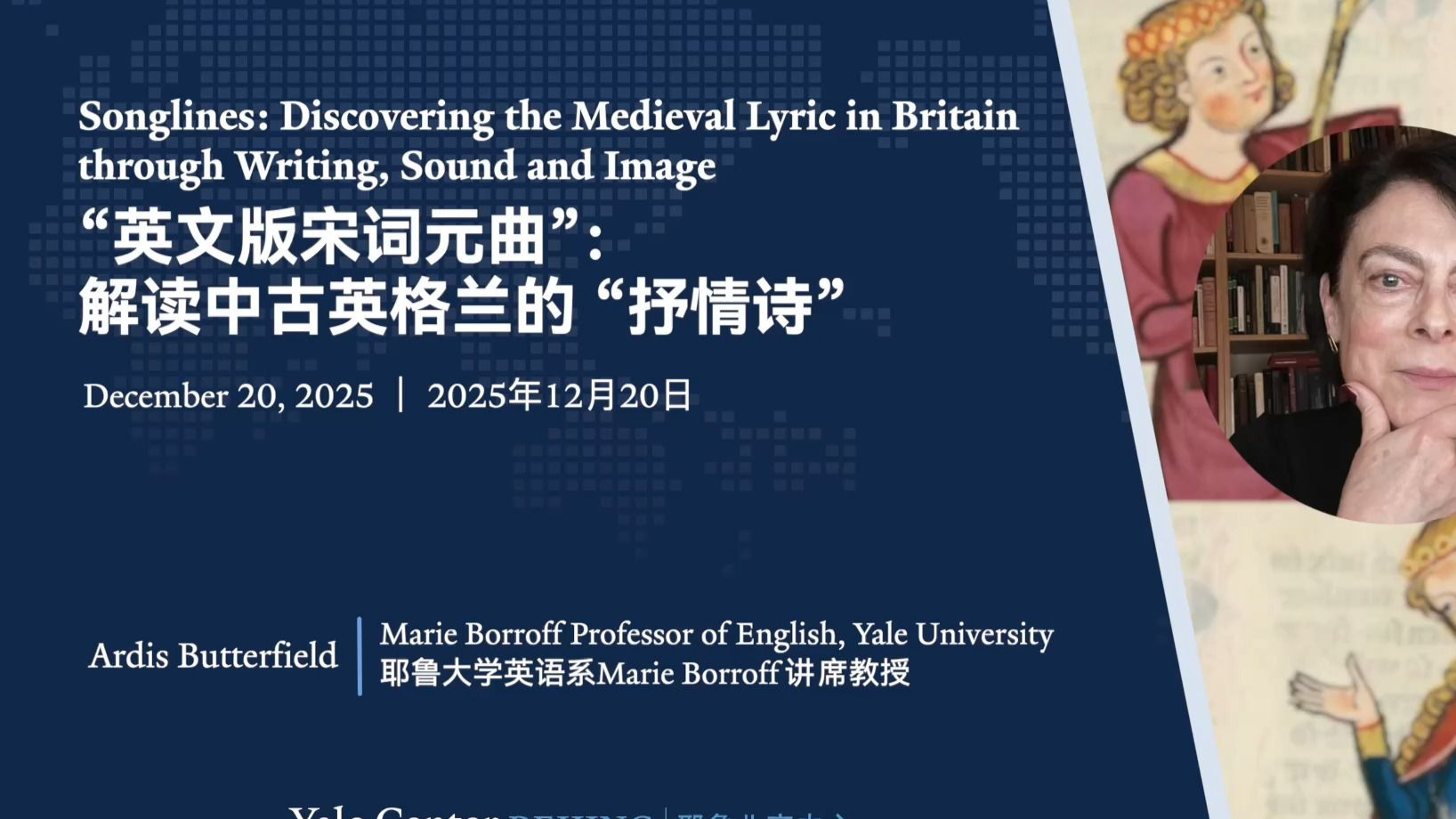
老外不懂诗词歌赋?听耶鲁英语系著名教授来华解读中古英格兰“抒
字幕摘录
| 时间 | 英文 | 中文 |
|---|---|---|
| 0:05 | Good evening, everyone, and welcome to Yale Center Beijing. | 各位晚安 欢迎来到耶鲁中心北京 |
| 0:09 | Can I get a show of hands for those of you | 我能给你们举个手吗? |
| 0:12 | who are here for the first time? | 谁第一次来? |
| 0:15 | Wow, that's pretty incredible. | 哇,这是相当不可思议的。 |
| 0:19 | I'm just gonna give a quick introduction | 我只是要简单介绍一下 |
| 0:22 | 然后欢迎Artis Butterfield教授来到讲台。 | |
| 0:27 | My name is Carol Lee Rafferty. | 我叫卡罗尔·李·拉费蒂 |
| 0:29 | I am a member of the Yale College Class of 2000, | 我是耶鲁大学2000年班的成员, |
| 0:34 | and I'm the executive director of Yale Center Beijing. | 我是耶鲁北京中心执行董事 |
| 0:38 | For those of you who are new to the center, | 你们中新到中心的人, |
展开字幕全文(965 条)
| 序号 | 英文 | 中文 |
|---|---|---|
| 1 | Good evening, everyone, and welcome to Yale Center Beijing. | 各位晚安 欢迎来到耶鲁中心北京 |
| 2 | Can I get a show of hands for those of you | 我能给你们举个手吗? |
| 3 | who are here for the first time? | 谁第一次来? |
| 4 | Wow, that's pretty incredible. | 哇,这是相当不可思议的。 |
| 5 | I'm just gonna give a quick introduction | 我只是要简单介绍一下 |
| 6 | 然后欢迎Artis Butterfield教授来到讲台。 | |
| 7 | My name is Carol Lee Rafferty. | 我叫卡罗尔·李·拉费蒂 |
| 8 | I am a member of the Yale College Class of 2000, | 我是耶鲁大学2000年班的成员, |
| 9 | and I'm the executive director of Yale Center Beijing. | 我是耶鲁北京中心执行董事 |
| 10 | For those of you who are new to the center, | 你们中新到中心的人, |
| 11 | we were founded in 2014 as Yale University's | 我们成立于2014年 作为耶鲁大学 |
| 12 | only university-wide center outside of its US campus, | 只有全大学中心 在其美国校园外, |
| 13 | representing its 14 schools, kind of like an embassy | 代表14所学校, 有点像大使馆 |
| 14 | and an activity center, and throughout the year, | 和一个活动中心, 和整个一年, |
| 15 | we host events such as these with thought leaders | 我们主办这样的活动 与思想领袖 |
| 16 | from academia, business, government, culture, | 来自学术界、商界、政府、文化界、 |
| 17 | science and technology, various fields coming to speak | 科学技术,各个领域的演讲 |
| 18 | on the most interesting or critical topics | 关于最有趣或最关键的专题 |
| 19 | facing our world. | 面对我们的世界。 |
| 20 | So you're more than welcome to come to our events. | 所以欢迎你来参加我们的活动 |
| 21 | Tonight, I am so honored and privileged | 今晚,我非常荣幸和荣幸 |
| 22 | 欢迎耶鲁大学的Artis Butterfield教授 | |
| 23 | This is her first time in China. | 这是她第一次来中国 |
| 24 | And we're just so delighted to have her | 我们很高兴有她 |
| 25 | because on her travels, she has agreed to do this talk, | 因为她旅行时同意做这个演讲 |
| 26 | which is on her new edited volume | 她的新编辑本 |
| 27 | on medieval lyrics in Britain. | 在中世纪歌词 在英国。 |
| 28 | She is a scholar of literature and music | 她是文学和音乐的学者 |
| 29 | in 13th to 15th century Europe. | 在13至15世纪的欧洲。 |
| 30 | Do people here know what these centuries align to | 这里的人知道这几个世纪里 |
| 31 | in terms of Chinese dynasties, 13th and 15th century? | 就中国王朝而言,13世纪和15世纪? |
| 32 | Anyone? | 有人吗? |
| 33 | Our younger students, I see that we have | 我们的年轻学生,我知道我们有 |
| 34 | young high school students, college students, | 年轻的高中生 大学生 |
| 35 | graduate students, lifelong learners. | 研究生,终身学习。 |
| 36 | Welcome, everyone. | 欢迎各位 |
| 37 | And also Yale alums, whom I learned, | 和耶鲁校友,我学到, |
| 38 | wanted to study medieval literature, | 想研究中世纪的文学 |
| 39 | but actually ended up doing epidemiology, | 但实际上 做流行病学, |
| 40 | which is amazing. | 这是惊人的。 |
| 41 | Professor Artis Butterfield is the Marie Barof | 阿蒂斯·巴特菲尔德教授是玛丽·巴洛夫 |
| 42 | Professor of English and by courtesy, | 英语教授和礼貌 |
| 43 | a professor of French and music. | 法语和音乐教授。 |
| 44 | She was born in Pakistan and educated in South India | 她出生在巴基斯坦,在南印度接受教育 |
| 45 | and England and completed her bachelor's and PhD degree | 并完成了她的学士和博士学位 |
| 46 | at Cambridge, at the Trinity College of Cambridge. | 剑桥三一学院 |
| 47 | Before joining Yale in 2012, she was a research fellow | 在2012年加入耶鲁大学之前,她是一名研究员 |
| 48 | at Downing College and later professor | 在唐宁学院和后来的教授 |
| 49 | at University College London. | 在伦敦大学学院 |
| 50 | She has many works under her belt, | 她腰带下面有很多工作 |
| 51 | including poetry and music in medieval France | 包括中世纪法国的诗歌和音乐 |
| 52 | and the familiar enemy, Chaucer Language | 和熟悉的敌人,Chauser语言 |
| 53 | and the Nation in the Hundred Years' War, 2009, | 《与百年战争中的民族的关系》,2009年, |
| 54 | which won the 2010 Society for French Studies | 赢得2010年法语研究会 |
| 55 | R.H. Gapper奖并获命名 | |
| 56 | a Choice Outstanding Academic Title in 2010 | a 2010年选择杰出学术称号。 |
| 57 | and was presented to the Académie Françaises. | 并被提交法国科学院。 |
| 58 | So without further ado, I am just so delighted | 所以,不做更多,我只是 很高兴 |
| 59 | that many of you are here to listen to this topic | 你们很多人都来听这个话题 |
| 60 | before the holiday season. | 在节假日之前 |
| 61 | And I hope you'll all enjoy this. | 我希望你们都喜欢这个 |
| 62 | Welcome, Professor Artis Butterfield. | 欢迎阿尔蒂斯·巴特菲尔德教授 |
| 63 | It's such an honor to be here. | 来这真是荣幸 |
| 64 | Thank you so much for inviting me. | 谢谢你邀请我 |
| 65 | And yes, I'm having a fabulous time. | 是的,我玩得很开心 |
| 66 | My first ever visit to China. | 我第一次访问中国 |
| 67 | So yeah, it's just been a ball. | 所以,它只是一个球。 |
| 68 | What I want to talk about today is my new edition | 今天我想谈的是新版 |
| 69 | and I'm going to take you through | 我会带你通过 |
| 70 | a whole bunch of slides actually, | 其实是一堆幻灯片 |
| 71 | because what I'm doing is a kind of media study | 因为我做的是媒体研究 |
| 72 | of medieval song. | 中世纪的歌 |
| 73 | And this is what I'm gonna try and explain | 这就是我要试着解释的 |
| 74 | through the manuscripts. | 通过手稿。 |
| 75 | So this is my first slide. | 这是我的第一张幻灯片。 |
| 76 | What is a medieval English lyric? | 中世纪的英语词条是什么? |
| 77 | Now that sounds a strange question perhaps, | 这听起来有点奇怪,也许, |
| 78 | but it's when you're editing something, | 但这是当你编辑的东西, |
| 79 | if you're editing the plays of Shakespeare, | 如果你在编辑莎士比亚的剧本 |
| 80 | everybody knows what you're editing. | 每个人都知道你在编辑什么 |
| 81 | You're editing a Shakespeare play. | 你在编辑莎士比亚的剧本 |
| 82 | But in the case of medieval English lyrics, | 但对于中世纪英语歌词, |
| 83 | nobody agrees exactly what a medieval English lyric is. | 没人认同中世纪的英语词条 |
| 84 | So what I've done, it's taken me about 20 years | 所以,我所做的,我花了大约20年时间 |
| 85 | to do this project in a sense I've discovered | 从某种意义上说,我发现 |
| 86 | or I've asked the question all the way through | 或者我一直问这个问题 |
| 87 | by looking at a lot of manuscripts | 看着许多手稿 |
| 88 | from the 13th to the 15th centuries. | 从13世纪到15世纪 |
| 89 | And they have been very revealing | 他们一直非常揭示 |
| 90 | of all kinds of ways of thinking about short verse. | 以各种方式思考短诗 |
| 91 | And one of the things that I'm doing | 还有一件事,我在做什么 |
| 92 | is opening up the idea of an English lyric | 正在打开一个英文词组的想法 |
| 93 | to include the other languages | 包括其他语言 |
| 94 | that were central to medieval Britain, | 是中世纪英国的核心 |
| 95 | but forgotten about because everybody pays more attention | 但忘记了,因为每个人都更注意 |
| 96 | to English than to anything else. | 对英语比对任何其他事物。 |
| 97 | So I'm paying attention also to French and to Latin, | 所以我也注意法语和拉丁语 |
| 98 | and I've been paying a lot of attention to music. | 我一直在关注音乐 |
| 99 | So let me carry on. | 因此,让我继续。 |
| 100 | What is this? | 这是什么? |
| 101 | So I have done good authority | 所以,我已经做了良好的权威 |
| 102 | that Chaperone is one of the great singers of our time. | 查佩龙是我们时代最伟大的歌手之一 |
| 103 | And what do we think of with medieval English lyric? | 我们对于中世纪的英语歌词有什么看法? |
| 104 | Well, in Britain, or in the US, | 在英国或美国 |
| 105 | people think of horses riding off | 人们想着骑马离开 |
| 106 | in great triumph with flags. | 以旗帜获得伟大的胜利。 |
| 107 | They think of women with beautiful clothes, | 他们认为女人的衣服很漂亮, |
| 108 | of knights and armor, | 骑士和盔甲, |
| 109 | and a lot of color, a lot of fun, | 和很多颜色, 很多乐趣, |
| 110 | as well as the jousting and the battle that goes with it. | 以及欢乐和战斗 |
| 111 | But this is a very contemporary, | 但是,这是一个非常当代, |
| 112 | on the minute, she's just issued this song, | 一分钟,她刚刚发行 这首歌, |
| 113 | and it shows how the medieval | 它显示中世纪是如何 |
| 114 | is very much part of contemporary pop culture in Britain. | 也是英国当代流行文化的一部分 |
| 115 | I don't know if you've come across Chaperone, | 我不知道你是否见过查普龙 |
| 116 | but my youngest son is a great fan, | 但我小儿子是个很棒的粉丝 |
| 117 | so I borrowed it from him. | 所以我从他那里借来的 |
| 118 | But really, that's one view of the Middle Ages now, | 但实际上,这是中世纪的一种观点, |
| 119 | Middle Ages in England. | 英格兰的中世纪. |
| 120 | And then another view, | 然后另一个景色, |
| 121 | which I think is the more standard view, | 我认为这是比较标准的观点, |
| 122 | is the idea of monks singing, | 是僧侣唱歌的想法, |
| 123 | chant in churches and cathedrals. | 在教堂和教堂里诵咒 |
| 124 | And there you can see all the choir boys singing | 你可以看到所有的唱诗班男孩唱歌 |
| 125 | and there you can see some medieval musical notation. | 你可以看到一些中世纪的音乐标记。 |
| 126 | And that's a beautiful, huge mass book now in Yale, | 这是一本在耶鲁的 美丽而巨大的大众书 |
| 127 | Beinecke Library. | 贝内克图书馆. |
| 128 | And so these are the images that we have | 这就是我们拥有的图像 |
| 129 | of song in the Middle Ages, | 歌在中世纪, |
| 130 | one old, one new. | 一个新旧的 |
| 131 | But if you're trying to work out what to do | 但如果你想想办法 |
| 132 | with this notion of lyric in the Middle Ages, | 带着中世纪的诗歌观念, |
| 133 | one question is, where do you start? | 一个问题是,你从哪里开始? |
| 134 | And what I've done is picked | 我所做的就是选择 |
| 135 | one of the very earliest pieces of writing | 最早的作品之一 |
| 136 | that survives as a song with English language. | 以英语作为歌曲生存 |
| 137 | Now, the very first one, which some of you may know, | 现在,第一个,你们可能知道, |
| 138 | is by a poet called Cadwin. | 是一位诗人叫凯德温 |
| 139 | And he wrote back in the, | 他写回在, |
| 140 | his song was recorded by a historian called Bede | 他的歌被历史学家贝德录制 |
| 141 | back in the eighth century. | 在8世纪。 |
| 142 | And this was the first song to have English words. | 这是第一支有英文词的歌曲。 |
| 143 | And here it is, it's written down in English | 在这里,它是用英语写的 |
| 144 | in that right-hand column. | 在右栏。 |
| 145 | Don't worry, I'm not expecting you to read it, | 别担心 我不指望你读它 |
| 146 | but it's set into the story, | 但它被设定在故事, |
| 147 | the history that Bede was writing. | 贝德写的历史。 |
| 148 | But as you can see, there's no music. | 但是,如你所见,没有音乐。 |
| 149 | So the place where I'm starting is with the first poet | 我开始的地方是第一位诗人 |
| 150 | whose songs were recorded with music. | 他们的歌被用音乐录制 |
| 151 | And the first poet in English. | 也是第一位英语诗人. |
| 152 | And here I want to show you the music. | 我想给你看音乐 |
| 153 | Now, one interesting thing about this manuscript, | 关于这本手稿的一件有趣的事情 |
| 154 | so this is a biography of a hermit called Godrich. | 这是隐士戈德里希的传记 |
| 155 | Godrich lived for 100 years, astonishingly, | 戈德里希活了一百年 令人惊讶 |
| 156 | in the 12th century, or early 11th to 12th century. | 在12世纪,或11至12世纪早期. |
| 157 | And he was a pirate and a merchant. | 他是个海盗和商人 |
| 158 | He spent all his life traveling the seas. | 他一生都在海上游荡 |
| 159 | And then towards the end, he decided, | 最后他决定 |
| 160 | he became religious and decided to retire | 他变得虔诚,决定退休 |
| 161 | as a hermit in the North of England | 作为英国北部的隐士 |
| 162 | and spent a lot of his life in freezing cold water, | 在冷水里度过了他的一生 |
| 163 | undergoing great penance for his sins. | 正在为他的罪报忏悔 |
| 164 | And then one evening, he had a vision | 然后有一天晚上,他有一个愿景 |
| 165 | and from the Virgin of his sister, Virgin Mary, | 和他姐姐圣母玛利亚的 |
| 166 | and the songs were sung in this vision, | 歌声被歌唱在这个视觉中, |
| 167 | and he began singing them himself. | 他开始自己唱 |
| 168 | So he was revered as a saint by the local monastery | 所以他被当地修道院尊为圣人 |
| 169 | and a biography was written of him. | 还写了一篇关于他的传记 |
| 170 | And these songs were written down with music, | 这些歌都是用音乐写的 |
| 171 | but they were written down a bit late. | 但他们被写下来有点晚。 |
| 172 | The music apart was written down later. | 音乐分开是后来写下来的. |
| 173 | So there is the, you can see in the song, | 所以有,你可以看到在歌曲中, |
| 174 | or in the narrative, | 或在叙述中, |
| 175 | that actually the writing has been scratched out, | 写作被刮掉了, |
| 176 | music has been added in, | 音乐被添加到, |
| 177 | and then the writing has been replaced much closer. | 然后写作被替换得更近一些。 |
| 178 | The lines are much closer to, | 线路离我们更近 |
| 179 | because some of the space has been taken up by the music. | 因为有些空间已经被音乐占据了 |
| 180 | So this is very interesting. | 这很有趣。 |
| 181 | And this is the song. | 这是这首歌 |
| 182 | It's a song about the Virgin Mary. | 这是一首关于圣母玛利亚的歌曲. |
| 183 | ["Virgin Mary"] | ["维尔金·玛丽"] |
| 184 | Very quiet. | 非常安静 |
| 185 | ["Virgin Mary"] | ["维尔金·玛丽"] |
| 186 | So I don't know if you could hear that. | 所以我不知道你能听到吗? |
| 187 | I think from a Western point of view, it's very beautiful. | 我认为从西方的角度来说,它非常美丽. |
| 188 | It's very solemn, very serious. | 非常庄严,非常严肃. |
| 189 | It's about God. | 是为神. |
| 190 | And there's a joke, not a joke really, | 还有个笑话,不是笑话 |
| 191 | a pun on Godrich's name. | 戈德里希名字上的双关语 |
| 192 | So he calls himself Godricher, | 他自称是戈德里奇尔 |
| 193 | but in the poem, it means God's kingdom. | 但在诗中,它的意思是上帝的王国. |
| 194 | So he's talking about himself | 所以他在谈论自己 |
| 195 | and also asking God to welcome him to his kingdom. | 并请求上帝欢迎他来到他的王国。 |
| 196 | Now, let me move on to the next slide, | 现在,让我继续下一张幻灯片, |
| 197 | just to show you a little bit more in detail on that one. | 只是让你更详细地了解一下 |
| 198 | And then here, there's another whole page, | 还有一整页 |
| 199 | which has all of the music | 它拥有所有的音乐 |
| 200 | for the songs in the biography. | 在传记中的歌曲。 |
| 201 | The interesting thing here is that, yeah, | 有趣的是,没错, |
| 202 | that the songs are written in afterwards. | 歌词写在之后。 |
| 203 | So we don't know exactly whether they were | 所以我们不知道他们是否 |
| 204 | what Godrich sang, | 歌德里希所唱的歌, |
| 205 | but still it's a kind of extraordinary survival. | 但它仍然是一种非凡的生存。 |
| 206 | And that's why it started my edition with Godrich, | 这就是为什么它开始我的版本与戈德里希, |
| 207 | the first poet in English with music. | 英国第一位有音乐的诗人 |
| 208 | Now, in the first stages of copying down music | 现在,在复制音乐的第一阶段 |
| 209 | and verse poetry in English, | 用英语写诗 |
| 210 | you get lots of songs in strangely random places. | 你得到很多歌曲 在奇怪的随机的地方。 |
| 211 | So this one is one of my favorites. | 这个是我最喜欢的 |
| 212 | And it's on the back of a church document. | 并在教堂文件的背面写着. |
| 213 | So here's the document. | 这是文件。 |
| 214 | It's about a command, if you like, | 这是关于命令,如果你喜欢, |
| 215 | an instruction from the Pope to a particular Abbey. | 教宗对某个修道院的指示 |
| 216 | And so where is the music? | 音乐在哪里? |
| 217 | Where is the song? | 这首歌在哪? |
| 218 | It在背. | |
| 219 | Someone has just suddenly written in a song | 有人突然在歌词里写了 |
| 220 | on the back of this document. | 在本文档的后面。 |
| 221 | Now, let me put it the right way up. | 现在,让我把它正确的方式上升。 |
| 222 | And there you can see. | 你可以看到这里。 |
| 223 | And it's a song with two voice parts, | 这首歌有两个声音 |
| 224 | but only one line of music has been written in. | 但只有一行音乐被写进。 |
| 225 | And this is what the poem says. | 诗是这样写的 |
| 226 | And it's about a bird on a briar. | 是关于一只鸟在树上。 |
| 227 | And it's a love song. | 而作爱歌. |
| 228 | And the poet is talking about how dearly he loves, | 诗人正在谈论 他是多么的爱, |
| 229 | but also how he's in such anguish | 还有他有多痛苦 |
| 230 | that he fears he is near death. | 他担心自己快要死了 |
| 231 | Quite familiar words for a lot of love songs, | 对很多情歌来说很熟悉 |
| 232 | but there we go. | 但是我们走了。 |
| 233 | And so it's extraordinary to find this | 所以找到这个是非凡的 |
| 234 | on the back of a Pope's order to an Abbey | 教宗下令修道院 |
| 235 | on some very boring legal matter. | 对于一些非常无聊的法律问题。 |
| 236 | Here's another one, which is fun. | 这是另一个,很有趣。 |
| 237 | And this is mysterious, invisible love writing. | 这是神秘的,无形的爱情写作。 |
| 238 | What do I mean by that? | 这是什么意思? |
| 239 | Well, look on this page. | 看这页 |
| 240 | This is a page, again, of a treatise, | 这又是一篇论文的一页 |
| 241 | something religious. | 宗教的东西。 |
| 242 | Can you see a song on it? | 上面有歌吗? |
| 243 | I'd be surprised if you could. | 如果你可以的话,我会很惊讶的。 |
| 244 | Here's a close-up. | 特写如下. |
| 245 | Can you see anything? | 你看到什么了吗? |
| 246 | It's in the top margin. | 居顶边. |
| 247 | And without ink, someone has written in. | 没有墨水 有人写了 |
| 248 | You can just see the faint marks. | 你可以看到微弱的痕迹 |
| 249 | Another love song. | 又一首爱歌. |
| 250 | And again, this is a religious context, | 再说一遍 这是宗教背景 |
| 251 | but this is a love song about, again, | 但这是一首情歌,再次, |
| 252 | about how someone is deeply missing his lady, | 关于有人多么想念他的女士, |
| 253 | or we presume it's his lady. | 或者我们假设这是他的女士。 |
| 254 | Now, why has he written it like this? | 他为什么这样写? |
| 255 | Well, my theory is that he didn't want anyone to read it. | 我的理论是 他不想让任何人读 |
| 256 | He wanted to write it, but he didn't want it to be read. | 他本想写,但不想读. |
| 257 | So it was a kind of fun thing that he did | 所以他做了一件有趣的事 说得没错 |
| 258 | in this very otherwise very serious religious book. | 在这本非常严肃的宗教书里 |
| 259 | So these are moments, this one doesn't have any music. | 这些是瞬间,这个没有音乐。 |
| 260 | This one does. | 这个是的。 |
| 261 | Now, this is written very expertly, more music here, | 现在,这是非常专业的, 更多的音乐在这里, |
| 262 | clearly by a monk, because only the monks were trained, | 因为只有僧侣受过训练 |
| 263 | priests were trained to write music as well as this. | 教士们也接受了写音乐的训练 |
| 264 | But again, it's somewhat random. | 但还是有些随意 |
| 265 | It's in the middle of a book of other things, | 在一本其他东西的书中间 |
| 266 | and there it is. | 就是这样 |
| 267 | We don't quite know why. | 我们不知道为什么。 |
| 268 | It's just a short little song with music. | 这只是一首带有音乐的短曲. |
| 269 | So those are some of the early examples. | 这些是一些早期的例子。 |
| 270 | And then we get more complex songs, | 然后我们得到更复杂的歌曲, |
| 271 | and this time they're written in more than one language, | 这次他们用一种以上语言写成 |
| 272 | English and Latin, and English and French and Latin sometimes, | 英语、拉丁语、英语、法语、拉丁语 |
| 273 | or just French and Latin. | 或者只是法语和拉丁语 |
| 274 | Now, it just may surprise you | 现在,它只是会让你惊讶 |
| 275 | that the most important language in Britain | 英国最重要的语言 |
| 276 | in the Middle Ages was not English. | 在中世纪不是英语。 |
| 277 | English was a minor vernacular language that people spoke, | 英语是一种小方言 人们会说, |
| 278 | but didn't write that much in. | 但没有写那么多 |
| 279 | And the much more important language to write in was Latin. | 更为重要的语言是拉丁语。 |
| 280 | And then the second most important language was French. | 然后第二重要的语言是法语. |
| 281 | But in this song, which is very famous, | 但在这首非常出名的歌里 |
| 282 | this is called Summer Is A Common Inn, | 这叫夏日是普通客栈 |
| 283 | and I'll just play you a little bit of it again, | 我会再弹给你听 |
| 284 | if I can. | 如果我可以的话。 |
| 285 | How can I play this? | 我怎么玩这个? |
| 286 | It's my 18th birthday, do I just press it? | 今天是我十八岁生日,我按一下吗? |
| 287 | Ah. | 摆 |
| 288 | ["Summer Is A Common Inn"] | ["夏是普通客栈"]. |
| 289 | So look at this page. | 看看这页 |
| 290 | Can you see that there's a top line, | 你看,有一个顶线, |
| 291 | which is in black, a verse, and a second line in red? | 是黑色的,是诗文,是红色的第二行? |
| 292 | So the top line is in English, | 所以顶端是英文 |
| 293 | and the second line is in Latin. | 第二行是拉丁语 |
| 294 | It's a good example of, if you look at the English words, | 这是一个很好的例子, 如果你看英文单词, |
| 295 | the English words are all about summer is coming, | 英语词都是关于夏天的 |
| 296 | spring is coming, the birds are singing, | 春天来了,鸟儿在唱歌 |
| 297 | it's rebirth, the lambs are being born, | 它的重生,羊羔的诞生, |
| 298 | the little calves are being born, | 幼崽们诞生了 |
| 299 | and everything is good in the world. | 世间一切善根. |
| 300 | And there's a cuckoo singing. | 则有胡歌. |
| 301 | Now the Latin words say something quite different. | 现在拉丁语的单词说得相当不同. |
| 302 | They are talking about the crucifixion | 他们在谈论十字架 |
| 303 | and how God is looking out for his people | 真主怎样保护他的宗族, |
| 304 | and has given his only son to redeem them from their sins. | 并赐其独子以赎其罪. |
| 305 | It's very serious and solid, | 这是非常严肃和坚实的, |
| 306 | whereas the English words are very jolly and full of fun. | 而英语的词 是非常快乐和充满乐趣。 |
| 307 | But it's very characteristic of English, | 但英语很有特色 |
| 308 | I guess, academics, students, | 我想,学者,学生, |
| 309 | to enjoy putting two quite different meanings | 享受两个完全不同的意义 |
| 310 | {\fn黑体\fs22\bord1\shad0\3aHBE\4aH00\fscx67\fscy66\2cHFFFFFF\3cH808080}一起写诗 | |
| 311 | And so here we have the question | 所以这里我们有问题 |
| 312 | of how do we actually perform it? | 我们怎样才能真正做到? |
| 313 | In the black writing, in the middle, just below the music, | 在黑色的写作, 在中间, 就在音乐之下, |
| 314 | there are instructions on how to perform this. | 有关于如何执行的指示。 |
| 315 | And it's a round, I don't know if you know | 这是一回合,我不知道你是否知道 |
| 316 | this kind of music, where you start | 这种音乐,你从哪里开始 |
| 317 | and then someone else joins in with the same, | 然后其他人也加入了同样的行列, |
| 318 | and then someone else joins in. | 然后其他人会加入 |
| 319 | And you can actually sing about four or even six people | 你甚至可以唱四、六个人 |
| 320 | can sing the round together. | 可以一起唱这首歌 |
| 321 | So it's a kind of circular song | 所以,这是一种循环歌曲 |
| 322 | and then the last person is singing the last little beat. | 最后一个人唱最后一节 |
| 323 | And then there's a bass as well. | 还有贝斯 |
| 324 | And so that keeps being repeated all the way through. | 所以,它一直被不断重复。 |
| 325 | So it's a funny song. | 所以这首歌很有趣 |
| 326 | Nothing quite like it survives anywhere in England | 英国没有比这更活的 |
| 327 | or in English or in Latin or in French | 或用英语、拉丁语或法语 |
| 328 | or in any musical survival. | 或任何音乐生存。 |
| 329 | It's very fun and it must be something | 一定很好玩,一定有什么东西 |
| 330 | that they've gained the priests, the students in an abbey, | 他们得到了牧师和修道院的学生, |
| 331 | just produced for their own amusement, | 刚刚制作他们自己的娱乐, |
| 332 | enjoying the fact that there's such a contrast | 享受这样的反差 |
| 333 | between the two words. | 两字之间. |
| 334 | I'm just gonna pass quickly over another couple | 我只是要快速通过 另一对夫妇 |
| 335 | because this scene is the scene of the Annunciation. | 因为这个场景是安纳西特的场景 |
| 336 | So a lot of songs in the Middle Ages | 中世纪很多歌 |
| 337 | were about Christianity, were about God, about Jesus | 关于基督教,关于上帝,关于耶稣 |
| 338 | and about Jesus' mother, human mother, the Virgin Mary. | 还有耶稣的母亲 人类的母亲 圣母玛利亚 |
| 339 | And this is the moment where the angel was sent by God | 这是天使被上帝派遣的时刻 |
| 340 | to tell Mary that she was going to give birth to God's son. | 告诉玛丽她要生上帝的儿子 |
| 341 | And it's called the Annunciation. | 而名为安乐. |
| 342 | And it's a very solemn moment for the Christian religion. | 也是基督教的庄严时刻. |
| 343 | And Mary was the object of a lot of honor | 玛丽是许多荣誉的对象 |
| 344 | and worship in the Middle Ages. | 和中世纪的崇拜。 |
| 345 | And so this song is another bilingual song | 所以这首歌是另一首双语歌曲 |
| 346 | that's in a manuscript, again, a whole bunch of songs. | 这是在一本手稿,再次, 一整组歌曲。 |
| 347 | And again, you can see that there's Latin words | 再说一遍,你可以看到有拉丁语 |
| 348 | and then there's English words underneath | 然后下面有英文单词 |
| 349 | and once more it's bilingual. | 再说一遍是双语 |
| 350 | Now this, I can't resist telling you a funny story | 现在,我不能不告诉你一个有趣的故事 |
| 351 | about this particular song. | 关于这首歌 |
| 352 | So again, it's quite serious ostensibly. | 再说一遍 表面上很严重 |
| 353 | It's about the birth of Christ as a human baby. | 是关于基督作为人类婴儿的诞生. |
| 354 | But Chaucer makes a very unsuitable joke | 但乔瑟是个很不合适的笑话 |
| 355 | about Angelus' virginum. | 关于安杰鲁斯的处女作 |
| 356 | And I don't know if any of you know Chaucer's tale, | 我不知道你们谁知道Chauser的故事 |
| 357 | the Miller's tale. | 米勒的故事。 |
| 358 | Geoffrey Chaucer writes a whole bunch of stories | 杰弗里·乔瑟写了很多故事 |
| 359 | about pilgrims traveling to Canterbury. | 关于朝圣者 前往坎特伯雷。 |
| 360 | And this is the Miller who's drunk, destructible, | 这是米勒 谁喝醉了,毁灭, |
| 361 | insists on telling a very obscene story in front of everybody. | 坚持在大家面前讲一个非常淫秽的故事. |
| 362 | And because he's so drunk, they let him | 而且因为他醉成这样,他们让他 |
| 363 | because he's very strong and powerful | 因为他非常强大和强大 |
| 364 | and they don't want to risk fight developing. | 他们不想冒险去发展 |
| 365 | So the Miller tells a story and in the story, | 所以,米勒讲了一个故事 在故事中, |
| 366 | a student commits adultery with a carpenter's young, | 学生与木匠的年青通奸, |
| 367 | very attractive wife. | 非常有魅力的老婆,你喜欢吗? |
| 368 | The carpenter is an old man. | 木匠为老. |
| 369 | And so one night the student is on his own. | 所以有一天晚上 学生是靠自己。 |
| 370 | Chaucer形容他弹吉他 | |
| 371 | and he's playing Angelus' virginum, this religious song, | 他在演奏安吉鲁斯的处女歌 这首宗教歌曲 |
| 372 | which is all about, so Christ was born | 基督诞生了 |
| 373 | to a carpenter, Joseph, and effectively Mary | 给一个木匠,约瑟, 有效的麦尔彦 |
| 374 | was in kind of adulterous relationship with God, | 和上帝有某种性关系 |
| 375 | which sounds terrible to us now, very, very blasphemous. | 这听起来很可怕 现在,非常,非常亵渎。 |
| 376 | But it's a very typical joke made by a medieval poet | 但中世纪诗人开的玩笑很典型 |
| 377 | like Chaucer who plays with the erotic meaning of a song | 像Chaucer,谁玩 色情含义的歌曲 |
| 378 | and its religious meaning at one and the same time. | 以及它同时的宗教意义 |
| 379 | So this is quite astonishing to us, | 这对我们来说是相当惊人的, |
| 380 | I think as contemporary readers, | 我认为作为当代读者, |
| 381 | where we're very surprised to find that juxtaposition. | 在那里,我们非常惊讶地发现 并列。 |
| 382 | So this is just something to discover about medieval song. | 所以,这只是一些关于中世纪歌曲的发现。 |
| 383 | And there is another kind of interesting juxtaposition. | 还有另一种有趣的共鸣。 |
| 384 | This is a book written by an academic | 这是一本学术著作 |
| 385 | full of learned information about physics, about law. | 充满了物理学和法学知识 |
| 386 | And he has literally stuck in this little song with music. | 并且他真的坚持了这首小歌 用音乐。 |
| 387 | And I won't even tell you the words | 我甚至不会告诉你这些话 |
| 388 | because again, they're quite obscene. | 因为他们还是很淫秽的 |
| 389 | So it's an erotic little song stuck into an academic's book. | 所以这是一首色情小歌 被卡在一个学术的书。 |
| 390 | That's quite a fun surprise as well. | 这也是个有趣的惊喜 |
| 391 | So there's so many kinds of books | 所以有很多种书 |
| 392 | in which one can see short verse | 在其中可以看到短诗 |
| 393 | and love poetry, but not just love poetry. | 和热爱诗歌, 不只是热爱诗歌。 |
| 394 | But I also want to talk about the different languages | 但我也想谈谈不同的语言 |
| 395 | in which they were written. | 在那本书中, |
| 396 | And here are some books which are 13th century | 这是13世纪的一些书 |
| 397 | and into the early 14th century. | 并进入14世纪早期. |
| 398 | And they contain lots of verse | 他们有很多诗歌 |
| 399 | that is in French and Latin as well as English. | 法语、拉丁语以及英语。 |
| 400 | And this is a page, for example, | 举例来说,这是一页 |
| 401 | where there are three languages on the one page, | 在一页有三种语言的地方, |
| 402 | three songs in English and in French and in Latin. | 英文、法文和拉丁文三首歌曲。 |
| 403 | And this is very typical. | 这是非常典型的。 |
| 404 | And one of the interesting things | 还有一件有趣的事情 |
| 405 | that when editors have previously edited this manuscript, | 当编辑之前编辑过这份手稿时, |
| 406 | they've only picked out the words in English. | 他们只选了英文词 |
| 407 | They've ignored everything in Latin and French. | 他们忽略了拉丁语和法语中的一切. |
| 408 | And I'm trying to bring back the fact | 我想把事实带回来 |
| 409 | that there's Latin and French as well, | 还有拉丁语和法语 |
| 410 | because often there are many subtleties | 因为常常有很多微妙之处 |
| 411 | that are involved in realizing | 参与实现 |
| 412 | that the songs are in more than one language. | 歌曲使用多种语言 |
| 413 | And again, I think we could connect this to modern pop music | 再说一次,我想我们可以把这和现代流行音乐联系起来 |
| 414 | because a lot of modern pop music is translated, | 因为很多现代流行音乐被翻译, |
| 415 | but also uses different languages, | 但也使用不同的语言, |
| 416 | certainly in Western pop music. | 当然是西方流行音乐 |
| 417 | This is another extraordinary little example. | 这是另一个不寻常的例子。 |
| 418 | This is just a scrap of parchment, | 这只是一堆羊皮纸 |
| 419 | very grubby, very dirty, very hard to read. | 非常粗糙,非常肮脏,非常难以阅读. |
| 420 | It has 12 songs on it. | 上面写着12首歌 |
| 421 | So that is a surprise. | 因此,这是一个惊喜。 |
| 422 | Most are on this slide, | 大部分都在这张幻灯片上 |
| 423 | and then there were just a few on the back, | 后面只有几个 |
| 424 | which are just one liners. | 只是一个线条。 |
| 425 | And that's another example of how strangely songs survive | 这是歌声生存的又一个例子 |
| 426 | and how you have to discover them as you go through. | 以及你如何在经历的时候发现它们。 |
| 427 | 15th century, that was a 14th century example. | 15世纪,那是14世纪的例子。 |
| 428 | By the time you get to the 15th century, | 到15世纪的时候 |
| 429 | the number of manuscripts that are recording songs | 正在录制歌曲的手稿数量 |
| 430 | hugely increases, hugely increases. | 大幅增长,大幅增长。 |
| 431 | Why? | 为什么? |
| 432 | Because English is becoming more established | 因为英语越来越古老 |
| 433 | as a language in which you might want to, | 作为你可能想要的语言, |
| 434 | not just create verse poetry, but write it down. | 不只是创作诗歌,而是写下来。 |
| 435 | And on top of that, people are the middle classes. | 除此之外,人们是中产阶级。 |
| 436 | The more prosperous people became, | 越是繁荣 |
| 437 | the more they wanted to demonstrate | 他们越想展示 |
| 438 | how cultured and civilized they were. | 他们是多么的文明和文明。 |
| 439 | And so they started buying books, | 于是他们开始买书 |
| 440 | which previously only the priests would have recorded | 以前只有祭司能记录下来 |
| 441 | and used in great detail, | 并且详加运用, |
| 442 | really for teaching most of the time. | 大部分时间都是为了教书 |
| 443 | Chaucer is an exception. | 乔瑟是个例外 |
| 444 | There are a few poets in the 14th century | 14世纪有几个诗人 |
| 445 | whose poetry we have written down in English | 我们用英语写的诗歌 |
| 446 | and it's clearly widely read or known, | 它显然被广泛阅读或知晓, |
| 447 | but we only have records of it from the 15th century. | 但我们只有15世纪的纪录 |
| 448 | So again, it's the 15th century | 同样,这是15世纪 |
| 449 | where people start writing down | 人们开始写下来 |
| 450 | interesting and often comic and sometimes obscene | 有趣,常常是漫画,有时是淫秽 |
| 451 | and sometimes just very serious. | 有时很严肃 |
| 452 | A lot of love writing is also very serious and religious. | 许多爱情写作也非常严肃和宗教化. |
| 453 | A lot of it gets written down. | 很多都写下来了 |
| 454 | So I'll just give you a very few examples. | 所以我仅举几个例子。 |
| 455 | I couldn't resist including this. | 我忍不住要这样 |
| 456 | This is an Oxford student's notebook. | 这是牛津大学学生的笔记本 |
| 457 | So he was a chorister in Oxford | 所以他是牛津大学的修道士 |
| 458 | and his notebook survives. | 他的笔记本也活下来了 |
| 459 | It's quite messy, as you can see. | 这很乱,如你所见。 |
| 460 | He took a lot of notes in all his lectures, | 他在所有的演讲中都记了很多笔记, |
| 461 | in law, in languages, | 法律,语言, |
| 462 | and again, science, all kinds of things. | 再说一遍,科学,各种事情 |
| 463 | But he also, he was a chorister, he sang, | 但他也是,他是一个修道士,他唱歌, |
| 464 | and there are about eight songs | 还有八首歌 |
| 465 | which he just quickly sketches into his notebook. | 他很快地在笔记本上画了 |
| 466 | So they're very fun. | 所以它们很有趣 |
| 467 | And some of the, not many of them have music. | 而有些,没有多少人有音乐。 |
| 468 | He knew the melodies. | 他懂得旋律 |
| 469 | He didn't need to write them down, | 他不需要写下来, |
| 470 | but they're just some little scraps of melody here and there. | 但它们只是 一点点的旋律 在这里和那里。 |
| 471 | So that's a fun book to come across. | 这本书很有趣 |
| 472 | And there it is, an actual example | 就是这样,一个实际的例子 |
| 473 | of a student writing in the Middle Ages in England. | 英国中世纪的学生写作 |
| 474 | Another way in which my edition seeks to be a media, | 我的版本试图成为媒体的另一种方式 |
| 475 | multimedia edition, is that unlike, | 多媒体版, 不像, |
| 476 | well, unlike a lot of 19th or 20th century verse, | 不像很多19世纪或20世纪的诗歌 |
| 477 | and certainly the way in which we think of lyric now, | 肯定的方式,我们现在想到的歌词, |
| 478 | is that it's full of images. | 这是充满图像。 |
| 479 | Certain types of verse come accompanied by images. | 某些类型的诗歌伴有图像。 |
| 480 | And this one is a very, | 而这个是一个非常, |
| 481 | this next section is very serious, very religious. | 下一节很严肃,很虔诚 |
| 482 | It's about the pain of the crucifixion. | 论十字架之痛. |
| 483 | So just to recall the Christ is born, | 所以为了回顾基督诞生了 |
| 484 | and then at the age of 33, | 然后在33岁时 |
| 485 | he is pulled up in front of the judges, | 他被拉到法官面前, |
| 486 | and he's sentenced to death. | 他被判了死刑 |
| 487 | He's betrayed by his own people. | 他被自己的人民出卖了 |
| 488 | And then he's sentenced to a very painful death | 然后他被判了非常痛苦的死刑 |
| 489 | where he is nailed to a cross. | 他被钉在十字架上 |
| 490 | Now there's a whole collection of images | 现在有一大堆影像 |
| 491 | where people were required or wanted to | 需要或希望人们 |
| 492 | at the time of the crucifixion | 在钉十字架的时候 |
| 493 | in the church's liturgical year, | 在教堂的仪式的一年, |
| 494 | when it came to the moment | 当它到来的时刻 |
| 495 | where you remembered the crucifixion of Christ, | 在那里,你们记起基督的十字架, |
| 496 | people wanted to enter into the pain. | 人们想要进入痛苦。 |
| 497 | And so there were these small books | 所以有这些小书 |
| 498 | showing pictures of the so-called wounds of Christ. | 展示所谓的基督创伤的照片. |
| 499 | In other words, the weapons that were used | 换言之,所使用的武器 |
| 500 | to torture Christ. | 折磨基督。 |
| 501 | So this is quite hard and quite painful, | 所以这是相当困难和痛苦的, |
| 502 | I'm warning you, | 我警告你们, |
| 503 | some of these images. | 其中一些图像。 |
| 504 | And so here's a tiny book that was written, | 所以这里有本小书是写下来的 |
| 505 | the tiny devotional book. | 那本小的奉献书 |
| 506 | And then here's another one which is on a scroll. | 还有一张在卷轴上 |
| 507 | Now I know in ancient Chinese literature, | 现在我知道中国古代文学 |
| 508 | everything is written on rolls. | 所有东西都写在卷子上 |
| 509 | We have some rolls, scrolls in medieval English writing | 我们有一些卷,卷轴 在中世纪的英语写作 |
| 510 | and Latin and French as well. | 还有拉丁语和法语 |
| 511 | And this is a very small scroll. | 这是一个非常小的卷轴。 |
| 512 | And if you open it up, | 如果你打开它, |
| 513 | you find all these images of these weapons of Christ | 你找到这些基督武器的所有图像 |
| 514 | interwoven or with verses. | 彼此交织,或以诗文交织。 |
| 515 | So the idea was that you would meditate on the image | 因此,想法是 你会冥想 在图像 |
| 516 | and the verse would, | 和诗句, |
| 517 | you would remember the verse | 你会记得那首诗 |
| 518 | and it would help you articulate and identify | 它能帮助你表达和识别 |
| 519 | with the pain that Christ was experiencing. | 与基督正在经历的痛苦。 |
| 520 | So there are different images. | 所以有不同的图像。 |
| 521 | There are the hammer that was used to hammer the nails | 有锤子用来敲钉子 |
| 522 | into the cross and the ladder to climb up | 进入十字架和梯子上去 |
| 523 | to hang Jesus on the cross. | 把耶稣挂在十字架上 |
| 524 | So these are very vivid images that were used. | 因此,这些非常生动的图像被使用。 |
| 525 | And one of the things that I wanted to demonstrate | 还有一件我想展示的东西 |
| 526 | was that if you didn't have the images, | 如果你没有照片 |
| 527 | it wouldn't make any sense in the verse, right? | 这在诗里没有意义 对吧? |
| 528 | You sort of need the, you need both. | 你需要,你需要两者。 |
| 529 | You need the image and the poetry | 你需要像和诗歌 |
| 530 | because otherwise you couldn't understand | 否则你无法理解 |
| 531 | what the book was trying to do. | 这本书想做什么? |
| 532 | Here's another one. | 这里还有一个。 |
| 533 | Now this is a very interesting book | 这本书很有趣 |
| 534 | written by an order of monks who were not allowed to speak. | 由不准说话的僧人的命令书写. |
| 535 | They had took an order of silence | 他们采取了沉默的命令 |
| 536 | and they lived separately in cells | 他们分开住在牢房里 |
| 537 | and they produced, copied all kinds of material | 他们制作,复制各种材料 |
| 538 | in their long, long hours of every day. | 每天都有很长很长的时间 |
| 539 | Now this is, again, you can see an image | 现在,这是,再次,你可以看到一个图像 |
| 540 | of the crucified Christ | 被钉在十字架上的基督 |
| 541 | and it's a painful image that he is bleeding | 和痛苦的画面 他流血 |
| 542 | and his heart is bleeding. | 他的心脏在流血。 |
| 543 | And then you can see the heart. | 然后能见心. |
| 544 | It's very like a modern comic even if one doesn't sound. | 这就像现代漫画,即使一个声音不响。 |
| 545 | And so there's a speech bubble coming out | 所以有一个演讲泡泡出来 |
| 546 | from Christ's mouth. | 从基督的嘴。 |
| 547 | And then the heart is enlarged and is in the middle | 然后心脏就膨胀了,在中间 |
| 548 | and those are the five wounds | 这些是五伤 |
| 549 | that were made on Christ's body, | 那是在基督的身体上造出来的, |
| 550 | on his two hands, his two feet | 他的两只手和两只脚 |
| 551 | and his central wound, emotional wound if you like, | 还有他的中枢伤口 情感伤口 如果你想的话 |
| 552 | of pain and the spear wound in his side. | 疼痛和他身边的矛伤 |
| 553 | Now the person, the monk has written this verse, | 现在那个人,和尚写了这首诗 |
| 554 | this poem and then there's a figure in the middle | 这首诗,中间有个人物 |
| 555 | who is praying to the Christ. | 他向基督祈祷。 |
| 556 | And again, you can't really understand the poem | 再说一遍,你听不懂这首诗 |
| 557 | if you don't have the image as well. | 如果你没有图像。 |
| 558 | So I'm printing the image alongside the poem. | 所以我要把图像和诗一起印出来 |
| 559 | And the poem is a very, a quite common type of poem | 这首诗很常见 |
| 560 | where Christ is shown to be speaking dramatically | 在那里,基督被证明是 戏剧性的说话 |
| 561 | from the cross and he's speaking | 从十字架上,他说话 |
| 562 | with reproach to humankind. | 责备人类 |
| 563 | He's saying, oh man, unkind, human, | 他说,哦,人,不善良,人, |
| 564 | mankind, unkind, | 人类,是不仁爱的, |
| 565 | I have in mind my pain, my sharp pain. | 我有我的痛苦,我的锐利的痛苦。 |
| 566 | Have in mind, have in your mind my sharp pains. | 记住,你心里有我的尖锐疼痛 |
| 567 | Look at me and see that my pain, my heart is pierced for you. | 看着我,看看我的痛苦,我的心为你刺穿。 |
| 568 | And then Christ says to the man praying, | 然后基督对祈祷的人说, |
| 569 | he says, but don't feel sorry for me | 他说,但不要为我难过 |
| 570 | because I'm doing this joyfully. | 因为我这样做很快乐。 |
| 571 | The reason why I'm experiencing this pain | 我受这种痛苦的原因 |
| 572 | is so that you can be redeemed and made joyful. | 以便你们获得赎回和享受。 |
| 573 | But at the same time, I want you to understand | 但与此同时,我希望你明白 |
| 574 | how much my suffering extends in order to make you, | 我受了多少苦才能让你 |
| 575 | in order to save you from death. | 为了让你免于死亡 |
| 576 | So it's a complex poem and it's complexly dramatic. | 因此,这首诗是一首复杂的诗,并且具有复杂的戏剧性. |
| 577 | The Christ figure is speaking to mankind | 基督人物向人类说话 |
| 578 | and saying, pity me, but don't pity me. | 并说,可怜我,但不要可怜我。 |
| 579 | Pity me, but thank me for the kind of suffering | 可怜我,但感谢我的痛苦 |
| 580 | that I'm going through. | 我将经历。 |
| 581 | And the human response is sort of horror at the suffering, | 人类的反应是痛苦的恐怖 |
| 582 | identifying with the suffering an enormous joy | 与苦难同在, |
| 583 | that this suffering is being done for him. | 他正在遭受这种痛苦 |
| 584 | So again, a complex poem, but you need the image | 又是一首复杂的诗,但你需要这个形象 |
| 585 | to really understand what's happening. | 真正了解发生了什么。 |
| 586 | And then I'll just show you very quickly. | 然后我会很快地给你看 |
| 587 | These are even more unusual poems. | 这些诗更不寻常 |
| 588 | These are not verses, but just to give you an idea | 这些不是诗,只是给你一个想法 |
| 589 | of the context for this kind of poem, | 这首诗的背景, |
| 590 | this is actually called the book of blood. | 这其实叫血书 |
| 591 | And it's the first few pages are just showing | 这是头几页 只是显示 |
| 592 | blood dripping. | 血滴着 |
| 593 | And this is one page to a black page. | 这是黑页的一页。 |
| 594 | And then the next page, that is blood being represented. | 接下来的一页,就是血被代表。 |
| 595 | It's not physical blood. | 这不是身体的血。 |
| 596 | It's a representation of blood dripping down the page, | 这是血流成河的表现 |
| 597 | streams of blood. | 血流无穷. |
| 598 | So again, it's very painful. | 再说一遍,很痛苦 |
| 599 | And then finally you get to the game, | 然后你终于到了比赛, |
| 600 | this picture of Christ bleeding on a cross | 这张照片显示基督在十字架上流血 |
| 601 | and around Christ are these arms of Christ again, | 基督周围又是基督的双臂 |
| 602 | the images of him being tortured, | 他被折磨的画面, |
| 603 | which you can perhaps see there as well. | 你也许也能看到 |
| 604 | So it's a very powerful devotional experience. | 所以这是一个非常强大的奉献经历。 |
| 605 | And this is part of what my edition is showing | 这是我版所显示的一部分 |
| 606 | that poems versus are not, if you like, independent | 那首诗不是独立的 |
| 607 | of the medium in which they are represented. | 代表的媒介。 |
| 608 | You need to understand the visual, the emotional, | 你需要了解视觉 情感 |
| 609 | the sensual aspect of the poem. | 诗的感性方面。 |
| 610 | And you can see these verses. | 你可以看到这些诗句。 |
| 611 | Can't talk about medieval literature | 不能谈中世纪文学 |
| 612 | without talking about sermons. | 不谈布道。 |
| 613 | Now, they're not the most popular form of reading now. | 现在,它们不是现在最流行的阅读形式. |
| 614 | Not many scholars now read medieval sermons. | 现在读中世纪布道的学者不多. |
| 615 | It has to be said, we prefer the poems, | 不得不说 我们更喜欢这些诗 |
| 616 | the shorter items, the comedy, the emotion. | 短篇小说 喜剧 情感 |
| 617 | The sermons were wildly popular in the Middle Ages. | 这些布道在中世纪时非常流行. |
| 618 | So many survive, hundreds and hundreds | 这么多人活下来了 成百上千 |
| 619 | and hundreds and hundreds of them. | 和数百个。 |
| 620 | And then it becomes surprising to discover | 然后发现 |
| 621 | that in some of the sermons, there are English citations. | 在一些布道中,有英文引用。 |
| 622 | So again, you get English poems cited | 再说一次,你会被引用英语诗歌 |
| 623 | in these Latin sermons. | 这些拉丁布道。 |
| 624 | Oh, I haven't even shown you one, here's one. | 哦,我还没有给你看一个,这里有一个。 |
| 625 | And just to show you that the preachers, | 为了告诉你传教士们 |
| 626 | there are good stories about the preachers | 传教士们有好故事 |
| 627 | to make their audience more involved. | 让他们的观众更多参与。 |
| 628 | They would sometimes, it seems, break out into song | 他们有时,似乎, 爆发成歌曲 |
| 629 | in the middle of their sermons, | 在他们的布道中, |
| 630 | trying to get their audience to wake up | 试图让观众醒来 |
| 631 | and get into the message. | 并进入信息。 |
| 632 | So there are these English citations. | 所以有这些英文引用。 |
| 633 | Some of them have a lot of citations | 其中有的引用很多 |
| 634 | and some of them are in the form of, again, | 他们中有一部分人, |
| 635 | moralizing, teaching, you must behave better. | 道德化,教学,你必须表现得更好. |
| 636 | But others are, again, love songs. | 但其他人也是爱歌 |
| 637 | And there are some interesting stories about preachers | 还有传教士的一些有趣的故事 |
| 638 | who get too caught up in the love songs | 被爱情歌迷迷住了 |
| 639 | and forget to preach their more stern moral messages. | 忘记宣扬他们更严厉的道德信息 |
| 640 | So I just picked this manuscript | 所以我才选了这个手稿 |
| 641 | because it's got a fun little picture there. | 因为它有一个有趣的小图片在那里。 |
| 642 | And it's another example of how these are human beings, | 这是另一个例子,说明这些人是如何成为人类的, |
| 643 | that they're people writing books | 他们是写书的人 |
| 644 | who enjoy little sketches, little drawings in the margins. | 他们喜欢小草图,小画在边缘。 |
| 645 | I just wanted to show you here as well, this is Carol. | 我只是想告诉你 在这里,这是卡罗尔。 |
| 646 | So one mysterious thing about medieval English verse | 中世纪的英语诗歌有一件神秘的事 |
| 647 | is that almost none of it survives | 几乎无一幸存 |
| 648 | with music in the 14th century. | 音乐在14世纪。 |
| 649 | So we have the 13th century ones that I showed you. | 所以,我们有13世纪的, 我给你看。 |
| 650 | And then we have very little for the 14th century, | 14世纪我们很少 |
| 651 | almost nothing for English words. | 几乎没有英语词。 |
| 652 | And then they start being copied again in the 15th century. | 然后在15世纪它们又开始被复制. |
| 653 | So it's just one of these puzzles. | 所以这只是其中的一个谜题。 |
| 654 | Nobody quite knows why, there are various reasons. | 没有人知道为什么,有各种原因。 |
| 655 | One is that the music for English words | 一是英语单词的音乐 |
| 656 | was still not that taken, not that seriously | 还没有被采纳,没有那么认真 |
| 657 | if it had English words. | 如果它有英文词。 |
| 658 | So French words and Latin words, | 法语和拉丁语 |
| 659 | the music for that would be kept, | 将保留其中的音乐, |
| 660 | but you wouldn't necessarily think it worthwhile | 但你不一定觉得值得 |
| 661 | copying down music for English words. | 为英语单词复制音乐. |
| 662 | There's also the reformation. | 亦有改革. |
| 663 | So a little bit later, Henry VIII ransacked all the abbeys | 后来亨利八世洗劫了所有的修道院 |
| 664 | and cathedrals and monasteries | 教堂和寺院 |
| 665 | and a lot of stuff was burned or destroyed. | 许多东西被烧毁或摧毁。 |
| 666 | And so that may be another reason | 所以这可能是另一个原因 |
| 667 | why it just hasn't survived. | 为什么它只是没有存活下来。 |
| 668 | But by the 15th century, more survives with music. | 但到了15世纪,更多的人通过音乐生存下来. |
| 669 | And this is an example of a very sophisticated carol. | 这是一个非常精密的卡罗尔的例子。 |
| 670 | Again, it's a scroll. | 复次经卷. |
| 671 | A lot of music was copied onto scrolls. | 许多音乐被复制到卷轴上. |
| 672 | And here you can see this is music for three voices. | 在这里,你可以看到这是音乐 对于三个声音。 |
| 673 | You can in fact perform it with more than three voices, | 你可以用三个以上的声音来表演 |
| 674 | but here are some examples. | 但这里有一些例子。 |
| 675 | And so this one is beautifully copied on this scroll. | 所以这幅画在这张卷轴上复制得很好。 |
| 676 | It's been a little bit damaged over the centuries. | 几世纪来它受到一点点破坏. |
| 677 | So again, it's quite hard to read. | 再说一遍,很难读懂。 |
| 678 | Now the final category, | 现在最后一类 |
| 679 | which I've enjoyed finding and discovering | 我喜欢找到和发现 |
| 680 | is another form of media is that not everything, | 另一种媒体形式是,不是一切, |
| 681 | not all English verse survives on parchment. | 并不是所有的英语诗歌都靠羊皮纸生存。 |
| 682 | Some of it survives on other media like glass, | 有的靠玻璃等其他媒介生存 |
| 683 | like stone, like rings, like jugs. | 像石头,像戒指,像罐子。 |
| 684 | And I'm about to show you some of them. | 我要给你看一些 |
| 685 | Now, and wall painting. | 现在 还有墙壁画 |
| 686 | So here is one. | 因此这里有一个。 |
| 687 | This is to continue the rather grim theme. | 这是要继续一个相当严峻的主题。 |
| 688 | A lot of medieval poetry did focus on death, | 很多中世纪的诗歌都专注于死亡 |
| 689 | but the idea was to remind you that you will die. | 但想法是提醒你 你会死。 |
| 690 | And so you need to live differently now. | 所以你现在需要改变生活 |
| 691 | But people had, especially in the 15th century as well, | 但人们,特别是在15世纪, |
| 692 | they had a quite gruesome, | 他们有一个相当可怕的, |
| 693 | as it seems to us now, | 现在看来, |
| 694 | desire to have tombs made in advance of their deaths | 想要在死前建墓 |
| 695 | where they would represent themselves as corpses on a tomb. | 在那里,他们代表自己 尸体在一个坟墓。 |
| 696 | And the idea was that it would be a reminder | 想法是它会是一个提醒 |
| 697 | that you must enjoy life and live life well now | 让你享受生活,好好生活 |
| 698 | because you will no longer exist. | 因为你将不复存在。 |
| 699 | Now, this is an example of a verse called Earth to Earth. | 这是一首名为"地球对地球"的诗句的例子。 |
| 700 | And this is on a wall painting. | 这是在墙壁画上。 |
| 701 | And this is an interesting case | 这个案子很有趣 |
| 702 | because it's in a church and it's right next door | 因为在教堂里 就在隔壁 |
| 703 | to Shakespeare's school in Stratford. | 到莎士比亚的学校 在斯特拉特福德。 |
| 704 | So Shakespeare went to a grammar school in Stratford. | 于是莎士比亚就读于斯特拉特福德的一所文法学校. |
| 705 | And this is the building next door. | 这是隔壁的大楼。 |
| 706 | And on this wall is this Earth poem | 墙上有这首地球诗 |
| 707 | written out as you can see. | 写出来,如你所见。 |
| 708 | That figure on the left is Michael, the archangel. | 左边那个是迈克尔,那个天使 |
| 709 | And then you can see this corpse with worms | 然后你可以看到这具尸体和虫子 |
| 710 | crawling around on it and skeletons. | 到处爬着,还有骨架 |
| 711 | And again, they're looking quite cheerful for some reason. | 再说一遍,他们看起来很快乐 |
| 712 | I'm not quite sure why. | 我不知道为什么 |
| 713 | But the idea is, again, that you take note. | 但这个想法也是你注意到的。 |
| 714 | It's very vivid. | 非常生动. |
| 715 | So you take note and you make sure you live life well now. | 所以,你注意到,你确保 你的生活好现在。 |
| 716 | Other examples. | 其他例子。 |
| 717 | Now, I wanted to play this tune. | 我想弹这首曲子 |
| 718 | So there are a lot of bells in the Middle Ages. | 故中世纪钟声甚多. |
| 719 | The music of bells was very public sound in churches. | 钟声的音乐在教堂中非常公开. |
| 720 | People would hear bells many times during the day | 人们白天会听到许多钟声 |
| 721 | for all the different religious services. | 所有不同的宗教仪式。 |
| 722 | And I found this poem, very exciting, | 我发现了这首诗 非常令人兴奋 |
| 723 | in a church up in the north of England. | 在英格兰北部的教堂里 |
| 724 | And I arrived and the bells were ringing. | 我到了,铃声响起。 |
| 725 | So I quickly recorded them. | 所以我很快就录下来了 |
| 726 | Not sure if I can do this. | 不知道我能不能做到这一点。 |
| 727 | Let me see if I can find it. | 让我看看能不能找到它。 |
| 728 | So those are medieval English bells, church bells. | 这些是中世纪的英国钟,教堂钟。 |
| 729 | And I don't know if these bells themselves are medieval, | 我不知道这些钟本身是不是中世纪的, |
| 730 | but certainly there are many bells surviving | 但确实有许多铃声幸存下来 |
| 731 | in very old churches. | 在很古老的教堂里 |
| 732 | And this is a very old church. | 这是一个非常古老的教堂。 |
| 733 | You can see by the arches that it has, | 你可以看到它的拱门, |
| 734 | it's one of great age. | 这是一个伟大的时代。 |
| 735 | And inside this church, | 在这个教堂里 |
| 736 | there we are, there is a stone font. | 我们在这里,有一个石头字体。 |
| 737 | I don't know if you know what a font is, | 我不知道,如果你知道 什么是字体, |
| 738 | but a font is for baptism. | 但字体是用来洗礼的 |
| 739 | So it's a stone, hollowed out piece of stone, | 所以它是一块石头, 空洞的一块石头, |
| 740 | often beautifully carved. | 经常雕刻得很漂亮 |
| 741 | And inside you would put holy water | 里面放着圣水 |
| 742 | and you would baptize a child. | 你会给孩子施洗 |
| 743 | So the priest would put the sign of the cross | 所以牧师会把十字架的标志 |
| 744 | on the child with holy water | 带圣水的儿童 |
| 745 | and use oil as well, holy oil to name the child. | 还要用油 圣油给孩子取名 |
| 746 | And the idea was that they would be then christened | 想法是,他们会被洗礼 |
| 747 | or baptized to protect them from evil. | 或施洗以保护他们免受邪恶的侵害。 |
| 748 | And also they did it very early with babies. | 而且他们很早就和婴儿在一起了 |
| 749 | A lot of babies died when they were very young, | 很多婴儿很小就死了 |
| 750 | just born or even in childbirth. | 刚出生,甚至出生。 |
| 751 | And so the idea was to baptize a child quickly | 所以这个想法是尽快给孩子施洗 |
| 752 | to protect them from evil. | 保护他们免受邪恶的侵害 |
| 753 | Now this is a beautiful carved stone, a font. | 这是一个美丽的雕刻石,一个字体。 |
| 754 | Can you see the verse on it? | 你能看见那首诗吗? |
| 755 | Now it's written, it's just a line. | 今此书写,只是一行而已. |
| 756 | And I'll show you the close up here. | 我会告诉你这里的关闭。 |
| 757 | Now what's fascinating about this stone | 这石头有什么迷人的 |
| 758 | is that it's been written in runic signs, | 是,它是被写 在狂喜的迹象, |
| 759 | but it's middle English. | 但这是中英文 |
| 760 | So runic letters are much older. | 所以,多管闲事的字母要老得多。 |
| 761 | They come from the Norway, essentially, | 他们来自挪威,基本上, |
| 762 | and Sweden and Iceland. | 瑞典和冰岛。 |
| 763 | They come from the Scandinavian countries, | 他们来自斯堪的纳维亚国家, |
| 764 | the Vikings who conquered the northern part of England, | 征服英格兰北部的维京人 |
| 765 | in fact, all of England for a while. | 事实上,整个英格兰有一段时间。 |
| 766 | And these are old, old letters | 这些是老旧的字母 |
| 767 | that have been written on the side of this font. | 此字体的侧面。 |
| 768 | Now, can you see underneath the figure? | 现在,你能看到下面的图吗? |
| 769 | I think what he's doing, | 我认为他在做什么, |
| 770 | I think he's got a hammer or a chisel. | 我觉得他有锤子或凿子 |
| 771 | I think he's chiseling into the stone. | 我觉得他正在往石头上挖 |
| 772 | And then it says, Richard made me | 然后它说,理查德让我 |
| 773 | and to this splendid place brought me. | 来到了这个美丽的地方 把我带到了这里 |
| 774 | Who do you think is speaking? | 你认为是谁在说话? |
| 775 | What, sorry? | 什么,对不起? |
| 776 | The stone itself. | 石头本身. |
| 777 | The stone itself, absolutely. | 石头本身,绝对的。 |
| 778 | So it's a fascinating poem because in a sense, | 所以这首诗很迷人 因为从某种意义上来说 |
| 779 | the stone is giving credit to its creator, | 石头的创造者, |
| 780 | the craftsman who has made, | 那个匠人, |
| 781 | who has done this beautiful carving. | 谁做了这个美丽的雕刻。 |
| 782 | And because it's quite, again, quite complex | 因为它是相当,再次,相当复杂 |
| 783 | because the creator of this stone is demonstrating, | 因为这块石头的创造者正在证明, |
| 784 | if you like, that he's made something living | 如果你喜欢,他已经 使生活的东西 |
| 785 | that can speak. | 可以说话。 |
| 786 | And the whole point is that the stone is used | 整点是石块被使用 |
| 787 | for new birth, for new babies, | 给新生婴儿 |
| 788 | to give them the life of a Christian upbringing | 让他们过上基督教教育的生活 |
| 789 | and to anoint them as being given the life | 以赐予他们生命, |
| 790 | of the Christian religion. | 信仰基督教的宗教。 |
| 791 | So it's actually, again, | 所以实际上,再次, |
| 792 | an astonishingly complex piece of verse, | 惊人的复杂诗句, |
| 793 | but on an object and not on parchment. | 但是在物体上而不是在羊皮纸上 |
| 794 | And again, with a voice emerging | 再说一遍,声音在不断涌现 |
| 795 | from the object itself. | 从对象本身。 |
| 796 | And here's another one. | 这里还有一个。 |
| 797 | This is a castle. | 这是一个城堡。 |
| 798 | 14th century castle in England. | 英格兰14世纪城堡. |
| 799 | And there's a verse on the wall. | 而壁上刻有诗文. |
| 800 | Can you see the plaque on the right-hand side? | 你能看到右边的牌匾吗? |
| 801 | If you go up close, there it is. | 如果你走近,它就在这里。 |
| 802 | Quite hard to read. | 极难读诵. |
| 803 | And I forgot to write out the poem for you, | 我忘了为你写诗 |
| 804 | but it basically says, again, it's speaking | 但它基本上说, 再次,它说话 |
| 805 | and it's saying to the visitor of the castle, | 它在对城堡的访客说, |
| 806 | he's saying, watch me, look at me. | 他说,看着我,看着我 |
| 807 | I am the defender of this region. | 我是这一地区的捍卫者。 |
| 808 | Take care. | 小心点 |
| 809 | This castle belongs to the lord of the region. | 这座城堡属于该地区的领主. |
| 810 | Words to that effect. | 以此语. |
| 811 | And again, it's the castle speaking. | 再说一遍 是城堡在说话 |
| 812 | The castle is speaking to potential invaders, | 城堡在和潜在的入侵者说话 |
| 813 | potential visitors, guests, | 潜在访客,客人, |
| 814 | but really to invaders saying, take care. | 但真的对入侵者说,保重。 |
| 815 | Stand, stop, watch out. | 站住,站住,小心点。 |
| 816 | This is, I am the guard, the guardian of this region. | 我是这个区域的守护者 |
| 817 | You have to get past me, this stone wall. | 你得穿过我,这堵石头墙 |
| 818 | So, and then some jugs. | 所以,然后是一些壶。 |
| 819 | These are astonishing jugs. | 这是惊人的罐子。 |
| 820 | And they are bronze, very heavy. | 它们很青铜 非常重 |
| 821 | And they have verses written around the rim. | 他们有环绕四周的节文。 |
| 822 | Here's one. | 这里有一个。 |
| 823 | It's actually in the British Museum in London | 在伦敦大英博物馆 |
| 824 | and it's beautiful object again. | 又是美丽的物体 |
| 825 | We don't quite know whether they were used for pouring | 我们不太清楚它们是否用来灌水 |
| 826 | because they're so heavy. | 因为他们很重。 |
| 827 | I'm not sure how practical it would be, | 我不知道这有多实际 |
| 828 | but they're regal objects in many respects. | 但它们在许多方面都是皇家物品 |
| 829 | And one thing that's astonishing to know | 还有一件令人惊讶的事 |
| 830 | is that this group of jugs was found | 是这组罐子被发现了 |
| 831 | in the late 19th, early 20th century, not in England. | 19世纪后期,20世纪初,不在英国. |
| 832 | It was found in Ghana, would you believe. | 这是在加纳发现的,你相信吗? |
| 833 | And nobody quite knows how they ended up in Ghana, | 没人知道他们是怎么到加纳的 |
| 834 | but they were in the exchange of war trophies | 但他们在交换战利品 |
| 835 | in that sort of period. | 在那种时期。 |
| 836 | Somehow these medieval English objects | 这些中世纪的英国物体 |
| 837 | ended up in a king's court | 在国王的宫廷里 |
| 838 | or in a ruler's court in Ghana, a santi. | 或者在加纳的统治者法庭上,一个Santi。 |
| 839 | And so they then were returned to England later. | 于是他们后来被送回英国. |
| 840 | But it's an interesting example of how this object | 但它是一个有趣的例子 如何这个物体 |
| 841 | with verse written around it traveled so far in its history. | 书中写着这首诗 在历史上一直流传至今 |
| 842 | One couple more examples, rings. | 再举几个例子 戒指 |
| 843 | So rings have verses. | 因此,戒指有诗句。 |
| 844 | I don't know if it's a Chinese custom to engrave rings. | 我不知道刻戒指是不是中国的习俗. |
| 845 | It still is quite often in the West | 在西方还是很常见的 |
| 846 | to engrave a love motto inside a ring. | 在戒指内刻上爱情铭文 |
| 847 | So these are, this ring is sapphire | 这戒指是蓝宝石 |
| 848 | and it has, again, a love verse. | 它又有一段情诗 |
| 849 | Again, quite a naughty erotic verse inside in French. | 再说一遍,法语里面有段调皮的色情诗 |
| 850 | And then this is my last example. | 这是我最后的例子。 |
| 851 | This is in the 15th century, again, in England. | 这是在15世纪,再次在英国。 |
| 852 | In England, in the east side of the country, | 在英格兰, 在东边的国家, |
| 853 | I don't know if you can picture England in your mind, | 我不知道,如果你能想象 英国在你心中, |
| 854 | but there's a bulge on the right-hand side | 但是右手边有个凸起 |
| 855 | and London is down at the bottom. | 伦敦在底部 |
| 856 | And this eastern bulge is called East Anglia. | 而这个东坡被称为东安格利亚. |
| 857 | And there's a city there called Norwich. | 那里有个叫诺威奇的城市 |
| 858 | And in that whole region, | 在这个地区, |
| 859 | there are many surviving medieval churches, | 有许多中世纪教堂幸存下来, |
| 860 | even medieval domestic buildings. | 甚至中世纪的家庭建筑。 |
| 861 | And in the 15th century, people got very rich selling | 在15世纪,人们的销售非常富有 |
| 862 | and producing wool. | 并生产羊毛。 |
| 863 | And the merchants there built these huge churches. | 那里的商人建造了这些巨大的教堂. |
| 864 | And again, it was very important to them | 再说一次,这对他们很重要 |
| 865 | to encourage good works and to build big churches | 鼓励善作和建造大型教堂 |
| 866 | and spend a lot of money on chapels | 并花很多钱在礼拜堂上 |
| 867 | and on architecture and carvings and tombs, | 以及建筑、雕刻和坟墓, |
| 868 | again, to earn themselves good favor with God. | 以获得真主的恩惠。 |
| 869 | Now, this is a huge tower in a little village, | 现在,这是一个巨大的塔 在小村庄, |
| 870 | which now has about 70 people in it, but it still survives. | 它现在有大约70人,但它仍然存活。 |
| 871 | I don't know how they can afford | 我不知道他们怎么买得起 |
| 872 | to keep this huge church maintained. | 维持这个巨大的教堂。 |
| 873 | And inside this church, more bells, this is the belfry. | 而在这个教堂里, 更多的钟声, 这是钟声。 |
| 874 | So this is where, if you look at the top here, | 所以这里,如果你看看上面, |
| 875 | the bell tower goes right up there. | 钟楼就在那里。 |
| 876 | So what we just saw here on the left, | 我们刚刚在左边看到的 |
| 877 | inside that tower, we're now inside, going right up. | 在那座塔里面,我们现在就进去,往上走 |
| 878 | And on the ledge of the belfry, there's writing. | 而在贝勒弗利的柱子上,有写作. |
| 879 | Can you see that there's some writing on the ledge? | 你能看到窗台上有些文字吗? |
| 880 | And it says, | 上面写着: |
| 881 | God speed the plow and send us corn enough. | 上帝加快耕犁的速度 并给我们足够的玉米。 |
| 882 | And there's more verse that's part of it. | 且多有诗句其部分. |
| 883 | And this is from a manuscript showing a plowing scene | 这是从一个手稿 显示一个犁的场景 |
| 884 | with this poem, little poem written above. | 与这首诗,小诗在上面写。 |
| 885 | So it's quite surprising, I think, | 所以,这是相当令人惊讶的,我认为, |
| 886 | for many people who study poetry in England. | 在英国学习诗歌的很多人 |
| 887 | When we think of lyric poetry, we think of poems, | 当我们想到诗歌,我们想到诗歌, |
| 888 | again, usually not written with scrolls. | ,通常不用卷轴写。 |
| 889 | Scrolls are just not part of contemporary literature. | 卷轴只是不是当代文学的一部分. |
| 890 | Everything is a book, of course, online, | 一切都是一本书,当然,在线上 |
| 891 | but books are the material object printed on paper, | 但书是纸上印刷的材料, |
| 892 | very uniform. | 非常统一 |
| 893 | Books and press printing is all about uniformity, | 书籍和印刷都是关于统一的, |
| 894 | exactly the same copy every time | 每次都一样 |
| 895 | that prints out thousands of copies. | 印出数千份 |
| 896 | And the paper is white, the ink is black, | 纸是白色的 墨水是黑色的 |
| 897 | and a poem will be written on one side | 一边写一首诗 |
| 898 | with white margins all around. | 周围都是白边 |
| 899 | And we read it silently. | 我们默默地读了它。 |
| 900 | But what I'm trying to show about the Middle Ages | 但我想展示的中世纪 |
| 901 | is that these poems were written in many kinds | 这些诗是用多种形式写的 |
| 902 | of many kinds of material, not just parchment, | 很多种类的材料, 不只是羊皮纸, |
| 903 | not just books, but also in scrolls. | 不仅是书,还有卷轴 |
| 904 | And then on these other objects as well, | 然后在这些其他物体上, |
| 905 | metal and bronze, there are wooden jugs, | 金属和青铜, 有木制的罐子, |
| 906 | the wooden bowls, there are all kinds of things, | 木碗,有各种各样的东西, |
| 907 | stained glass windows. | 粘着玻璃窗 |
| 908 | And they also have music, some of them. | 他们也有音乐,有些是音乐。 |
| 909 | And so they need to be understood | 所以他们需要被理解 |
| 910 | as being very multiple in their character. | 因为他们的性格非常复杂 |
| 911 | And when we learn to read them, | 当我们学会读它们时, |
| 912 | we need to learn to read them with a lot of sound | 我们要学会用很多声音读出来 |
| 913 | and sensory experience that is part | 和感官体验是其中的一部分 |
| 914 | of the experience of reading. | 阅读经验。 |
| 915 | And so in a way, it's quite a shock for contemporary readers. | 所以在某种程度上,这对当代读者来说是相当震惊的. |
| 916 | We're not used to sound when we read. | 读书时不习声. |
| 917 | We may read silently in our heads. | 我们可以默默地在脑海中阅读。 |
| 918 | Some people, especially children, | 有些人,特别是儿童, |
| 919 | learn to read by sounding out. | 学着用声音去读 |
| 920 | I don't know how if that's also true in Chinese schools. | 我不知道中国学校是否也这样 |
| 921 | In English schools, children are taught to read often | 在英语学校,儿童经常学习阅读。 |
| 922 | by sounding out the letters. | 通过发音的字母。 |
| 923 | But it's a mark of being a child, | 但它是一个标志 作为一个孩子, |
| 924 | the mark of being a sophisticated adult reader | 成为成熟的成人读者的标志 |
| 925 | is that you read silently, | 你们是默诵的, |
| 926 | which is why we have big libraries | 这就是为什么我们有大图书馆 |
| 927 | with hundreds of people working silently. | 数百人默默工作 |
| 928 | So if you were in a medieval monastery, | 如果你在中世纪的修道院里 |
| 929 | you wouldn't read silently. | 你不会默读。 |
| 930 | You would pronounce the words, but you'd also sing. | 你会发音的, 但你也会唱歌。 |
| 931 | You'd sing chants, you'd sing songs, | 你会唱圣歌 你会唱歌 |
| 932 | and you might wear a piece of verse. | 你可能会穿一段诗。 |
| 933 | You might scratch it on a wall, paint it somewhere. | 你可以把它刮到墙上 画在什么地方 |
| 934 | So this is a very active experience | 所以,这是一个非常积极的经验 |
| 935 | of understanding poetry as something that's part of life | 理解诗作为生活的一部分 |
| 936 | in an active and sonic and visual way. | 以活跃和声优和视觉的方式。 |
| 937 | So my final slide is just, what do I mean by song lines? | 所以我最后的幻灯片只是, 我是什么意思的歌曲行? |
| 938 | Well, I mean, it's a kind of pump. | 嗯,我的意思是,这是一种泵。 |
| 939 | I'm thinking about the lines of a musical stave. | 我想到一个音乐台的台词 |
| 940 | I'm thinking about the lines of writing verse. | 思惟写诗之行. |
| 941 | I'm thinking about the lines of transmission. | 思惟传行. |
| 942 | So the connection between people, | 所以人们之间的联系, |
| 943 | you may, if you hear something being recited, | 如果你听到有人诵读, |
| 944 | that many people in a room can hear at the same time. | 房间里的很多人可以同时听到 |
| 945 | If you're reading privately, it's just you reading. | 如果你私下读,它只是你读。 |
| 946 | So I'm interested again in the way that medieval poetry | 所以我又对中世纪的诗歌感兴趣 |
| 947 | is sung in a public way or performed, | 以公开方式演唱或表演, |
| 948 | not always sung, but recited or performed publicly | 不总是唱,而是诵读或公开表演 |
| 949 | with a lot of people listening, | 很多人在听, |
| 950 | who then may send it on its way, | 他或许就把它送走, |
| 951 | member it, and re-perform it in other contexts. | 加入它,并在其他情况下重新执行它。 |
| 952 | And then the genealogical lines of history. | 然后是历史的分族线。 |
| 953 | So one of the interesting things you discover | 所以你发现了一件有趣的事情 |
| 954 | in medieval manuscripts is that you may have a verse | 在中世纪的手稿中 你可能有一个诗 |
| 955 | that was first copied in the 12th century or 13th century | 最早复制于12世纪或13世纪 |
| 956 | and then is copied many, many more times. | 然后被复制多次,多次。 |
| 957 | And ends up in the 15th century, slightly changed probably, | 最终在15世纪, 稍有改变, |
| 958 | or quite often heavily changed, | 或经常大变, |
| 959 | but transformed and reused and re-performed in that interval. | 但经过改造和再利用 并在那个间隔内重新完成 |
| 960 | So the verse, again, is not a single object | 因此,诗句,再次,不是一个单一的对象 |
| 961 | that you read once privately on a page. | 你私下读过一页 |
| 962 | It's something that is mobile, something that has a life | 这是移动的东西,有生命的东西 |
| 963 | that moves in throughout history between people | 在整个历史中 人与人之间 |
| 964 | and in the memory and in sound. | 在记忆和声音中 |
| 965 | Thank you very much. | 谢谢 |
该视频共有字幕 968 条。解锁更多字幕为会员功能,请移动到 价格