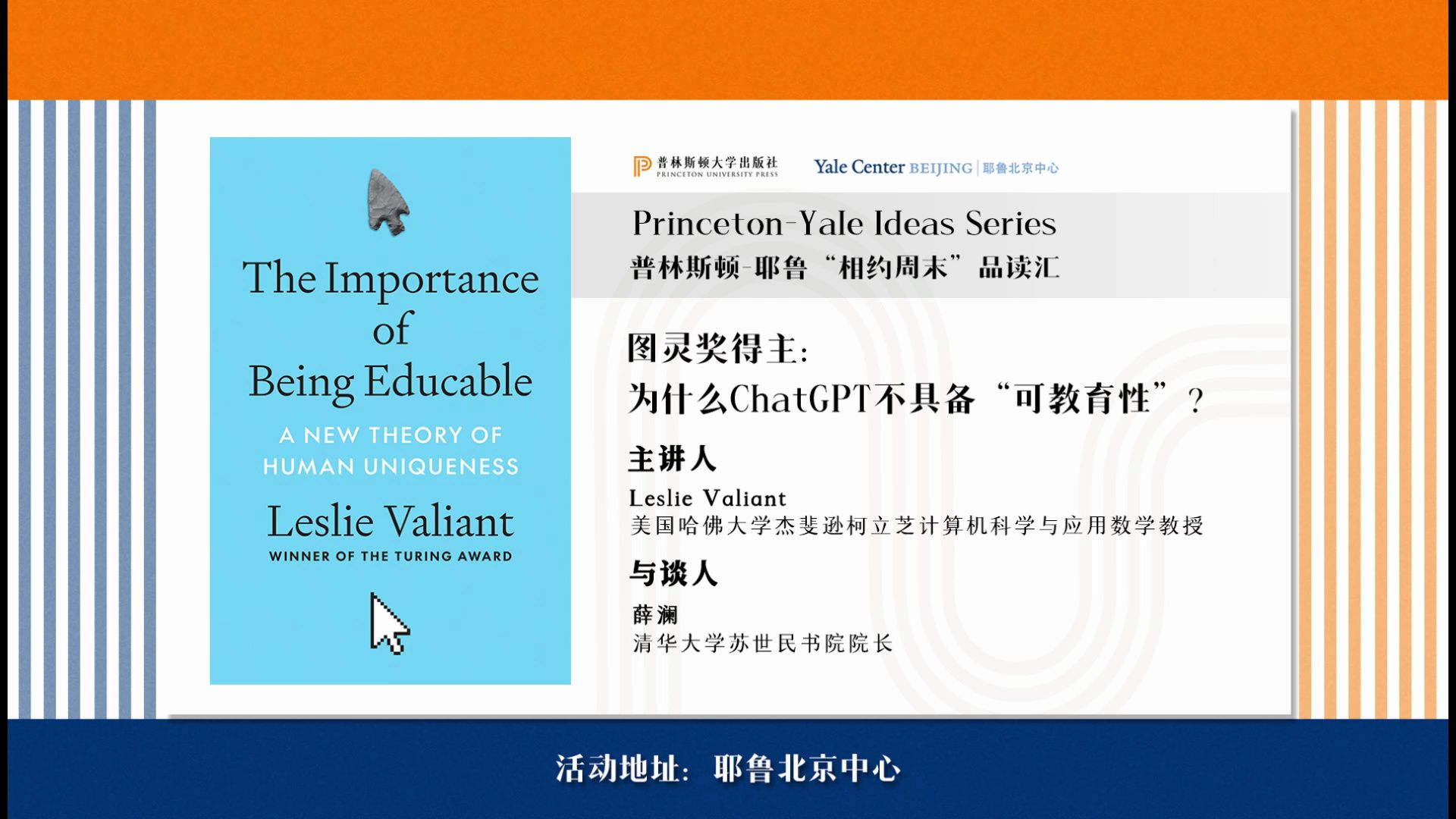
普林斯顿-耶鲁“相约周末”品读汇第六场:图灵奖得主对话清华苏
字幕摘录
| 时间 | 英文 | 中文 |
|---|---|---|
| 0:08 | Good morning everyone. | 大家早上好,你们好 |
| 0:09 | Welcome to the Yale Center Beijing. | 欢迎来到耶鲁中心北京. |
| 0:12 | I am Carolee Rafferty, the | 我是卡罗莉・拉费蒂 |
| 0:14 | executive director of Yale Center Beijing and a Yale College alumna. | 耶鲁北京中心执行董事和耶鲁学院校友. |
| 0:20 | I'm sorry that | 对不起 |
| 0:21 | I'm actually in the United States today, so I'm not there with you and our partner Princeton | 我其实今天在美国, 所以我不在那里 与你和我们的合作伙伴普林斯顿 |
| 0:28 | University Press and our distinguished speakers today, but I would still like to take this | 大学出版社和我们尊敬的演讲者今天,但我仍然想说: |
| 0:33 | opportunity to welcome all of you, our distinguished speakers, Professor Leslie Valiant and Dean | 欢迎各位,尊敬的发言者,莱斯利·瓦利安特教授和迪恩 |
| 0:42 | Xue Lan from the Schwarzman College who's returning to the Yale Center Beijing. | 薛兰从施瓦兹曼学院返回耶鲁中心北京. |
| 0:47 | As some | 作为一些 |
展开字幕全文(1087 条)
| 序号 | 英文 | 中文 |
|---|---|---|
| 1 | Good morning everyone. | 大家早上好,你们好 |
| 2 | Welcome to the Yale Center Beijing. | 欢迎来到耶鲁中心北京. |
| 3 | I am Carolee Rafferty, the | 我是卡罗莉・拉费蒂 |
| 4 | executive director of Yale Center Beijing and a Yale College alumna. | 耶鲁北京中心执行董事和耶鲁学院校友. |
| 5 | I'm sorry that | 对不起 |
| 6 | I'm actually in the United States today, so I'm not there with you and our partner Princeton | 我其实今天在美国, 所以我不在那里 与你和我们的合作伙伴普林斯顿 |
| 7 | University Press and our distinguished speakers today, but I would still like to take this | 大学出版社和我们尊敬的演讲者今天,但我仍然想说: |
| 8 | opportunity to welcome all of you, our distinguished speakers, Professor Leslie Valiant and Dean | 欢迎各位,尊敬的发言者,莱斯利·瓦利安特教授和迪恩 |
| 9 | Xue Lan from the Schwarzman College who's returning to the Yale Center Beijing. | 薛兰从施瓦兹曼学院返回耶鲁中心北京. |
| 10 | As some | 作为一些 |
| 11 | of you may know, Steve Schwarzman is a distinguished alumnus of Yale University and so we share | Steve Schwarzman是耶鲁大学的杰出校友 所以我们分享 |
| 12 | common resources including fantastic faculty and speakers and students. | 包括优秀的教师、演讲者和学生 |
| 13 | I would also like | 我还想 |
| 14 | to thank our colleagues at the Princeton University Press and Yale Center Beijing for making this | 感谢普林斯顿大学出版社和耶鲁大学北京中心的同事 |
| 15 | event possible as part of the Princeton Yale Idea Series we've launched here between the | 作为普林斯顿耶鲁思想系列的一部分 |
| 16 | Yale Center Beijing and Princeton University Press. | 耶鲁中心北京与普林斯顿大学出版社. |
| 17 | I'm going to get off very soon because | 我很快就要下车了 因为... |
| 18 | I want to leave the podium to my colleague Devin Lau, also a Yale College alumnus who's | 我想把讲台交给我的同事德文·劳 也是耶鲁大学的校友 |
| 19 | program director of the Yale Center Beijing. | 北京耶鲁中心方案主任。 |
| 20 | He and I have switched places. | 他和我换了地方 |
| 21 | He's usually | 他通常会 |
| 22 | based in New Haven and I'm usually based in Beijing, but at the moment I'm in the US and | 总部在纽黑文,我通常总部在北京 但此刻我在美国 |
| 23 | he's in China. | 他在中国 |
| 24 | He will talk a little bit about the Yale Center Beijing and also welcome Princeton | 他将略谈一下耶鲁中心北京,也欢迎普林斯顿 |
| 25 | University Press's Li Lingxi to the podium. | 大学出版社李玲茜登上讲台. |
| 26 | I understand that Lingxi will have the honor | 我知道玲茜会很荣幸的 |
| 27 | of introducing our wonderful speakers for today. | 介绍我们今天精彩的发言者。 |
| 28 | So without further ado, again, welcome | 所以,不用再多说了,再次欢迎 |
| 29 | everyone and thank you to our speakers and audiences and the teams at Princeton University | 感谢普林斯顿大学的演讲者和听众及团队 |
| 30 | Press and the Yale Center Beijing. | 出版社与耶鲁北京中心. |
| 31 | Thank you. | 谢谢 |
| 32 | Thank you, Carol. | 谢谢你,卡罗尔。 |
| 33 | As Carol mentioned, my name | 正如卡罗尔提到的,我的名字 |
| 34 | is Devin Lau. | 是刘德文 |
| 35 | I am the associate director for Yale Center Beijing, normally based at Yale | 我是耶鲁中心北京分局的副局长 通常在耶鲁 |
| 36 | in New Haven, but very honored to be able to be here in Beijing today to welcome all | 来到纽黑文 但很荣幸今天能来到北京 欢迎大家 |
| 37 | of you to this event. | 你们参加这次活动 |
| 38 | Today, I want to introduce a little bit about Yale Center Beijing. | 今天,我想向大家介绍一下耶鲁中心北京的情况。 |
| 39 | I'm | и琌 |
| 40 | just curious, how many of you guys are here for the first time? | 只是好奇 你们有多少人第一次来? |
| 41 | If you're here for the | 如果你是来这的 |
| 42 | first time, raise your hand. | 第一次,举起手来 |
| 43 | Okay, good. | 好吧,不错。 |
| 44 | So about half of you. | 大约一半的你。 |
| 45 | So Yale Center Beijing, | 所以耶鲁中心北京 |
| 46 | we are now entering our 10th year anniversary. | 我们现在进入我们的十周年纪念日。 |
| 47 | We were established in 2014 as Yale's only | 我们成立于2014年,是耶鲁唯一的 |
| 48 | center outside of New Haven that serves the whole university. | 纽黑文外的中心 服务整个大学。 |
| 49 | Afterwards, if you want, | 之后,如果你想的话, |
| 50 | there's a history wall behind me on the other wall that talks about the history of Yale | 我身后另一面墙上有一堵历史墙 讲述耶鲁的历史 |
| 51 | and China. | 中国。 |
| 52 | And as many of you guys probably know, it is the longest running relationship | 你们中很多人可能都知道, 这是最长的运行关系 |
| 53 | between any American university and China. | 在任何美国大学和中国之间 |
| 54 | And so we're very glad to be here. | 因此,我们很高兴来到这里。 |
| 55 | And thank | 谢谢 |
| 56 | you for coming on a Saturday morning to join us for this event. | 你周六早上来参加我们的活动 |
| 57 | We try to bring world leaders | 我们试图带来世界领袖 |
| 58 | across various different fields in the humanities, in the sciences, in technology, any field | 在人文、科学、技术、任何领域 |
| 59 | where there's interesting and cutting edge research to be done to bring together different | 进行有趣的尖端研究 将不同的 |
| 60 | people from different backgrounds to have good conversation about sort of the most pressing | 来自不同背景的人 来好好谈谈最紧迫的问题 |
| 61 | issues of the future. | 未来问题。 |
| 62 | And so I can't think of a more appropriate person to be talking | 所以我想不出一个更适合说话的人 |
| 63 | today and a more appropriate venue for this event. | 今天是举办这次活动的更合适地点。 |
| 64 | Just to show you a glimpse of how important | 只是让你看看有多重要 |
| 65 | this event is, as you know, you are at Yale Center Beijing. | 这件事情,你知道,你正在耶鲁中心北京。 |
| 66 | Our speaker today, Professor | 今天我们的演讲人,教授 |
| 67 | Leslie Valiant, is a professor at Harvard. | 莱斯利·瓦利安特是哈佛大学的教授. |
| 68 | And this is a Princeton University press. | 这是普林斯顿大学的报纸。 |
| 69 | So it's very hard to get Harvard, Yale, and Princeton all together in one room for an | 所以很难把哈佛,耶鲁,普林斯顿 都放在一个房间里 |
| 70 | event. | 活动。 |
| 71 | And so with that, I'm going to turn it to the representative from Princeton University, | 因此,我要把它 普林斯顿大学的代表, |
| 72 | who also happens to be a Yale SOM graduate I just found out, to introduce our speakers | 他刚好是耶鲁大学的毕业生 我刚刚发现,介绍我们的演讲者 |
| 73 | for today. | 为今天。 |
| 74 | Thank you, Devin, and thank you, Kara. | 谢谢你,德文,谢谢你,卡拉。 |
| 75 | So just a minor correction, I'm graduate from | 所以,只是一个小更正,我毕业于 |
| 76 | Columbia, so there's another Ivy League representative in the room today. | 哥伦比亚,所以有另一个常春藤联盟代表 今天在房间里。 |
| 77 | So okay, I thanks everyone | 好,谢谢大家 |
| 78 | for the offline and we also have the online audience for joining our July Princeton Yale | 我们也有在线观众 加入我们的七月普林斯顿耶鲁大学 |
| 79 | idea series. | 创意系列. |
| 80 | So this is an initiative in 2024, featuring world leading scholar and their | 因此,这是2024年的一项举措, 以世界著名学者及其 |
| 81 | most recent publications by Princeton University press. | 最近普林斯顿大学出版社出版的出版物。 |
| 82 | This event aims to foster scholarly | 这一活动旨在培养学术人才。 |
| 83 | exchange between China and the West on cutting edge topics of global relevance. | 中国和西方就具有全球意义的尖端议题进行交流。 |
| 84 | So since | 所以,自从 |
| 85 | Kara and Devin has given us their welcoming remarks, so I was just going to directly to | 卡拉和德文向我们致欢迎辞 所以我正要直接说 |
| 86 | introduce our speaker and the books today. | 今天介绍我们的演讲者和书籍。 |
| 87 | We're very pleased to have two honorable guests | 我们很高兴有两位贵宾 |
| 88 | featuring the importance of being educatable. | 说明教育的重要性。 |
| 89 | Firstly, I would like to introduce Professor | 首先,我想介绍教授 |
| 90 | Leslie Valiant. | 莱斯利·瓦利安特 |
| 91 | Valiant教授是T. Jefferson Coolidge计算机科学教授 | |
| 92 | and Applied Mathematics in Harvard University. | 和哈佛大学应用数学. |
| 93 | So he's the recipient of the Turner Award | 所以他是特纳奖的得主 |
| 94 | and the Venia Prize for his foundational contribution to machine learning and computer science. | 和威尼娅奖 他对机器学习和计算机科学的奠基贡献。 |
| 95 | And recently, in the very fresh news, in the 2024 International Congress for Basic Science, | 最近,在非常新鲜的新闻中, 在2024年国际基础科学大会上, |
| 96 | Professor Valiant was awarded the Basic Science Lifetime Achievement Award. | 瓦利安特教授被授予基础科学终身成就奖. |
| 97 | Congratulations | 祝贺你 |
| 98 | to you, Professor, to have another one to your award collection. | 敬你,教授,给你的奖品收藏 |
| 99 | So our honorable discussion | 所以我们的光荣讨论 |
| 100 | today is Professor Xue Lan, Dean of Schwarzman College and Tsinghua University. | 今天是施瓦兹曼学院和清华大学院长薛兰教授. |
| 101 | Professor | 教授 |
| 102 | Xue is also a distinguished faculty of Arts, Humanities and Social Sciences and Tsinghua | 薛亦是文科,人文科和社会科学及清华科的杰出院士. |
| 103 | University, where he also serves as the Director of the Institute for AI International Governors | 大学,他还担任大赦国际国际理事研究所所长 |
| 104 | and Director of China Institute for Science and Technology Policy. | 并担任中国科学技术政策研究所所长. |
| 105 | I want to have a special | 我想有一个特别的 |
| 106 | mention is Professor Xue Lan also sits on the advisory board of Princeton University | 薛兰教授也是普林斯顿大学的顾问 |
| 107 | Press in China. | 中国出版社. |
| 108 | Thanks for your continuous guidance and support to us. | 谢谢你对我们的持续指导和支持。 |
| 109 | And Professor | 还有教授 |
| 110 | Xue's research interests include global governance, crisis management, science, technology and | 薛'的研究兴趣包括全球治理,危机管理,科学,技术,以及研究. |
| 111 | innovation policy. | 创新政策。 |
| 112 | So with this very extensive expertise, I hope, I believe your research | 所以,有了这种非常广泛的专业知识, 我希望,我相信,你的研究 |
| 113 | contribution will provide a lot of insight into our topic today. | 贡献将为我们今天的专题提供很多见解。 |
| 114 | Okay, let's finally | 好吧,让我们终于 |
| 115 | circle back to the book of today. | 圆回今日之书. |
| 116 | The importance of being educatable, which tackles a very | 教育的重要性,它涉及一个非常复杂的问题。 |
| 117 | key issue is our intelligence driven culture lack a very clear definition, intelligence | 关键的问题是 我们的智能文化 缺乏一个非常明确的定义,智能 |
| 118 | is. | 没错 |
| 119 | And in this visionary work, Professor VanLand argues that the remarkable educability | 在这部富有远见的作品中,范兰德教授认为,卓越的可教育性 |
| 120 | of human brain understood as an information processing ability is what sets our species | 人类大脑被理解为 一种信息处理能力 是我们物种的形成 |
| 121 | apart enables the flourishing of our civilization. | 我们的文明得以繁荣。 |
| 122 | So by examining how we learn and comparing | 所以通过研究我们如何学习和比较 |
| 123 | it to the animals and AI, Professor VanLand emphasized the education should be the humankind's | VanLand教授强调教育应该是人类的 |
| 124 | natural preoccupation. | 自然的关心。 |
| 125 | Very fascinating. | 非常令人着迷。 |
| 126 | So last a little of the house, Professor VanLand | VanLand教授 房子的最后一点 |
| 127 | will speak for 40 to 45 minutes to offer the key insights of the book. | 将发言40至45分钟,提供这本书的关键见解。 |
| 128 | And Professor Xue | 还有薛教授 |
| 129 | Lan will comment and share his perspective for 15 to 20 minutes. | 兰将评论并分享他的观点,时间为15至20分钟. |
| 130 | So anyone who has questions | 所以任何有疑问的人 |
| 131 | for two speakers will be able to raise them in the Q&A sessions. | 两名发言者可以在“QQA”会议上发言。 |
| 132 | So let's work on Professor | 所以,让我们的工作教授 |
| 133 | (原始内容存档于2018-09-27). Lais-Louis VanLand. | |
| 134 | Okay, well, thank you very much for inviting me here. | 好吧,谢谢你邀请我来这里 |
| 135 | And thank | 谢谢 |
| 136 | you for PUP for publishing this book. | 你为PUP出版这本书。 |
| 137 | So you know, I find writing a book in a quite a big | 所以,你知道,我发现写一本书 在相当大的 |
| 138 | effort takes a lot of time. | 努力需要很多时间。 |
| 139 | So I only do it if I really have to. | 所以,我只这样做,如果我真的需要。 |
| 140 | So this book brings together | 所以这本书聚集在一起 |
| 141 | some ideas I've been thinking about for a very long time. | 一些想法,我已经想了很久。 |
| 142 | And it kind of come out somehow | 不知怎么的出来了 |
| 143 | these elements came together in a new way. | 这些要素以新的方式结合在一起。 |
| 144 | So I thought I had something to say. | 所以我觉得我有话要说 |
| 145 | And so | 这样 |
| 146 | this book tries to say it. | 这本书试图说出来。 |
| 147 | So that's the book. | 故此书. |
| 148 | Okay, so very roughly, well, I'll tell you | 好吧,那么简单,好吧,我告诉你 |
| 149 | what the book is really about. | 那本书到底是为了什么 |
| 150 | But one byproduct of the book is that while I was writing | 但书的一个副产品是 当我写的时候 |
| 151 | it, sort of AI in the shape of large language models were suddenly launched onto the world | 它,某种AI的形状 大语言模型 突然向世界推出 |
| 152 | in a rather strange way, I thought. | 我觉得有点奇怪 |
| 153 | So maybe confusing way. | 所以也许混乱的方式。 |
| 154 | So I think one of the byproducts | 所以我认为其中的一个副产品 |
| 155 | of the book, I think it does offer a simple way of looking at AI, which maybe is simpler | 我认为它的确提供了一种简单的AI的视角, |
| 156 | than what the press tell you. | 比媒体告诉你。 |
| 157 | But the main point of the book, which is what I'll try | 但书的要点,这就是我要尝试 |
| 158 | to tell you about, is that it's really about humans. | 告诉你,这是真的 关于人类。 |
| 159 | Okay, so it's really about humans | 好吧,这真的是关于人类的 |
| 160 | looked at from a computational perspective. | 从计算的角度审视。 |
| 161 | So the main question is, what is the cognitive | 所以主要问题是 认知是什么 |
| 162 | capability that humans have that have enabled us to build the civilization that we have? | 人类有能力 使我们建立文明? |
| 163 | And since everything we ask computers to do, almost everything reflects ourselves, we try | 既然我们要求电脑做的一切, 几乎一切都反映了我们自己, 我们尝试 |
| 164 | to get computers to do what we try to do. | 让电脑做我们想做的事 |
| 165 | This is also an answer to the question of | 这也是对以下问题的回答: |
| 166 | what's the potential power of AI. | AI的潜在力量是什么? |
| 167 | So the idea of treating humans and computers in the same | 因此,关于对待人类和计算机的想法是相同的 |
| 168 | breath. | 呼吸 呼吸 呼吸 呼吸 呼吸 呼吸 |
| 169 | 我们从Alan Turing那里得到了执照 | |
| 170 | And in a radio broadcast in 1951, | 在1951年的一次电台广播中 |
| 171 | he asked whether can every task done by humans be also done by a machine? | 他问,人类完成的每一项任务是否都能够由机器完成? |
| 172 | And I think his | 我觉得他 |
| 173 | answer was very important, I think. | 我认为,答案非常重要。 |
| 174 | So he said that it is customary in a talk or article | 所以他说,这是习惯 在谈话或文章中 |
| 175 | on this subject to offer a grain of comfort in the form of a statement that some particularly | 以声明的形式提供舒适的一粒 |
| 176 | human characteristic could never be imitated by a machine. | 人类的特征永远无法被机器模仿. |
| 177 | It might, for instance, be said | 例如,可以说 |
| 178 | that no machine could write good English or that it could not be influenced by sex appeal | 没有机器能写好英语 或不会受到性吸引力的影响 |
| 179 | or smoke a pipe. | 或抽烟管。 |
| 180 | I cannot offer any such comfort for I believe that no such bounds can be set. | 我无法提供这种安慰,因为我认为没有这种界限。 |
| 181 | So he basically said that this is settled, whatever humans can do, machines will be able | 所以他基本上说,这是解决的, 无论人类能做什么,机器都能够 |
| 182 | to do as well. | 也一样 |
| 183 | And I think it's worth taking his words for it because this wasn't just | 我认为这是值得的 他的话,因为它不仅仅是 |
| 184 | philosophical guess on his part. | 他的哲学猜测。 |
| 185 | This was really his science. | 这真的是他的科学。 |
| 186 | So his main contribution to science | 所以他对于科学的主要贡献 |
| 187 | was what became known as the Turing thesis, which is that certain definition of computation, | 就是所谓的图灵论文 就是计算的某些定义 |
| 188 | which he devised, he hypothesized to be the most powerful there is in the universe for any device | 他设计了它, 他假设它是宇宙中最强大的任何装置 |
| 189 | whether it's biological, chemical, electrical. | 无论是生物,化学,电气。 |
| 190 | And this hypothesis has stood up well. | 而这个假说得到了很好的支持. |
| 191 | It's a | 这是一个 |
| 192 | very firmly established principle of science. | 科学原则非常牢固 |
| 193 | So in principle, he told us that whatever | 所以原则上,他告诉我们,无论 |
| 194 | humans can do, machines can do as well. | 人类可以,机器也可以 |
| 195 | And I say we should take his word for this. | 我说我们应该接受他的话 |
| 196 | And this isn't a very productive question, although this is the question which everyone | 虽然这是每个人的问题 |
| 197 | asks at the end. | 问在结尾。 |
| 198 | I know that, but let's not start with that. | 我知道,但让我们不要从那开始。 |
| 199 | So I think the more important | 所以我认为更重要的 |
| 200 | question is that supposing at a general level, humans and machines can do the same thing. | 问题是,一般意义上的假设,人类和机器也可以做同样的事情. |
| 201 | Well, what is it that humans can do? | 人类能做什么? |
| 202 | Why don't we define what humans can do? | 我们为什么不定义人类能做什么呢? |
| 203 | If we | 如果我们 |
| 204 | can't define ourselves, then what are we talking about? | 无法定义自己,那么我们在说什么呢? |
| 205 | So how to characterize human capabilities. | 如何描述人的能力 |
| 206 | So for thousands of years, we're told that the most important study is the study of ourselves, | 所以几千年来 我们被告知最重要的研究是研究我们自己 |
| 207 | but I don't think we understand ourselves too much. | 但是我觉得我们不太了解自己 |
| 208 | And then as an illustration of this, | 然后作为一个例子, |
| 209 | we can look at the word intelligence. | 我们可以看看智能这个词 |
| 210 | So I think humans almost define ourselves by the word | 所以我认为人类几乎用这个词来定义自己 |
| 211 | intelligence. | 情报 |
| 212 | So when we measure our mental capabilities, we often call the result an | 因此,当我们测量我们的精神能力时, 我们经常把结果称为 |
| 213 | intelligence quotient. | 情报商号. |
| 214 | When we attempt to emulate our mental factors, we call it artificial | 当我们试图模仿 我们的精神因素, 我们称之为人为的 |
| 215 | intelligence. | 情报 |
| 216 | Some fear that machines more intelligent than humans would be an existential | 有些人担心机器比人类更聪明 会成为存在 |
| 217 | threat. | 威胁。 |
| 218 | So the press is full of scare stories and in searching the cosmos, we're seeking | 因此,媒体充斥着恐怖的故事 在搜索宇宙中,我们正在寻找 |
| 219 | intelligent life. | 聪明的生活。 |
| 220 | So you would think that we'd understand intelligence, but we don't and | 所以你会认为我们理解情报, 但我们不... |
| 221 | professionals don't either. | 专业人士也不会 |
| 222 | So for psychologists who are responsible for intelligence tests, | 所以对于负责情报测试的心理学家来说 |
| 223 | it became important to actually find out what is it that we're testing people for. | 发现我们测试人的目的很重要 |
| 224 | And famously, | 而著名的是, |
| 225 | this quotation from a report from the American Psychological Association says that | 美国心理学会的一篇报道引述如下: |
| 226 | two dozen prominent theorists were recently asked to define intelligence, they gave two dozen | 二打著名理论家最近被要求定义情报 他们给了二打 |
| 227 | somewhat different definitions. | 定义有些不同。 |
| 228 | And so the reason for this isn't very mysterious. | 所以这个原因并不神秘。 |
| 229 | So by definition, | 所以,根据定义, |
| 230 | I mean that if you think you know what intelligence is, then my question is, well, | 我的意思是,如果你认为你知道什么是情报, 那么我的问题是,嗯, |
| 231 | how do you recognize an intelligent person? | 你怎么认识一个聪明人? |
| 232 | So what behavior do you look for? | 你在找什么行为? |
| 233 | And this is very | 这是非常 |
| 234 | surprising because so the IQ tests when they started, they were inspired partly by this | 出乎意料的是,在开始智商测试时, 他们部分地受到这个启发 |
| 235 | psychologist, the Charles Spearman in 1904, and he defined it implicitly. | 心理学家,1904年的查尔斯·斯皮尔曼(Charles Spearman),他隐含地定义了这一点. |
| 236 | So he talked about | 所以他谈到 |
| 237 | statistical correlations between how children in schools do different subjects. | 在校儿童如何完成不同科目的统计相关性。 |
| 238 | And so intelligence | 如此聪明 |
| 239 | is something to do with this statistical correlation. | 这与统计相关性有关。 |
| 240 | He didn't define, you know, what an | 他没有定义,你知道,什么是 |
| 241 | intelligent person does, you know, how to recognize it. | 聪明的人,你知道, 如何识别它。 |
| 242 | So intelligence has always had this | 所以情报部门一直有这个 |
| 243 | implicit definition, which is justified by correlations. | 隐含的定义,以相关关系为理由. |
| 244 | Okay, so the reason people do | 好吧,所以人们这样做的原因 |
| 245 | intelligence tests is that maybe it correlates with performance in college. | 智力测试可能与大学的成绩有关 |
| 246 | But of course, | 当然 |
| 247 | many other things correlate with many other things, we somehow should do better, should be | 很多其他的事情和很多其它的事情有关 我们该做得更好 |
| 248 | actually define what we're doing. | 实际定义我们在做什么。 |
| 249 | So, okay, so this is the question I approach. | 所以,好吧,这就是我遇到的问题。 |
| 250 | And | 还有 |
| 251 | under cover design at Princeton University Press, who are rather brilliant cover design for us. | 在普林斯顿大学出版社的封面设计下 他们对我们来说非常出色 |
| 252 | So he summarized the book by asking, how is it that we got from that's a picture of a | 所以,他总结了这本书,问, 它是怎样得到的,这是一张图片, |
| 253 | historic arrow to a cursor on a computer? | 历史箭头到计算机上的光标? |
| 254 | So how is it that humans went from, | 人类是怎么从这里来的? |
| 255 | you know, in about 5,000 years from the kind of Stone Age, Iron Age, whatever to | 从石器时代到铁器时代 大约五千年的时间里 |
| 256 | present day civilization? | 现在的文明? |
| 257 | And so the exact question I ask is, what is the cognitive capability | 所以,我问的准确问题是, 什么是认知能力 |
| 258 | that enabled humans to go from one to the other? | 能让人类从一个到另一个? |
| 259 | And so I call this the civilization | 所以我把这叫做文明 |
| 260 | enabler. | 推进器。 |
| 261 | And cognitive is a capability. | 而认知是一种能力。 |
| 262 | And so by doing this, I make my task easier. | 因此,通过这样做,我让我的任务更容易。 |
| 263 | So | 这么说 |
| 264 | I don't have to address all the issues which we share with other animals. | 我不必讨论我们与其他动物共有的所有问题。 |
| 265 | So how we see how we | 我们如何看待我们 |
| 266 | move our emotions are all very interesting questions. | 移动我们的情绪都是非常有趣的问题。 |
| 267 | But we share all these with other | 但是,我们分享这一切 与其它 |
| 268 | animals. | 动物 |
| 269 | They have a lot of this. | 他们有很多这些。 |
| 270 | So that's not a human invention. | 所以这不是人类的发明。 |
| 271 | So these things are part of us | 所以这些东西是我们的一部分 |
| 272 | important part of us. | 我们的重要部分。 |
| 273 | But somehow the difference between us and other animals isn't this. | 但不知何故,我们和其他动物之间的区别不是这个. |
| 274 | | |
| 275 | so we're looking for a more abstract mental capability, which we evolve, which we evolved. | 所以我们在寻找一种更抽象的心理能力 我们进化,进化。 |
| 276 | Okay. | 摆 |
| 277 | And so I do take the approach of computation, which is what I do. | 所以我采取计算的方法,这就是我的工作。 |
| 278 | That's my day job. | 这是我的日常工作。 |
| 279 | Okay. | 摆 |
| 280 | And the methodologies we're discussing at length and the book does, but | 而我们正在讨论的方法 和书有,但 |
| 281 | very roughly, what it's about is that I want to, when I define the capability, | 大致来说,我想当定义能力时, |
| 282 | I want it to be kind of well defined in a mathematical sense that, you know, when you | 我想从数学的角度来定义它 当你 |
| 283 | exercise this capability, okay, when you exercise this capability, you know, you should know, | 行使这个能力,好吧, 当你行使这个能力, 你知道,你应该知道, |
| 284 | you should be able to say what the difference is after from what it was before. | 你应该能说出之前的区别 |
| 285 | Okay, so it's a | 好吧,所以这是一个 |
| 286 | functionally well defined that, you know, if you do something, you know, what difference you're | 功能上的定义很好,你知道, 如果你做了一些事情, 你知道,你有什么区别 |
| 287 | making. | 制作。 |
| 288 | And the second part hidden away there is that it should be computationally feasible. | 第二部分隐藏在外的是 计算上应该是可行的 |
| 289 | So we shouldn't wish for kind of pie in the sky, which is we should do things, which is only | 所以我们不应该在天上想吃馅饼 这就是我们应该做一些事情,这只是 |
| 290 | defined functions, which are computationally in principle doable in this universe. | 定义函数,这些函数原则上可以在这个宇宙中实现。 |
| 291 | So there is a | 所以有一个 |
| 292 | methodology there, which restricts us to things which are fairly concrete. | 将我们限制在相当具体的事情上。 |
| 293 | Okay. | 摆 |
| 294 | So what is this | 这是什么 |
| 295 | civilization enabler? | 文明促进器? |
| 296 | Well, of course, in various forms, this question has been asked by many people | 当然, 以各种形式, 许多人都问过这个问题 |
| 297 | for a long time. | 长久以来 |
| 298 | And so here, you know, on the website, you can find 617 different topics and | 所以在这里,你知道,在网站上, 你可以找到617个不同的话题, |
| 299 | academic references to research on how humans and non-humans differ. | 学术上提及了人类与非人类之间如何差异的研究. |
| 300 | So there's no shortage of | 所以,没有缺少 |
| 301 | opinions and data on this. | 关于这一点的意见和数据。 |
| 302 | But, you know, I'm looking for something very particular. | 但是,你知道,我在找非常特别的东西。 |
| 303 | So I want | 所以,我想这样 |
| 304 | a cognitive capability, which enables humans to achieve the civilization we have. | 一种认知能力,它使人类能够实现我们的文明。 |
| 305 | And so obviously | 很明显 |
| 306 | not like so eyebrows, supposedly, only humans have eyebrows in the animal kingdom, but there's no | 不像那样的眉毛 应该是只有人类在动物王国有眉毛 但是没有 |
| 307 | mathematics. | 数学 |
| 308 | Okay. | 摆 |
| 309 | Animal domestication. | 动物驯化. |
| 310 | So there's, of course, a lot of literature on people who say | 所以,当然,有很多关于人们说 |
| 311 | what was important in human history. | 这在人类历史上很重要 |
| 312 | So animal domestication was very important in human history. | 因此动物驯化在人类历史上非常重要. |
| 313 | But again, there's no theory that if you can domesticate animals, then you can make rockets | 但还是没有理论,如果你可以驯养动物, 那你就可以制造火箭 |
| 314 | {\fn黑体\fs22\bord1\shad0\3aHBE\4aH00\fscx67\fscy66\2cHFFFFFF\3cH808080}去月球 {\fn黑体\fs22\bord1\shad0\3aHBE\4aH00\fscx67\fscy66\2cHFFFFFF\3cH808080}去月球 | |
| 315 | Okay. | 摆 |
| 316 | So it's not a capability which explains why we do what we do. | 所以这不是一种能力 来解释我们为什么这样做。 |
| 317 | So there are | 这么说 |
| 318 | people who work on human evolution, anthropology, emphasize are special to humans. | 那些致力于人类进化、人类学的人 对人类来说是特别的 |
| 319 | We collaborate a | 我们合作 |
| 320 | lot. | 经常 |
| 321 | We do social learning, but to other animals, intelligence, as I said, is not too well defined. | 我们做社会学习,但对其他动物来说,智力,正如我所说,没有太明确. |
| 322 | So symbols and language. | 所以符号和语言。 |
| 323 | So is this disturbing having this thing there? | 所以,这是令人不安的 这件事情在那里? |
| 324 | Or | 或者说 |
| 325 | yeah, yes. | 对,对。 |
| 326 | Can we remove this? | 我们能把这个拿掉吗? |
| 327 | I don't know. | 师曰. |
| 328 | Anyway, so if we can remove it, that would be good, I think. | 无论如何,所以如果我们能移除它,这将是好的,我认为。 |
| 329 | But | 不过 |
| 330 | sure. | 当然 |
| 331 | I'll try to do it. | 我会尽力的 |
| 332 | Anyway. | 总之 |
| 333 | Okay, so I can see what I'm saying here. | 好吧,所以我可以看到我在这里说什么。 |
| 334 | Anyway. | 总之 |
| 335 | Okay. | 摆 |
| 336 | So symbols and language are getting closer. | 所以符号和语言越来越接近了. |
| 337 | But again, they're not | 再说一次,他们不是 |
| 338 | capabilities. | 能力。 |
| 339 | They're important. | 他们很重要。 |
| 340 | But just because you teach an ape language, it doesn't make them | 但只是因为你教了猿人语言, 这并不让他们 |
| 341 | behave differently. | 行为不同。 |
| 342 | Okay. | 摆 |
| 343 | So briefly, so what did Darwin say about this question? | 达尔文对这个问题怎么说? |
| 344 | So somewhere, | 所以在某个地方 |
| 345 | basically, he said that, you know, along all these dimensions, conventional dimensions, | 基本上,他说,你知道, 在所有这些维度, 常规维度, |
| 346 | he believed that humans differ only in degree and not absolutely. | 他相信人类只在程度上不同 而不是绝对不同 |
| 347 | So he couldn't find any, | 所以他找不到一个 |
| 348 | you know, simple phrase which distinguished us. | 你知道,简单的句子 把我们区分开来。 |
| 349 | So comment that, okay, so the main comment here is | 所以,评论,好吧, 所以这里的主要评论是 |
| 350 | that what advantage we have is that with this computer science approach, I can be more precise, | 我们的优势在于 通过这种计算机科学方法 我可以更精确地说 |
| 351 | you know, a bit more theoretical, but I can be more precise. | 你知道,有点理论, 但我可以更精确。 |
| 352 | And by being more precise, | 更精确一点 |
| 353 | I can express things which are slightly more complicated. | 我可以表达一些更复杂的事情。 |
| 354 | Okay. | 摆 |
| 355 | So just picking single words | 所以只选一个单词 |
| 356 | from the dictionary, maybe too simple. | 从字典,也许太简单。 |
| 357 | Maybe there's no single word from the dictionary, | 也许词典上没有单词 |
| 358 | which suffices. | 足够了。 |
| 359 | But if you construct something slightly more complicated, then maybe | 但如果你构筑的东西稍微复杂一些, 那么也许 |
| 360 | you get there. | 你到达那里。 |
| 361 | Okay. | 摆 |
| 362 | So okay. | 所以没关系。 |
| 363 | Okay. | 摆 |
| 364 | Thank you. | 谢谢 |
| 365 | Okay. | 摆 |
| 366 | So basically what I have to say, so I can describe to you what I propose as this | 所以,基本上,我必须说, 所以我可以描述给你 我提议作为这个 |
| 367 | civilization enabler. | 文明促进器。 |
| 368 | So it's a composite capability in terms of how we learn information. | 因此,从我们如何学习信息的角度来说,这是一个综合能力。 |
| 369 | It's about how we learn and process information. | 这是关于我们如何学习和处理信息。 |
| 370 | It's put in this computer science kind of | 放在电脑科学里 |
| 371 | way of thinking. | 思维方式 |
| 372 | So basically, I can summarize this to various levels of detail. | 所以,基本上,我可以概括一下 各个层次的细节。 |
| 373 | And then at | 礛 |
| 374 | I've got some afterthoughts, which are various directions in which I have ventured to think, | 我有一些事后的想法, 这些是不同的方向, 我冒昧地想, |
| 375 | which I hadn't thought about before, inspired by this definition. | 我之前没有想过, 灵感来自这个定义。 |
| 376 | Okay. | 摆 |
| 377 | So I think if you look | 所以我觉得如果你看 |
| 378 | at this definition, then you start thinking in various directions. | 在这个定义中,你开始从不同的方向思考。 |
| 379 | Okay. | 摆 |
| 380 | So this, my proposed | 所以这个,我提议 |
| 381 | solution, I call educability. | 解决,我叫教育。 |
| 382 | It's a word, it's an invented word, which is a definition, | 这是一个词,这是一个发明的词, 这是一个定义, |
| 383 | and I'll tell you what I mean by it. | 我会告诉你我的意思 |
| 384 | But obviously, it's most similar to the idea that | 但很明显,它最类似的想法是: |
| 385 | we are waiting around to be educated. | 我们正等着接受教育 |
| 386 | We're waiting around to be filled with, to absorb | 我们等着被填满 吸收 |
| 387 | knowledge and to use it. | 知识并用. |
| 388 | Okay. | 摆 |
| 389 | So very roughly, people stand around reading their cell phones, | 粗略地说,人们站在周围看手机, |
| 390 | watch movies, they read books. | 看电影,他们看书。 |
| 391 | So we're all the time waiting to absorb more and more knowledge. | 因此,我们一直在等待 吸收越来越多的知识。 |
| 392 | We're very good at absorbing more and more knowledge. | 我们非常善于吸收越来越多的知识. |
| 393 | And we can put the knowledge into | 我们可以把知识投入到 |
| 394 | our minds and organize it and use it. | 我们的心灵,组织它,使用它。 |
| 395 | So we're very good at something. | 所以我们很擅长的东西。 |
| 396 | And I'm trying to capture | 我试图抓住 |
| 397 | this as best I can. | 尽我所能 |
| 398 | Okay. | 摆 |
| 399 | So I've got a one-page definition, and then I unpack it later on. | 所以我有一个一页的定义, 之后我把它拆开。 |
| 400 | So this basically consists of three capabilities. | 所以这基本上由三个能力组成。 |
| 401 | The first one is that we can generalize from | 首先,我们可以概括 |
| 402 | experience. | 经验 |
| 403 | So we can have particular experiences, and we can generalize from it to gain more general | 因此我们可以有特殊的经验, 我们可以从它中概括到更普遍 |
| 404 | beliefs. | 信仰 信仰 信仰 信仰 信仰 信仰 |
| 405 | And so this will boil down to exactly what current machine learning does. | 因此,这可以归结为 真正的当前机器学习的作用。 |
| 406 | Okay. | 摆 |
| 407 | So | 这么说 |
| 408 | current machine learning, for example, now large language models take lots of sentences | 例如,当前机器学习,现在大型语言模型需要很多句子 |
| 409 | and are very good at predicting the next word. | 而且很擅长预测下一个词 |
| 410 | Okay. | 摆 |
| 411 | That's an example of generalization. | 以此为例通论. |
| 412 | So | 这么说 |
| 413 | that's very successful, but it's not everything. | 这是非常成功的,但它不是一切。 |
| 414 | We start with that. | 我们从这个开始。 |
| 415 | So the second aspect is that | 所以第二个方面是 |
| 416 | once we're good at acquiring these beliefs from experience, then it seems natural that we want | 一旦我们善于从经验中获得这些信念,那么我们自然想要 |
| 417 | to combine it. | 结合它。 |
| 418 | So if we've learned two things and the first belief we acquire, we see situations | 所以,如果我们学到了两件事 和我们得到的第一个信念, 我们看到了情况 |
| 419 | where we predict what's going to happen next. | 我们预测接下来会发生什么 |
| 420 | Then from our second belief, we want to predict | 然后从我们的第二个信念,我们要预测 |
| 421 | what will happen after that. | 之后会发生什么? |
| 422 | So when we plan how we get home this afternoon, then we make a sequence | 所以,当我们计划 我们如何回家今天下午, 然后我们做一个序列 |
| 423 | of predictions. | 预测。 |
| 424 | And each of these we've learned separately, but we can combine them. | 每一个我们分别学到, 但我们可以结合它们。 |
| 425 | And the | 还有 |
| 426 | third thing is being able to acquire beliefs, not from our own experience, but I suppose from | 第三点是能够获得信仰 而不是从我们的经验, 但我想从 |
| 427 | others' experience possibly, but by being told explicitly. | 其他人的经验可能是, 但通过被明确告知。 |
| 428 | So if you sit in a lecture room, | 所以如果你坐在讲堂里 |
| 429 | then you're explicitly told beliefs, you're taught a formula and you know how to execute the formula, | 然后明确地告诉你信仰, 你被教导一个公式 你知道如何执行公式, |
| 430 | you're taught a recipe, you're taught some procedure. | 你被教过一个食谱, 你被教过一些程序。 |
| 431 | So you're taught in computational | 所以,你教计算 |
| 432 | terms, you're basically taught a computer program which you can execute. | 术语,你基本上被教导一个计算机程序 你可以执行。 |
| 433 | And where this program | 计划在哪里 |
| 434 | comes from, who knows, it's not your personal experience. | 从,谁知道,这不是你的个人经验。 |
| 435 | And certainly formula education is | 当然,公式教育 |
| 436 | very much based on number three, but by itself it's not very rich. | 非常基于第三位,但本身并不十分丰富. |
| 437 | And so all this you have to | 所以这一切你必须 |
| 438 | describe in some context which is rich enough that it's worthwhile. | 在某种背景下描述 足够丰富 值得它。 |
| 439 | So if your whole world was | 所以如果你的世界是 |
| 440 | like a one pixel screen, then it wouldn't be worth doing this. | 就像一个像素显示屏, 那么它不值得这样做。 |
| 441 | So this says that we can do | 这么说我们能做到 |
| 442 | these kinds of things in what I call a mind's eye. | 我称之为心目中的这些东西 |
| 443 | So we can analyze a scene, we can see three | 所以我们可以分析一个场景,我们可以看到三个 |
| 444 | people in front of me and see who's sitting next to whom. | 人们在我面前 看看是谁坐在旁边 |
| 445 | We can analyze small scenes and we can | 我们可以分析小场景 我们可以 |
| 446 | learn about these scenes and do all those things. | 了解这些场景 并做所有这些事情。 |
| 447 | And the last part is that we can also do | 最后一点是,我们也能做到 |
| 448 | symbolic naming that we can give arbitrary names to people or to things or to scientific concepts. | 象征着我们可以给人或事物或科学概念任意命名。 |
| 449 | And all these things, three things are implemented, are integrated. | 并且所有这些东西,三件事都得到了实施,是综合的. |
| 450 | So that's a | 这么说吧 |
| 451 | definition and just very briefly. | 定义和非常简短。 |
| 452 | So educational philosophers talk about many things, | 所以教育哲学家谈了很多事情 |
| 453 | but certainly they do hit these three things that I suppose number three is this very formal | 但当然,他们确实打击了这三件事, 我想第三件事情是非常正式的 |
| 454 | called transferring knowledge from one person to another. | 将知识从一个人转移到另一个人。 |
| 455 | We have traditional education, | 我们有传统教育, |
| 456 | but also emphasize that doing some hands-on learning when we learn from our own experience. | 但同时也强调当我们从自己的经验中吸取教训时,要进行一些实践学习。 |
| 457 | Number one is also important, inseparable. | 第一也很重要,不可分割。 |
| 458 | And the number two is like being able to apply what | 二号就像能够应用什么 |
| 459 | you've learned and not just soaking in information, you have to be able to kind of apply it. | 你学会了,不只是在信息中浸泡, 你必须能够应用它。 |
| 460 | So these | 所以这些 |
| 461 | three things touch what people discuss is a good thing to do in education. | 三件事触动人们讨论的 是教育中的一件好事 |
| 462 | So as I said, the hypothesis is that we are able to do this and other species cannot. | 因此,正如我所说的,假设是,我们能够做到这一点,而其他物种则不能这样做。 |
| 463 | Then I don't have to give you an evolutionary timeline, but I can give a reasonable guess. | 那我就不用给你一个进化时间表 但我可以给你一个合理的猜测 |
| 464 | And the point here is that the basic idea of generalizing experience using that is surely | 这里的要点是,把经验概括起来的基本思想是: |
| 465 | very ancient. | 非常古老的。 |
| 466 | So every animal in the world that it's looking for food and avoiding predators, | 所以世界上的每一个动物 都在寻找食物和躲避掠食者 |
| 467 | is able to learn from experience. | 能够学习经验。 |
| 468 | So that's very ancient. | 所以这是非常古老的。 |
| 469 | But on top of this, the more recent | 但除此之外,最近一个 |
| 470 | addition what humans can do is to be able to learn explicit descriptions of complicated things from | 此外,人类能够做的是能够从中学习关于复杂事物的明确描述。 |
| 471 | each other. | 彼此间. |
| 472 | And of course, we do this through the language. | 当然,我们通过语言来做到这一点。 |
| 473 | But what I'm describing is the | 但我所描述的是 |
| 474 | capability you have to receive it. | 你必须接受它的能力。 |
| 475 | So the support of the hypothesis is that this basic capability | 所以这个假设的支持是 这个基本能力 |
| 476 | talking about species has had from the beginning. | 谈论物种 从一开始。 |
| 477 | So we may have had this capability | 所以我们也许有这种能力 |
| 478 | by coming out just before. | 刚刚出来的时候 |
| 479 | So certainly during the lifetime of our species, | 所以在我们人类的一生中 |
| 480 | people have looked for genetic changes, which might account for our | 人们一直在寻找基因的改变 这可能代表我们 |
| 481 | greater increases in cognitive performance, but haven't haven't found any. | 认知性能的提高,但还没有找到。 |
| 482 | So it's quite possible | 所以这是完全可能的 |
| 483 | that what's going on is that we had some capability from the beginning, but it just took a very long | 事情是这样的 我们从一开始就有某种能力 但只是花了很长的时间 |
| 484 | time to kind of to become useful. | 是时候变得有用了 |
| 485 | So certainly the idea of being able to exchange knowledge from | 因此,肯定的想法是,能够交流来自 |
| 486 | others is it gets more and more useful if there's more and more knowledge to exchange. | 如果有更多的知识可以交流,它就会越来越有用。 |
| 487 | So anyway, | 所以不管怎样 |
| 488 | I'm not committed to this timeline, but it's just a possible timeline. | 我并不致力于这个时间表,但这只是一个可能的时间表. |
| 489 | Okay, so generalization from experience. | 好吧,那么概括 从经验。 |
| 490 | So maybe I'll just go quickly through | 所以,也许我会 只是通过快速 |
| 491 | slightly more technical aspects of it. | 技术方面稍有改进。 |
| 492 | So this basically is formalized here as it is in | 因此,基本上,这是正式在这里,因为它在 |
| 493 | machine learning. | 机器学习。 |
| 494 | So the idea there is that there's some learning algorithm. | 所以这个想法是 有一些学习算法。 |
| 495 | So in our brains, | 在我们的大脑里 |
| 496 | we have some learning algorithm, and this sees examples. | 我们有一些学习算法, 这里可以看到实例。 |
| 497 | Okay, so examples, and the examples are labeled with pictures. | 好吧,所以例子, 例子的标签与图片。 |
| 498 | So this is what large language models are entirely based on, and all the other | 所以这就是大型语言模型完全基于, 而所有其他 |
| 499 | useful applications of AI are all just based on this, which is very successful. | AI的有用应用都是基于这一点,这非常成功. |
| 500 | So the D means that the examples on which you train have to come from the same source as when | 因此,D意味着你所训练的例子必须来自与何时相同的来源 |
| 501 | you test. | 你测试。 |
| 502 | So if you learn something, then it applies in the world you learn it from. | 所以,如果你学到了什么, 那么它应用 在世界上,你学习它。 |
| 503 | The world changes, you know, maybe what you've learned isn't useful anymore. | 世界在变化,你知道,也许你学到的东西 已经没用了。 |
| 504 | So this more formal definition of what learning is for the properly approximately correct model, | 因此,这个更正式的定义 学习是什么 是正确的模型, |
| 505 | and basically it's got the quantitative feature, which says that the more effort you put into | 基本上它有数量特征, 它说,你付出更多的努力 |
| 506 | learning, for example, if you take more computation you put in, you shouldn't be able to predict | 学习,例如,如果你接受更多的计算, 你不应该能够预测 |
| 507 | better and better, future examples. | 未来的例子 |
| 508 | So it's better prediction with more effort, that sounds | 所以,这是更好的预测 用更多的努力,这听起来 |
| 509 | reasonable. | 讲理 |
| 510 | But this says that the curve goes down fast enough that you will be well rewarded | 但是,这说明曲线的下行速度足够快,你将得到很好的回报 |
| 511 | the more and more effort you spend. | 你付出了越来越多的努力。 |
| 512 | And this is why, you know, computer companies spend enormous | 这就是为什么,你知道, 计算机公司花费巨大 |
| 513 | resources on training their nets, millions of dollars worth. | 培训他们的网的资源,价值数百万美元。 |
| 514 | And another way of saying it is, | 另一种说法是, |
| 515 | well, these algebraic curves are that if you say 10 times more effort, you halve your error, | 那么,这些代数曲线是,如果你说10倍的努力, 你的一半错误, |
| 516 | then if you put in another 10 times more effort, then you should have the error again. | 如果你再加10倍的努力,那你应该再犯一次错误。 |
| 517 | So that's the kind of rate at which you expect to be rewarded for this phenomenon of | 所以,这就是那种速率 你期望得到奖励 对于这个现象 |
| 518 | properly approximately correct learning to happen. | 正确无误的学习 |
| 519 | Okay, so now let's finish with that. | 好了,现在让我们结束这个。 |
| 520 | So the second aspect of this definition is that we train beliefs. | 因此这个定义的第二个方面就是我们培养信仰。 |
| 521 | So once you've learned beliefs, | 所以一旦你学会了信仰 |
| 522 | then surely would be a waste not to be able to apply them in sequence. | 那样的话,对于不能依部就班地加以应用,那确是一种浪费。 |
| 523 | And here the phenomenon | 在这里,现象 |
| 524 | is that we're training uncertain beliefs. | 我们是在培养不确定的信仰 |
| 525 | So when you learn from experience, then what you've | 所以,当你从经验中学习,然后你有什么 |
| 526 | learned is uncertain, it'll be wrong some of the time. | 学得并不确定,有时会出错 |
| 527 | So if you train together things which are | 所以,如果你一起训练的东西 |
| 528 | uncertain, things get even more uncertain. | 不确定,事情会变得更加不确定。 |
| 529 | But you want some limit on it, you want some principles | 但你想要一些限制, 你想要一些原则 |
| 530 | on which you can make sure that your training isn't total nonsense. | 你可以保证你的训练不是胡说八道的 |
| 531 | So this is rarely discussed, | 所以,这是很少讨论, |
| 532 | just one quotation from the era of politics. | 政治时代的一句话 |
| 533 | So it says, true genius resides in the capacity | 所以说 真正的天才就是以能力为本 |
| 534 | of evaluation of uncertain, hazardous and conflicting information. | 评估不确定、危险和相互冲突的信息。 |
| 535 | Winston Churchill may or | 温斯顿·丘吉尔可能或 |
| 536 | may not have said that, but this is attributed to him. | 可能不是这么说的 但这是他干的 |
| 537 | And I mean this slightly ironically in that, | 有点讽刺的是, |
| 538 | obviously, this is all very important, but this is important for everybody. | 显然,这一切都非常重要, 但这对每个人都很重要。 |
| 539 | For the, you know, | 为了,你知道, |
| 540 | smallest animals that they're faced with hazardous and conflicting information, | 最小的动物,他们面对 危险和冲突的信息, |
| 541 | and they have to resolve it. | 他们必须解决它。 |
| 542 | So how they are able to combine the information they've learned | 因此,他们如何能结合 他们学到的信息 |
| 543 | in a rational way is kind of very important. | 从理性的角度来说,这是非常重要的。 |
| 544 | So the first stage of this learning by example, | 因此,这个学习的第一阶段 通过实例, |
| 545 | that's very well described as a kind of good theory of which predicts that, you know, | 这被很好地描述为一种良好的理论 预测,你知道, |
| 546 | if you've got enough evidence for having learned something, then you can be confident that it'll | 如果你有足够的证据 已经学到一些东西, 那么你可以有信心,它会 |
| 547 | work in the future. | 未来的工作。 |
| 548 | You want something similar when you train things together. | 一起训练的时候你想要类似的东西 |
| 549 | And so for this, | 因此,为了这个, |
| 550 | I use a formation called robust logic. | 我用一个叫强力逻辑的阵型 |
| 551 | And the main things you have to put in the, you have to | 而主要的东西,你必须放进,你必须 |
| 552 | ensure is that this is what's called soundness. | 保证这就是所谓的健全。 |
| 553 | So in logic, soundness is the idea that when | 因此,在逻辑上,声音就是当 |
| 554 | you train things together, you've got reason to believe your conclusion. | 你训练的东西在一起, 你有理由相信你的结论。 |
| 555 | And you need this | 你需要这个 |
| 556 | in this uncertain context. | 在此不确定的情况下。 |
| 557 | And we want these things to be computationally feasible. | 我们希望这些东西在计算上可行。 |
| 558 | And very | 非常喜欢 |
| 559 | roughly, the context is that if you just do learning by example, it's like having one big | 大致来说,背景是,如果你只是通过实例来学习, 这就像有一个大 |
| 560 | learning box, like in that brain. | 就像在大脑里一样 |
| 561 | Whereas if, okay, thank you, thank you, thank you. | 好吧,谢谢,谢谢,谢谢 |
| 562 | Whereas in this robust logic framework, want to think of the idea that one is, | 在这个强大的逻辑框架内, 想要想到一个想法是, |
| 563 | instead of learning one thing, you're learning many things. | 而不是学习一件事, 你正在学习很多事情。 |
| 564 | Maybe you're learning a separate box | 也许你正在学习一个单独的盒子 |
| 565 | for learning each word in the English or Chinese dictionary. | 用于在英文或中文词典中学习每个词。 |
| 566 | And then when you see a situation, | 然后当你看到一个情况, |
| 567 | these things all make predictions of what's true. | 这些东西都预言了什么是真实的。 |
| 568 | And then, but once it's made a prediction, | 然后,但一旦它做了一个预测, |
| 569 | you can use that prediction as the input for the next box. | 您可以使用该预测作为下一个框的输入。 |
| 570 | So you can chain your conclusions. | 所以你可以把结论连起来 |
| 571 | And, okay, so roughly the idea is that if you chain two rules, which you've got 99% | 好吧,所以大致的想法是,如果你链 两项规则,你有99% |
| 572 | faith in, when you chain it, you should have maybe 98% faith. | 相信,当你锁上它, 你应该有 98%的信仰。 |
| 573 | Okay. | 摆 |
| 574 | Now, what I mentioned | 现在,我所说的 |
| 575 | is that you need a rich enough constraint, rich enough context. | 即你需要一个丰富的约束, 丰富的背景。 |
| 576 | So this is a clever crow, | 所以,这是一个聪明的乌鸦, |
| 577 | which can solve all kinds of problems. | 它能解决各种问题。 |
| 578 | Like there's a water jar, and it puts a stone in, | 就像有一个水罐, 它把一块石头英寸 |
| 579 | and there's a seed which rises. | 并有一种子升起。 |
| 580 | But the point is that the world for this crow has some complexity. | 但问题是 这只乌鸦的世界有些复杂 |
| 581 | So you have to describe it somehow. | 所以你必须用某种方式描述它。 |
| 582 | So there's a glass, there's water in the glass, there's a seed | 所以有玻璃,有水 在玻璃,有种子 |
| 583 | floating on the water. | 浮于水上. |
| 584 | It's got the water level. | 其有水位. |
| 585 | Water level may rise or fall, but you need to be | 水位可能上升或下降,但你需要 |
| 586 | able to describe the world in some complexity. | 能够以某种复杂的方式描述世界。 |
| 587 | Otherwise, you're just not dealing with the | 否则,你只是不处理 |
| 588 | problem this animal has to face. | 这只动物必须面对的问题 |
| 589 | So this is the context in which we have to describe this. | 因此这就是我们必须描述的背景。 |
| 590 | And so in this robust logic, how you do this is the same idea, is that maybe you wake up in the | 所以在这个强健的逻辑中,你是如何这样做的, 也是同样的想法, 也许你醒来的时候, |
| 591 | morning, and you've got these tokens in your mind, and these tokens you can assign a predicate. | 早上,你有这些标志 在你的脑海里, 这些标志你可以指定一个上游。 |
| 592 | So maybe at this moment, you're thinking of your dog, and you're also thinking of something else | 所以也许此时此刻,你正在想着你的狗,你还在想别的东西 |
| 593 | which your dog likes. | 你的狗喜欢的 |
| 594 | And then what happens is that from your memory, you bring up some rules | 然后发生的事情是 从你的记忆中 你提出一些规则 |
| 595 | which predict what your dog likes. | 预言你的狗喜欢什么 |
| 596 | It may be a bone. | 可能是骨头 |
| 597 | So in this robust logic, the idea is that | 所以,在这个强大的逻辑中,想法是 |
| 598 | the rule is a classifier. | 规则是一个分类器。 |
| 599 | So basically, it's a predictor, just like you have a predictor | 所以基本上,这是一个预测器, 就像你有一个预测器 |
| 600 | where the picture contains an elephant, this will be a predictor, whether this thing is a bone, | 图片中包含一头大象, 这将会是一个预测器, 不管这东西是骨头, |
| 601 | and this you will have learned from examples by the first method of learning from examples. | 你们将从例子中吸取这个教训。 |
| 602 | And the kind of possible prediction complexity depends on what you can learn. | 而这种可能的预测复杂性取决于你能学到什么。 |
| 603 | But very roughly, the idea is that, you know, for this entity and for humans, | 但大致来说,这个想法是,对于这个实体和人类来说, |
| 604 | we've got the mind's eye, which is information which we are kind of conscious of at any time. | 我们有心智的眼光, 这是我们随时都能意识到的信息。 |
| 605 | And all the information we learn passes through our mind's eye. | 我们所学到的所有信息 都来自我们的心灵 |
| 606 | We're told things, we see things. | 我们被告知,我们看到了一些东西。 |
| 607 | So all the examples we see are like through this narrow window. | 因此,我们看到的所有例子都像通过这个狭窄的窗口。 |
| 608 | And so and we learn about the world | 我们了解世界 |
| 609 | through a narrow window. | 通过一个狭窄的窗口。 |
| 610 | And this is what we learn. | 这就是我们学到的。 |
| 611 | And this is what we have to be able to train. | 这也是我们要训练的 |
| 612 | Okay, so then this is a comment for people who do machine learning. | 好吧,那么这是对做机器学习的人的评论。 |
| 613 | So when I ask a question like, | 所以当我问这样的问题, |
| 614 | did Aristotle own a cell phone, then humans can answer this easily enough. | 亚里士多德有手机吗 人类可以轻易回答 |
| 615 | And so can | 也一样 |
| 616 | many computers. | 很多电脑。 |
| 617 | But the example here is interesting, because this isn't an example | 但这里的例子很有趣,因为这不是一个例子 |
| 618 | where you've seen many similar cases. | 你见过很多类似的案子 |
| 619 | Okay, so you haven't seen many cases of | 好吧,所以你还没有看到很多案例 |
| 620 | Greek philosophers with the property they owned. | 希腊哲学家拥有他们拥有的财产。 |
| 621 | Okay, we don't just see the stuff. | 好吧,我们不只是看到的东西。 |
| 622 | Okay. | 摆 |
| 623 | So we | 所以我们 |
| 624 | answer this by some sort of reasoning, we chain together things about, you know, | 以某种推理来回答, 我们把事情连在一起,你知道, |
| 625 | when cell phones were invented, when Aristotle lived, etc. | 当手机被发明, 当亚里士多德生活等。 |
| 626 | So it's by chaining. | 故以连锁. |
| 627 | So the point is | 所以重点是 |
| 628 | that in the system, we'll solve this, not simply by just learning it from examples, | 在系统中,我们将解决这个问题, 不只是通过从实例中学习, |
| 629 | but we'll chain together several things we've learned by examples. | 但我们会连结 几个我们学到的例子。 |
| 630 | Okay, so some people call | 好吧,所以有人打电话 |
| 631 | this out of distribution, because this example doesn't look like what you learned from, but | 这出自发行量, 因为这个例子 不像你学到的,但 |
| 632 | still answer it in a principled way. | 仍然以原则性的方式回答这个问题。 |
| 633 | So this training is like reasoning. | 所以这种训练就像推理。 |
| 634 | Okay, so | 好吧,这样吧 |
| 635 | so let's now go to the third part of educability, which, as I said, is taking instruction from | 所以,让我们现在去 教育的第三部分, 正如我说的, 正在接受指示 |
| 636 | others. | 别人。 |
| 637 | So in some sense, this is the simplest to explain. | 所以从某种意义上说,这是最简单的解释。 |
| 638 | ┮иΤ┮Τ architecture | |
| 639 | described. | 说明。 |
| 640 | But in addition, if someone tells you, so if I've learned something in my brain, | 但此外,如果有人告诉你, 所以如果我学到了什么在我的大脑, |
| 641 | and I've got some recipe from cooking something, then I can just tell you the recipe, and you'll | 我从烹饪中得到了一些食谱, 然后我可以告诉你食谱,你会 |
| 642 | be able to execute it in your mind, or maybe in the real world. | 可以在你的脑海中执行 也许在现实世界 |
| 643 | So theoretically, this is just | 所以,理论上,这只是 |
| 644 | Turing's universal Turing machine, that we can interpret arbitrary procedures in our minds. | 图灵的通用图灵机,我们可以在思想中解释任意程序. |
| 645 | Okay, so this is the third part of educability. | 好吧,这是教育的第三部分。 |
| 646 | And just to emphasize why this third part is | 而只是强调为什么这第三部分是 |
| 647 | important, well, this is maybe the most obvious one. | 这也许是最明显的 |
| 648 | So the last discovery is made with painful | 所以最后的发现是痛苦的 |
| 649 | and costly experience to be shared. | 和代价高昂的经验可以分享。 |
| 650 | So if you're a physicist, or maybe 100 famous physicists do | 所以,如果你是一个物理学家, 或者也许100名著名物理学家做 |
| 651 | many experiments, take years and years, and most of the experiments fail, but they can tell the | 许多实验,历时多年, 大多数实验都失败了, 但他们可以知道 |
| 652 | experiments to a classroom, and they'll know it by the evening. | 到教室做实验,晚上就会知道 |
| 653 | Okay, so this is critical for | 好吧,所以这是关键 |
| 654 | science. | 科学。 |
| 655 | Also, I think some of the things which we learn and which we tell other people are very | 而且,我认为一些东西,我们学习 和我们告诉别人是非常 |
| 656 | general. | 将军 |
| 657 | So for example, a method of reasoning. | 例如,一种推理方法。 |
| 658 | So for example, doing arithmetic. | 例如,做算术。 |
| 659 | So doing arithmetic | 所以做算术 |
| 660 | is a method of reasoning. | 是一种推理方法。 |
| 661 | Before it was discovered a few thousand years ago, you know, there's no | 在几千年前被发现之前,没有 |
| 662 | chance of doing science. | 做科学的机会。 |
| 663 | So this, so handing on to people what you've learned explicitly is very | 所以,把你们明白的 知识交给人们是非常 |
| 664 | important, because the new method of reasoning. | 重要的,因为新的推理方法。 |
| 665 | So this is how science accumulates. | 这就是科学的积累。 |
| 666 | This is why | 这就是为什么 |
| 667 | we can do complicated things in science. | 我们可以在科学领域做复杂的事情。 |
| 668 | And also beyond science, humans have very complex cultures, | 也超越科学,人类的文化非常复杂, |
| 669 | which depend on pooling resources. | 这取决于集中资源。 |
| 670 | Okay, so that's basically what the proposal is. | 好吧,所以基本上这就是建议是什么。 |
| 671 | And now I want to describe various directions, various consequences, I think, which | 现在我想描述各种方向,各种后果,我想 |
| 672 | one is led to. | 一个被引向。 |
| 673 | But before I explain the first one, the main thing to explain is that, you know, | 但在我解释第一个之前 需要解释的是 你知道 |
| 674 | so we live in some complicated environment. | 所以我们生活在一些复杂的环境中。 |
| 675 | So think of some primitive animal on the sea floor. | 想想海底的原始动物 |
| 676 | And so they learn to adapt to the environment, where to find food, how to avoid their prey. | 于是他们学会适应环境,在哪里找到食物,如何避开猎物. |
| 677 | And then they also do some reasoning on this. | 然后他们也做了一些推理。 |
| 678 | But in doing this, everything they do is, | 但是在这样做时 他们所做的一切 |
| 679 | is kind of fits the world. | 有点适合世界 |
| 680 | It's grounded. | 被禁闭. |
| 681 | Okay, so the world says, this is a safe thing to do. | 好吧,世界说,这是安全的事情。 |
| 682 | You'll find food here. | 你会找到食物在这里。 |
| 683 | That's what they learn. | 这就是他们学到的。 |
| 684 | So if they practice it, they will find food, | 如果他们练习,他们就会发现食物, |
| 685 | it will be safe. | 这将是安全的。 |
| 686 | But the third part of this educationality is something different. | 但这种教育的第三部分是不同的. |
| 687 | It says | 上面写着 |
| 688 | that someone can just tell you something. | 有人可以告诉你一些事情。 |
| 689 | Okay, and then you'll take it in and you'll execute it. | 好吧,然后你会接受它, 你会执行它。 |
| 690 | But how do you know whether what you've been told is useful or true or safe or not terrible? | 但是,你怎么知道你被告知的事是有用的,还是真实的,还是安全的,或者不是可怕的? |
| 691 | Okay. | 摆 |
| 692 | Well, the answer is you can't. | 答案是你不能这么做 |
| 693 | Okay. | 摆 |
| 694 | Because this can be totally arbitrary. | 因为这完全是任意的。 |
| 695 | It's divorced | 已经离婚了 |
| 696 | from the world you live in. | 从你生活的世界。 |
| 697 | Whereas here, the learning activity is all you're adapting to the | 在这里,学习活动是你适应的 |
| 698 | world you live in. | 你活在这个世界里 |
| 699 | So if you're adapting to the world you live in, presumably it's going to be | 所以,如果你适应 你生活的世界, |
| 700 | useful and safe as long as the world doesn't change. | 只要世界没有改变,就有用和安全。 |
| 701 | Okay, so now I come to the downside | 好吧,现在我来到了下方 |
| 702 | of being educable, which is the last point, which is that, so what I've described is, | 我所描述的是, |
| 703 | in educationality, are all methods of absorbing information, taking information in. | 在教育方面,所有吸收信息、获取信息的方法。 |
| 704 | But it seems | 但看起来 |
| 705 | that we don't, I haven't described to you, and I don't think we have accompanying capabilities | 我们没有,我还没有告诉你, 我不认为我们有伴随能力 |
| 706 | for verifying the truth or validity or reality of what we've learned. | 来验证我们所学到的真相或真实性 |
| 707 | Okay, so I don't think it's | 好吧,所以我不认为 |
| 708 | okay. | 还好。 |
| 709 | Okay, so being educable also makes us victims of arbitrary belief systems, | 好吧,所以教育 也使我们受害者 武断的信仰系统, |
| 710 | ideologies, conspiracy theories, there's misinformation. | 意识形态 阴谋论 都是假的 |
| 711 | And I think what I'm emphasizing | 我认为我强调 |
| 712 | here isn't that there's some bad people who tell us wrong things, but that we have an inherent | 这里不是有一些坏人 谁告诉我们错误的事情, 但我们有一个固有的 |
| 713 | failure in ourselves, which it may be useful to recognize. | 我们自己的失败,也许应该承认这一点。 |
| 714 | So I think it's not that evolution | 所以我觉得不是那种进化 |
| 715 | made a big omission and made us incapable of verifying theories, it's just that probably | 做了一个很大的疏漏 使我们无法验证 理论,它只是可能 |
| 716 | it's inherently impossible to verify theories beyond a certain extent. | 从本质上讲,在某种程度上无法验证理论。 |
| 717 | So if someone tells you | 所以如果有人告诉你 |
| 718 | what happened on the other side of the world yesterday, well, you can't go over and check it. | 昨天发生在世界另一边的事 你不能过去检查一下 |
| 719 | Someone tells you the result of a physics experiment they did, you just have to trust them. | 有人告诉你一个物理实验的结果 你只需要相信他们 |
| 720 | Okay, so trust is a very important part of being able to exploit the fact that we're | 好吧,所以信任 是一个非常重要的一部分 能够利用的事实,我们 |
| 721 | educable. | 教育方面。 |
| 722 | When we go to college, we have better trust than what we're told is true. | 当我们上大学时,我们比我们被告知的更可信 |
| 723 | No options. | 没有选择 |
| 724 | Okay, so quickly, so how do I improve my educability? | 好吧,那么快,那么我如何提高我的可教育性? |
| 725 | People ask this, some people | 人们问这个,有些人 |
| 726 | ask, how do I improve my child's educability? | 问,我如何提高我孩子的受教育程度? |
| 727 | The answer is, I don't know. | 答案是,我不知道。 。 。 |
| 728 | But before you can | 不过在你能做到之前 |
| 729 | discuss this, you would have to be able to test for educability. | 讨论这一点, 你必须能够测试 教育性。 |
| 730 | Okay, so it would be nice if we | 好吧,如果我们 |
| 731 | could increase the educability of the population. | 能够提高人口的受教育程度。 |
| 732 | Is that possible? | 有可能吗? |
| 733 | But before we can discuss this, | 但在我们讨论之前 |
| 734 | we need to be able to have some tests for whether you're educable, extent to which you're educable. | 我们需要能测试一下你是否可以教育 教育的程度 |
| 735 | And so in some sense, this is an extremely simple concept because an educability test would test | 因此,从某种意义上说,这是一个非常简单的概念, 因为一个教育性测试会测试 |
| 736 | only for knowledge acquired after the beginning of the test. | 只用于测试开始后获得的知识. |
| 737 | So most times you go into a test, | 所以大多数时候你都去测试, |
| 738 | they tell you, test you for some previous knowledge, some knowledge you gained before | 他们告诉你,测试你 一些以前的知识, 一些你以前获得的知识 |
| 739 | you walked into the test, or they test you for some trait you have, some characteristic you have. | 你走进测试, 或者他们测试你的一些特征 你有一些特征。 |
| 740 | But this is different. | 但这是不同的。 |
| 741 | So the only thing you're testing for is your educability, | 所以,你唯一的测试是 你的可教育性, |
| 742 | that's your one trait. | 那是你唯一的特质 |
| 743 | But how they test you is that's something in the course of the test | 但是他们怎么测试你的,这是测试过程中的东西 |
| 744 | that have to give you some information. | 告诉你一些信息 |
| 745 | And then you've tested on whether, you know, | 然后你已经测试了是否,你知道, |
| 746 | can you generalize from it? | 你能概括一下吗? |
| 747 | Can you reason from it? | 你能解释一下吗? |
| 748 | Can you do the things which I've | 你能做我做过的事吗? |
| 749 | stated being the basis of educability? | 声明是可教育性的基础? |
| 750 | Okay, so this may be hard to do, but certainly the | 好吧,所以这可能很难做到这一点, 但当然 |
| 751 | the ambition is different, I think, from existing tests. | 我认为,雄心不同于现有的测试。 |
| 752 | Okay, I really want, I don't want to know | 好吧,我真的很想,我不想知道 |
| 753 | what you knew before the test. | 测试前你知道的 |
| 754 | I don't want to test you for your previous knowledge. | 亦不以前识为验. |
| 755 | I really want | и痷稱 |
| 756 | to test you for, you know, how well you've used the knowledge you've gained during the test. | 测试你,你知道, 你是如何很好地利用 你学到的知识 在测试。 |
| 757 | So for example, a typical IQ test is something I get Apple is to see then. | 例如,一个典型的智商测试 就是苹果公司当时看到的。 |
| 758 | Okay, so no, this is not educability, because I haven't told you anything during the test. | 好吧,所以不,这不是 教育,因为我还没有告诉你 在测试期间。 |
| 759 | I'm testing you for some previous, your understanding of previous relationships. | 我在测试你以前对以前关系的理解 |
| 760 | Okay, so going on. | 好吧,那么继续。 |
| 761 | So this model of educability is kind of a mathematical model if you unfold it, | 因此,这个可教育性模型是一种数学模型,如果你把它展现出来, |
| 762 | but does have many, many parameters. | 但确实有许多参数。 |
| 763 | So even, of course, standard machine learning has many | 所以,当然,标准机器学习有很多 |
| 764 | parameters. | 参数。 |
| 765 | So choice of data you train on, choice of learning algorithm. | 所以选择你训练的数据 选择学习算法 |
| 766 | And okay, so I'll | 好吧,所以我会 |
| 767 | just emphasize here, here is its belief choice. | 在这里强调一下,这就是它的信仰选择。 |
| 768 | By this, I mean that if you're kind of a standalone | 我是说如果你是一个独立的人 |
| 769 | system, then you always have to decide whom to trust. | 系统,然后你总是要决定谁可以信任。 |
| 770 | So even if you see example, you're | 所以,即使你看到的例子,你是 |
| 771 | learning from example, examples, I mean, do you trust the example? | 从例子中学习,例子,我的意思是,你相信这个例子吗? |
| 772 | Maybe it's a false example. | 或谓假譬. |
| 773 | If someone tells you a theory or a fact, you know, do you believe them? | 如果有人告诉你一个理论或一个事实, 你知道,你相信他们吗? |
| 774 | And certainly, | 当然 |
| 775 | psychologists tell us that humans have quite sophisticated ways of doing this. | 心理学家告诉我们,人类有相当复杂的方法做到这一点。 |
| 776 | So | 这么说 |
| 777 | children initially trust their parents more than others, later on, they don't. | 孩子们一开始比其他人更信任自己的父母,后来他们不相信. |
| 778 | And people trust people in authority, etc, etc. | 而人们信任人们的权威等. |
| 779 | So certainly a standalone system, | 所以当然是一个独立的系统, |
| 780 | one parameter is, is, you know, it shouldn't believe everything it hears, | 一个参数是,你知道, 它不应该相信它听到的一切, |
| 781 | it needs to make some choices. | 它需要做出一些选择。 |
| 782 | And that's a parameter. | 这是一个参数。 |
| 783 | There's probably no optimal choice. | 可能没有最佳选择 |
| 784 | It kind of depends on the world you live in. | 这取决于你生活的世界 |
| 785 | And there are lots of other parameters which | 还有许多其他参数 |
| 786 | I haven't described. | 我没有描述。 |
| 787 | But I really do think that these having parameters is not a bug of this | 但我真的认为这些有参数 不是一个错误 |
| 788 | model. | 型号。 |
| 789 | But it's a feature of cognition. | 但这是认知的一个特征. |
| 790 | The fact that we're all different, we're good at different | 我们都是不同的,我们擅长不同的 |
| 791 | things. | 东西。 |
| 792 | We've learned different things. | 我们学到了不同的东西。 |
| 793 | These are all different parameters, if you like. | 这些都是不同的参数,如果你喜欢。 |
| 794 | And it's | 这是 |
| 795 | a feature of cognition that things happen in great variety. | 一种认知的特征是 事情的发生多种多样。 |
| 796 | It's not that we're all trying to | 不是说我们都想 |
| 797 | run the 100 meter race. | 跑100米赛跑 |
| 798 | Okay, so no singularity. | 好吧,所以没有奇特。 |
| 799 | Okay, so people tell us to be afraid of a | 好吧,所以人们告诉我们 害怕一个 |
| 800 | super intelligent machine, which will take over. | 超级智能机器,它将接管。 |
| 801 | And the argument usually starts with something | 而争论通常从某种东西开始 |
| 802 | like this, that's an ultra intelligent machine, etc, etc, etc. | 像这样,这是一个超智能的机器等等。 |
| 803 | So I'm rather skeptical of these | 所以我很怀疑这些 |
| 804 | things. | 东西。 |
| 805 | Because so often these arguments assume that you have to be afraid of something rather | 因为这些争论往往认为 你不得不害怕什么 |
| 806 | mysterious, which we don't understand. | 神秘,我们不明白。 |
| 807 | And ultra intelligent, that sounds | 和超智能,这听起来 |
| 808 | fearsome. | 令人恐惧。 |
| 809 | But what if our basic capabilities are a very kind of prosaic, | 但是,如果我们的基本能力 是一种非常偏执, |
| 810 | explicit, simple, simple notions, as I've described simple computational notions, | 正如我所描述的 简单的计算概念 |
| 811 | which we can understand. | 我们能理解的 |
| 812 | So it may be that computers will be able to do these things | 所以也许电脑可以做这些事情 |
| 813 | easily and with a great speed. | 轻而易举,速度很快。 |
| 814 | But we understand them. | 但我们理解他们。 |
| 815 | They're not very different from what humans | 他们和人类没什么不同 |
| 816 | do. | 说吧 |
| 817 | Okay. | 摆 |
| 818 | So for example, also, what if your capabilities are all there is supposing, | 举例来说,还有,如果你的能力是所有的假设, |
| 819 | this is basically what AI is going to be, then we shouldn't be so afraid. | 这基本上就是AI会是什么, 那么我们不应该如此害怕。 |
| 820 | Okay, so maybe these | 好吧,也许这些 |
| 821 | machines will learn faster, will do this and that faster. | 机器会学得更快,会学得更快 |
| 822 | But we understand what they do. | 但我们明白他们在做什么。 |
| 823 | It's not that they'll necessarily want to take over. | 不是说他们一定会想接手 |
| 824 | And also the idea that with all the | 还有这个想法 用所有的 |
| 825 | parameters that it's not that there's one scale of machine, which gets smarter and smarter. | 参数并不是说机器有一个尺度,它变得更聪明。 |
| 826 | It's not like chess, where there's one dimension, just like humans are very diverse. | 不像象棋,它有一个维度,就像人类非常多样化一样. |
| 827 | So when | 所以什么时候 |
| 828 | machines be very, very diverse, what they're good at, and the arguments for this, you know, | 机器是非常,非常多样化的, 他们擅长的, 和这个论点,你知道, |
| 829 | larger intelligence machine taking over, I think, becomes less convincing with this viewpoint. | 我认为,更大的情报机器接管, 变得不那么令人信服。 |
| 830 | Okay. | 摆 |
| 831 | So pitfalls of studying human behavior. | 所以研究人类行为的陷阱。 |
| 832 | Well, social sciences often come with different | 社会科学往往有不同的 |
| 833 | flavors. | 味道不错 |
| 834 | So what is that about? | 那这是怎么回事? |
| 835 | So eugenics was a kind of social science 100 years ago, | 所以优生是100年前的一种社会科学 |
| 836 | where we now think that they put too much emphasis on on the importance of nature | 我们现在认为他们过于强调大自然的重要性 |
| 837 | over nurture. | 过度培育。 |
| 838 | And we believe they went badly wrong. | 我们相信他们错了 |
| 839 | So oops. | 所以说 |
| 840 | Okay, so the basic difficulty | 好吧,所以基本困难 |
| 841 | in social sciences seem to be that it's very hard to draw conclusions about human behavior | 在社会科学中 很难得出关于人类行为的结论 |
| 842 | that are transferable in time and space. | 可在时间和空间中转移。 |
| 843 | So you can examine how humans behave in a certain | 所以,你可以检查 人类如何在某种 |
| 844 | point of time and certain location, but it doesn't mean that they'll behave the same way somewhere | 时间点和某些地点, 但这并不意味着,他们会 行为相同的地方 |
| 845 | else. | 别的 |
| 846 | So basically what educability has to offer, I think I'm giving a word. | 因此,基本上,教育可以提供什么, 我想我在给出一个字。 |
| 847 | So I'm giving a word | 所以我说 |
| 848 | to this notion of nurture. | 对这个培养的概念。 |
| 849 | So we say nature is the influence of environment on humans, | 所以我们说大自然是环境对人类的影响, |
| 850 | but what is nurture? | 但什么是培育? |
| 851 | So I'm saying that, you know, let's figure out what nurture is. | 所以我说,你知道的, 让我们看看什么是培育。 |
| 852 | And I'm saying | 我说 |
| 853 | nurture is certain ways in which we absorb information. | 培养是我们吸收信息的某些方式。 |
| 854 | Okay, so that's, we can study | 好吧,这样,我们可以学习 |
| 855 | nurture a bit more carefully than otherwise. | 培养起来比其他更小心 |
| 856 | Okay, so education, lastly, it would be nice to | 好吧,所以教育, 最后,这将是很好的 |
| 857 | contribute to some more scientific basis for education. | 有助于为教育奠定一些更科学的基础。 |
| 858 | So we all know that the education | 所以我们都知道教育 |
| 859 | world, enormous efforts are made in teaching better. | 世界正在作出巨大努力,更好地进行教学。 |
| 860 | Some of it is science based, a lot of | 有一些是基于科学的, 很多 |
| 861 | research on like better methods of teaching writing in schools. | 研究学校中更好的教学方法。 |
| 862 | That's all very important. | 这都很重要 |
| 863 | But one would hope that there's room for kind of a more basic science of education where you try | 但是,人们希望有空间 一种更基本的 教育科学 在你尝试 |
| 864 | to study the actual ways in which we kind of process information and acquire it. | 研究我们处理和获取信息的实际方式。 |
| 865 | Okay, so | 好吧,这样吧 |
| 866 | I'll stop for there. | 我会停在那里。 |
| 867 | So thank you. | 谢谢 |
| 868 | Thanks very much. | 非常感谢 |
| 869 | I think I gained a lot of confidence after | 我觉得我赢得了很多信心 |
| 870 | this presentation, because I just realized what the press is doing cannot be replaced by the AI | 我刚刚意识到媒体的所作所为 不能被AI所取代 |
| 871 | in the near term, because we're dealing with very each individual scholars, learning about the ideas | 在近期,因为我们处理的 是非常个别的学者, 学习的想法 |
| 872 | and communicating with them. | 和他们沟通。 |
| 873 | And this process dealing with each individual cannot be streamlined | 处理每个人的过程不能精简 |
| 874 | or replaced by the artificial intelligence in the very near term. | 或者在很短的时间内被人工智能所取代 |
| 875 | So thank you so much. | 非常感谢 |
| 876 | I think this | 我觉得 |
| 877 | is very illuminating and provoke us to think about what's the definition of intelligence | 很有启发性 激起我们思考情报的定义 |
| 878 | that we're talking about in different contexts. | 我们在不同的场合谈论。 |
| 879 | And for the next, and let's work on Professor | 接下来 我们来研究教授 |
| 880 | Xue Lan to provide your perspective and insights on this topic. | 薛兰为您提供这个话题的观点和见解. |
| 881 | First of all, I think, you know, I | 首先,我认为,你知道,我 |
| 882 | got the book, you know, a few days ago, and I'll try to read it. | 几天前拿到书了 我会试着读的 |
| 883 | But I think I spend quite some time | 但我想我花了很多时间 |
| 884 | really not getting a lot. | 实在没多少 |
| 885 | But I think, you know, after hearing these presentations, I much, much | 但我想,你知道, 在听到这些演讲后, 我很多,很多 |
| 886 | better understanding. | 更能理解我们 |
| 887 | So I think as she said, it's probably difficult to replace this kind of face | 所以我想,正如她说的, 更换这种脸可能很难 |
| 888 | human in touch, you know, through other ways. | 人类接触,你知道, 通过其他方式。 |
| 889 | So thanks so much for the presentation. | 非常感谢你的介绍。 |
| 890 | I think I still, I'm still happily digesting of the other things you presented on. | 我觉得我还是很快乐地 消化了你展示的其他东西 |
| 891 | But let me | 但让我 |
| 892 | start with the choice of word. | 从词的选择开始。 |
| 893 | You use the educability. | 你使用可教育性。 |
| 894 | I think the, after I read, you know, | 我觉得,我读完之后,你知道, |
| 895 | part of it, it's immediate things. | 一部分,这是眼前的事情。 |
| 896 | Is this the educability or learning? | 这是教育还是学习? |
| 897 | Because I think there's | 因为我觉得 |
| 898 | tend to be some kind of difference. | 有点不同 |
| 899 | At least people in university say learning is more of an | 至少大学里的人说学习更像是 |
| 900 | internally driven education, somewhat from outside in. | 内部驱动的教育,有些来自外部。 |
| 901 | So do you have some, you know, | 所以,你有一些,你知道, |
| 902 | why you're choosing this? | 你为什么要选这个? |
| 903 | So learning in this machine learning context has already acquired | 所以在这个机器学习的背景中 已经得到了学习 |
| 904 | a fairly particular meaning. | 一个相当特殊的意义。 |
| 905 | But my only comment on what you're saying is that, so in the book, | 但我对你所说的唯一评论是 所以在书中 |
| 906 | I do mention what I think is the difference between training and training education. | 我确实提到我认为培训与培训教育之间的区别。 |
| 907 | And I do, | 而我会的 |
| 908 | what I say is that in training, at the time when you do the training, you have a good idea | 我说,在训练中, 当你做训练的时候, 你有一个好主意 |
| 909 | of the context in which you want someone to perform. | 您想要某人表演的背景。 |
| 910 | But in education, people learn things, | 但是在教育方面,人们学习的东西, |
| 911 | which hopefully is so general that they'll be useful even in context which aren't foreseen at | 希望它如此泛泛 即使在没有预见到的情况下 也会有用 |
| 912 | all by the time of the teaching. | 皆以教时. |
| 913 | So education, I do raise it at a high level where you learn | 因此,教育,我确实提高它 在高水平的你学习 |
| 914 | things, but which will be usable in context which you can't even be foreseen. | 东西,但可以使用 在环境,你甚至无法预见。 |
| 915 | I think the second, of course, I think you've already started with, you know, | 我认为,第二,当然, 我想你已经开始,你知道, |
| 916 | you're not happy with the current intelligence kind of, you know, framework. | 你对目前的情报不满意 那种,你知道,框架。 |
| 917 | And I think, | 我觉得 |
| 918 | of course, I think you did mention that in terms of really how to operationalize it to kind of | 当然,我想你确实提到过 真正如何操作它到某种程度 |
| 919 | intelligence. | 情报 |
| 920 | It's not, you know, exact to the degree that you kind of three ways of defining | 这不是,你知道,精确到 程度你种 三种方法定义 |
| 921 | capability. | 能力。 |
| 922 | Besides that, any other things that you think that actually this new kind of a | 除此之外,任何其他你认为 实际上是这种新类型 |
| 923 | framework can do better than the intelligence kind of framework in understanding human, | 框架比了解人类的智慧框架能做得更好 |
| 924 | you know, cognitive capabilities? | 你知道,认知能力? |
| 925 | Right. | 对 |
| 926 | So, I mean, I, so obviously I've been | 所以,我的意思是,我, 很明显,我已经 |
| 927 | starting with the AI angle. | 从AI角度开始。 |
| 928 | So I don't think the word intelligence has been very useful for, | 所以我不认为情报这个词 已经非常有用, |
| 929 | certainly for the AI thing, just because it's called intelligence. | 当然是人工智能 因为它叫做智能 |
| 930 | It doesn't help us, | 没用的 |
| 931 | you know, understand anything. | 你知道,理解任何东西。 |
| 932 | Once you start learning, it's clearer what you should try to do, | 一旦你开始学习, 它更清楚你应该怎么做, |
| 933 | get the machine to do. | 让机器来做。 |
| 934 | But what I'm saying is that if one can find out some property, | 但我想说的是 如果有人能发现一些财产 |
| 935 | some characteristic of humans, which is truer, then that should be very valuable. | 人类的某些特征,这是更真实的, 那么这应该是非常宝贵的。 |
| 936 | Okay. | 摆 |
| 937 | So if your ability is really a basic characteristic, then the thousandth | 如果你的能力真的是一个基本特征, 那么第一千个 |
| 938 | consequences it could have. | 它可能带来的后果。 |
| 939 | Like we could improve our education, understand ourselves. | 就像我们能改善我们的教育,了解我们自己。 |
| 940 | So the fact that if intelligence gives us no information and it's all other concepts gives | 所以事实上,如果情报给我们 没有信息,这是所有其他的概念给 |
| 941 | us some information about ourselves for it must be good. | 我们有一些关于我们自己的信息,因为它必须是好的。 |
| 942 | I think another thing is that again, | 我觉得还有一件事 |
| 943 | you've already touched on, on the, you know, how the, you know, sort of in nature versus in | 你已经接触过,你知道, 如何,你知道, 那种自然与在 |
| 944 | nurture. | 培养。 |
| 945 | And you mentioned that this is really, you're really talking about more of the nurture | 你提到,这是真的, 你真的在谈论更多的养育 |
| 946 | process and also your evolution process. | 过程和进化过程。 |
| 947 | But are there any elements of nature inherent in this? | 但是,这里面是否有任何自然因素? |
| 948 | So basically, you know, I think this is probably people's general understanding of intelligence. | 所以,基本上,你知道, 我认为这可能是 人们对智能的一般理解。 |
| 949 | There are some sort of born differences. | 有一些天生的差异。 |
| 950 | So to what degree that that difference can be | 那么,这种区别可以达到何种程度 |
| 951 | incorporated into your framework? | 是否纳入了您的框架? |
| 952 | Do you think that makes a difference? | 你觉得这有什么区别吗? |
| 953 | So certainly for me, the nature would be this, what I've described, this cognitive | 对我来说,自然会是这样,我所描述的,这种认知 |
| 954 | computational infrastructure. | 计算基础设施。 |
| 955 | If you're asking, maybe we're not identical in what we're born with, | 如果你问,也许我们 与生俱来, |
| 956 | we have differences. | 我们有分歧。 |
| 957 | Okay. | 摆 |
| 958 | So that's, yeah, that's certainly true. | 所以,是的,这是肯定的。 |
| 959 | But so that can be | 但这样可以 |
| 960 | incorporated. | 已合并。 |
| 961 | So in the book, I do make some references to the fact to some tests which are | 所以在书里,我确实提到一些事实 在一些测试中 |
| 962 | used for diagnosing children. | 用于诊断儿童。 |
| 963 | And so certainly there's some differences between us. | 所以我们之间肯定有些分歧。 |
| 964 | So for | 这么说吧 |
| 965 | example, some of us, I think the geometric information better than verbal information. | 举例来说,我们有些人认为,几何信息比口头信息更好。 |
| 966 | So, yeah, so as far as how this basic computation infrastructure is implemented, | 所以,是的,至于如何实施这种基本的计算基础设施, |
| 967 | as I said, there are many parameters and we will differ. | 正如我所说,有许多参数,我们将有所不同。 |
| 968 | So for example, one very standard | 比如说,一个非常标准 |
| 969 | test that you want children is memory capacity. | 测试想要的孩子是记忆能力。 |
| 970 | Like how many digits can you memorize in your | 就像你能记住多少个数字 |
| 971 | head? | 头? |
| 972 | That's an important parameter of any computational device and we differ apparently. | 这是任何计算设备的重要参数 我们显然有分歧 |
| 973 | So these things have many parameters. | 所以这些东西有许多参数。 |
| 974 | And I think these basic concrete tests do reflect that. | 我认为这些基本的具体测试确实反映了这一点。 |
| 975 | So these things have many parameters. And I think these basic concrete tests do reflect that. So | 所以这些东西有许多参数。 我认为这些基本的具体测试确实反映了这一点。 这么说 |
| 976 | So I'm not denying that we have differences, but I'm saying that the way in which we're the same | 所以我不否认我们有分歧, 但我说,我们的方式是一样的 |
| 977 | needs description, and I think that's what I'm trying to do. | 需要描述 我想这就是我想做的 |
| 978 | No, I think, of course, I see a lot of people talking about the AIs, you know, in the AIs, | 不,我想,当然,我看到很多人谈论AI, 你知道,AI, |
| 979 | you know, with rapid development of a lot of language models and so on. | 你知道,随着许多语言模型的迅速发展等等. |
| 980 | I think people are talking about the so-called crisis in education, right? | 我认为人们在谈论所谓的教育危机,对不对? |
| 981 | People are concerned | 人们关心 |
| 982 | given that there's so much knowledge that the system can, you know, that's already acquired, | 鉴于有这么多的知识 系统可以,你知道, 这是已经获得, |
| 983 | you know, what, you know, human beings, you know, what we can do in terms of, and also, | 你知道,什么,你知道, 人类,你知道,什么 我们可以做,还有, |
| 984 | I think the traditional way of learning or traditional way education may have a problem. | 我认为传统学习方式或传统教育方式可能有问题. |
| 985 | I think that it seems that your concept of the educability actually offers some hope. | 我认为,你关于可教育性的概念实际上带来了一些希望。 |
| 986 | At least, | 起码 |
| 987 | it seems that you're really, you know, pointing out some ways for human beings to say | 你似乎真的,你知道, 指出一些方法 人类说 |
| 988 | it's not necessarily that knowledge itself, but it's certain capability that actually human beings | 这不一定是知识本身, 但某些能力 实际上是人类 |
| 989 | can develop and make use of it. | 可以开发和利用它。 |
| 990 | But people might argue maybe AI machine, AI system can also | 但人们可能会争论 也许AI机器,AI系统也可以 |
| 991 | do that. | 做到这一点。 |
| 992 | So will there be, you know, a way, I mean, will there be some fundamental difference that | 所以,你知道,有一个方法,我的意思是, 有一些根本的区别, |
| 993 | human beings would be, you know, for the educability? | 人类是,你知道, 为教育? |
| 994 | Human beings would have, but, | 人类会的,但是, |
| 995 | you know, AI machine would never be able to do that. | 你知道,AI机器 永远不会做到这一点。 |
| 996 | Okay, so the first thing, yeah, on education, yes, I mean, my thoughts now are that we have to stay, | 好吧,所以第一件事,是的,关于教育, 是的,我的意思是,我现在的想法是,我们必须留下, |
| 997 | what people ask is, you know, how do we use computers to improve education? | 人们问的是,你知道,我们如何使用计算机来改善教育? |
| 998 | But I think | 但我觉得 |
| 999 | that's a premature question because I think, you know, I think we don't know too much about | 这是一个不成熟的问题,因为我认为,你知道, 我认为我们不知道太多 |
| 1000 | education. | 教育。 |
| 1001 | We have to think more carefully about what are the goals of education or what are we | 我们必须更仔细地思考教育的目标是什么,我们是什么 |
| 1002 | really trying to do? | 真的想这么做吗? |
| 1003 | And if you decide that, then maybe we can see how computers can help. | 如果你决定了,那么也许我们可以看到 计算机可以帮助。 |
| 1004 | But in your last thing, you know, I think you're back to my first slide about how we're | 但最后一件事,你知道, 我想你回到我的第一个幻灯片 关于我们是如何 |
| 1005 | different from computers, and which I said, you know, isn't the most productive thing. | 和计算机不同, 我说,你知道, 这不是最有生产力的事情。 |
| 1006 | So, you know, I think Turing was right. | 我想图灵是对的 |
| 1007 | So if you specify very specific task, like playing chess, | 所以,如果你指定非常具体的任务, 像下棋, |
| 1008 | or if you specify very well what you want, what a job is, for example, I'm sure you can get a | 或者如果你非常明确你想要什么,什么是工作,例如,我相信你可以得到一个 |
| 1009 | computer to do it very well. | 电脑能做得很好 |
| 1010 | And I think we should see the world as a world where it's kind of a, | 我认为我们应该把这个世界 看作是一个... |
| 1011 | what's it called? | 叫什么来着? |
| 1012 | It's a kind of a shared economy, but some things are done by computers, | 这是一种共享经济, 但有些事情是由计算机完成的, |
| 1013 | some things are done by humans. | 有些事情是人类做的 |
| 1014 | And, you know, we shouldn't live for the fact that there's | 而且,你知道,我们不应该活着的事实,有 |
| 1015 | exclusively human, which a computer would never be able to do. | 完全属于人类 电脑是不可能做到的 |
| 1016 | But I mean, the important thing is | 但我要说的是 |
| 1017 | that humans should stay in control. | 人类应该保持控制。 |
| 1018 | Who controls the world? | 谁控制世界? |
| 1019 | We should stay in control. | 我们应该保持控制。 |
| 1020 | So, you know, | 所以,你知道吗, |
| 1021 | who decides what this conference is about? | 是谁决定这个会议的目的? |
| 1022 | I went to it's about mathematics. | 我读的是数学 |
| 1023 | So who decides what's | 那么,谁决定什么 |
| 1024 | attractive mathematical statement? | 吸引人的数学说明? |
| 1025 | I think humans should. | 我认为人类应该这样 |
| 1026 | So I think we need to keep control. | 所以,我认为我们需要保持控制。 |
| 1027 | And | 还有 |
| 1028 | we should decide what's worthwhile to do, what's important, what's good. | 我们应该决定什么是值得的,什么是重要的,什么是好的。 |
| 1029 | And we'll have machines | 还有机器 |
| 1030 | which, given world characterized tasks, they'll be able to do as well as we can. | 他们可以尽我们所能完成这些任务 |
| 1031 | All kinds of | 各种各样的 |
| 1032 | reasons people may prefer human doing it rather than a machine. | 人们可能更喜欢人而不是机器 |
| 1033 | So coming over, I went through | 所以,过来,我经历了 |
| 1034 | an airport where you could buy a cup of coffee, both from a robot and from a human. | 你可以从机器人和人类那里 买杯咖啡 |
| 1035 | And the robot | 还有机器人 |
| 1036 | was charging more than the human. | 比人类还充电 |
| 1037 | So it seems that humans prefer to buy coffee from the robot. | 看来人类更喜欢从机器人那里买咖啡. |
| 1038 | So, | 这么说 |
| 1039 | you know, so if that's the case, then that's bad. | 你知道,所以如果是这样的话,那么这是不好的。 |
| 1040 | So anyway, so as far as what to do about human | 所以不管怎样,对于人类来说 |
| 1041 | education, it's a big question. | 教育,这是一个大问题。 |
| 1042 | I don't know the answer to that. | 我不知道这个答案 |
| 1043 | But I think this way of thinking, | 但我认为这样的想法, |
| 1044 | maybe a start. | 也许是一个开始。 |
| 1045 | And on the other thing, yes, it's complicated between us and machines who will do | 另外,我们和机器之间很复杂 |
| 1046 | it. | 这个 |
| 1047 | It's complicated. | 这很复杂。 |
| 1048 | Well, I think since it's educatable, I mean, | 嗯,我想既然它是可教育的,我的意思是, |
| 1049 | educability, I think it's something, indeed, we have to, I think a lot of people probably in | 教育性,我认为这是一些东西, 确实,我们必须, 我认为很多人可能 |
| 1050 | the education field would be interested in understanding implication of using this new | 教育领域有兴趣了解使用这种新的教育手段的意义。 |
| 1051 | framework to understand human cognitive capability. | 理解人类认知能力的框架。 |
| 1052 | And as you said, I mean, now in education, | 正如你说的 现在在教育领域 |
| 1053 | we still do not have really a very scientific basis in our education practice. | 我们的教育实践仍然没有非常科学的基础。 |
| 1054 | So how in what | 那么,怎样在什么 |
| 1055 | ways, you know, whether you can provide some, you know, at least, you know, some ideas on how | 方法,你知道, 是否你可以提供一些, 你知道,至少,你知道, 一些想法如何 |
| 1056 | actually people can use this idea to improve their education practice, you know, maybe for | 其实人们可以用这个想法 来改善他们的教育实践, 你知道,也许 |
| 1057 | younger children, for university or for adult learning? | 幼童、大学还是成人学习? |
| 1058 | Well, I think the one difficulty is that the educational world at the moment is very kind of | 我觉得唯一的困难是 教育界现在很 |
| 1059 | based on best practices. | 以最佳做法为基础。 |
| 1060 | They think they teach very, very practical skills, like doctors do | 他们觉得自己教的很实用 就像医生一样 |
| 1061 | something very practical, doctors, of course, there's a basic science of biology that supports it. | 医生们,一些非常实用的东西, 当然,有一个生物学的基础科学支持它。 |
| 1062 | I think education should be similar. | 我认为教育应该是类似的。 |
| 1063 | But at the moment, I think it's very much best practices | 但目前 我觉得这是非常好的做法 |
| 1064 | world. | 这个世界 |
| 1065 | So how actually one tries to, and of course, there are many psychologists who work | 所以,实际上人们是如何尝试, 当然,有很多心理学家工作 |
| 1066 | in education departments who, again, have a more science based along in this direction. | 在教育部门,他们在这方面具有更多的科学基础。 |
| 1067 | But much of the science isn't used very much by education. | 但大部分科学并没有被教育所充分利用. |
| 1068 | So yeah, so I think it's a very big | 所以,是的,所以我觉得这是一个非常大 |
| 1069 | question how one thing one needs to do, do more research and persuade the education world to use | 问一个人需要做什么 做更多的研究 说服教育界使用 |
| 1070 | the research. | 研究的线索 |
| 1071 | I think it's a very, very big project. | 我认为这是一个非常,非常大的项目。 |
| 1072 | My last question is, to what degree | 我最后的问题就是,在什么程度上 |
| 1073 | do you think this might be linked to, say, neuroscience, I mean, to most of the, you know, | 你觉得这可能和神经科学有关吗? 我是说,大多数... |
| 1074 | sort of physical, you know, biological science that using this kind of a, I mean, your is more | 某种物理,你知道,生物科学 使用这种类型的,我的意思是,你更 |
| 1075 | abstract, more macro level of understanding of the cognitive capabilities. | 抽象的,对认知能力更宏观的理解. |
| 1076 | And while, of course, | 当然 |
| 1077 | we already have a lot of progress in, you know, sort of bioscience, in brain science, and to what | 我们在生物科学、脑科学 以及什么方面已经取得了很大进展 |
| 1078 | degree this too can be linked? | 这个程度也可以连接吗? |
| 1079 | Yes, I've also have interest in neuroscience. | 是的,我也对神经科学感兴趣 |
| 1080 | But just at the | 但就在那个 |
| 1081 | moment, the gap between neuroscience understanding, and say, psychology or education is enormous. | 即刻,神经科学理解, 和说,心理学或教育之间的鸿沟是巨大的。 |
| 1082 | So | 这么说 |
| 1083 | kind of things people understand in neuroscience are extremely low level properties of neurons, | 人们在神经科学中理解的东西 神经元的特性极低 |
| 1084 | which at the moment, no one can link to behavior. | 目前没有人能把行为联系起来 |
| 1085 | But ultimately, sure, ultimately, it's the same | 但最终,当然, 最终,它是相同的 |
| 1086 | thing is. | 事情是这样的。 |
| 1087 | So maybe I'll stop here. | 所以,也许我会停止在这里。 |
该视频共有字幕 1089 条。解锁更多字幕为会员功能,请移动到 价格