是文学,也是“社会学史诗”——和耶鲁法语系教授一起抚过202
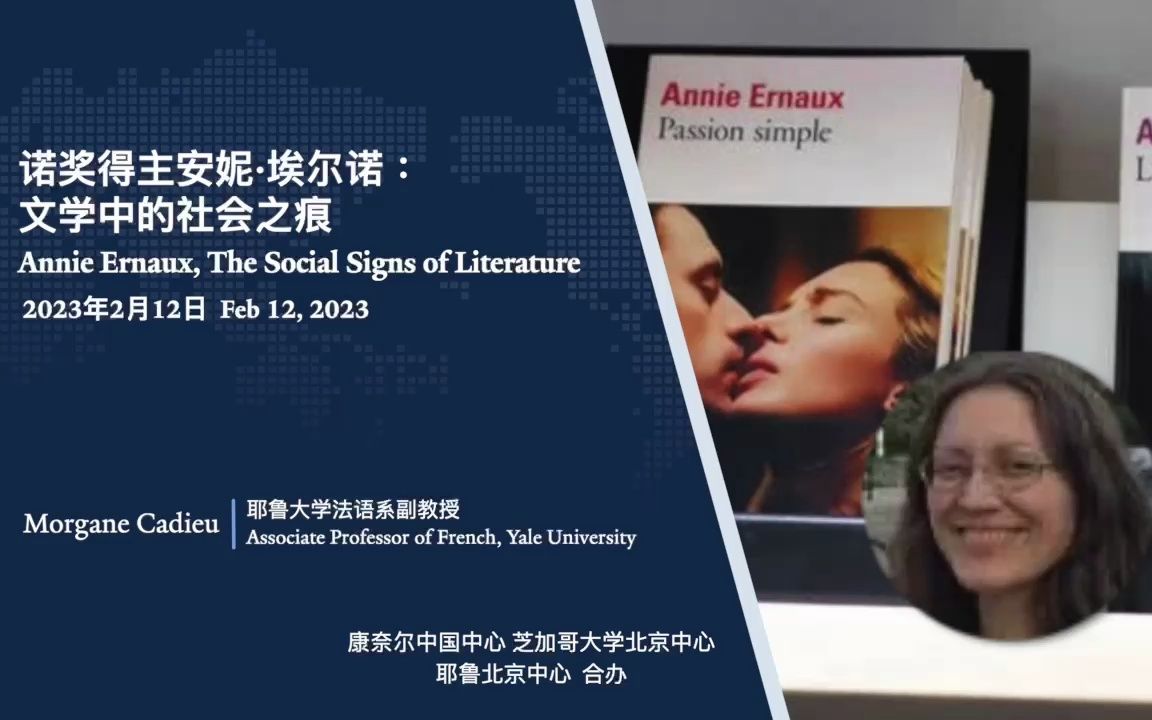
字幕摘录
| 时间 | 英文 | 中文 |
|---|---|---|
| 0:04 | Good day, everyone, and especially to our speaker, | 日安,各位,特别是我们的演讲者, |
| 0:08 | Morgane Cadieux教授兼康奈尔中国中心嘉宾 | |
| 0:13 | and the University of Chicago Center in Beijing. | 和芝加哥大学北京中心. |
| 0:18 | Welcome to this Zoom talk on Anya F. Ngo, the social science of literature. | 欢迎收看关于Anya F. Ngo的演讲 文学的社会科学 |
| 0:27 | I'm Carol Lee Rafferty, the executive director of Yale. | 我是卡罗尔·李·拉费蒂 耶鲁的执行董事 |
| 0:30 | For those of you who may be new to the Yale Center in Beijing, | 你们这些新来北京耶鲁中心的人 |
| 0:33 | the Center is Yale University's only university-wide center outside of the U.S. | 中心是耶鲁大学唯一的全美大学中心. |
| 0:38 | Throughout the year, we host events and programs such as these, | 全年,我们主办诸如此类的活动和方案, |
| 0:43 | where we convene thought leaders from all sectors to discuss the most cutting-edge, interesting, and relevant topics facing our world. | 在那里,我们召集来自所有部门的思想领袖讨论我们世界面临的最尖端、最有趣和相关的议题。 |
| 0:53 | Today, we're especially delighted to be able to invite Yale professor and Cornell alumna, Morgane Cadieux. | 今天,我们特别高兴能邀请耶鲁教授和康奈尔校友摩根·卡迪厄斯. |
展开字幕全文(547 条)
| 序号 | 英文 | 中文 |
|---|---|---|
| 1 | Good day, everyone, and especially to our speaker, | 日安,各位,特别是我们的演讲者, |
| 2 | Morgane Cadieux教授兼康奈尔中国中心嘉宾 | |
| 3 | and the University of Chicago Center in Beijing. | 和芝加哥大学北京中心. |
| 4 | Welcome to this Zoom talk on Anya F. Ngo, the social science of literature. | 欢迎收看关于Anya F. Ngo的演讲 文学的社会科学 |
| 5 | I'm Carol Lee Rafferty, the executive director of Yale. | 我是卡罗尔·李·拉费蒂 耶鲁的执行董事 |
| 6 | For those of you who may be new to the Yale Center in Beijing, | 你们这些新来北京耶鲁中心的人 |
| 7 | the Center is Yale University's only university-wide center outside of the U.S. | 中心是耶鲁大学唯一的全美大学中心. |
| 8 | Throughout the year, we host events and programs such as these, | 全年,我们主办诸如此类的活动和方案, |
| 9 | where we convene thought leaders from all sectors to discuss the most cutting-edge, interesting, and relevant topics facing our world. | 在那里,我们召集来自所有部门的思想领袖讨论我们世界面临的最尖端、最有趣和相关的议题。 |
| 10 | Today, we're especially delighted to be able to invite Yale professor and Cornell alumna, Morgane Cadieux. | 今天,我们特别高兴能邀请耶鲁教授和康奈尔校友摩根·卡迪厄斯. |
| 11 | She will draw on materials from her forthcoming book with the University of Chicago Press, | 她将借鉴即将与芝加哥大学出版社出版的书中的材料, |
| 12 | which is called On Both Sides of the Tracks, Social Mobility in Contemporary French Literature, | 叫做"两条轨道上的 当代法国文学中的社会流动" |
| 13 | which centers on the work of Anya F. Ngo to provide us with an introduction to the work of the 2022 Nobel Laureate in Literature. | 介绍2022年诺贝尔文学奖得主的工作。 |
| 14 | And of course, because of her Cornell and because of the book's University of Chicago affiliation, | 当然,因为她的康奈尔 和该书的芝加哥大学联系, |
| 15 | we're really happy to be co-hosting this event at the Cornell Center and the University of Chicago Center. | 我们很高兴在康奈尔中心和芝加哥大学中心 共同主办这个活动 |
| 16 | Morgane Cadieux是耶鲁的法语助理教授, | |
| 17 | where she teaches courses on contemporary literature, social mobility, and everyday life. | 她教授当代文学、社会流动和日常生活课程。 |
| 18 | Professor Cadieux earned her PhD from Cornell University. | Cadieux教授从康奈尔大学获得博士学位。 |
| 19 | 她的第一本法文书,Marché au Hadard, Flûnement et création dans la crosse du XXe siècle,, 译者: la, û, û, û, é, é, û, é, é, é, é, | |
| 20 | examined a 20th century experimental group of writers using mathematical models to produce novels, | 研究了一群20世纪的作家 利用数学模型制作小说 |
| 21 | reflect on creativity and free will, and propose new ways of envisioning literary walks in urban settings. | 思考创造力和自由意志,并提出在城市环境中设想文学行走的新方式。 |
| 22 | Today's events will proceed as follows. | 今天的活动将如下。 |
| 23 | Professor Cadieux will be giving a presentation, which will be followed by a Q&A. | Cadieux教授将作一个演讲,随后将进行一个QQA. |
| 24 | Throughout the talk, all of you are welcome to post your questions in the chat box. | 在整个谈话过程中,欢迎大家在聊天盒中发表自己的问题. |
| 25 | And my colleague Jingxin from the center, from the Yale Center, she will be selecting questions from the chat box, | 我的同事Jingxin从中心, 从耶鲁中心, 她将选择的问题 从聊天盒, |
| 26 | as well as other questions that we've collected from some of you in advance. | 还有我们事先从你们中收集到的其他问题。 |
| 27 | So without further ado, let's welcome Professor Morgane Cadieux. | 所以,不做进一步的, 让我们欢迎摩根卡迪厄教授。 |
| 28 | Thank you very much. | 谢谢 |
| 29 | Thank you very much for your introduction. | 非常感谢你的介绍。 |
| 30 | Good evening. | 边 |
| 31 | Good morning, everyone. | 大家早上好,我们走 |
| 32 | Thank you very much for taking the time to attend this conference on a Sunday. | 非常感谢你们抽出时间参加星期天的会议。 |
| 33 | I'm very happy to have the opportunity to share my work on Annie Ernaud with you. | 我很高兴有机会与你分享我关于安妮·厄诺的作品. |
| 34 | Annie Ernaud was born Annie Duchesne in 1940 to a family of peasants, workers, and shopkeepers. | 安妮·厄诺(Annie Ernaud)于1940年出生于一个农民,工人和店主家庭. |
| 35 | Her parents, who left school at the age of 12, owned a grocery store cafe on the outskirt of a small town in Normandy. | 她的父母12岁离开学校,在诺曼底一个小镇的外裙上拥有一家杂货店咖啡馆. |
| 36 | Besides writing, Ernaud taught in high school at the beginning of her career and quickly joined the National Center for Distance Education, | 除了写作,厄诺在职业生涯初期在高中任教,并迅速加入国家远程教育中心, |
| 37 | where she worked until her retirement. | 她在那里工作直到退休为止。 |
| 38 | She's been living for years in the suburbs of Paris, in a town built in the 1970s, Sergie-Pontoise. | 她已经在巴黎郊区生活了多年,一个建于1970年代的小镇塞吉-庞托瓦斯. |
| 39 | Her attention to the details of ordinary life and the importance of trains and supermarkets as memory spaces are particularly potent | 她对普通生活细节的关注 以及火车和超市作为记忆空间的重要性 |
| 40 | in what she called not intimate, but extimate diaries set in this city. | 在她所谓的不亲密, 但极限日记设置在这个城市。 |
| 41 | Exteriors, 1993, Thin Scenes, 2000, and Look at the Lights, My Love, 2014. | "外表",1993年,"薄景",2000年,"望灯","我的爱",2014年. |
| 42 | Ernaud's social and geographical trajectory from Normandy to Sergie and her parents' corner store to suburban malls constitutes an important strength of her work. | 埃诺德从诺曼底到塞吉的社会和地理轨迹,以及她父母的角店到郊区商场的轨迹,构成了她工作的重要力量. |
| 43 | Influenced by sociologist Pierre Bourdieu and philosopher and novelist Simone de Beauvoir, | 受社会学家皮埃尔·波迪厄和哲学家及小说家西蒙·德·博沃伊的影响, |
| 44 | Ernaud constantly weaves a social and feminist consideration, as in her first novel, Cleaned Out, 1974, | Ernaud不断编织一个社会和女权主义的考虑,如她的第一部小说"清洁"(Cleaned Out, 1974). |
| 45 | in which she puts side by side the narrator's backstreet abortion and upward mobility. | 她把旁白的背后堕胎 和向上流动放在一起 |
| 46 | She will later abandon the novel form and the tense full tone of her first text, notably in Immense Place, 1983, | 她后来会放弃小说的形式 以及她第一部作品的紧张语气, 特别是1983年的Immense Place, |
| 47 | a brief and powerful narrative on social emancipation in light of her father's death. | 根据她父亲的死 简单而有力的社会解放叙事 |
| 48 | As an ethnologist of herself, Ernaud publishes what she calls auto-socio biographies on her family and social trajectory. | 作为她本人的民族学家,埃尔诺德出版了她所称的关于家庭和社会轨迹的自动社会传记. |
| 49 | Here are a couple of examples, Do What They Say or Else, 77, Adolescence, A Woman's Story, 87, and I Remain in Darkness, 97, on her mother, | 这里有几个例子, "做他们说的话或else, 77, 青少年, A Woman's Story, 87, 我留在黑暗中,97, 在她的母亲身上, |
| 50 | Shame, 1997, as well, on social violence and affects, and L'autre fille, on the author's sister who died before Ernaud was born. | 《耻辱》,1997年,关于社会暴力和影响,以及《L'autre fille》,关于Ernaud出生前死亡的提交人妹妹。 |
| 51 | She invented a specific language and the crossroad of literature, history, and sociology. | 她发明了一种特定的语言和文学,历史,社会学的十字路口. |
| 52 | What she called her flat writing and later a detached or factual writing is an egalitarian style, | 她所说的平面写作 以及后来的脱节或事实写作 是平等的风格, |
| 53 | a potential vector of class mobility that makes it possible to address the greatest number of readers by fusing the language registers of her original social class and her class of arrival. | 使用原始社会阶层和到达阶层的语言登记册,从而解决读者人数最多的问题。 |
| 54 | Her accessible yet highly crafted prose has the power to overcome social estrangement and generate a leveling that aims to do away with hierarchies without giving rise to either populism or miserabilism. | 她的易懂而又高度巧妙的传教士有能力克服社会疏远,产生一种平局,旨在消除等级制度,而不会引起民粹主义或不良主义。 |
| 55 | For many readers and critics, the navel gazing of autobiographies is accountable for the decline of contemporary literature. | 对许多读者和批评家来说,自传的迷宫观是当代文学衰落的原因. |
| 56 | In the case of Ernaud, it morphs into a formidable eye-opening tool for inquiry. | 就Ernaud而言,它演变成一个可怕的开眼工具来进行调查。 |
| 57 | Whether she uses the pronoun I or alternates between various personal pronouns, she aims to dissenter herself, to find history and community within the singular details of her own biography. | 无论她使用代名词I还是各种个人代名词之间的替补,她都旨在表达自己的异议,在她自己的传记中的单数细节中寻找历史和社区. |
| 58 | The more personal, the more socially relevant. | 个人性越强,社会相关性越强. |
| 59 | This is how I interpret the title of her masterpiece, what is considered her masterpiece. | 这就是我如何诠释她杰作的标题,什么被认为是她的杰作. |
| 60 | Les Années, the year 2008, which retraces the life of a woman from the 1950s to today. | Les Années,2008年,它追溯了20世纪50年代至今天女性的生活. |
| 61 | Année, with a capital A, is the plural form of Ernaud's first name, Annie. | 首府A的安内(Année)是厄尔诺德第一名字安妮的复数形式. |
| 62 | And this interpretation is accentuated in English, Annie becomes Annie. | 而这种解释在英语中更为突出,安妮成为安妮. |
| 63 | And indeed, the anthology of her works is entitled Écrire la vie, writing life and not writing my life. | 事实上,她的作品的解剖学是 写生活而不是写我的生活。 |
| 64 | The Nobel Prize Ernaud received in fall 2022 foregrounds her unswerving fight against inequality and for the rights of those she calls the dominated. | 诺贝尔奖在2022年秋天获得,这预示着她与不平等以及她所称的主宰者的权利进行不懈的斗争。 |
| 65 | In a book long interview, she defines herself not as a woman who writes, but as someone with a woman history who writes and demonstrates an unflinching feminism in book after book. | 在长篇大论的采访中,她将自己定义为不是写作的女性,而是写作并表现书中不折不扣的女权主义的女性历史人物. |
| 66 | A frozen woman, 81, a race to be independent ended up in a normative relationship. | 一个被冻结的女人,81岁,一个独立独立的种族最终在规范的关系中. |
| 67 | A precise account of abortion in happening, 2000, added abortion and contraception were both illegal in France and particularly hard to access for working class women. | 2000年堕胎的准确情况是,在法国,堕胎和避孕都是非法的,工人阶级妇女尤其难以获得。 |
| 68 | And the narrative and reflection on rape and consent in a girl's story, 2016. | 以及2016年女孩故事中对强奸和同意的叙述和反思. |
| 69 | Another aspect of her feminist prose has to do with her explicit explorations of sex and desire. | 她的女权传言的另一个方面与她对性与欲望的明确探索有关. |
| 70 | Her affair with a Russian diplomat in Simple Patient, 1991, and Getting Lost, 2001. | 她与俄罗斯外交官的私情"简单病人",1991年和"迷失",2001年. |
| 71 | Jealousy in The Possession, 2002. | 《拥有的嫉妒》,2002年。 |
| 72 | The sexual body undergoing chemotherapy in Usage de la photo, 2005. | 《照片使用法》中接受化疗的性身体,2005年。 |
| 73 | And her relationship with a man 30 years her junior in Le Jeune homme, 2022. | 她和一个男人的关系 30岁,她的初级 在Le Jeune Homphy,2022。 |
| 74 | And three of these feminist texts have been adapted for the screen. | 而这些女权主义的文本中有三部被改编为屏幕. |
| 75 | France is the country that has received the most Nobel prizes in literature. | 法国是获得文学界诺贝尔奖最多的国家. |
| 76 | Patrick Modiano won it in 2014 and subsequently delivered a remarkable Nobel lecture. | 帕特里克·莫迪亚诺在2014年赢得了这个奖项,并随后发表了一个引人注目的诺贝尔讲座. |
| 77 | Marie Sconde was awarded the alternative in 2019. | 2019年,玛丽·斯康德被授予了替代品. |
| 78 | What the Nobel Prize seems to reward is the attention of French writers to memory. | 诺贝尔奖似乎奖励的是法国作家对记忆的关注. |
| 79 | In 2014, the Academy praised Modiano's, I quote, art of memory with which he has evoked the most ungraspable human destinies and uncovered the life world of the occupation, end of quote. | 2014年,学院称赞了莫迪亚诺,我引用了莫迪亚诺的记忆艺术,他用这一艺术唤起了最难受的人类命运,并揭示了占领的生活世界,即引用的结束. |
| 80 | Last year, the Academy chose the same keyword, but with a different emphasis. | 去年,学院选择了相同的关键词,但重点不同. |
| 81 | Ernaud was acclaimed, I quote, for the courage and clinical equity with which she covers the roots and stretchments and collective restraints of personal memory, end of quote. | 我引证Ernaud的勇气和临床上的公平性,她以这种勇气和公平来涵盖个人记忆的根基和伸展以及集体约束,引文结束。 |
| 82 | From Modiano to Ernaud, the art of memory becomes personal. | 从莫迪亚诺到埃尔诺德,记忆艺术变成了个人的艺术. |
| 83 | Of course, she could be read as a memoirist, archivist, a witness, but she's an artist too, who looked at the world through literary glasses. | 当然,她可以被读作回忆家,档案学家,证人,但她也是一个艺术家,通过文学眼镜观察世界. |
| 84 | Life for her is a matter of forms. | 生活对她来说是一个形式问题。 |
| 85 | Textuality guarantees the authenticity of her social and autobiographical narratives. | 文字保证了她社会和自传性叙述的真实性. |
| 86 | Ernaud spent her life appending classifications, her writings have enlarged and tilted the stakes of literature. | 厄诺德一生都在附加分类,她的著作有所扩展,倾斜了文学的利害关系. |
| 87 | Memory is crucial for Ernaud, as it is for Modiano, but memory should not be considered a more literary topic than other topics such as abortion or supermarkets, for instance. | 记忆对Ernaud至关重要,对Modiano也是如此,但不应将记忆视为比堕胎或超市等其他主题更文学的话题。 |
| 88 | My next book, forthcoming in 2024 with the University of Chicago Press, is focused on the works of Annie Ernaud. | 我的下一本书,即将于2024年与芝加哥大学出版社一同出版,主要讲述安妮·厄诺的作品. |
| 89 | And I too believe that it is through literary details, through poetics, that one can best apprehend our social moment, especially the place of class mobility in today's France and the contemporary routes of emancipation, literature and education. | 我也相信,正是通过文学细节,通过诗歌,人们才能最好地抓住我们的社会时刻,特别是今天法国的阶级流动位置以及当代解放,文学和教育的路线. |
| 90 | 在她写作的日记"L'Atelier Noir, The Black Work or The Black Studio"中,厄诺写道,另一个陷阱是生命,生命本身,它的文件. | |
| 91 | I've never done it. | 我从来没有这样做。 |
| 92 | We need another kind of writing, one that calls to question, end of quote. | 我们需要另一种写作方式, 一种令人质疑的, 引用的结尾。 |
| 93 | So let us examine a couple of quotes to see what Ernaud means. | 因此,让我们研究一下一些引文,看看厄诺是什么意思。 |
| 94 | Socially mobile authors like Ernaud are over trained readers, acute readers of literary science who have crossed the social field from one class to another through studying, reading, writing and teaching, and have thus become experts at interpreting text. | Ernaud等社会流动作家都是受过训练的读者,文学科学的尖锐读者,他们通过学习,阅读,写作和教学,从一个班级跨过社会领域,从而成为翻译文本的专家. |
| 95 | Readers of social science as well, because they have learned to navigate various social milieus and often write books with an explicitly sociological lens. | 社会科学的读者也一样,因为他们学会了导航各种社会环境,并经常用明确的社会学透镜写书. |
| 96 | The literary figure of the social climber thus stands as a compelling entryway into the intricate coordinates of the contemporary social field and literary landscape. | 因此,社会登山者的文学人物是进入当代社会领域和文学景观复杂坐标的一条令人信服的通道。 |
| 97 | Social climbers publish bestsellers and dwell in social novels. | 社会登山者出版畅销书,并居住在社会小说中. |
| 98 | Social mobility is a plot, a touching and uplifting success story, a compact narrative with a clear beginning and end packed with twists and outcomes. | 社会流动是一个情节,一个感人和振奋人心的成功故事,一个紧凑的叙述,有一个清晰的开始和结束,充满了曲折和结果. |
| 99 | People by intriguing personages who need to learn the social and linguistic codes of another crowd. | 人们通过吸引需要学习另一群人的社会和语言规范的人物。 |
| 100 | Social mobility is a relatable story, people reading coming of age stories have come of age too. | 社会流动性是一个可歌可泣的故事,人们阅读即将到来的年龄故事也已经到了年龄。 |
| 101 | Moreover, social climbers made it to a privileged stratum of the society, thereby getting the opportunity to tell, write and publish their own stories. | 此外,社会登山者也进入了社会的特权阶层,从而获得了讲述、撰写和发表自己故事的机会。 |
| 102 | The social climber or the parvenu is certainly a controversial figure, spotlighted by the proponents of meritocracy or detested because it partakes in liberal storytelling and symbolizes betrayal. | 社会攀登者或帕韦努当然是一个有争议的人物,受到德才主义支持者的注意,或因参与自由主义故事的讲述和象征背叛而感到厌恶。 |
| 103 | Yet it possesses a dual standpoint that provides reader with a panoptical access to the social field and according to philosopher Jennifer Morton, a unique position to advocate for policy change. | 然而,它具有双重观点,为读者提供社会领域的全景访问,而哲学家Jennifer Morton认为,这是倡导政策变革的独特地位。 |
| 104 | Narratives of class mobility offer a pocket-sized panorama of society, a digest of our political and literary moment. | 对阶级流动的叙述提供了一种袖珍的社会全貌,是对我们政治和文学时刻的总结。 |
| 105 | Why focus on literature and not on sociology or to discuss such pressing social issues? | 为什么只关注文学,而不关注社会学,或者讨论如此紧迫的社会问题? |
| 106 | First of all, because it has become customary and condescending to do the very opposite and consider that outsider writers are interesting only insofar as their literature is testimonial. | 首先,因为做非常相反的事情已经成为一种习惯和屈尊,并认为外人作家只有在他们的文学是证明的时候才有趣. |
| 107 | Second, a parvenu's world is already literary, whether professional writers or amateurs, the leading voices who comment on social mobility in the public sphere have published a book. | 第二,一个parvenu的世界已经是文学了,无论是专业作家还是业余作家,评论公共领域社会流动性的主要声音已经出版了一本书. |
| 108 | The epigraph from Ernaud that I chose for my own book points in this direction, I quote, I realize that I am always searching for the signs of literature in reality, end of quote. | 我引用Ernaud为我自己的书选择的这个方向的传记,我意识到我总是在寻找现实中文学的征兆,即引用的结尾. |
| 109 | The social climbers eye and insight are irremediably tied to the text, not simply to writing books in general, but to detecting literary signs. | 社会登山者的眼睛和洞察力无可挽回地与文字捆绑在一起,不仅一般地写书,而且发现文学标志. |
| 110 | Reading and decoding constitute the core of a parvenu's experience. | 阅读和解码构成一个parvenu体验的核心. |
| 111 | In the 1993 book entitled Cultural Capital, literary critic John Guillory argues that the value of literature has declined because the educational needs of the professional managerial class are no longer aligned with the parsing of great works. | 在1993年的"文化资本"一书中,文学评论家约翰·吉洛里(John Guillory)认为,文学的价值已经下降,因为专业管理阶层的教育需求不再符合对伟大作品的剖析. |
| 112 | The figure of the social immobile writer tilts this observation as literature remains a vital site of class mobility in 21st century France, a site of identification through reading, a source of cultural capital through which working class students | 社会无动于衷的作家的人物将这种观察推向了这个观点,因为文学仍然是21世纪法国阶级流动的重要场所,通过阅读进行识别的场所,是工人阶级学生通过阅读获得文化资本的来源. |
| 113 | what used to be reserved for a few, a place like school that still permits cross class conversations. | 过去留给少数人的, 学校这样的地方 仍然允许跨班交谈。 |
| 114 | The reading bulimia social writers often confess is at the origin of their life choices and vision of the society. | 阅读暴躁的社会作家经常忏悔是他们人生选择和社会愿景的起源. |
| 115 | I quote, we choose to interpret our lives or to live according to books, end of quote. | 我引用,我们选择解释我们的生活 或者按照书籍生活,引用的结尾。 |
| 116 | Ernaud here equates life to interpretation. | Ernaud在这里将生命等同于解释。 |
| 117 | Ernaud, we can call her a paper parvenu, will read her all life in order to study, to teach, to write. | Ernaud, 我们可以叫她纸帕文, 将读她一生的学习, 教书,写作。 |
| 118 | Literature not only appears as a socially marked choice between available pastimes, but as the very location of her cross class trajectory. | 文学不仅表现为社会上对可用消遣的一种显著选择,也是她跨阶级轨迹的所在地. |
| 119 | And textuality, the attention to text, guarantees the authenticity of her social and autobiographical novels. | 而文字性,对文字的注意,保证了她的社交和自传小说的真实性. |
| 120 | She's unable to narrate the same even twice for this very reason, and this is quote number two. | 她连两遍都说不出同样的话 这也是第二句 |
| 121 | I cannot describe those moments because I already did so in another book, which is to say that there will never be another possible narrative with other words with sentences in another order, end of quote. | 我无法描述这些时刻,因为我已经在另一本书中这样做了。 这本书说,永远不会有另一种可能的叙述,而其他的文字则有另一种顺序的句子,引文的结尾。 |
| 122 | Her father's death in this case exists as a single specific ordering of words. | 本案中她父亲的死是作为单词的具体顺序而存在的. |
| 123 | Twice in her literary career, Ernaud also published chunks of her personal diary, but not out of egotism or exhibitionism. | 在她的文学生涯中,厄诺还两次发表了她个人日记的片段,但并非出于自负主义或展品主义. |
| 124 | She had already penned and published the corresponding narrative version, and she explains this original practice as follows. | 她已经写下并出版了相应的叙事版本,她将这种原始做法解释如下. |
| 125 | This is quote number three. | 此是引经三. |
| 126 | It seems to me that I couldn't publish any part of my diary that doesn't correspond to a published narrative, as if only the latter authorized me to do it, as if life had to become form, concerted literary form with a degree of generality for me to presen | 在我看来,我无法出版我日记中任何与已出版的叙事不符的部分,仿佛只有后者授权我做,仿佛生活必须变成形式,协调的文学形式,并具有一定程度的通俗性,我才能以刻不容缓,无形性,引用的结尾来呈现. |
| 127 | Life is a matter of form. | 人生是形而上学的事 |
| 128 | The narrative takes precedence over the diary or carefully selected language precedes the role like exposition of life diving into her subjectivity and into her past is relevant in so far as autobiographical details can lead to insights about the social w | 叙述优先于日记或精心选择的语言先于诸如将生命潜入到她的主观性中来等角色,而对于她的过去,就自传性细节可以导致对社会世界的洞察力而言,是相关的. |
| 129 | And this is the last quote. | 且此是最后引经. |
| 130 | I need it for my personal reality to become literature, only in becoming literature will it become true, and something other than an individual experience, end of quote. | 我需要它使我的个人现实成为文学, 只有成为文学,它才会变成真实的, 以及除了个人经历之外的东西, 引用的结尾。 |
| 131 | This is why Ernaud is constantly trying strategies to arrive at what she calls an impersonal form of prose. | 这就是为什么厄诺德在不断尝试策略 以达到她所谓的非人性化的传言形式。 |
| 132 | After losing her father, Annie Ernaud published La Place in 1983, A Man's Place, a narrative of social estrangement in which she retraces her father's biography and her own vulnerability in light of her father's recent death. | 失去父亲后,安妮·厄诺于1983年出版了"La Place"(A Man's Place),这是她根据父亲最近去世的情况,重述父亲的传记和自己的脆弱性,讲述了社会疏远. |
| 133 | The text whose paragraph are separated by blanks of various length, won a major French price and stands as Ernaud's most read, acclaimed, and commended work. | 其段落用不同长度的空白分隔开来,赢得了法国的一大价钱,成为埃尔诺读得最多,声名狼藉,并称赞了作品. |
| 134 | This does not tell the story of a unique and miraculous social climber. | 这不是一个独特的奇迹般的社会登山者的故事。 |
| 135 | On the contrary, Ernaud realizes that her parents, successively peasants, factory workers, and shopkeepers, were socially mobile too. | 相反,Ernaud意识到,她的父母,相继是农民、工厂工人和店主,也具有社会流动性。 |
| 136 | In this context, Ernaud's trajectory loses its singularity. | 在这种情况下,厄诺的轨迹失去了它的奇特性. |
| 137 | She repeated her parents' social mobility, although more publicly and spectacularly better. | 她重复了父母的社会流动性,尽管更加公开和引人注目。 |
| 138 | This trajectory raises the question, can Ernaud as a writer, teacher, and commentator spread the mobility she had inherited from her parents? | 这个轨迹引起了一个问题,作为作家,教师,评论家的埃尔诺能否传播她从父母那里继承的流动性? |
| 139 | Is transmission restricted to conveying information like an archivist, or can it be a truly performative handover that has the tangible effect of emancipating readers and students? | 传播是被限制在像档案员那样传递信息,还是能够成为真正有表现力的交接,具有解放读者和学生的实际效果? |
| 140 | Ernaud's literary strategy is visible in her use of what is called reported speech, that is to say how a narrator quotes other characters, other discourses, words from other voices. | Ernaud的文学策略在她使用所谓的"报告式演讲"中可见,即一个旁白者如何引用其他人物,其他话语,来自其他声音的话语. |
| 141 | It is especially visible in Ernaud's letter, an important genre throughout her work. | 在埃尔诺德的信中尤为明显,这是她整个作品中的重要流派. |
| 142 | This is quote number one. | 此是引经第一. |
| 143 | Flat writing comes to me naturally, the same writing that I used formally to write to my parents to give them essential news, end of quote. | 平淡的写作自然而然地来到我身边, 和我以前正式写给我父母的写作一样, |
| 144 | And this is how Ernaud puts this definition into practice. | 这就是厄诺如何将这个定义付诸实践。 |
| 145 | Quote number two. | 引经二. |
| 146 | My mother wrote me a report of the surrounding world. | 我妈妈给我写了一份关于周围世界的报告 |
| 147 | It's called here, we hope it won't last. | 它叫这里,我们希望它不会持续。 |
| 148 | We went Sunday to see our friends from Granville. | 我们星期天去见格兰维尔的朋友 |
| 149 | Old Lady X died at 60, that's not old. | X老太太60岁去世了,那不老 |
| 150 | My father signed it. | 我父亲签的 |
| 151 | I also answered them in the tone of an official statement. | 我还以正式发言的基调回答了这些问题。 |
| 152 | They would have perceived any attempt at style as a way of keeping them at a distance, end of quote. | 他们会认为任何风格上的尝试 都是一种让他们保持距离的方式 引文的结尾 |
| 153 | The style is flat in the sense of constative. | 风格平坦,寓意为康定. |
| 154 | Ernaud quotes her mother's letter without distinguishing between the two voices. | 埃诺德引用了她母亲的信,没有区分两个声音. |
| 155 | While the letter X, as in Old Lady X, usually indicates anonymity, here it looks like a crossroads, a visualization of how a mother and daughter from different social classes can interact through language and literature. | 虽然字母X,如Ord Lady X,通常表示匿名,但这里看起来像一个十字路口,是不同社会阶层的母亲和女儿如何通过语言和文学互动的可视化. |
| 156 | Ernaud also wrote to her parents right after passing the teaching exam. | Ernaud也在通过教学考试后写信给她的父母。 |
| 157 | I quote, and this is great. | 我引用,这是伟大的。 |
| 158 | You really dragged them through, your students, the inspector reproached me later in the principal's office. | 你真正拖他们过去,你的学生, 督察责备我 后来在校长办公室。 |
| 159 | The inspector extended his hand to me, then looking me right in the eyes, Madam, congratulations. | 探长向我伸出手,然后看着我的眼睛,女士,祝贺你。 |
| 160 | The author repeated congratulations to my hand, but the woman with a smile. | 作者一再祝贺我的手,但那个微笑着的女人. |
| 161 | That very night, I wrote to my parents that I was a tenured professor. | 就在那天晚上,我写信给我的父母,说我是一个终身教授。 |
| 162 | My mother answered that they were very happy for me, end of quote. | 我妈妈回答说 他们为我感到非常高兴 引用的结尾 |
| 163 | So look at the form, look at this quote. | 所以看表格,看这个引文. |
| 164 | Ernaud uses punctuation to signal other voices, to signal reported speech. | Ernaud使用标语来信号其他声音,信号所报道的语音. |
| 165 | Immediately hear the professor's voice through direct discourse. | 马上通过直接的谈话听到教授的声音. |
| 166 | You really dragged them through, your students, the inspector reproached me. | 你真的拖过他们,你的学生, 督察责备我。 |
| 167 | Then the narrator introduces the words only after the citation. | 然后旁白者只在引文之后才介绍这些词。 |
| 168 | At the very moment Ernaud passes the exam, when social mobility becomes official, discourse is also abruptly juxtaposed to the narration. | 正当Ernaud通过考试时,当社会流动正式化时,讨论也突然与叙述同时进行。 |
| 169 | Without an introduction, then looking me right in the eyes, Madam, congratulations. | 没有介绍,然后看着我的眼睛,女士,恭喜你。 |
| 170 | This use of speech represents the violent rupture of social mobility. | 这种言论的使用代表了社会流动性的暴力破裂。 |
| 171 | The achievement is a social verdict that creates a clear distinction between before and after the column. | 成就是社会判断,可以明确区分列前后. |
| 172 | At the same time, Ernaud uses indirect discourse to describe her later. | 同时,埃尔诺德也使用间接的论述来形容她后来的样子. |
| 173 | I wrote that, she answered that. | 我写的,她回答。 |
| 174 | It is as if she tried to soften the exam results, to convey them as flatly as possible to her parents in order to somehow undo the social estrangement they announce. | 她似乎试图软化考试结果,尽可能简洁地传达给她的父母,以便以某种方式消除他们宣布的社会疏远。 |
| 175 | To better understand how or if social mobility can be transmitted outside of the family sphere, I'd like to compare what I've just quoted to the last paragraph of this book, La Place, A Man's Place, | 为了更好地了解社会流动性如何或是否可以在家庭领域之外传播,我想比较一下我刚才所引用的内容与本书最后一段,La Place, A Man's Place, |
| 176 | where Ernaud meets one of her former students. | Ernaud认识了她以前的一位学生 |
| 177 | And this is the last quote on this slide. | 这是这张幻灯片上的最后一句话。 |
| 178 | In October of last year, I recognized behind the register when I was in line with my cart, a former student. | 去年10月,我与我的前学生,我的车一致时,在登记册后面认出了我。 |
| 179 | Which is to say that I remembered she had been my student five or six years earlier. | 也就是说我记得她五六年前是我的学生 |
| 180 | I didn't know her name anymore, nor in what class I'd had her. | 我都不知道她的名字了 也不知道我上哪个班 |
| 181 | To say something when my turn arrived, I asked her, you're doing well? | 轮到我的时候,我问她,你还好吗? |
| 182 | You like it here? | 你喜欢这里吗? |
| 183 | She answered, yes, yes. | 她回答说,是的,是的。 |
| 184 | Then after scanning the canned food and the drinks with embarrassment, the technical school, it didn't work out. | 后来在扫描罐装食品和尴尬的饮料,技校之后,没有成功. |
| 185 | She seemed to think that I still remembered her course choices, but I had forgotten what she'd been said to technical school. | 她似乎认为我仍然记得她的课程选择 但我忘了她在技术学校说的话 |
| 186 | I said to her goodbye. | 我跟她道别了 |
| 187 | She was already grabbing the next groceries with her left hand and keying things in without looking with the right hand. | 她已经用左手抓下一批杂货 并用右手按键 |
| 188 | End of quote. | 引文结束. |
| 189 | The sign, the marks of reported speech and the discourses are very chaotic in this quote. | 上面的标志,所报道的言论和言论的标记,在本引文中非常混乱. |
| 190 | The narrator first asked a question features of what is called direct discourse, an introductory verb, a colon, a quotation mark and a question mark. | 旁白者首先提出了所谓直接对话的问题特征,一个介绍性动词,一个结肠,一个引号和一个问号. |
| 191 | I asked her, you're doing well? | 我问她,你做的很好吗? |
| 192 | You like it here? | 你喜欢这里吗? |
| 193 | But the student's answer is radically different. | 但学生的回答却完全不同. |
| 194 | She replied, yes, yes. | 她回答说,是的,是的。 |
| 195 | No quotation marks, no colon, no pronoun. | 无引号,无结肠,无代词. |
| 196 | And when the cashier speaks again, the narrator does not introduce her words. | 而当收银员再次发言时,旁白者并没有介绍她的话. |
| 197 | After scanning the food and the drinks with embarrassment, the technical school didn't work out. | 在对食物和饮料进行扫描后,尴尬地,技术学校没有成功. |
| 198 | Finally, Erno says goodbye with quotation marks, but without a colon. | 最后,厄诺以引号告别,但没有结肠. |
| 199 | There is a strong difference between Erno's and her students discourses, as well as between this scene and Erno's correspondence with her mother. | 厄诺与她的学生的言论,以及这个场景与厄诺与她母亲的书信往来有着强烈的区别. |
| 200 | The response of the student cashier is abrupt. | 学生收银员的反应是突然的. |
| 201 | She answered, yes, yes. | 她回答说,是的,是的。 |
| 202 | Yet Erno does not insist on distance, but uses a hybrid form that leveled the two women, that puts the two women on the same level. | 然而,厄诺并不坚持距离,而是使用一种混合形式,将两位女性平分,将两位女性平分在同一级别. |
| 203 | I see it as a way of bringing the cashier, of not leaving her at the door, of not emphasizing the class gap with quotation marks, colon, pronouns or italics. | 我认为这是把收银员带来,不把她留在门口,不用引号、结肠、代词或斜体字强调阶级差距的一种方式。 |
| 204 | Certainly, emancipation is not concretely transmitted in Laplace, but when it comes to forms, Erno blurs the difference between the student and herself by erasing the junction between narration and speech at the risk of writing a paragraph that is quite h | 当然,解放不是在拉普拉斯语中具体传达的,但是在形式上,厄尔诺模糊了学生与自己之间的区别,将叙述和言论之间的交汇抹去,冒着写一段很难听的险境. |
| 205 | In my book, I also demonstrate that the metaphor of the train has replaced the idiom of the social ladder as upward mobility of climbing up. | 在我的书中,我还表明,列车的比喻已经取代了社会阶梯的典型,成为爬升的向上移动. |
| 206 | Such a shift from ladder to train registers the transformation of social mobility from one-way success stories of arrival to ongoing processes of pendular movements. | 这种从梯子到培训的转变,记录了社会流动从单向成功事例的到来向持续流动过程的转变。 |
| 207 | In Erno's book, A Man's Place, the use of reported speech I have just described is coupled with the representation of trains. | 在厄尔诺的书"人的地方"中,使用我刚才描述的被报道的演说,与列车的表示相配合. |
| 208 | In the following passage, she travels from her own Paris after the death of her father, and the train car becomes the place of a sudden social realization that triggers her creativity. | 在接下来的一段话中,她在父亲去世后从自己的巴黎出行,火车车成为了突然产生社会认识的地方,触发了她的创造力. |
| 209 | On the return train on Sunday, I was trying to keep my son entertained so that he would stay calm. | 在周日的回程列车上,我试图保持我儿子的娱乐,让他保持冷静. |
| 210 | First class travelers don't like noise or children who move, all of a sudden with shock. | 头等舱旅行者不喜欢噪音或儿童移动,突然惊动. |
| 211 | Now I'm really a bourgeois and it's too late. | 现在我真的是个资产阶级了,已经太晚了. |
| 212 | Later on, during the summer, waiting for my first job, I will have to write all of this. | 后来,在夏天,等待我的第一份工作, 我将不得不写这一切。 |
| 213 | I meant right about my father, his life, and the distance that emerged in adolescence between him and me. | 我说的是关于我父亲,他的生命, 以及他和我在青春期中出现的距离。 |
| 214 | A class distance, but a particular kind that has no name like separated love, end of quote. | 一个阶级的距离, 但一种没有名字 像分离的爱情, 引用的结束。 |
| 215 | It's hard to tell here whether Erno includes herself or not in this first class group because of the impersonal formulation of travelers in general. | 这里很难分辨厄尔诺是否因为一般旅行者的不人性化配体而将自己纳入这个一等舱组. |
| 216 | Does she amuse her son because they don't like noise or because she is the one who no longer does? | 她逗她儿子玩是因为他们不喜欢吵闹 还是因为她不再喜欢吵闹? |
| 217 | There is no pronoun I in the sentence when there is one within the quotation marks so as to distinguish between the two voices. | 当引号内有一个,以区分两个声音时,句子中没有代词I. |
| 218 | The first two sentences are separated by a period, not a comma, a detail that reinforces the indeterminacy of the narrator's travel class. | 前两句以一个时期,而不是逗号分开,这个细节强化了旁白者旅行课的不确定性. |
| 219 | The eruption of the punctuation demonstrates the radicality of the social rupture at stake. | 喷发的喷发表明了危在旦夕的社会破裂的激进性。 |
| 220 | The abrupt juxtaposed, unintroduced words from Erno are meant to make us feel, to make us readers feel formally typographically materially, the sudden realization of class distance. | 来自厄尔诺的突如其来的并列的,未引申的词,意在让我们感到,让我们的读者从物质上正式感到,突然意识到阶级距离. |
| 221 | An entryway into the bourgeoisie, the trend is also a way for Erno to reconnect with her childhood. | 进入资产阶级的一条通道,这个趋势也是厄尔诺重新与她的童年联系在一起的方法. |
| 222 | And this is the second quote. | 而此第二引经. |
| 223 | It's thus outside in the passenger on the metro or the RER, which is the commuter rail. | 因此它位于地铁或RER上的乘客室外,即通勤铁路. |
| 224 | 在Gallerie Lafayette和Auchan的电梯里 那些我以前存在的人 引文结束 | |
| 225 | The memory of her social trajectory is stored on public transportation. | 她的社会轨迹的记忆被存储在公共交通上. |
| 226 | This emphasis on trains and forms, literary forms, can even be the detail that catches the attention of non-professional ordinary readers. | 这种对火车和形式,文学形式的强调,甚至可以是引起非专业普通读者注意的细节. |
| 227 | A critic, Lynn Thomas, has studied the many letters received by Annie Erno, and she cites the following one from a person who read A Man's Place on a train traveling in France between Bordeaux and Bayonne, I quote. | 一位评论家琳恩·托马斯(Lynn Thomas)研究了安妮·厄诺(Annie Erno)收到的许多信件,她引用了以下一封信,这封信来自一位在波尔多和巴约讷之间旅行的火车上读过《人物之地》的人。 |
| 228 | I got off the train feeling drunk with that specific inebriation born of what I can find no other word to describe the ecstasy of language. | 我从火车上喝醉了 那种我找不到其他词 来形容语言的迷幻 |
| 229 | I was in love with your italics, end of quote. | 我爱上了你的斜体字 引用的结尾 |
| 230 | So the train is not only a play to leisurely scheme airport novels called the train station novels in French, but to close read them, whether you are an academic or not. | 所以列车不仅是用来休闲策划机场小说的一种戏剧,这些小说叫火车站小说法文版,还要关闭阅读,无论你是否是学者. |
| 231 | The train also played an unexpected crucial role in telling anecdotes of Annie Erno's literary life. | 列车在讲述安妮·厄诺的文学生活传闻方面也起到了意想不到的关键作用. |
| 232 | In a book on literary prices, sociologist Nathalie Ennick interviewed Erno about the Renaudot Prize she won for A Man's Place in 1984. | 在一本关于文学价格的书中,社会学家娜塔莉·恩尼克采访了埃尔诺,讲述了她在1984年为"一个男人的地方"赢得的雷诺多奖. |
| 233 | After the reception for the prize at 1am, the author insisted on taking a train home to Sergie in the suburbs of Paris, instead of a taxi whose fare would have been covered by her publishing house. | 在凌晨1点接受大奖后,作者坚持搭火车到巴黎郊区的塞吉回家,而不是搭出租车,出租车的票价本来会由她的出版社支付. |
| 234 | At the Saint-Lazare train station, while reading a newspaper, a young man accosted Erno and asked, oh, so you know how to read? | 在圣拉扎尔火车站,在看报纸的时候,一个年轻人勾搭了厄尔诺,问,哦,你知道怎么看吗? |
| 235 | Taking a train home was a way for Erno to continue inhabiting not the latter, but the railroad space between classes, between childhood and adulthood, especially because her parents shop in Normandy was located near the station. | 搭火车回家是厄诺继续居住而不是后者的一种方式,而是班级之间的铁路空间,童年和成年之间的铁路空间,特别是因为她的父母在诺曼底的商店位于车站附近. |
| 236 | Although she had just been awarded a prize for the quality of her prose and for narrative upward mobility, the young commuter reminded Erno, whose grandfather was illiterate, | 虽然她刚刚因为她的传言和叙事性向上流动而获奖,但年轻的通勤者提醒了Erno,他的祖父是文盲, |
| 237 | that class affiliations remain ambiguous in train stations. | 在火车站里 班级关系仍然模糊不清 |
| 238 | To conclude, I would like to reflect on Dorothea Tanning's 1942 Birthday, a painting that had a great influence on Annie Erno's writing. | 最后,我想反思一下多罗西娅·坦宁1942年的生日,这幅画对安妮·厄诺的写作产生了很大影响. |
| 239 | Erno refers to this image several times in her prose. | 厄诺在她的散文中多次提到这个形象. |
| 240 | In her diary L'Atelier Noir, she says in 1989, that's the first quote, | 在她的日记L'Atelier Noir中,她在1989年说,这是第一句话, |
| 241 | a question I asked myself before, what structure corresponds to Tanning's painting Birthday? | 我曾经问过自己一个问题,什么结构与坦宁的画作生日相对应? |
| 242 | End of quote. | 引文结束. |
| 243 | This self-portrait of an American painter, de-influenced by surrealism, could aptly caption Erno's writing and education, | 这个美国画家的自画像 受到超现实主义的影响 可以恰当地描述厄诺的写作和教育 |
| 244 | She Who Completed the Master's Thesis on Woman and Love in Surrealism. | 她完成了关于超现实主义中女性与爱情的硕士论文. |
| 245 | The French title of Birthday, | 法国的生日称号, |
| 246 | also contains the author's birth name, Annie, Annie Versaire, a sonorous detail that can partly explain Erno's fascination with this work of art. | 也包含了作者的出生名字安妮,安妮·凡尔赛尔(Annie Versaire),这段赞美的细节可以部分解释厄尔诺对这部艺术作品的迷恋. |
| 247 | Erno returned to this painting about 20 years later in the novel Les Années, the Years. | 埃尔诺大约20年后在小说"The Years"(Les Années)中回到这幅画中. |
| 248 | Quote. | 引经. |
| 249 | She thinks that this painting represents her life and that she is as she was formerly in Gone with the Wind in January later in Noja. | 她认为这幅画代表了她的生活,并且她和以前一样,在后来的1月,在诺哈与风同在Gone. |
| 250 | End of quote. | 引文结束. |
| 251 | The author of L'Atelier Noir seems to ask in the first person a question that the narrator of Les Années answers in the third. | L'Atelier Noir的作者似乎在第一人中问了一个问题,Les Années的旁白者在第三个中回答了这个问题. |
| 252 | These two successive excerpts point to a supreme position of life and form. | 这两部连续的节选指出了生命和形式的最高地位. |
| 253 | The structure of the first quote is the life of the second. | 第一引文的结构是第二引文的生命. |
| 254 | Erno lives in the painting in the same way as she inhabits a world crafted by novels. | 厄诺住在画中的方式与她住在一个小说创作的世界一样. |
| 255 | Birthday multiplies the symbols of in-betweenness, a clothed but naked woman, natural and manufactured features, myth and reality, flora and fauna. | 生日将中间的象征,一个衣着但裸体的妇女,自然和人造特征,神话和现实,动植物的象征相乘. |
| 256 | This self-portrait, like Erno's autobiographical writing, is not a testimony, but a structure left to our interpretation. | 这个自画像,就像厄诺的自传性写作一样,不是证词,而是留给我们解释的结构. |
| 257 | Do the doors look out onto her home or inner thoughts? | 门是看着她的家 还是内在的想法? |
| 258 | Is Tanning showing us her past or her future? | 坦宁告诉我们她的过去还是她的未来? |
| 259 | And more importantly, although Erno does not underline this possible analogy when she refers to birthday, the painting shows the concrete and symbolic doors between social classes, | 更重要的是,虽然厄诺在提到生日时没有强调这种可能的类比,但画中展现了社会阶层之间的混凝土和象征性的门, |
| 260 | doors that represent the life of a socially mobile author entrenched on the doorstep, a hand on the doorknob, even more so in Tanning's painting as one threshold only leads to another. | 门代表着一个社会移动的作家的生命 门把手放在门把手上 在丹宁的画里 更是这样 只有一个阈值只能通往另一个阈值 |
| 261 | Thank you very much. | 谢谢 |
| 262 | Thank you very much, Professor Keiji, for sharing your inspiring insights on the works of Erno, which is very thought-provoking. | 非常感谢你,惠治教授, 分享你对埃尔诺的作品的启发性见解, 这非常发人深省。 |
| 263 | And if anyone have any questions, please feel free to type your questions in the chat box or you can just raise your hand and I will have you unmute. | 如果有人有任何问题,请随意在聊天框中输入你的问题,否则你可以举起手来,我会让你解密。 |
| 264 | Anyone have any questions so far? | 有问题吗? |
| 265 | All right. | 好吧,我们走。 |
| 266 | Hi, Professor. | 嗨,教授,你好吗? |
| 267 | Thank you for coming. | 谢谢你能来 |
| 268 | My question is, I have read the book The Great Gatsby. | 我的问题是 我读过《伟大的盖茨比》一书 |
| 269 | To me, it is also a story of social mobility. | 对我来说,这也是社会流动性的故事。 |
| 270 | The main character, he's really trying to get into the higher class so he can achieve his dream. | 主角,他真的想进入更高阶层,以便实现自己的梦想. |
| 271 | But it is not in the form of autobiography. | 但它不是以自传的形式。 |
| 272 | So would you please compare the two work and maybe tell us a little bit about similarity and the difference? | 请你们比较一下这两部作品 也许可以告诉我们一些相似之处和区别? |
| 273 | Thank you very much. | 谢谢 |
| 274 | I really like this question. | 我真的很喜欢这个问题。 |
| 275 | I think this is a great comparison. | 我认为这是一个很好的比较。 |
| 276 | And I discussed The Great Gatsby a little bit in my book because there are actually two different models created by economists. | 我在书中略谈了"伟大的盖茨比", 因为实际上有两种不同的模型 由经济学家创造。 |
| 277 | One that is called The Great Gatsby Curve to discuss social mobility. | 一个叫做"伟大的盖茨比曲线"来讨论社会流动性. |
| 278 | 另一个以法国小说"勒佩尔·戈里奥特"(Le Père Goriot)命名的作品是"戈里奥特神父"(Father Goriot),即"拉斯蒂尼亚克·迪莱玛"(The Rastignac Dilemma). | |
| 279 | So economists tend to use this type of novel, these types of narrative, to try to explain to us with data what it means to represent social mobility in a given society. | 因此,经济学家倾向于使用这种类型的小说,这些类型的叙事,试图用数据向我们解释它意味着什么来代表特定社会中的社会流动性. |
| 280 | What I like about what you say is that you make the difference between autobiography and novel. | 我喜欢你说的就是 你让自传和小说有所区别 |
| 281 | And this is something I'm trying to show in the book is that today, to read about social mobility, we have to read autobiographies in a way. | 我试图在书中展示的是,今天, 要读到社会流动性, 我们必须从某种角度阅读自传。 |
| 282 | In the past, in Fitzgerald text or even in 19th century French novel, you had access to the story through something invented through a novel, a novel. | 过去,在菲茨杰拉德的文字甚至19世纪的法国小说中,你通过小说,小说中发明的东西,可以接触到这个故事. |
| 283 | But today, if you read contemporary French novel, those are no longer stories of social mobility. | 但是今天,如果你读法国当代小说, 那些不再是社会流动性的故事。 |
| 284 | They are stories of downward mobility or stories of precarity. | 它们是向下流动的故事,或者是不规则的故事。 |
| 285 | So it looks like, and I think this is why I would say it's important to look at literature because the fact that social mobility has moved from a novel with many different characters to an autobiography really shows that social mobility has become rare. | 因此看起来是这样的,我想这就是为什么我要说, 研究文学很重要, 因为社会流动性已经从一个有多个不同人物的小说转移到一个自传中, 这真的表明社会流动性变得少见了。 |
| 286 | That's the exception that only one person can tell and no longer what is possible at the scale of a book with multiple trajectories. | 这就是只有一个人能分辨的例外,并且不再有在一本具有多种轨迹的书的尺度上可能做到的事. |
| 287 | So I would really say this is a way to look at contemporary literature and to understand how social novel are no longer hoping for the upward mobility of many different characters. | 所以我真的要说,这是一种审视当代文学,了解社会小说如何不再希望许多不同人物的升迁. |
| 288 | So I think what you say about Fitzgerald applies very well to the change of the French novel from the late 18th and 19th century to today. | 因此我认为你所说的关于菲茨杰拉德的话非常适用于法国小说从18和19世纪晚期到今天的变化. |
| 289 | Thank you. | 谢谢 |
| 290 | Thank you for the answer. | 谢谢你的回答 |
| 291 | Of course. | 当然 |
| 292 | Thank you, Morgan and Jules for your questions. | 谢谢你,摩根和朱尔斯的提问 |
| 293 | And we have collected some questions from our audience before, and if anyone have questions at the moment, you can use the zoom function and to raise your hands. | 我们之前从观众那里收集了一些问题, 如果现在有人有问题, 你可以使用缩放功能,举起手来。 |
| 294 | All right, so here is a question from Julian from who is from Cornell University, and her question is, what do you think is the most powerful aspect of our writing in terms of challenging or distorting traditional imaginaries of how writing should perform | 好吧,这里有一个朱利安的问题 从谁来自康奈尔大学, 她的问题是,你认为什么是我们写作最有力的方面 在挑战 或扭曲 传统想象 写作如何为他的观众表演? |
| 295 | I would say that really depends on what you like to read. | 我会说这真的取决于你喜欢看什么。 |
| 296 | If you like to read something. | 如果你喜欢读一些东西。 |
| 297 | Some. | 有点 |
| 298 | Yeah, I was using the word tense or revengeful narrative but if you read her first novel, you really have a sense that she's, she's very angry the narrator is very angry. | 是的,我用了紧张或复仇的叙事这个词 但如果你读了她的第一部小说, 你真的觉得她是, 她非常生气 旁白非常生气。 |
| 299 | And maybe because at that point, and noise is leaving her class of origin, and then she the writing changes later on, when she tries to come back so if you're looking for a style that is not the flat writing of immense place I would recommend starting wit | 可能因为那时 噪音正在离开她的起源, 然后她写作改变了以后, 当她试图回来, 所以如果你在找一种风格, |
| 300 | first book cleaned out was very similar in terms of topics to a man's place which is the book that is the most quoted, but has that that tone of of angriness and revenge. | 第一本被清除的书 在话题上和男人的地方非常相似 这是最受引用的书 但有那种愤怒和复仇的语气 |
| 301 | That really shows another aspect of how I felt toward toward her family but she really explained that she tried to no longer write like this because if you write like this, you use a revengeful tone to portray her working class background, then you're sor | 这确实说明了我对她家庭的感受的另一方面 但她真的解释说 她不想再这样写了 因为如果你这样写 你用复仇的语气来描绘她的工人阶级背景 |
| 302 | class of arrival you're siding with the upper class, because you're make the working class look distant and very different by mocking it so she tries to adopt a more flat neutral objective detached tone so that you can almost not locate her socially but t | 你站在上层阶级一边,因为你嘲笑工人阶级,让工人阶级看起来很遥远,很不一样,所以她试图采用更平坦的中性客观脱离语气,这样你几乎无法在社会上找到她,但不可能找到她。 |
| 303 | reader can feel distance or snobbery related to her nose, her nose parents for instance so I think I think this is why style is important because it shows how you can write about social mobility without denigrating the class in which you were born. | 读者可以感觉到与鼻子,鼻子父母相关的距离或流言蜚语, 所以我想这就是为什么风格很重要, 因为它表明你如何写作社会流动性,而不贬低你出生的阶级。 |
| 304 | Okay, wonderful. | 好极了,不错 |
| 305 | Thank you. | 谢谢 |
| 306 | And another question from high school students, you mean, | 另一个问题来自高中生,你是说, |
| 307 | as literature and the process of literary creation become part of all this life. | 作为文学和文学创作过程 成为所有这一切生活的一部分。 |
| 308 | What are the potential impacts, they may have on the office. | 它们对办公室的潜在影响是什么? |
| 309 | So, is the question. | 所以,问题是。 |
| 310 | I just want to make sure understanding well is this person asking about the power of creation on an author's life, or is it something different. | 我只是想确保大家理解 这个人问 创作的力量 在作者的生活中, 还是有什么不同。 |
| 311 | I guess this is because what's the work of the writers is actually kind of reflect the personal life of the office. | 我想这是因为作家们的作品实际上 反映了办公室的个人生活。 |
| 312 | This is what I'm understanding. | 这就是我所理解的。 |
| 313 | And I think she's wondering, the potential impacts on the office. | 我觉得她很想知道 对办公室的潜在影响 |
| 314 | Yeah, it's a good question because I don't know is constantly writing, she has a personal diary. | 是啊,这是一个很好的问题,因为我不知道 是不断写, 她有一个个人日记。 |
| 315 | And she also has a writing diary, in which she writes any issue she has with her writing. | 而且她还有一本写日记, 上面写了她写的任何问题。 |
| 316 | She's sort of debating draft or reflecting of on what she's currently writing and I think if you read her text and some of the quotes have selected today you see that there is not that much difference between the life and the writing. | 她正在辩论草案,或者思考她现在写的东西, 我认为如果你读过她的文本, 以及今天的一些引文, 你会发现生命和写作之间没有多大区别。 |
| 317 | She's really trying to say that since she started school, she inhabited a literary world so she has difficulty making the difference between the world of Jane Eyre, the one of Gone with the Wind, or the world of the great, and the coordinates of her real | 她真的想说,自她开始上学以来,她居住着一个文学世界,所以她很难在简·艾瑞的世界(Gone with the Wind)或大世界(Gone of the Great)与她真实生活的坐标之间做出区别. |
| 318 | So, this is why if you're trying to read a book, for instance, with sociology, or with economics, you're trying to say, let's look at this book, this novel, this narrative, and try to see what is the sociological background of the author, what's her conte | 所以,这就是为什么你试图读一本书, 比如说社会学,或者经济学, 你试图说,让我们看看这本书,这部小说,这个叙述, 试着看看作者的社会学背景,她的背景。 |
| 319 | That's often what we do when we look at social novels. | 这就是我们看社会小说时经常做的. |
| 320 | And with Ernaud, her context is literature. | 而与埃尔诺德,她的背景是文学. |
| 321 | So if you want to understand what she's trying to argue, what she's trying to say about social mobility, you cannot really make the difference. | 所以如果你想了解她想争辩什么, 她想说什么社会流动性, 你就不能真正改变。 |
| 322 | You cannot really make the difference between a political, sociological, economic context, and literature. | 你无法真正区分政治、社会学、经济背景和文学。 |
| 323 | The two are very much superimposed, and this is why she published first narratives, and then her diary. | 两者非常叠加,这就是为什么她发表了最初的叙述,然后是她的日记. |
| 324 | She wants to publish the crafted description of her life before publishing the diary. | 她想在出版日记前发表她生平的精心描写. |
| 325 | It's really the crafting, the carving of the style that is at the core of what she wants to say about contemporary society. | 真正在她想要对当代社会表达的观点的核心,是工艺,雕刻风格. |
| 326 | So I like this question about creation, life, and writing because they are hard to separate in Ernaud's practice of language, I would say. | 所以我喜欢这个关于创造、生活和写作的问题, 因为他们在厄诺的语言实践上很难分开。 |
| 327 | Thank you, Professor Kelly. | 谢谢你,凯利教授。 |
| 328 | This is very interesting. | 这很有趣 |
| 329 | Yeah, I remember this one of your call is we even live according to the books. | 是的,我记得你的一个电话是,我们甚至按照书的顺序生活。 |
| 330 | So this is, yes, very interesting from the writer's perspective to think that way. | 因此,从作家的角度来看,这是非常有趣的。 |
| 331 | All right. | 好吧,我们走。 |
| 332 | So, yeah, the next question is from Jiang Cui, and our question is, she's wondering the future of literature, and how that will be formed by various possibilities of forms, not only textual, but social media interactive, or from AI. | 所以,是的,下一个问题来自江桂, 我们的问题是,她想知道文学的未来, 以及它是如何通过形式的各种可能性形成的, 不仅是文字,还有社交媒体的互动, 或者是AI。 |
| 333 | And then she's like, she's a bit curious about their potential, which is very interesting that everyone talks about GPT. | 然后她喜欢,她有点好奇 他们的潜力, 这很有趣,每个人都谈论GPT。 |
| 334 | Yes, it's interesting because there are two separate interests in my research. | 是的,这很有趣 因为我的研究有两个不同的兴趣。 |
| 335 | That is what I presented today about social mobility, but in the introduction, you heard I also worked on literature that was produced by algorithm, by math, by models. | 这就是我今天介绍的关于社会流动性, 但是在导言中,你听说我还研究了由算法,数学,模型产生的文学。 |
| 336 | So I'm very interested in those questions. | 所以我对这些问题很感兴趣。 |
| 337 | I don't think they're completely compatible with what Annie Ernaud does, but with my first project, there was really this group of writers in France in the 60s, in the 70s, really thought that you could not create something from nothing, that you had to i | 我认为它们与安妮·厄诺的作品并不完全兼容,但是在我的第一个项目中,在60年代,70年代,法国确实有一群作家,真的认为你无法从无到有地创造出一些东西,你不得不对自己施加限制来创造. |
| 338 | You cannot just be at your desk, waiting from some inspiration or some story to come to you. | 你不能只是站在你的办公桌,等待 从一些灵感或一些故事来给你。 |
| 339 | So they impose themselves constraints through math, but also through using computers. | 因此,他们通过数学, 以及通过使用计算机, 来施加自我约束。 |
| 340 | And that was a way for them to trigger their imagination and their creativity. | 这是他们激发想象力和创造力的方法。 |
| 341 | But of course, those writers used 1960s, 1970s machine, but I would be very curious about the use of contemporary machines to do this, to do the same thing, because the computer was not at the same stage, or any type of computation was very different at t | 但是,当然,那些作家们用的是20世纪60,70年代的机器,但我对使用当代机器来做这个,做同样的事情感到非常好奇,因为计算机并不处于同一阶段,或者任何类型的计算在当时都有很大的不同. |
| 342 | So I'd be curious about what writers like Georges Pérec or Raymond Cuenot from those years would have thought of chat GPT, for instance, and whether there are some critics that argue that if the literature is produced by a machine, should the reader be a | 所以我会好奇的是,这些年的乔治·佩雷克或雷蒙德·库诺特等什么作家会想到聊天,例如GPT,是否有一些批评者认为如果文献是由机器制作的,读者也应该是机器? |
| 343 | Or is it meant to be read by humans? | 或谓为人所念. |
| 344 | Or can it be better read by machine? | 或者可以用机器读得更好? |
| 345 | And then the machine would not just be the writer and the creator, but the machine will replace us as readers of literary works as well, or could replace us. | 然后机器不仅会成为作家和创作者, 机器也会取代我们成为文学作品的读者, 或者可以取代我们。 |
| 346 | That's true. | 没错 |
| 347 | Thank you very much. | 谢谢 |
| 348 | Yeah, we got a lot of pro collected questions. | 是啊,我们得到了很多 专业收集的问题。 |
| 349 | But if anyone have questions now, and please feel free to ask Professor Morgan, this is a fantastic chance for you. | 但如果现在有人有疑问 请随便问摩根教授 这对你来说是个绝佳的机会 |
| 350 | And so the next question is from the alumni from Cornell University. | 下一个问题来自康奈尔大学的校友。 |
| 351 | And her question is, with Okhno, she's especially struck by her work, Le Ennume, and is literary representations, personal accounts of abortion and effects of reproductive law. | 她的问题是,与奥克诺,她特别受到她的作品"勒·恩纳姆"的打击,是文学表现,个人对堕胎的叙述和生殖法的效果. |
| 352 | Would you mind speaking on the crossovers between literature and reproductive law or justice, how one influences the other? | 你介意谈谈文学与生殖法或正义之间的交叉吗? 两者如何影响? |
| 353 | Yeah, that's a very important question when it comes to Okhno. | 是啊,这是 一个非常重要的问题 当涉及到冈野。 |
| 354 | The very first novel she published was actually both about abortion and mobility. | 她出版的第一部小说实际上既涉及堕胎又涉及流动性. |
| 355 | And she had a really interesting point about trying to flee her social milieu, trying to acquire | 她有一个非常有趣的点 关于试图逃离 她的社会环境,试图获得 |
| 356 | different ways of talking, of moving, of reading, trying to acquire a different way of using her body, for instance, and how that was in contradiction with pregnancy and the fact that she wanted to abort, with the fact that she wanted to put something out | 不同的说话方式,移动方式,阅读方式,试图获得不同的方式使用她的身体,比如说,这与怀孕以及她想流产的事实是如何矛盾的,而她想把一些东西从她的身体里拿出来. |
| 357 | So she has a really interesting descriptions, analysis of how you can change your body through reproduction or through social mobility, and how much control you have on this. | 因此,她有一个非常有趣的描述, 分析你如何通过生殖或社会流动性来改变你的身体, 以及你对此有多少控制力。 |
| 358 | And this is why I would say it's interesting to read all her texts, because she starts with this very angry narrative about abortion. | 这就是为什么我要说,阅读她所有的文本是很有趣的, 因为她从关于堕胎的非常愤怒的叙事开始。 |
| 359 | Then many years later in happening in 2000, she comes back to abortion, but really sent on this event through a very flat and constative | 之后很多年后,她又回到了2000年的堕胎, 但实际上,通过一个非常平坦的,稳定的。 |
| 360 | clinical tone to describe how to describe this event. | 临床语气来描述如何描述这一事件. |
| 361 | And even much later, she talked about questions of consent related to her first sexual relationship. | 甚至在很多时候,她谈到与她第一次性关系有关的同意问题. |
| 362 | So there is something interesting in Okhno is that she says she grew up in a very feminist | 所以在奥克诺有件事很有趣 她说她是一个非常女权主义者长大的 |
| 363 | household. | 户口。 |
| 364 | The representation of her mother was very different from women's rights in general at the time. | 她母亲的代表权与当时一般的妇女权利大不相同. |
| 365 | So her mother was not doing the cooking, for instance. | 比如说她妈妈没做饭 |
| 366 | There was her father who was cooking meals. | 她父亲在做饭 |
| 367 | So she grew up in a different household. | 所以她成长在一个不同的家庭。 |
| 368 | But yet, when she met her husband, Philippe Ernaud, this is why she's called Annie Ernaud. | 然而,当她遇见她的丈夫菲利普·厄诺时,这就是她被称作安妮·厄诺的原因. |
| 369 | She used to be called Annie Duchene. | 她曾经被称为安妮·杜切内. |
| 370 | This is really for her this marriage or entryway into the bourgeoisie. | 这真的对她来说是婚姻 或进入资产阶级之路。 |
| 371 | There was school, but there was also marrying someone from the bourgeoisie, and she became more submissive. | 有学校,但也有资产阶级的某个人结婚,她变得更加顺从. |
| 372 | So there is always the social and the sexual. | 所以总是有社会和性。 |
| 373 | The marriage that changes her social class, the way she's treated by doctor during her abortion, whether the doctor thinks she's a working class girl or whether the doctor realizes that she's a student and she should be talked to differently. | 改变她社会阶级的婚姻,她堕胎时被医生治疗的方式,医生是否认为她是工人阶级女孩,或者医生是否意识到她是学生,应该与她进行不同的交谈. |
| 374 | So there is never any discussion of reproductive laws, abortion, sexuality, women's rights in general, without a discussion about how it's different across social classes. | 因此,对于生殖法,堕胎,性欲,一般的妇女权利,从来没有讨论过,没有讨论过它在不同社会阶层的区别. |
| 375 | So I would say that the first book where she writes about social mobility and abortion is the matrix of the way she thinks social rights and human rights together, I would say. | 所以我要说,她写关于社会流动性和堕胎的第一本书是她认为社会权利和人权在一起的方式的矩阵,我要说。 |
| 376 | Thank you very much. | 谢谢 |
| 377 | As we, as our audience have various backgrounds. | 作为我们的观众,我们有不同的背景。 |
| 378 | There is another questions from students, how to start to be a writer as a member of the generation. | 学生们还有另一个问题,如何开始成为一代人的作家. |
| 379 | When we write the memory of our past years, how can we be rational, rather than emotional. | 当我们写下我们往年的记忆时,我们怎么能理性,而不是情感. |
| 380 | Can you repeat the question. | 你能再说一遍吗? |
| 381 | There's a question from a high school students. | 中学生有问. |
| 382 | So, yes, he is from the generation is born from 2000 years. | 所以,是的,他是一代人 出生于2000年。 |
| 383 | I guess that the question is how to start to be a writer as a member of the generation. | 我想问题在于如何开始作为一个世代的成员成为作家. |
| 384 | When we write the memory of our past years of the pandemic going on. | 当我们写下我们过去这些年对这一流行病的记忆时。 |
| 385 | How can we be rational, rational, rather than emotional. | 我们怎么能理性,理性,而不是情感. |
| 386 | That's an interesting question and I like the idea that there are questions from high school students because Erno taught in high school so she said she said she was not a very good professor, because she used her teaching to write. | 这是一个有趣的问题 我喜欢高中生的问题 因为厄诺在高中教书 所以她说她不是一个很好的教授 因为她用她的教学来写作 |
| 387 | She was more interested in how the teaching could help her write than just purely about being an educator and about about teaching students and she also later taught at a distant learning center, so she did not have a concrete interaction with the student | 她更感兴趣的是,教学如何能帮助她写作,而不只是教育家和学生的教学,后来她还在远处的学习中心教书,所以她与学生没有具体的互动。 |
| 388 | is from her office and it was not in front of the classroom, so I just close that that parenthesis so about about generation and writing. | 是从她的办公室, 它不是在课堂前, 所以我只是关闭这个括号 如此关于一代和写。 |
| 389 | What's interesting about about Erno is that there is her first book in 74. | 关于厄诺的有趣之处在于74年有她的第一本书. |
| 390 | So it was a while ago, 1974, but she had written a book before this. | 所以是一阵子前,1974年, 但她在这之前写过一本书。 |
| 391 | That was not accepted by any publisher. | 没有任何出版商接受这一说法。 |
| 392 | And it was a book that was very experimental. | 这是一本非常实验性的书。 |
| 393 | And to answer the question from the students, there was a book from her generation from the type of experimental writing that had inspired her from the 50s from the 60s. | 而为了回答学生们的提问,她这一代人有一本从实验性写作类型学来的书,启发了她从50年代到60年代. |
| 394 | So she really tried to be part of that train that was called the Nouveau, the new novel, something very experimental about the emotion you feel by looking at a patch of light on the wall. | 所以她真的想加入那辆叫做"新星"的火车, 这部新小说, 通过在墙上看到一束光来实验你感受的情感。 |
| 395 | So, very abstract, very emotional, nothing about social classes and upward mobility and this book was not accepted. | 所以,非常抽象,非常情感, 没有任何关于社会阶级和向上流动的,这本书不被接受。 |
| 396 | So it's at the moment when she started talking about more grounded issues, issues of reproductive rights, issues of upward mobility, that the book was accepted. | 因此,正是在她开始谈论更多基础问题,生殖权利问题,向上流动问题的时候,这本书才被接受. |
| 397 | So I think if the question is about generation, Erno would probably say that you have to talk about your personal experience. | 所以,我认为如果问题是关于一代人的问题, 厄诺可能会说,你必须谈谈你的个人经历。 |
| 398 | And this is by talking about something very personal that you can have an effect on an entire generation or that you can reflect your generation. | 这是通过谈论一些非常私人的事情, 你可以对整整一代人产生影响, 或者你可以反映你的一代人。 |
| 399 | And if you look at her book Les Années, The Years, she really tries to retrace the life of women in general from the 1950s to today. | 如果你看看她的书"Les Années, The Years", 她真的想从20世纪50年代到今天, 来回顾一下妇女的生活。 |
| 400 | And she's trying to create transitions from generations to generation. | 她试图创造代代相传的转变. |
| 401 | And I would say that now she's 82 year old, maybe 83 year old Erno, but she still has the capacity to interact with younger generation. | 我想说,现在她已经82岁了, 也许83岁了,Erno, 但她仍然有能力与年轻一代互动。 |
| 402 | She inspires many young socially mobile writers or writers writing about social or about sexuality. | 她启发了许多年轻社会移动作家或作家写作社会或性爱. |
| 403 | So this ability of in a way that sounds counterintuitive, but looking inward as a way to better connect to the people who are actually very different, very different from you. | 所以这种能力听起来很反感, 但把内在看做一个更好的方式, 与那些实际上与你非常不同,非常不同的人联系起来。 |
| 404 | But I would say if you look at her on social media, in interviews, she's very curious about the younger generation. | 但我会说,如果你在社交媒体上看到她, 在采访中, 她对年轻一代非常好奇。 |
| 405 | She's not trying to severe her work from today. | 她从今天起就不想把工作搞乱 |
| 406 | She really wants to understand how how women's rights are described today, how social mobility is conceived. | 她真的想知道今天如何描述妇女权利,如何构想社会流动性。 |
| 407 | So she's not to to isolate her work from from contemporary issues. | 所以她不是要把她的作品与当代问题隔开. |
| 408 | Thank you very much. | 谢谢 |
| 409 | And there is probably relate to the last questions. | 也许还有最后一个问题 |
| 410 | Do you think the elements of the social mobility in literature is less focused on in our generation in this generation than any other time in history? | 你认为文学中社会流动性的要素在我们这一代人中比历史上任何其他时间都更不重视? |
| 411 | And that's that's a good question. | 且道如何是好问. |
| 412 | And as I was replying to the previous question about the 19th century social novel and to this contemporary novel, I would say that in France, especially, but also also in the United States, there is really a trend of socially mobile writers telling their | 当我回答之前关于19世纪社会小说和这部当代小说的问题时,我要说,在法国,特别是,同样在美国,确实有一种社会流动作家讲述他们的故事的趋势。 |
| 413 | That it really has become a trend. | 这真的已经成为一种趋势。 |
| 414 | You think of authors like Edouard Louis, Didier Erribon, who said they have been inspired by Ernaud. | 你想想像爱德华·路易斯,迪迪埃·厄里邦这样的作家,他们说他们受到了厄诺的启发. |
| 415 | So one thing that is different today is that the question of social mobility can be connected to other topics. | 因此,今天有一点不同,那就是社会流动性问题可以与其他专题联系起来。 |
| 416 | So if you think of Moroccan writer Abdelataya, for instance, who goes to Paris from Morocco by way of Switzerland, you can think today about questions of migration and social mobility together. | 因此,如果你想到摩洛哥作家Abdelataya, 他从摩洛哥经瑞士前往巴黎, 你可以一起思考移徙和社会流动的问题。 |
| 417 | And you have to think about this question together to understand what contemporary social mobility is all about. | 你必须一起思考这个问题 来理解当代社会流动性的本质。 |
| 418 | So the social topic, I would say, has always been present. | 因此,我要说,社会问题一直存在。 |
| 419 | You can see it in very different types of literature, especially from the 19th century, because it was the birth of the novel with questions of social issue up to today. | 你可以在非常不同的文学类型中看到它,特别是从19世纪开始,因为它是小说诞生的,提出了直到今天的社会问题的问题. |
| 420 | But also have to broaden the scope of what class mobility can mean in 21st century France. | 但也须扩大阶级流动在21世纪法国的含义范围. |
| 421 | Thank you, Professor Morgan-Kadu. | 谢谢你,摩根卡杜教授 |
| 422 | As time goes on, I'm probably going to have to finish this talk soon, but we still have two more questions to ask you. | 随着时间的流逝,我可能要 完成这个谈话很快, 但我们还有两个问题要问你。 |
| 423 | The first question gets to Lisa, please. | 第一个问题请问丽莎 |
| 424 | Hi, everyone. | 大家好,你们好。 |
| 425 | Thank you, Professor Kadu, for the wonderful lecture. | 谢谢你,卡杜教授, 精彩的演讲。 |
| 426 | So from what I learned, Annie Ernaud, she transferred to different classes, right? | 所以从我学到的,安妮·厄诺 她转学到不同的班级,对吧? |
| 427 | So initially she was from a small place from basically the lower class because her parents are grocery store owners. | 所以最初她来自一个小地方,基本上来自下层阶层,因为她的父母是杂货店老板. |
| 428 | And then she entered the upper class through her marriage and her experiences. | 然后她通过结婚和经历进入上层阶级. |
| 429 | So I'm a little curious about what's her attitude towards this transition and how does she feel about like going through different classes and what's her experience? | 所以我有点好奇她对这一转变的态度如何,她对经历不同班级的感觉如何,她的经历如何? |
| 430 | The key word here is feeling. | 这里的关键词是感觉。 |
| 431 | And thank you for this question, because Ernaud is often discussed in relationship to affect. | 感谢您提出这个问题,因为埃尔诺经常在关系上讨论影响. |
| 432 | For instance, she wrote a book called Shame that could be understood as a way for her to talk about the shame she felt towards her family, | 例如,她写了一本名为"羞耻"的书,可以被理解为是她谈论自己对家人的羞耻感的一种方式, |
| 433 | but also the shame she felt towards herself for being a shame of anything. | 她对自己感到羞耻 因为她为任何事感到羞愧 |
| 434 | So some would say that affects could be a good way to read Ernaud. | 所以有些人会说,这种影响可能是阅读Ernaud的好办法。 |
| 435 | And when you ask about her attitude and the fact that she grew up in a small town and then she made it to the upper class, | 当你问起她的态度和她在小镇长大 然后她来到上层阶级时 |
| 436 | I think the answer could be to look at where she lives now. | 我认为答案可能是 看看她现在住在哪里 |
| 437 | She doesn't live in Paris. | 她不住在巴黎。 |
| 438 | She doesn't live in the capital or center, cultural center of France. | 她并不居住在法国的首都或中心,文化中心. |
| 439 | She lives in the suburb on the northwest of the capital, as if she felt that she did not entirely belong to the center and wanted to stay in the margin, | 她住在首都西北部的郊区,好像她觉得自己并不完全属于中央,想留在边区, |
| 440 | in the city that was culturally diverse and that between her rural hometown and the Paris of publishing houses and mature prices. | 她的家乡和巴黎的出版社和成熟的物价 |
| 441 | So if you look at at where she lives, I think you have the beginning of an answer about staying in a place that is not entirely like home, | 所以,如果你看看她住的地方, 我认为你有一个开始的答案 住在一个不完全像家的地方, |
| 442 | but is highly the place of power either. | 但却是强权之地 |
| 443 | So the city of Sergi could be the answer to your question. | 这样塞尔吉城就可以回答你的问题了 |
| 444 | Thank you. | 谢谢 |
| 445 | And the last question goes to you. | 最后的问题就交给你了 |
| 446 | Hi, Professor Morgan. | 嗨,摩根教授,你好吗? |
| 447 | Thank you for the speech. | 谢谢你的演讲 |
| 448 | I have two questions. | 我有个问题 |
| 449 | The first one is like when we talked about writing's future and we sort of talked about artificial intelligence producing writing. | 第一个就像我们谈论写作的未来, 我们谈论人工智能产生写作。 |
| 450 | I feel like you sort of implied or at least in chat GBT's introduction implies that AIs do not have experience. | 我认为你有些暗示,至少是在聊天GBT的介绍中暗示AI没有经验. |
| 451 | They only have insight. | 他们只有洞察力 |
| 452 | And you also mentioned the group of writers from French who also think that, you know, experience is where we root our writing in. | 你还提到了一群来自法国的作家, 他们也认为经验是我们写作的基础。 |
| 453 | So can I say or can we say that writing all relates back to or revolves around or refers to experience and experience is what makes us human. | 因此,我可以说,或者我们可以说,所有写作都与我们有关,或者围绕着我们有关,或者提到经验与经验,这使我们成为人类。 |
| 454 | But I don't think so, because, you know, animals also have experience. | 但我不这么认为, 因为,你知道,动物也有经验。 |
| 455 | But yeah, that's the first one. | 但是,这是第一个。 |
| 456 | The second one is that I really liked how you mentioned that sexuality intersects with social class. | 第二,我真的很喜欢你提到 性与社会阶级交织在一起。 |
| 457 | produces a bigger picture of feminism. | 产生一个更大的女性主义的画面。 |
| 458 | So if there's a book of Agnès about, you know, giving birth | 所以如果有一本关于阿格尼斯的书 你知道,生孩子 |
| 459 | and how gaining body autonomy through sexuality | 以及如何通过性行为获得身体自主性 |
| 460 | that you can recommend, if that's one book, | 你可以推荐, 如果这是一本书, |
| 461 | what would it be? | 会是什么? |
| 462 | Yeah, thank you. | 谢谢 |
| 463 | So thank you very much for those two questions. | 非常感谢你问了这两个问题。 |
| 464 | I would recommend to answer your second question, | 我建议回答你的第二个问题, |
| 465 | reading a book that exists in English | 读取英语中存在的书 |
| 466 | 这在法语中叫做"冻女人"(A Frozen Woman, La Femme Gelée). | |
| 467 | It's one of her, it's her second or maybe her third book. | 这是她之一,是她的第二本或可能是她的第三本书. |
| 468 | And it really describes how she entered her marriage, | 它真的描述了她如何结婚, |
| 469 | had children, had to stay home to raise her children, | 有孩子,不得不留在家里抚养孩子, |
| 470 | but then wanted to go back to work | 但后来想回去工作 |
| 471 | and run it to find a way to write. | 并运行它 找到写的方法。 |
| 472 | And emancipation to her was very much related to writing. | 而解放对她来说与写作有很大关系. |
| 473 | So I would start with A Frozen Woman | 我从一个被冻的女人开始 |
| 474 | to have a broad picture of Ernaud's feminism. | 来了解厄诺的女权主义 |
| 475 | Ernaud有点意思是 | |
| 476 | she doesn't write a lot about her children. | 她不怎么写她的孩子 |
| 477 | You see a little bit her two sons | 你看到她的两个儿子 |
| 478 | in the book I was quoting, A Man's Place, | 在书里我引用,一个男人的地方, |
| 479 | and she calls them or she calls one of them the child. | 她叫他们 或者她叫其中一个孩子 |
| 480 | She doesn't say my child, she doesn't say the child's name, | 她不说我的孩子, 她不说孩子的名字, |
| 481 | but she says a child. | 但她说一个孩子。 |
| 482 | And she just didn't actually film a documentary | 她没有拍纪录片 |
| 483 | with one of her two sons, | 和她的两个儿子中的一个 |
| 484 | where they use excerpts from family films | 他们使用家庭电影节选 |
| 485 | to tell the story of Ernaud starting to write | 讲述厄诺开始写作的故事 |
| 486 | in the late 60s and 70s. | 在60年代和70年代后期。 |
| 487 | So it seems that there is something | 所以似乎有东西 |
| 488 | that prevents her from discussing her children. | 阻止她讨论孩子 |
| 489 | And I wonder whether it's because | 我想知道是不是因为 |
| 490 | they're not part of social mobility. | 他们不是社会流动性的一部分。 |
| 491 | They're not really related to her class mobility. | 和她的班级调动没有关系 |
| 492 | Her parents were socially mobile. | 她的父母是社会流动的。 |
| 493 | She was socially mobile, | 她是社会移动, |
| 494 | but her children grew up in a more fixed | 但她的孩子长大了 在一个更固定的 |
| 495 | middle-class, upper-class, | 中产阶级,上层阶级, |
| 496 | and not in something that was in between. | 而不是在中间的东西。 |
| 497 | So I think A Frozen Woman and the movie with her, | 所以我觉得一个被冻的女人 和电影和她, |
| 498 | one of her son could be a good way | 她儿子中的一个可能是好办法 |
| 499 | to answer your first question. | 回答你的第一个问题。 |
| 500 | Second question, I'm really not sure | 第二个问题,我真的不确定 |
| 501 | experience or the fact that experience | 经验或事实 |
| 502 | is what is left to the writer. | 这是留给作家的 |
| 503 | I was working on that, it's called the Oulipo. | 我正在努力,它叫欧利波。 |
| 504 | They disagreed about these issues. | 他们不同意这些问题。 |
| 505 | They really thought that to write, you needed a constraint. | 他们真的想写,你需要一个约束。 |
| 506 | And some writers said that if to write is to use constraint, | 一些作家说,如果写作是使用约束, |
| 507 | then a computer can do it. | 电脑就可以了 |
| 508 | And so what is human is the mistake, is the error, | 人类的确是错误的,确是错误的。 |
| 509 | is something that goes against the constraint | 是违反约束的东西 |
| 510 | that you have imposed yourself. | 你强迫自己。 |
| 511 | So for instance, there is a famous novel | 比如说,有本著名的小说 |
| 512 | that's called A Void that is written without the letter E. | 这叫做无字母E的Void。 |
| 513 | There is no E in the text as a constraint | 文本中没有E作为约束 |
| 514 | to sort of write a new type of novel. | 写出一种新的小说 |
| 515 | And the exception would be to add a mistake, to add an E. | 而例外的是增加一个错误,增加一个E. |
| 516 | And some writers thought that this was the place | 有些作家认为 这个地方 |
| 517 | left to human and to creation. | 留给人类和创造。 |
| 518 | The way to create pure randomness, chaos, and a mistake, | 制造纯随机性 混乱和错误的方法 |
| 519 | authors disagreed. | 作者们不同意。 |
| 520 | They thought that you can create the constraint | 他们认为你可以制造束缚 |
| 521 | and you can create the exception to the constraint as well. | 也可以创造限制的例外 |
| 522 | So I would not take this topic from the point of view | 所以我不想从这个角度来看待这个话题 |
| 523 | {\fn黑体\fs22\bord1\shad0\3aHBE\4aH00\fscx67\fscy66\2cHFFFFFF\3cH808080}你对自己施加了什么样的约束 {\fn黑体\fs22\bord1\shad0\3aHBE\4aH00\fscx67\fscy66\2cHFFFFFF\3cH808080}那又怎样 | |
| 524 | And is human always on the side of error? | 人类总是站在错误的一边吗? |
| 525 | This is what we add to a constraint or not. | 这就是我们是否增加了限制。 |
| 526 | This is, I think, what I was trying to think | 我想这就是我想的 |
| 527 | in my first book. | 在我的第一本书。 |
| 528 | But I think experience is an interesting keyword. | 但我认为经验是一个有趣的关键词。 |
| 529 | It's just not the way I entered through this discussion. | 这不是我通过这个讨论进入的方式。 |
| 530 | Thank you very much. | 谢谢 |
| 531 | Thank you very much again to Professor Kejdu | 再次感谢Kejdu教授 |
| 532 | and then to all of your contribution | 然后对你所有的贡献 |
| 533 | and your great questions. | 还有你的大问题 |
| 534 | So before we finish, as a tradition, | 所以在我们完成之前 作为传统 |
| 535 | I will invite all of you to turn your camera | 我邀请你们所有人把相机打开 |
| 536 | and we will take a group photo together. | 我们一起拍张合影 |
| 537 | So I will count down from three, two, one, smile. | 我数到三,二,一,微笑 |
| 538 | Great, thank you very much again and good evening. | 很好 再次谢谢你 晚上好 |
| 539 | Thank you, good evening, Professor Kejdu | 谢谢你,晚安,凯杜教授 |
| 540 | and then good day to everyone in China. | 然后对中国的每个人说再见 |
| 541 | All right, have a good day. | 好吧,祝你今天过得愉快。 |
| 542 | Bye bye. | 再见 |
| 543 | Thank you, Professor. | 谢谢你,教授 |
| 544 | Bye. | 再见。 |
| 545 | Thank you very much. | 谢谢 |
| 546 | Thank you. | 谢谢 |
| 547 | Professor Fai. | 辉教授. |
该视频共有字幕 548 条。解锁更多字幕为会员功能,请移动到 价格