看不见的微生物却主宰着地球上的生命?耶鲁教授聊了聊如何在与微
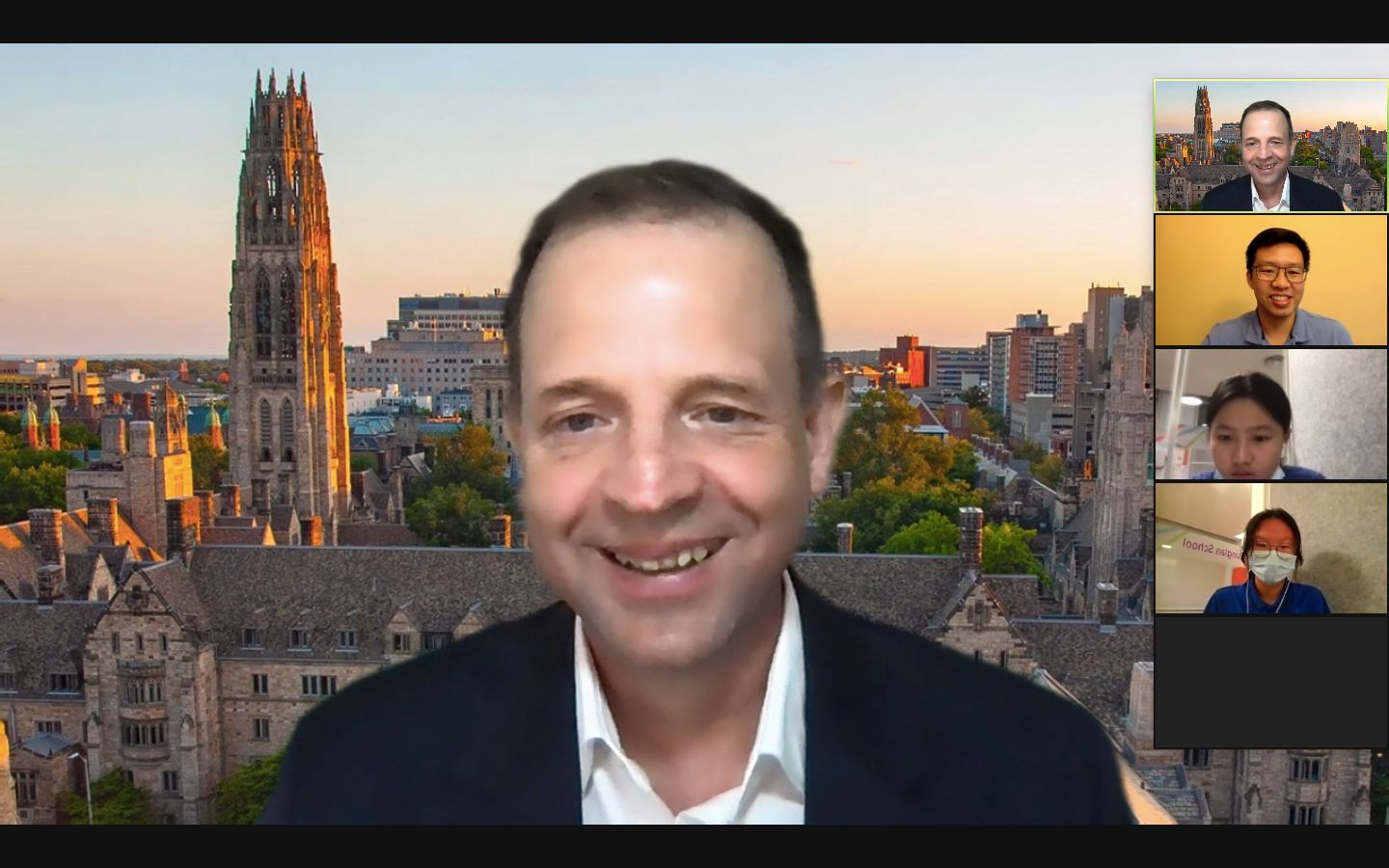
字幕摘录
| 时间 | 英文 | 中文 |
|---|---|---|
| 0:04 | Good morning for me and Professor Pestia here in New Haven | 早上好,我和佩斯蒂亚教授在纽黑文 |
| 0:10 | and good evening to those of you guys joining us | 祝大家晚上好,大家一起来 |
| 0:13 | from China and hello from everybody else around the world. | 来自中国和世界各地其他人的问候。 |
| 0:18 | Good to see everybody. | 很高兴见到大家 |
| 0:20 | Actually, I can't see everybody | 其实,我看不见大家 |
| 0:21 | because people don't have their cameras on. | 因为人们没有摄像头 |
| 0:23 | And so that would be the first thing I'd ask is | 所以,这将是第一件事 我想问的是 |
| 0:26 | that if people are able to turn on their cameras | 如果人们可以打开摄像机 |
| 0:29 | so that when we do begin with our talk | 所以,当我们开始 我们的谈话 |
| 0:33 | that we're not just staring at a black screen, | 我们不只是盯着黑幕看 |
展开字幕全文(1337 条)
| 序号 | 英文 | 中文 |
|---|---|---|
| 1 | Good morning for me and Professor Pestia here in New Haven | 早上好,我和佩斯蒂亚教授在纽黑文 |
| 2 | and good evening to those of you guys joining us | 祝大家晚上好,大家一起来 |
| 3 | from China and hello from everybody else around the world. | 来自中国和世界各地其他人的问候。 |
| 4 | Good to see everybody. | 很高兴见到大家 |
| 5 | Actually, I can't see everybody | 其实,我看不见大家 |
| 6 | because people don't have their cameras on. | 因为人们没有摄像头 |
| 7 | And so that would be the first thing I'd ask is | 所以,这将是第一件事 我想问的是 |
| 8 | that if people are able to turn on their cameras | 如果人们可以打开摄像机 |
| 9 | so that when we do begin with our talk | 所以,当我们开始 我们的谈话 |
| 10 | that we're not just staring at a black screen, | 我们不只是盯着黑幕看 |
| 11 | that would be great. | 这将是伟大的。 |
| 12 | My name is Devin Lau | 我叫刘德文 |
| 13 | and I am the Assistant Director of Yale Center Beijing. | 我是耶鲁中心北京的助理主任 |
| 14 | For many of you guys that have been joining us | 对很多加入我们的人来说 |
| 15 | throughout the last year and a half now, | 在过去的一年半里 |
| 16 | you'll know that we at Yale Center Beijing | 你会知道我们在北京耶鲁中心 |
| 17 | have been hosting talks from professors | 一直主持教授演讲 |
| 18 | throughout Yale University who have contributed | 在整个耶鲁大学中, |
| 19 | to various fields of research. | 参加各个领域的研究。 |
| 20 | And today we are very lucky | 今天我们很幸运 |
| 21 | 让Jordan Pestia教授加入我们 | |
| 22 | He is speaking to us about addressing human health problems | 他正在和我们讨论解决人类健康问题 |
| 23 | through microbial genetics | 通过微生物遗传学 |
| 24 | and quantitative environmental science. | 和定量环境科学。 |
| 25 | And this is something that we've actually had to deal | 这是我们不得不处理的事情 |
| 26 | with quite personally here in New Haven | 和在纽黑文的相当个人 |
| 27 | as well as around the world is actually seeing | 以及世界各地都看到 |
| 28 | how his research has been applied to the real world. | 他的研究是如何应用到现实世界的. |
| 29 | So Professor Jordan Pestia | 所以乔丹·佩斯蒂亚教授 |
| 30 | is the Thomas E. Golden Jr. | 是小托马斯·E·金。 |
| 31 | Professor | 教授 |
| 32 | of Environmental Engineering at Yale. | 耶鲁大学环境工程系 |
| 33 | His research integrates microbiology, genetics, | 他的研究融合了微生物学,遗传学, |
| 34 | engineering, data science and public health | 工程、数据科学和公共卫生 |
| 35 | to study important environmental problems | 研究重大环境问题; |
| 36 | including human health impacts, water-based epidemiology | 包括人类健康影响、基于水的流行病学 |
| 37 | and biological control of global methane emission. | 全球甲烷排放的生物控制。 |
| 38 | And like I mentioned, | 正如我所提到的, |
| 39 | his research has had very direct implications | 他的研究产生了非常直接的影响 |
| 40 | on how we in New Haven and in Connecticut | 我们如何在纽黑文和康涅狄格州 |
| 41 | but also elsewhere have been impacted by COVID, of course | 当然,其他地方也受到COVID的影响。 |
| 42 | but he's had a very interesting perspective on that | 但是他对此有非常有趣的观点 |
| 43 | which I'm sure he'll talk about today. | 我敢肯定,他会谈论今天。 |
| 44 | He's a member of the Connecticut Academy of Sciences | 他是康涅狄格州科学院院士 |
| 45 | and Engineering as well as the associate editor | 以及副编辑 |
| 46 | for the journal Indoor Air | 室内空气杂志 |
| 47 | and the founding chair of the Gordon conference | 戈登会议的创始主席 |
| 48 | on microbiology of the built environment. | 关于建筑环境的微生物学。 |
| 49 | So today we are very lucky to have him join us. | 因此,今天我们非常幸运地让他加入我们。 |
| 50 | So the format will be about a 20 to 30 minute talk | 所以形式是20到30分钟的谈话 |
| 51 | and then we'll open it up to questions from the audience. | 然后,我们将打开它 从观众提问。 |
| 52 | So if you do have questions, please get ready | 所以如果你有问题 请准备好 |
| 53 | to ask them either via the chat function | 通过聊天功能询问它们 |
| 54 | or during the Q&A session, I will call on people directly. | 我将直接召见各位。 |
| 55 | And again, once again, welcome. | 再次欢迎你 |
| 56 | And if you are able to please turn on your video cameras | 如果你能打开你的摄像机 |
| 57 | as a way to make this a more lively | 以此使这更活泼 |
| 58 | and personal interaction. | 以及个人互动 |
| 59 | And with that, I will turn it over to professor Pesci. | 这样我就把它交给佩西教授 |
| 60 | Thanks very much, Devin, for that kind introduction. | 非常感谢 德文 那样的介绍 |
| 61 | I'm gonna share my screen here and get started. | 我要在这里分享我的屏幕 然后开始 |
| 62 | So Devin correctly listed the title of my presentation | 所以德文正确列出了我演讲的标题 |
| 63 | or certainly the title I gave to you | 或者我给你的头衔 |
| 64 | but I was thinking more about it and I thought, | 但我在考虑,我想, |
| 65 | this is kind of what I really wanna talk about. | 这正是我真正想谈的 |
| 66 | So I'm interested in solving environmental problems | 所以我有兴趣解决环境问题 |
| 67 | and we use the normal channels in my lab | 我们用正常的渠道在我的实验室 |
| 68 | that are available in traditional | 传统语言 |
| 69 | to environmental engineers | 环境工程师 |
| 70 | but we also throw biotechnology into the mix. | 但我们也把生物技术投入其中 |
| 71 | And because of that integration | 因为这种融合 |
| 72 | of those two different sciences, | 这两种不同的科学, |
| 73 | we can take on just a broad variety of problems | 我们可以处理各种各样的问题 |
| 74 | always with the eye towards solving problems. | 总是着眼于解决问题。 |
| 75 | And I also wanna convince you to get a dog | 我也想说服你养狗 |
| 76 | and that's gonna be the second part of my talk. | 这将成为我谈话的第二部分。 |
| 77 | Somehow this is all gonna come together. | 不知怎的,这一切会合而为一 |
| 78 | All right, so some things that are going on | 好吧,所以有些事情正在发生 |
| 79 | in my lab right now is, | 现在在我的实验室里 |
| 80 | we genetically engineer cyanobacteria. | 我们基因工程师氰菌。 |
| 81 | This is cyanobacteria growing here | 这里生长着青菌 |
| 82 | and we've modified them so much | 我们修改了这么多 |
| 83 | to put all of their energy and CO2 | 把他们所有的能量和二氧化碳 |
| 84 | into the production of lipids | 用于生产脂类 |
| 85 | that we can get flocks of lipids that float into a container. | 我们可以把大量脂类 漂到容器里 |
| 86 | This is a course for efficient biofuels production. | 这是高效生产生物燃料的路线。 |
| 87 | So that's example of taking a reactor, | 这就是拿反应堆的例子 |
| 88 | genetic modification, optimizing the reactor conditions | 基因改造,优化反应堆条件 |
| 89 | and being able to grow bacteria in a way | 能够以某种方式培育细菌 |
| 90 | to get them to do things for us that we wouldn't normally | 让他们为我们做我们通常不会做的事 |
| 91 | or what they wouldn't normally wanna do. | 或者他们通常不愿意做的事 |
| 92 | The second thing that goes along with process engineering | 第二件与工艺工程有关的事 |
| 93 | is I know we're all concerned about climate change. | 我知道我们都关心气候变化 |
| 94 | One of the largest natural emissions of climate gases | 气候气体最大的自然排放 |
| 95 | is methane and it's methane from wetlands. | 是甲烷,是湿地的甲烷 |
| 96 | And that's increasing as permafrost melts | 随着永久冻土的融化,这正在增加 |
| 97 | and also as the temperature is warm | 温度也变暖 |
| 98 | and microbial activity on the earth heats up. | 地球的微生物活动会发热 |
| 99 | And so we're doing a lot of fundamental studies | 所以我们做了很多基础研究 |
| 100 | in wetlands right now on the microbial populations | 在湿地,现在的微生物种群 |
| 101 | that produce and degrade methane | 产生和降解甲烷 |
| 102 | to try and figure out ways to slow that down. | 试着想办法慢下来 |
| 103 | The other thing we do in our lab is we look at human waste | 我们在实验室里做的另外一件事就是 研究人类的废物 |
| 104 | and we look at infectious disease | 我们看着传染病 |
| 105 | and the nexus between those two. | 以及两者之间的联系。 |
| 106 | And then the final thing is we think a lot about buildings | 最后,我们想了很多建筑 |
| 107 | and truthfully, buildings are our environment. | 说实话 建筑是我们的环境 |
| 108 | They're my environment and I'm sure | 他们是我的环境,我相信 |
| 109 | that they're your environment. | 他们是你的环境。 |
| 110 | They're even my dog's environment. | 他们甚至是我的狗的环境。 |
| 111 | We spend 90% of our time in our buildings | 我们90%的时间都花在我们的建筑里 |
| 112 | and the largest energy expenditure in United States, | 以及美国最大的能源支出, |
| 113 | 40% of all of our energy goes into buildings. | 40%的能量进入建筑物 |
| 114 | And of course, the contaminants that we're exposed to | 当然,我们接触到的污染物 |
| 115 | in buildings are different than those | 在建筑物中与那些不同 |
| 116 | that we're exposed to outdoor air. | 我们暴露在室外空气中 |
| 117 | And there are typically worse | 通常还有更糟的 |
| 118 | and at higher concentrations inside buildings. | 并且建筑内部浓度较高。 |
| 119 | Our environmental exposures, | 我们的环境暴露, |
| 120 | and if you care about environmental contamination, | 如果你关心环境污染, |
| 121 | it's really in buildings. | 它真的在建筑里。 |
| 122 | Outdoor, of course, is important, | 当然,户外很重要 |
| 123 | but buildings is where it comes to the fore. | 但建筑是它的前方。 |
| 124 | So let's start out with just taking two of these topics on, | 因此,让我们开始 只是拿两个这些话题, |
| 125 | human waste, infectious disease, | 人类废物、传染病、 |
| 126 | and then the second one is gonna be more about buildings. | 然后第二部会更多关于建筑物。 |
| 127 | So I did wanna talk a little bit about COVID | 所以我想谈谈COVID |
| 128 | because we're actually not finishing this up. | 因为我们实际上没有完成这件事。 |
| 129 | I know that COVID is slowing down in a lot of places, | 我知道很多地方COVID减速了 |
| 130 | but of course for us, some of this stuff | 当然,对于我们来说,有些东西 |
| 131 | is just getting going because we're still living | 是因为我们还活着 |
| 132 | in this world of monitoring. | 在这个监测的世界里 |
| 133 | And that we worked out in early March, 2020 | 而我们在2020年3月初就解决了 |
| 134 | when SARS-CoV-2 infection started increasing | 当SARS-CoV-2感染开始增加时 |
| 135 | in New Haven, Connecticut with others | 在康涅狄格州纽黑文与其他人 |
| 136 | that one way to efficiently monitor this | 这是有效监控的方法之一 |
| 137 | is to monitor the virus in wastewater. | 在废水中监测病毒 |
| 138 | That's because we have spent billions of dollars | 因为我们花了几十亿美元 |
| 139 | in infrastructure to connect all of our homes | 在基础设施中连接我们所有的家园 |
| 140 | and our businesses and offices | 和我们的企业和办事处 |
| 141 | to a wastewater treatment plant. | 在废水处理厂。 |
| 142 | When we are sick, SARS-CoV-2 ends up in our stool | 当我们生病时,SARS -CoV -2就在我们凳子上 |
| 143 | and that ends up in a wastewater treatment plant. | 最终在废水处理厂。 |
| 144 | And we thought that if we wanted to detect | 我们想,如果我们想检测 |
| 145 | its presence in the city, | 它在城市的存在, |
| 146 | we could find it most efficiently in the treatment plant, | 我们可以在治疗厂找到最有效的方法 |
| 147 | but also we could maybe get some ideas | 但也许我们可以得到一些想法 |
| 148 | about what the infection rate are. | 关于感染率是什么。 |
| 149 | And so that kind of turns out to be true. | 所以,这种 事实证明是真实的。 |
| 150 | This is COVID-19 clinical cases | 这是COVID-19临床病例 |
| 151 | in this first outbreak in Connecticut, this top line here, | 在康涅狄格州发生的第一次疫情中 这条最上面的线 |
| 152 | this bottom line, which mirrors it in shape | 此底线, 它的形状 。 |
| 153 | is the concentration of SARS-CoV-2 | 是非典-CoV-2的浓度 |
| 154 | in New Haven's wastewater treatment plant over that. | 在纽黑文的废水处理厂里 |
| 155 | You can see a pretty clear relationship. | 你可以看到一个相当清晰的关系。 |
| 156 | In fact, the relationship is better | 事实上,这段关系比较好 |
| 157 | than what you would get from testing. | 比你从测试中得到的还要多 |
| 158 | So wastewater surveillance doesn't care | 所以,废水监视 不在乎 |
| 159 | about the same things that we care about in testing. | 和我们在测试中关心的一样 |
| 160 | They don't care if you're asymptomatic or not. | 他们不在乎你是不是无症状 |
| 161 | If you're sick, you shed. | 若有病则脱身. |
| 162 | Doesn't matter whether you go get tested or not. | 你是否去接受测试不重要 |
| 163 | Doesn't matter about whether you want to get tested | 要不要做测试不重要 |
| 164 | on a holiday, whether the government can afford you testing, | 在假日,政府是否 能够负担你测试, |
| 165 | whether there are resources. | 是否有资源。 |
| 166 | Doesn't care about any of that stuff, | 不在乎那些东西, |
| 167 | whether it's cold out that day. | 那天是不是很凉? |
| 168 | These all affect the testing data, | 这些都影响到测试数据, |
| 169 | but they don't affect wastewater data | 但不会影响废水数据 |
| 170 | because we all use the toilet at a common rate. | 因为我们都用普通的厕所 |
| 171 | So this is what testing looked like. | 这就是测试的样子。 |
| 172 | This is a first wave in New Haven, Connecticut. | 这是康涅狄格州纽黑文的第一波. |
| 173 | This is that second big wave, | 这是第二波大浪 |
| 174 | and this is what we call the British variant, | 这就是我们所谓的英国变体, |
| 175 | the B117 wave that was driven by a more infection variant. | B117的波 是由感染变体驱动的 |
| 176 | But what you can see is this first wave | 但你看到的是这第一波 |
| 177 | looks like it has a lot fewer cases, | 看起来案子少了很多 |
| 178 | but if you look at deaths, that's not the case. | 但是如果你看死亡, 情况并非如此。 |
| 179 | There were actually more deaths in the first wave, | 在第一波的死亡数实际上更多, |
| 180 | and it suggests that there were probably more infections. | 这表明感染可能更多。 |
| 181 | When we look at wastewater that bears out, | 当我们看着废水 证明, |
| 182 | this concentration here is much higher. | 这里的集中程度要高得多 |
| 183 | It peaks out much higher for the wastewater data | 就废水数据而言,它达到顶峰 |
| 184 | than it does for the testing data, | 而不是测试数据, |
| 185 | indicating there was a lot more infection | 说明感染更多 |
| 186 | in New Haven early on than we knew about. | 在纽黑文的早期 比我们知道。 |
| 187 | We got testing programs ramped up later on, | 我们的测试程序后来得到了提升, |
| 188 | but wastewater was able to catch | 但废水能够捕捉到 |
| 189 | what the weak and limited testing programs | 什么是薄弱和有限的测试程序 |
| 190 | early on in the pandemic were not able to catch. | 早年在大流行期间未能感染。 |
| 191 | We have a dashboard now where we monitor this stuff | 我们有一个仪表板 在那里我们监测这些东西 |
| 192 | continually in Connecticut. | 持续在康涅狄格州。 |
| 193 | So we take samples from about | 所以,我们采集样本 从大约 |
| 194 | wastewater treatment plants in the major cities. | 主要城市废水处理厂. |
| 195 | They serve about a million people, | 他们为大约一百万人服务, |
| 196 | and we get that data each day, | 我们每天都得到数据, |
| 197 | and we put it out on the web, and we track it. | 我们把它放在网上,然后追踪它。 |
| 198 | This is an older shot right now, | 这是现在的老镜头 |
| 199 | but concentrations are all very low now, | 但现在浓度非常低 |
| 200 | they're all kind of in this bottom range here. | 他们都在这里的底部。 |
| 201 | And it's especially important that we continue to do this | 尤其重要的是,我们要继续这样做 |
| 202 | in the event that there are any outbreaks that happen. | 如果发生任何突发事件。 |
| 203 | We don't expect much over the summer, | 夏天我们没什么期望 |
| 204 | but we expect outbreaks probably in the fall again, | 但预计秋天还会爆发 |
| 205 | much smaller because of the large vaccination population, | 由于大量接种疫苗,接种人数少得多。 |
| 206 | but we expect outbreaks. | 但我们期待爆发。 |
| 207 | But of course, Connecticut is not the problem, | 但当然 康涅狄格州不是问题所在 |
| 208 | or the United States or many of the developed countries | 美国或许多发达国家 |
| 209 | in the world that have nice vaccine coverage, | 在疫苗覆盖良好的世界, |
| 210 | it's developing world right now | 现在是发展中国家 |
| 211 | that's gonna be the problem. | 这才是问题所在 |
| 212 | It's gonna be places that have limited vaccination coverage. | 接种范围有限的地方 |
| 213 | We expect COVID to be around for a long, long time. | 我们期望COVID在身边很长很长一段时间。 |
| 214 | We expect COVID outbreaks in many places in the world | 我们预计世界许多地方都会爆发COVID |
| 215 | to be strong next year, | 明年要坚强起来 |
| 216 | and we'd like to export this type of knowledge | 我们想输出这种知识 |
| 217 | to those other countries so you can efficiently do this. | 对其他国家来说,这样你才能有效地做到这一点。 |
| 218 | The cost of testing wastewater, one of these samples, | 测试废水的成本 其中一个样本, |
| 219 | is roughly the cost of testing one person. | 大约是测试一个人的费用。 |
| 220 | So in New Haven, Connecticut, | 在康涅狄格州纽黑文 |
| 221 | we can test the whole city for 200,000 people | 我们可以测试整个城市20万人 |
| 222 | for about $30, and that's about as much as it costs | 大约30美元,这差不多是它的成本 |
| 223 | to test the whole population. | 测试整个人口。 |
| 224 | If we look more broadly about it, | 如果我们从广义上看 |
| 225 | I think many people have been lulled into this idea | 我想很多人 都喜欢这个想法 |
| 226 | that we always test for respiratory diseases, | 我们总是测试呼吸道疾病, |
| 227 | but if you think about it, | 但是如果你考虑一下 |
| 228 | when's the last time you had a cold, | 你上次感冒是什么时候 |
| 229 | or maybe you had the flu even, | 或者,也许你有流感甚至, |
| 230 | and you went to a physician, | 你去看医生, |
| 231 | and you got diagnosed with something, | 你被诊断出有什么东西 |
| 232 | but they actually took a sample and did a PCR test in a lab | 但他们在实验室做了PCR测试 |
| 233 | and then gave you those PCR test results back. | 然后还给你那些PCR测试结果 |
| 234 | I'm wagering to say never for most people, | 我敢肯定,从来没有为大多数人, |
| 235 | or if it has been a few people, it's been very rare. | 或者,如果它已经 几个人, 这是非常罕见的。 |
| 236 | We don't monitor infectious diseases that way. | 我们不监测传染病的方式。 |
| 237 | We don't have confirmation of what's going on. | 我们没有确认发生了什么 |
| 238 | In the United States, | 在美国, |
| 239 | we have more than a billion infectious diseases a year. | 我们每年有十亿多传染病。 |
| 240 | That's three, or I'm sorry, respiratory diseases a year. | 这是3,或者,我很抱歉,呼吸道疾病一年。 |
| 241 | That's more than three infections for most people. | 大多数人的感染超过3次. |
| 242 | For children, it can be five to eight infections a year. | 对于儿童来说,每年可能感染5至8次。 |
| 243 | Juxtapose that billion versus about 10,000 | 10亿对10000 |
| 244 | infectious diseases from water contamination each year. | 每年水污染引起的传染病。 |
| 245 | We have no idea what the agents are of those diseases. | 我们不知道这些疾病的毒剂是什么。 |
| 246 | We don't track them, | 我们没有跟踪他们, |
| 247 | and it's a big blind spot in our epidemiology. | 它是一个巨大的盲点 在我们的流行病学。 |
| 248 | And so, if we just go into wastewater | 所以,如果我们只是进入废水 |
| 249 | and we just sequence everything | 我们只是整理一切 |
| 250 | and we start pulling out of the different viruses, | 我们开始从不同的病毒中抽出来, |
| 251 | these are all the different types of viruses | 这些都是不同类型的病毒 |
| 252 | that you could see. | 你可以看到这一点。 |
| 253 | And you can see that there's a diversity of viruses | 你可以看到病毒的多样性 |
| 254 | in wastewater, not just coronaviruses. | 在废水, 不只是冕病毒。 |
| 255 | And it suggests that we could monitor | 这说明我们可以监控 |
| 256 | many, many different infectious diseases, | 许多,许多不同的传染病, |
| 257 | even things like HIV, rhinovirus, for example, | 甚至是HIV,犀牛病毒之类的东西 |
| 258 | for colds, et cetera, by looking into wastewater. | 对寒冷,等等, 通过研究废水。 |
| 259 | So we're moving forward with trying to build up epidemiology | 所以我们在努力发展流行病学 |
| 260 | to now start to consider | 现在开始考虑 |
| 261 | all the different respiratory diseases that we have. | 所有不同的呼吸道疾病,我们有。 |
| 262 | 我想在COVID之前, | |
| 263 | respiratory diseases were taken as a matter of course, | 呼吸系统疾病是理所当然的 |
| 264 | just a nuisance, you had to deal through it. | 只是个麻烦,你不得不处理它。 |
| 265 | You had to plow through these things. | 你不得不耕这些东西。 |
| 266 | We're developing technology, I think right now, | 我们现在在开发科技 |
| 267 | that that's gonna change. | 那会改变的 |
| 268 | 200 years ago, that was the same situation | 200年前,情况也一样 |
| 269 | with drinking water. | 与饮用水。 |
| 270 | And we hope that we can take some of those lessons | 我们希望我们能吸取一些教训 |
| 271 | that were used in drinking water and wastewater | 用于饮用水和废水 |
| 272 | that were developed largely by environmental engineers | 主要由环境工程师开发 |
| 273 | to treat water and use that to treat air, | 处理水和利用水处理空气, |
| 274 | to design buildings, to do all kinds of interventions | 设计建筑, 做各种干预 |
| 275 | so that these respiratory diseases, | 这样这些呼吸道疾病, |
| 276 | I don't think they're ever gonna be a thing of the past, | 我不认为他们会永远是过去的事情, |
| 277 | but can be reduced dramatically. | 但可以大幅削减。 |
| 278 | All right, so I wanna shift gears a little bit away | 好吧,我想换个位子 |
| 279 | from SARS and think about just about growing up | 从非典开始 想想怎么成长 |
| 280 | and living in a building is something that we all do. | 住在一栋楼里是我们大家要做的 |
| 281 | And let's talk about a different disease. | 而论异病. |
| 282 | This time, let's talk about allergies | 这次我们来谈谈过敏症 |
| 283 | and respiratory disease like asthma. | 呼吸道疾病如哮喘 |
| 284 | So one in five children in the United States | 美国每五个孩子就有一个 |
| 285 | have respiratory allergens, have some sort of allergies. | 呼吸道过敏 某种过敏 |
| 286 | One in 10 has asthma. | 十分之一的人患有哮喘. |
| 287 | And in the US, the rates of asthma have doubled. | 在美国,哮喘发病率翻了一番。 |
| 288 | 50% of Americans are sensitized to some type of allergy. | 50%的美国人对某种过敏反应敏感. |
| 289 | We have food, air, latex, you name it. | 我们有食物,空气,乳胶,你说的 |
| 290 | And this number, but this number is only 7% | 这个数字,但这个数字只有7% |
| 291 | among certain populations in the United States. | 在美国某些人群中。 |
| 292 | The Amish community in Indiana is a religious community | 印第安纳的阿米什社区是一个宗教社区 |
| 293 | that doesn't use any sort of mechanized equipment. | 没有任何机械化设备 |
| 294 | They don't have cars or anything like that. | 他们没有汽车或类似的东西。 |
| 295 | They live in close proximity with animals on farms. | 他们与农场里的动物生活在很近的地方. |
| 296 | And so, we have these always built-in experiments | 因此,我们有 这些总是内置的实验 |
| 297 | in our societies where one group | 在我们社会中,一个群体 |
| 298 | may have a high incidence of disease | 疾病发病率可能很高 |
| 299 | and another group may have a low incidence of disease. | 而另一个群体的发病率可能较低。 |
| 300 | So that's some clue in figuring out | 所以,这是一些线索 找出 |
| 301 | where asthma is coming from. | 哮喘是从哪里来的 |
| 302 | In China, of course, asthma prevalence | 当然,在中国,哮喘流行 |
| 303 | is growing very rapidly. | 增长非常迅速。 |
| 304 | It's up to six times greater in urban areas | 市区最多6倍 |
| 305 | versus rural areas for children. | 与农村儿童相比。 |
| 306 | So another clue about what is it about urban areas | 因此,另一个线索 关于它是什么 关于城市地区 |
| 307 | that is so important for asthma. | 这对哮喘很重要 |
| 308 | So this is, maybe you recognize this is Hong Kong. | 所以这是,也许你认得这是香港。 |
| 309 | I would guess nobody would doubt | 我想没有人会怀疑 |
| 310 | that this is what an urban area looks like. | 这就是一个城市地区的样子。 |
| 311 | This is a very different environment than Bavaria, | 这环境和巴伐利亚完全不同 |
| 312 | which is in Germany. | 在德国 |
| 313 | This is an agricultural region in Germany. | 这是德国的一个农业区. |
| 314 | And the reason I show you this picture, | 我给你看这张照片的原因 |
| 315 | and we'll get into this a little bit more detail, | 我们再详谈一下 |
| 316 | is that this is very rural | 这是非常的农村 |
| 317 | and the children and adults who live in this area | 儿童与成年人 |
| 318 | have almost zero asthma and allergies. | 几乎没有哮喘和过敏 |
| 319 | Their rates are off the charts | 他们的费率不计时 |
| 320 | in the negative direction, that is. | 在消极的方向,这是。 |
| 321 | It's just almost unheard of for children | 对孩子们来说,这几乎是前所未有的 |
| 322 | to have asthma when they grow up in this region. | 当他们在这个地区长大时,就会有哮喘。 |
| 323 | One thing that they do very differently | 有一件事,他们做的非常不同 |
| 324 | than most of us, I would wager, | 比我们大多数人,我敢打赌, |
| 325 | is that they live in houses | 他们住在房子里 |
| 326 | that are in very close proximity to their animals. | 它们离动物很近 |
| 327 | So here they have cattle. | 这里有牛 |
| 328 | Their houses up here in the living quarters | 他们的房子在这里的生活区 |
| 329 | are on top in the brown area. | 在棕色区域上方 |
| 330 | These white areas are barns. | 这些白色地区是谷仓. |
| 331 | And so the cattle live right directly below them | 牛就住在他们下面 |
| 332 | in the same building as they do. | 和他们在同一栋楼里 |
| 333 | When people have looked at this | 当人们看到这个 |
| 334 | and studied in epidemiology studies, | 并研究流行病学, |
| 335 | this is what we call a graph of odds ratios. | 这就是我们所谓的概率比图。 |
| 336 | This is just a way of saying, | 这只是一种说法, |
| 337 | are your odds greater of having a disease | 你患上疾病的可能性更大吗? |
| 338 | or less of having a disease? | 或少有病吗? |
| 339 | And in this case, when things are pointing to the left | 在这种情况下,当事情指向左边时 |
| 340 | of this dashed line, | 这条破线, |
| 341 | that means that you're protected from a disease. | 也就是说,你被保护 不受疾病的影响。 |
| 342 | And children who grew up in Bavaria, right, | 还有在巴伐利亚长大的孩子 |
| 343 | and that lived in one of these farmhouses | 住在一个农舍里 |
| 344 | before year one, that is, | 在第一年之前,即 |
| 345 | they were born there and they lived there early, | 他们出生在那里, 他们在那里很早, |
| 346 | have almost a 10 times lower chance of getting asthma | 患哮喘的几率低了十倍 |
| 347 | and are on five times lower chance | 机会是五倍 |
| 348 | of something called atopy, | 一种叫阿托比的东西, |
| 349 | which is a propensity for developing allergic disease. | 这是发展过敏性疾病的倾向。 |
| 350 | That's versus the same population, | 这是对相同的人口, |
| 351 | the same genetics of children who live very nearby, | 住在附近的孩子的遗传学 |
| 352 | but may have even lived in the region, | 但也许已经住在这个地区, |
| 353 | but have never lived in one of these farmhouses | 但从未住过这些农舍 |
| 354 | and certainly didn't do so | 当然没有 |
| 355 | in the first year of their lives, right? | 在他们生命的第一年,对不对? |
| 356 | So there's something about being born | 所以,有的东西 出生 |
| 357 | and spending your first year of life | 度过人生的第一年 |
| 358 | in one of these farmhouses | 在其中一间农舍里 |
| 359 | that gives you this tremendous protection against asthma. | 这样你就能防哮喘 |
| 360 | And of course, the idea is that it's animals. | 当然,这个想法是 它是动物。 |
| 361 | What is it about animals that secretly confers this? | 秘密授予这个的动物是什么? |
| 362 | Along these lines, | 根据这些思路, |
| 363 | we would participate in epidemiology studies. | 我们将参与流行病学研究。 |
| 364 | This is with the California Department of Health. | 这是加州卫生部的 |
| 365 | And this is a cohort of asthmatic children called Chamacos | 这是一群叫Chamacos的哮喘病儿童 |
| 366 | that was followed from birth. | 从出生开始就一直跟着我 |
| 367 | Pregnant women were enrolled in California | 加利福尼亚州怀孕妇女入学 |
| 368 | and they were followed through the age of 12, | 他们被跟踪到12岁。 |
| 369 | where they were, | 他们在哪里, |
| 370 | we knew the conditions in which the homes lived, | 我们知道家里住着什么 |
| 371 | the children lived in in the first year, | 孩子们在第一年, |
| 372 | and we knew what kind of diagnosis they got for asthma | 并且我们知道他们对于哮喘的诊断是什么 |
| 373 | or allergies all the way through age 12. | 或过敏 一直到12岁。 |
| 374 | And when we did that, | 当我们这样做时, |
| 375 | and we did the epidemiology | 我们做了流行病学 |
| 376 | and we looked at the microbial populations | 我们看着微生物群 |
| 377 | that lived in the homes, | 住在家里的人, |
| 378 | one thing stood out really dramatically, | 有一件事很突出 |
| 379 | and that was fungi. | 这是真菌。 |
| 380 | The children who did not develop asthma | 没有患哮喘的儿童 |
| 381 | were exposed to a large diversity of fungi, right? | 接触了大量的真菌,对不对? |
| 382 | And so I'm showing you plates of fungi here | 所以我给你看这些真菌的盘子 |
| 383 | because this is just a better way to look at it. | 因为这是更好的方法来看待它。 |
| 384 | But of course, what you are exposed to in your home | 但当然,你在家里所接触的 |
| 385 | don't look like this unless they're growing on your walls, | 不要这样,除非他们在你的墙上生长, |
| 386 | which isn't a good thing. | 这不是一件好事。 |
| 387 | It's the small microscopic spores | 是小微粒孢子 |
| 388 | that grow in these sort of bodies, right? | 长在这种身体,对不对? |
| 389 | There are millions and millions of these | 有数百万个这样的 |
| 390 | in each person's homes. | 在每个人的家中。 |
| 391 | One gram of your carpet dust contains | 你的地毯灰尘含有一克 |
| 392 | millions to potentially billions of spores | 数百万到潜在的数十亿孢子 |
| 393 | of these types of fungi. | 这些类型的真菌。 |
| 394 | But it's not so much the fact that you're exposed | 但并不是因为你被曝光 |
| 395 | to a lot of them or a little of them, | 他们中有许多人,有一部分人, |
| 396 | it's that you're exposed to many different kinds. | 你接触过很多不同的种类 |
| 397 | And the more different kinds you're exposed to | 你接触的种类越多 |
| 398 | seems to have a strong protective effect. | 似乎有强大的保护效果。 |
| 399 | Now we get at that through biotechnology. | 现在我们通过生物技术来达到这个目的。 |
| 400 | That is by taking dust samples, sequencing their DNA, | 这就是通过采集尘埃样本, 排序他们的DNA, |
| 401 | 透过DNA | |
| 402 | and identifying the different varieties of fungi. | 并识别不同品种的真菌. |
| 403 | That's something we could never get through by plating | 那是我们永远无法通过电镀 |
| 404 | because while this looks like | 因为当这看起来像 |
| 405 | there's a real diverse group of fungi | 有一种真菌很多样化 |
| 406 | and it's all pretty interesting in a house. | 房子里的东西都很有趣 |
| 407 | This is what? | 这是什么? |
| 408 | One, two, three, four, five, one, two, three. | 一,二,三,四,五,一,二,三,四,四 |
| 409 | This is 20 different species. | 此为二十种. |
| 410 | In a gram of dust, we'll see thousands of different species | 在一克尘埃中,我们会看到成千上万种不同的物种 |
| 411 | when we actually sequence them. | 当我们真正地排序他们。 |
| 412 | All right. | 好吧,我们走。 |
| 413 | So this is what the odds ratios look like that. | 这就是概率率的模样。 |
| 414 | This is our study called the Chamaco study. | 这是我们的研究,叫做查马科研究。 |
| 415 | And you had roughly a five time protective effect | 你大概有5次保护效果 |
| 416 | if you had a high diversity of fungi in your house | 如果你家里有多种真菌 |
| 417 | not developing asthma. | 不是发作哮喘。 |
| 418 | That is for high fungal diversity in your home, | 这是为了你家里的真菌多样性 |
| 419 | you are five times less likely to develop asthma | 你患哮喘的可能性是现在的五倍 |
| 420 | than you are if you have low fungal diversity in your home. | 比你家的真菌种类少还多 |
| 421 | This was confirmed in another epi study recently | 最近的另一篇论文证实了这一点 |
| 422 | in the United States | 美国 |
| 423 | and in two other epidemiology studies in Europe. | 以及在欧洲的另外两项流行病学研究。 |
| 424 | So now it's four out of four | 现在四分之四了 |
| 425 | say that there's something important about fungal diversity. | 说真菌多样性很重要 |
| 426 | The hypotheses for these types of things | 这些类型的假设 |
| 427 | have been put forward and it's that microbial richness | 是微生物的丰富性 |
| 428 | results in diversity of something called paths. | 导致被称为路径的多样性。 |
| 429 | These are path and associated microbial patterns. | 这些是路径和相关的微生物模式。 |
| 430 | That is just the type of biochemical signature | 那只是生化的标志 |
| 431 | that's on the outside of different microbes. | 这是不同微生物的外表 |
| 432 | When a child is exposed to those early on in life | 当一个孩子在生命的早期接触到那些 |
| 433 | as their immune system is developing, | 由于他们的免疫系统正在发展, |
| 434 | the immune system develops | 免疫系统发展 |
| 435 | to recognize those types of microorganisms. | 承认这些类型的微生物。 |
| 436 | If they don't have a diversity of recognition, | 如果他们没有多样性的认可, |
| 437 | the immune system is poorly trained | 免疫系统训练不足 |
| 438 | and that results in this cascade | 而导致这种级联 |
| 439 | that causes allergies and asthma. | 导致过敏和哮喘。 |
| 440 | Other associated hypotheses, | 其他相关假设 |
| 441 | again, happen with a gut microbiome | 再来一次,用肠道微生物 |
| 442 | that your gut microbiome needs to be trained | 你的肠道微生需要训练 |
| 443 | by specific types of microorganisms, | 特定类型的微生物, |
| 444 | not just the patterns, | 不只是模式, |
| 445 | but maybe microbes that do things within your gut. | 但也许微生物 做你直觉内的事情。 |
| 446 | You have to be seeded in a proper way. | 须以正法种子. |
| 447 | You need a lot of microbial diversity | 你需要很多微生物多样性 |
| 448 | in order to have that happen early on in life. | 为了让这 发生在生命的早期。 |
| 449 | And if you don't get enough bacterial and fungal richness, | 如果你没有得到足够的细菌和真菌丰富, |
| 450 | that is our diversity early on, you have a problem. | 那是我们早期的多样性,你有一个问题。 |
| 451 | So how do you get exposure | 所以,你如何获得曝光 |
| 452 | to more microbial diversity early on in life? | 早期的微生物多样性? |
| 453 | This is the dog, right? | 这是狗,对不对? |
| 454 | How did those children in Bavaria | 巴伐利亚的孩子们是怎么死的 |
| 455 | get that microbial exposure? | 有微生物接触吗? |
| 456 | I can't say whether they have dogs or not. | 我不能说他们有没有狗 |
| 457 | I'm assuming they probably have dogs, | 我想他们可能有狗, |
| 458 | but it's the cattle, right? | 但它的牛,对不对? |
| 459 | They grow up around cattle. | 他们在牛群周围长大 |
| 460 | They grow around pigs and other type of livestock. | 它们围绕猪和其他种类的牲畜生长. |
| 461 | The microbial diversity in those homes in Bavaria | 巴伐利亚这些家庭中的微生物多样性 |
| 462 | is very high. | 已经很高了 |
| 463 | If you look at the microbial diversity | 如果你看看微生物的多样性 |
| 464 | in homes in Connecticut, | 在康涅狄格州的家中, |
| 465 | and I would wager in China as well, | 我也会去中国打赌 |
| 466 | and you compare homes with dogs versus homes without dogs, | 你们把家和狗比作没有狗的家, |
| 467 | you'll find much higher microbial diversity | 你会发现更多的微生物多样性 |
| 468 | in homes with dogs. | 在家中与狗。 |
| 469 | In fact, when we just look at Connecticut | 事实上,当我们看着康涅狄格州 |
| 470 | and we look at just a survey, | 我们只看一个调查, |
| 471 | this is over 200 homes in our state. | 我们州有两百多户人家 |
| 472 | These are fungi, bacteria, human cells and dog cells, right? | 这些是真菌,细菌,人类细胞和狗细胞,对吧? |
| 473 | And this is just a kind of a cumulative probability | 这只是一种累积概率 |
| 474 | of what these concentrations are. | 这些浓度是多少? |
| 475 | About half the homes have dogs, | 大约一半的家庭有狗, |
| 476 | so we don't see any dog cells in homes that don't have dogs. | 所以家里没有狗细胞 |
| 477 | But some of these homes have, you know, | 但其中一些家庭,你知道, |
| 478 | 10,000 dog cells per gram of dust. | 每克灰尘一万只狗细胞. |
| 479 | They're pretty heavily covered with dogs. | 他们被狗覆盖着 |
| 480 | In fact, over and over, | 事实上 一遍又一遍 |
| 481 | when you look at microbial diversity, | 当你看着微生物的多样性, |
| 482 | even things like scraping off the dust from your TV screen, | 即使是从电视屏幕上刮去尘埃的东西 |
| 483 | if you have a dog, | 如果你有一条狗, |
| 484 | you can look at the signatures of those microbial communities | 您可以查看微生物群落的特征 |
| 485 | and you can tell a dog lives in that house. | 你可以告诉狗住在那房子里 |
| 486 | The one thing that really tends to move the dial | 唯一能移动拨号的 |
| 487 | on the microbial diversity in a house is living with dogs. | 在一个房子里的微生物多样性 和狗一起生活。 |
| 488 | There's another thing that tends to move that dial as well, | 还有一样东西也倾向于移动那个拨号 |
| 489 | and that's mold growing in your house. | 那是你家里的模具生长 |
| 490 | And unfortunately, mold moves the dial the other way. | 不幸的是,模具把拨号移到另一边。 |
| 491 | Fungi diversity, good. | 真菌的多样性,很好。 |
| 492 | Fungi growing on your walls, bad, that is, right? | 你墙上长着真菌,很坏,对吧? |
| 493 | Because that turns to lower diversity. | 因为这变成了较低的多样性。 |
| 494 | This is a large problem throughout the world | 这是全世界最大的问题 |
| 495 | because as we have problems with climate change, | 因为我们有 气候变化的问题, |
| 496 | we continue to get these large flooding events. | 我们继续得到这些 大型洪水事件。 |
| 497 | We continue to get hotter days, more moisture, | 我们继续得到更热的日子,更多的水分, |
| 498 | that results in fungi growing | 导致真菌生长 |
| 499 | in building materials in our homes. | 我们家的建筑材料。 |
| 500 | Up to 50% of homes in the United States | 美国50%以上的家庭 |
| 501 | have reported some sort of mold growing in their house. | 已经报告某种模具 在他们的房子里生长。 |
| 502 | And if we look at things like record-breaking daily rainfalls, | 如果我们看的东西 像破纪录的每日降雨, |
| 503 | which contribute to dampness and moisture in house, | 使室内湿润, |
| 504 | that's just increasing with increased energy and moisture | 随着能量和水分的增加, 水量会增加 |
| 505 | in the atmosphere due to climate. | 在大气中,由于气候。 |
| 506 | We did an experimental design | 我们做了一个实验设计 |
| 507 | where we looked at a national study. | 在那里,我们看 一个全国性的研究。 |
| 508 | We wanted to know more about mold in houses. | 我们想知道更多 房子的模具。 |
| 509 | And so we did the same sort of DNA sequencing approach | 所以我们做了同样的DNA测序方法 |
| 510 | where we took dust from different houses. | 在那里,我们从不同的房屋中取出灰尘。 |
| 511 | We sequenced it. | 我们排好了 |
| 512 | We identified all the fungi based on the genes | 我们根据基因确定了所有的真菌 |
| 513 | associated with individual unique fungi. | 与单个独特的真菌有关。 |
| 514 | And then we put together what the populations look like | 然后我们整理出人群的样子 |
| 515 | in homes from around the United States. | 在美国各地的家中 |
| 516 | We looked at homes that had documented mold problems. | 我们查看了那些记录了模具问题的家庭。 |
| 517 | We looked at homes that had no documentation | 我们看了没有文件的家 |
| 518 | of mold problems. | 模具问题。 |
| 519 | To see if there's a difference really | 看有没有区别 |
| 520 | between a moldy home and a non-moldy home. | 在一个发霉的家和 一个非乳房的家之间。 |
| 521 | And the reason why that's the question is because, | 问题就在于 |
| 522 | you know, when mold occurs in a home, | 你知道,当模具发生在家里, |
| 523 | it might be under a sink, | 可能在水槽下方 |
| 524 | might be mold growing in a closet, | 可能是在衣柜里生长的模具 |
| 525 | might be mold growing in the basement. | 可能是在地下室生长的模具。 |
| 526 | And the question is in these living areas | 问题是在这些生活区 |
| 527 | and children's bedrooms, | 和孩子们的卧室, |
| 528 | or the most common areas in the house, | 或家里最常见的地方, |
| 529 | do we see an influence of that mold | 我们是否看到模具的影响 |
| 530 | that grows in those building materials? | 在那些建筑材料中生长的? |
| 531 | And the first thing that we see | 我们看到的第一件事 |
| 532 | is that there is a big influence | 影响很大 |
| 533 | and it influences this diversity. | 它影响了这种多样性。 |
| 534 | So this is just a technical term | 所以这只是个技术术语 |
| 535 | that we have to put in, you know, | 我们必须把,你知道, |
| 536 | for scientific journals. | 科学期刊。 |
| 537 | They don't want to see the term diversity here. | 他们不想在这里看到多样性一词。 |
| 538 | This is observed ASV count. | 这被观察到ASV计数. |
| 539 | ASV is just a way of kind of saying species here. | ASV只是一种说物种的方法。 |
| 540 | And it's the higher the count, | 计数越高 |
| 541 | the more diversity to the more different types | 多样性越多,类型就越不同 |
| 542 | of fungi exist in a home. | 存在于家中的真菌 |
| 543 | This is if you just look at direct mold, | 如果你看看直接的模具 |
| 544 | just add some mold growing on a wall | 只要在墙上加一些模具 |
| 545 | and you can say that's a relatively diverse thing. | 你可以说这是一个相对多样的事情。 |
| 546 | There's a few different species | 有几个不同的物种 |
| 547 | technically typically growing there. | 从技术上讲,那里是典型的生长地。 |
| 548 | If you look at the air of a moldy home though, | 如果你看着发霉的家的空气 |
| 549 | it looks kind of like direct mold, very low diversity. | 它看起来有点像直接的模具, 非常低的多样性。 |
| 550 | When you go to a home that doesn't have mold | 当你去一个没有模具的家庭 |
| 551 | or no history of mold, | 或者没有模具的历史, |
| 552 | you see a range of diversities, | 你可以看到一系列的多样化, |
| 553 | but on average that diversity is much higher | 但平均来说,多样性要高得多 |
| 554 | and it looks a lot like the diversity | 它看起来很像 多样性 |
| 555 | that you would get from outside. | 你会从外面得到。 |
| 556 | When we put these together and we sequence everything, | 当我们把这些组合起来 然后把一切都排序 |
| 557 | you end up with hundreds or thousands of samples, | 你最后有上千个样本 |
| 558 | each with tens of thousands of identifications in them. | 里面有成千上万的身份证 |
| 559 | And we wanted to use all of this information | 我们想用所有这些信息 |
| 560 | to put it together to see if we could classify | 把它拼在一起 看看我们能不能分类 |
| 561 | based on a DNA sequence test, | 根据DNA序列测试, |
| 562 | whether a house had a mold problem or not, | 无论房子是否出现模具问题, |
| 563 | whether it was the mold signature | 不管是模具签名 |
| 564 | made it look like a moldy house or not. | 让它看起来像一个发霉的房子与否。 |
| 565 | Because a lot of times there are health problems in homes | 因为很多时候家里有健康问题 |
| 566 | and there are no obvious mold growth there | 那里没有明显的模具生长 |
| 567 | because homes based on surface area are mostly hidden spaces. | 因为基于地表面积的家园大多是隐藏空间. |
| 568 | That is the spaces that you can see in your home | 这就是你在家里看到的空间 |
| 569 | are the minority of spaces. | 属于少数空间。 |
| 570 | Mold grows inside the walls, under the floor, | 墙壁内,地板下 |
| 571 | in floorboards, in ceilings, in ventilation systems. | 在地板、天花板、通风系统。 |
| 572 | And so mold inspection can often elude people | 所以模具检查 往往可以避开人们 |
| 573 | and it's a large multi-billion dollar problem | 这是一个巨大的数十亿美元的问题 |
| 574 | in an industry that has no tools to really go in, | 在一个没有工具真正进入, |
| 575 | sample the air and say, yes, you have a mold problem. | 抽查空气并说,是的,你有模具问题。 |
| 576 | So we put all this data together, | 所以我们把这些数据集中起来 |
| 577 | we put them into things like decision trees, | 我们把它们放进诸如决策树之类的东西里 |
| 578 | which is a basis of a machine learning algorithm, | 这是机器学习算法的基础 |
| 579 | in this case a random forest model. | 在这种情况下 一个随机的森林模型。 |
| 580 | And we just ask questions, right? | 我们只是问问题,对不对? |
| 581 | Here's some moldy houses, here's some moldy houses. | 这里有一些腐烂的房子, 这里有一些腐烂的房子。 |
| 582 | What about the aspergillus, the species of mold? | 阿斯珀吉勒斯,模具的种类呢? |
| 583 | It's a concentration high in these houses. | 这些房子的集中度很高 |
| 584 | Some are no, some are yes. | 有些是否定的,有些是肯定的。 |
| 585 | It turns out it's typically high in a moldy house. | 原来它通常在发霉的房子里很高. |
| 586 | What about malassezia? | 那马拉西娅呢? |
| 587 | This is a human skin. | 这是人皮 |
| 588 | Turns out it's typically higher in no mold houses | 原来在没有模具屋的地方一般会更高 |
| 589 | because the other mold from moldy houses | 因为另一个模具来自模具屋 |
| 590 | is crowding it out, right? | 正在挤出它,对不对? |
| 591 | You can just ask this for species after species, | 你可以问这个 物种之后, |
| 592 | for microbial condition after microbial condition, | 在微生物病情之后, |
| 593 | you can do this a thousand times. | 你可以这样做一千次。 |
| 594 | You can do this for many, many different buildings | 你可以为许多不同的建筑做这个 |
| 595 | and you get this, not one single decision tree, | 你得到这个, 没有一个决定树, |
| 596 | you get what's called a random forest. | 你得到所谓的随机森林。 |
| 597 | And that random forest can take this very broad | 和随机的森林可以带走这个非常宽的 |
| 598 | group of sequence information from a lot of diverse homes | 许多不同家庭的序列信息组 |
| 599 | and it can make some sense out of it | 并且它可以让一些道理出来 |
| 600 | and build a classification system. | 并建立分类系统。 |
| 601 | You can train this classification system saying, | 你可以训练这个分类系统说, |
| 602 | this is what we want moldy houses to look like, | 这就是我们想要的模样房子, |
| 603 | this is what we want no mold houses to look like. | 我们不想让模具屋变成这样 |
| 604 | And you can see, you got a way of predicting it. | 你可以看到,你有一个预测的方法。 |
| 605 | That is houses that are moldy, | 那是有腐烂的房屋, |
| 606 | we predict in this case about 95% of the time, | 我们预测,在这种情况下 95%的时间, |
| 607 | houses that are not moldy, same thing. | 不发霉的房子,同样的事情。 |
| 608 | This is based on how many different houses. | 这是基于多少不同的房屋。 |
| 609 | Anything to the left here is an incorrect prediction. | 这里左边的任何东西都是不正确的预测. |
| 610 | Same thing here, anything to the right | 同样的事情在这里,任何正确的 |
| 611 | is a correct prediction. | 是一个正确的预测。 |
| 612 | So again, we're above 90% in being able to predict it. | 再说一遍,我们90%以上都能够预测。 |
| 613 | So this is a tool that's been patented | 这个工具已经申请了专利 |
| 614 | is now going through product development | 正在开发产品 |
| 615 | and that we're hoping that we can get in homes | 希望我们能回家 |
| 616 | fairly rapidly. | 相当迅速 |
| 617 | The idea again is that inspector would just need to come in, | 再说一遍 督察只需要进来 |
| 618 | take a Q-tip and swap some settled dust | 取个Q小调,换些固定的灰尘 |
| 619 | that would just be sent to his lab, | 那只是被送到他的实验室, |
| 620 | sequenced overnight, put into the algorithm. | 进入算法 |
| 621 | And then you could say that this home | 然后你可以说这个家 |
| 622 | has got characteristics of mold problem. | 有模具问题的特点 |
| 623 | You need remediation or you don't remediation. | 你需要补救或不补救。 |
| 624 | So I'm gonna end here with two big questions | 所以我要在这里结束 两个大问题 |
| 625 | about environmental biotechnology and our human health. | 关于环境生物技术和我们的人类健康。 |
| 626 | And the first one is about wastewater surveillance. | 第一个是废水监控。 |
| 627 | Can that be a standard epidemiological tool | 会不会是标准的流行病学工具? |
| 628 | for the broad survey of infectious disease? | 对传染病的广泛调查? |
| 629 | And so we're not just talking about, | 所以,我们不只是在谈论, |
| 630 | can we add another tool to our survey of infectious disease? | 我们能否在传染病调查中增加另一个工具? |
| 631 | We're actually asking, | 我们实际上在问, |
| 632 | can we start to really accurately survey infectious disease | 我们能开始精确地调查传染病吗? |
| 633 | for the first time, right? | 这是第一次吧? |
| 634 | Some diseases have better surveys than others, | 有些疾病比其他疾病有更好的调查 |
| 635 | but mostly we ignore this problem. | 但我们大多忽略了这个问题。 |
| 636 | We don't have good ideas when outbreak occurs | 爆发的时候我们没有好办法 |
| 637 | for many different types of agents. | 对于许多不同类型的代理。 |
| 638 | And so we're gonna ask the question | 所以我们要问一个问题 |
| 639 | and we're gonna continue on with this work | 我们要继续工作 |
| 640 | and how we can develop this for flu, for HIV, | 以及我们如何发展它 对于流感,艾滋病毒, |
| 641 | for many, many diseases, | 对于许多疾病, |
| 642 | things like Lyme disease in Connecticut | 康涅狄格州莱姆病之类的 |
| 643 | to get a good idea when these seasons are, | 想知道当这些季节, |
| 644 | when they occur, what the cases levels are. | 当它们发生时,什么是案件水平。 |
| 645 | We think this could be a tremendous attribute | 我们认为这可能是一个巨大的属性 |
| 646 | to public health. | 公共卫生。 |
| 647 | The second idea here then is, | 这里的第二个想法是, |
| 648 | how can we intentionally design buildings | 我们怎样设计建筑? |
| 649 | to control human exposure to hazardous | 控制人类接触危险 |
| 650 | as well as beneficial microbes? | 还有有益的微生物? |
| 651 | If microbial diversity is good for us, | 如果微生物多样性对我们有利 |
| 652 | how can we design homes to encourage microbial diversity | 如何设计鼓励微生物多样性的家园 |
| 653 | so our children don't develop immune systems diseases | 这样我们的孩子就不会出现免疫系统疾病 |
| 654 | like asthma and allergies? | 像哮喘和过敏? |
| 655 | Getting a dog is one thing, | 养狗是一回事 |
| 656 | but of course that's not really a home design. | 但这当然不是家庭设计 |
| 657 | That's more of a personal decision. | 这更是一个个人的决定。 |
| 658 | How can we encourage better ventilation? | 我们如何鼓励更好的通风? |
| 659 | How can we encourage more outdoor air? | 我们如何鼓励更多的室外空气? |
| 660 | Especially in mega cities throughout the world | 特别是全世界特大城市 |
| 661 | that have air pollution problems | 有空气污染问题的 |
| 662 | and ventilation isn't as easy as it is | 通风也没那么容易 |
| 663 | in other more rural areas of the country. | 全国其他农村地区。 |
| 664 | So those are the problems that we continue to work on. | 因此,这些都是我们继续处理的问题。 |
| 665 | I thank you very much for your attention | 非常感谢大家的注意 |
| 666 | and I'll leave it there. | 我会把它留在那。 |
| 667 | Thank you so much. | 非常感谢 |
| 668 | That was a most fascinating presentation | 这是非常迷人的演讲 |
| 669 | and we could go into so many of those different ideas | 我们可以去 这么多不同的想法 |
| 670 | and really explore them. | 并真正探索它们。 |
| 671 | I'm gonna open it up now for questions from the audience. | 我现在要打开它 观众提问。 |
| 672 | So if anybody has questions, | 所以如果有人有疑问 |
| 673 | please feel free to raise your hand | 请随便举手 |
| 674 | using the Zoom raise your hand function | 使用缩放提升手的功能 |
| 675 | or you can type out your question in the chat box. | 或者您可以在聊天框中输入您的问题。 |
| 676 | Either way, I'd be more than happy to call on people | 不管怎么样,我更愿意找别人 |
| 677 | so that you guys can ask the questions | 这样你们就可以提问了 |
| 678 | that you have directly. | 直接给你的 |
| 679 | And I'm sure there are many fascinating conversations | 我敢肯定,有很多有趣的谈话 |
| 680 | that we can be having. | 我们可以有。 |
| 681 | So if you have any questions, | 如果你有任何问题 |
| 682 | feel free to raise your hand or use the chat box. | 随便举手或使用聊天盒 |
| 683 | And again, especially if you're asking a question, | 再说一遍 特别是如果你在问问题 |
| 684 | it'd be great if you could turn on your webcam | 打开你的摄像头就好了 |
| 685 | just so we could know who we're talking to. | 为了让我们知道我们在跟谁说话 |
| 686 | All right, let's start with Maggie here. | 好了,我们从玛姬开始 |
| 687 | I'm going to unmute you. | 我要揭发你 |
| 688 | Hi, so I have a question about the process of your study. | 嗨,所以我有一个问题 关于你的学习过程。 |
| 689 | So what is the most difficult problem for your team | 那么,什么是你团队最困难的问题 |
| 690 | in the process of quantitative detection | 在定量检测过程中 |
| 691 | of such amount of small microorganism in the sewage? | 排污中如此多的小型微生物? |
| 692 | It's a really good question, Maggie. | 这是一个非常好的问题,玛姬。 |
| 693 | So you're asking about the microorganisms in sewage | 所以你在问污水中的微生物 |
| 694 | are low concentrations | 低浓度 |
| 695 | and this must be difficult to detect. | 这肯定很难发现 |
| 696 | And it turns out it is. | 原来是的 |
| 697 | When you go to get a COVID test | 当你去做COVID测试时 |
| 698 | and they take a swab of your nose, | 他们从你的鼻子里抽出来 |
| 699 | the concentrations, if you're positive of COVID in that swab | 浓度,如果你是 COVID的阳性 在那个swab |
| 700 | are more than a million times greater | 超过100万倍 |
| 701 | than the concentrations in wastewater. | 比废水中的浓度高。 |
| 702 | So they are very low concentrations, | 他们的浓度是很低的, |
| 703 | but we use approach called quantitative PCR | 但我们用的是量性PCR |
| 704 | or another one called droplet digital PCR. | 或者另一个叫液滴数码PCR |
| 705 | These are methods that can actually detect | 这些方法可以实际发现 |
| 706 | just one gene in an environmental sample. | 只是环境样本中的一个基因 |
| 707 | Practically, that's a hard thing to do, | 实际上,这很难做, |
| 708 | but there are extraordinarily sensitive methods, | 但有特别敏感的方法, |
| 709 | something like one times 10 to the negative 15 or 18th grams | 1乘以10的负15或18克 |
| 710 | of material can be detected | 可以检测到材料 |
| 711 | in these methods pretty accurately. | 这些方法非常准确。 |
| 712 | So we have a capability of getting low detection. | 因此,我们有能力 得到低检测。 |
| 713 | We can detect just a few sort of COVID sequences | 我们可以检测到几类COVID序列 |
| 714 | if they're available in our wastewater. | 如果在废水里有的话 |
| 715 | The trick to making that happen | 达到这个目的的诡计 |
| 716 | is to extract the nucleic acid, the RNA from wastewater | 就是从废水中提取核酸,RNA |
| 717 | in a very careful way such that it's cleaned up. | 非常小心地清理干净 |
| 718 | And so we have moved from using all kinds | 因此,我们从使用各种 |
| 719 | of different rigorous extraction techniques | 不同严格提取技术 |
| 720 | to using robots now to extract our RNA. | 用机器人来提取我们的RNA |
| 721 | It does it in a very common way | 它以非常常见的方式 |
| 722 | and we get high concentrations, high enough to detect. | 我们得到高浓度, 高到足以检测。 |
| 723 | So it's trickier in wastewater | 所以在废水中更狡猾 |
| 724 | because there's inhibitory compounds | 因为有抑制性化合物 |
| 725 | that mess up all that PCR reaction, | 搞砸了所有的PCR反应, |
| 726 | but it's possible to do. | 但这是可能的。 |
| 727 | So it's quite accurate. | 所以这是相当准确的。 |
| 728 | So there won't be that much errors, right? | 所以不会有那么多错误,对不对? |
| 729 | Yeah, it's accurate. | 是啊,这是准确的。 |
| 730 | And you have to be a little philosophical | 你必须有点哲学 |
| 731 | about what accurate means. | 关于什么是准确的含义。 |
| 732 | I would say that it's not accurate. | 我会说这不准确。 |
| 733 | I would say it's precise. | 我会说这是准确的。 |
| 734 | That is that it's repeatable. | 这是可以重复的。 |
| 735 | So, if we go in and we want to detect | 所以,如果我们进去,我们想检测 |
| 736 | the concentration of COVID in a room, in the air, | COVID集中在一个房间,空气中, |
| 737 | or in the wastewater of any pathogen in water, for example, | 例如,在水中任何病原体的废水中, |
| 738 | and we get the answer that it's 100 pathogens | 我们得到的答案是 这是100个病原体 |
| 739 | per milliliter of water, for example, right? | 例如,每毫升的水,对不对? |
| 740 | The real answer may be that it's 10,000, | 真正的答案可能是一万块 |
| 741 | but we don't really care as long as we're consistent, right? | 但是只要我们保持一致 我们就不会在乎了 对吧? |
| 742 | Because what we care about is seeing the increases | 因为我们关心的是看到增加 |
| 743 | and the decreases. | 和减少。 |
| 744 | And as long as we can see those increases and decreases | 只要我们能看到这些增减 |
| 745 | and that our data correlates strongly with the health effects, | 我们的数据与健康影响密切相关 |
| 746 | that's the basis of saying that it's accurate or not. | 这是说它是否准确的依据。 |
| 747 | Ever getting to a true concentration | 从来没有真正集中 |
| 748 | in an environmental sample | 在环境样本中 |
| 749 | where you have all these extractions | 在那里你拥有所有这些提取 |
| 750 | and all these processes to quantify | 和所有这些过程的量化 |
| 751 | is kind of a recipe for being depressed | 是一种消沉的秘方 |
| 752 | about how poor our analytical methods are. | 我们的分析方法有多差 |
| 753 | So, we would just want to be precise. | 所以,我们只是想 准确。 |
| 754 | We want to measure rises and falls. | 我们想测量升降。 |
| 755 | We want to always pin the data to a health metric. | 我们想始终把数据归结为健康指标。 |
| 756 | And if we can do that, we feel good about it. | 如果我们能做到这一点, 我们感觉很好。 |
| 757 | Great, that's amazing. | 好极了,这太棒了。 |
| 758 | So, I'm just going to piggyback off that question real quick | 所以,我只是要去 抓住这个问题 非常快 |
| 759 | and sort of discuss a little bit more | 再多讨论一下 |
| 760 | about the sort of process that you came with | 关于你来的过程 |
| 761 | 开发COVID测试. | |
| 762 | I mean, it sounds like we could have done this | 我的意思是,这听起来像 我们可以做到这一点 |
| 763 | for a lot of diseases, but we really haven't done this. | 但是我们真的没有这样做。 |
| 764 | Would that be true? | 是真的吗? |
| 765 | And sort of, could you talk a little bit more | 有点,你能多说几句吗? |
| 766 | about sort of the history of using wastewater | 关于使用废水的历史 |
| 767 | as a way to protect diseases? | 用来保护疾病? |
| 768 | Yeah, so certainly we didn't, I don't, | 是啊,所以我们当然没有,我没有, |
| 769 | I think it's kind of like, | 我觉得这有点像, |
| 770 | New Haven likes to say they invented the hamburger, right? | 纽黑文喜欢说他们发明了汉堡,对吧? |
| 771 | And if you said, well, I'm the first person | 如果你说,嗯,我是第一个人 |
| 772 | who decided to use wastewater to look at infectious disease, | 决定用废水来观察传染病, |
| 773 | that's a pretty basic idea | 这是一个非常基本的想法 |
| 774 | that may not be attributable to one person. | 不得归于一人。 |
| 775 | But I will say the early history of it is, | 但我会说它的早期历史是, |
| 776 | we've always cared about pathogens in wastewater, | 我们一直关心废水中的病原体, |
| 777 | but that's mostly been because that wastewater | 这主要是因为那些废水 |
| 778 | gets into our drinking water at some point. | 在某个时候进入我们的饮用水。 |
| 779 | So we've always been careful to quantify that. | 所以我们一直小心地量化这一点。 |
| 780 | To actually use pathogen levels in wastewater | 在废水中实际使用病原体水平 |
| 781 | for epidemiology, just go back to polio surveillance. | 在流行病学方面,只要回到脊髓灰质炎的监控。 |
| 782 | And that's where it's most commonly been used. | 而最常用的就是这里. |
| 783 | And there have been programs | 还有一些节目 |
| 784 | from the World Health Organization, | 世界卫生组织, |
| 785 | the Gates Foundation have done this. | 盖茨基金会已经这样做了。 |
| 786 | The country of Israel | 以色列国 |
| 787 | had a polio surveillance program as well. | 还有脊髓灰质炎监控计划 |
| 788 | The idea being, if you want to truly eradicate it, | 这个想法是, 如果你想真正消灭它, |
| 789 | there are a few places around the earth world | 世界上有几个地方 |
| 790 | that there are still polio problems. | 还有脊髓灰质炎的问题 |
| 791 | If you can get in and sample collective waste | 如果你能进入和取样 集体废物 |
| 792 | every now and then, | 偶尔, |
| 793 | you might be able to detect when outbreaks occur. | 您可能能够检测到何时爆发。 |
| 794 | And this has been actually successful. | 这其实是成功的。 |
| 795 | But the science really got developed | 但科学真的得到了发展 |
| 796 | and more attention paid to it during COVID, right? | 和更多的关注 在COVID,对不对? |
| 797 | So I think this is more of a beginning of a science then. | 所以,我认为这是一个科学的开始。 |
| 798 | It was in a very nascent stage with polio. | 它处于脊髓灰质炎的新生阶段。 |
| 799 | Great, that's amazing. | 好极了,这太棒了。 |
| 800 | We've got another question here from Gibb, I believe. | 吉布又问了个问题 |
| 801 | Sorry if I mispronounced your name. | 对不起,如果我发错了你的名字。 |
| 802 | You're correct. | 你说得对 |
| 803 | Hi, I'm Gibb Parrish. | 嗨,我是吉布帕瑞许。 |
| 804 | I actually live in Yarmouth, Maine. | 其实我住在缅因州雅茅斯 |
| 805 | So I'm in the United States. | 所以我在美国。 |
| 806 | And we've actually had conducted wastewater testing too | 我们实际上也进行了废水测试 |
| 807 | 为COVID-19, 为SARS-CoV-2 在过去的六个月。 | |
| 808 | And we're a much smaller place than New Haven is. | 我们比纽黑文小得多 |
| 809 | And so the correlation that we've had | 所以,我们的关联性 |
| 810 | between wastewater SARS-CoV-2 concentrations | 非典-CoV-2废水浓度之间 |
| 811 | and the cases in our particular town | 以及我们特定城镇的情况 |
| 812 | is a little less good than yours has been. | 比你以前还好 |
| 813 | The question I have is your big question | 我的问题是你的大问题 |
| 814 | related to wastewater testing. | 与废水测试有关。 |
| 815 | And in order to do it at scale in a lot of places over time, | 为了在很多地方进行大规模的工作 |
| 816 | one has to keep the cost of doing it down | 要少花钱 |
| 817 | and it has to be actually quite easy to do. | 并且必须非常容易做。 |
| 818 | In our particular case, | 在我们的具体情况中, |
| 819 | we have to pay roughly $400 per sample | 我们每个样本都要付大约400美元 |
| 820 | to obtain our result. | 以获得我们的结果。 |
| 821 | And I know of other towns and cities | 我知道其他城镇和城市 |
| 822 | where the cost may approach $1,000 per sample. | 费用可能接近每个样本的1 000美元。 |
| 823 | And it also would help if in fact the testing can be done | 如果能进行测试 也会有所帮助 |
| 824 | in the place where the wastewater is | 在废水所在的地方 |
| 825 | as opposed to having to send it somewhere | 而不是不得不送去某个地方 |
| 826 | because that provides a faster turnaround. | 因为这能提供更快的转机。 |
| 827 | So I guess I'm wondering, | 所以我想问, |
| 828 | you said your costs are about $30 per sample, | 你说你的成本是每样30美元 |
| 829 | which I think is remarkably low. | 我认为这是非常低的。 |
| 830 | And I don't know if that is including | 我不知道这是否包括 |
| 831 | the infrastructure necessary to in fact, | 事实上,必要的基础设施, |
| 832 | set up the system to be able to do that | 建立能够做到这一点的系统 |
| 833 | on an ongoing basis where you are. | 在您所在的地方持续进行。 |
| 834 | I mean, how do you sort of deal with | 我的意思是,你如何处理 |
| 835 | the practicality of this | 这一点的实用性 |
| 836 | if you wanted to scale up like you're talking about? | 如果你想像我说的那样扩大规模吗? |
| 837 | Yeah, that's a really good question. | 是啊,这是一个非常好的问题。 |
| 838 | And first I wanted just to mention, | 首先我想说 |
| 839 | you talked about correlations. | 你谈论了相关性。 |
| 840 | That sounds right to me what you said. | 你说的对 |
| 841 | When you work in a large city like New Haven or Hartford, | 当你在纽黑文或哈特福德等大城市工作时 |
| 842 | Hartford's 300,000 people in one plant, | 哈特福德的30万人在一个工厂, |
| 843 | things tend to blend together and you don't really, | 事情总是融合在一起,而你不是真的, |
| 844 | that if you just look at the curve of the cases, | 如果你只是看 案件的曲线, |
| 845 | there are no individual outbreaks. | 没有个别的爆发。 |
| 846 | They all just blend together into one smooth curve. | 他们只是融合在一起 在一个光滑的曲线。 |
| 847 | And that tends to be reflected in the wastewater as well. | 这往往也反映在废水中。 |
| 848 | So everything smooths out and you get nice correlations. | 所以一切都顺畅了, 你得到了很好的关联。 |
| 849 | Now the opposite side of that, | 现在相反的一面 |
| 850 | we've worked with the town of Norwich, | 我们和诺威奇一起工作过 |
| 851 | Norwich has 22,000 people. | 诺威奇有22,000人. |
| 852 | And so it's quite a bit smaller, | 所以它有点小, |
| 853 | still not small by many standards. | 以许多标准来看,还不算小。 |
| 854 | And you can see almost outbreaks of maybe individual families, | 你可以看到几乎爆发 也许个别的家庭, |
| 855 | or early on you could hear about an outbreak in the school. | 或者很早就能听到学校爆发了 |
| 856 | We could see that in the cases. | 我们可以看到这种情况。 |
| 857 | We also see that in the wastewater | 我们还看到在废水中 |
| 858 | and so what you see is a collection of outbreaks, | 你所看到的,是一系列的暴发, |
| 859 | maybe with gaps in between, | 也许有间隙, |
| 860 | both in the wastewater as well as in the testing data. | 在废水和测试数据中。 |
| 861 | And so the smaller you get, | 所以,你得到的越小, |
| 862 | the harder it is to accurately predict these things. | 更难准确预测这些事情。 |
| 863 | So I just want to say, I agree with you on that. | 所以我想说 我同意你的看法 |
| 864 | And I think that's a limitation in smaller towns. | 我认为这是在小城镇的一个限制。 |
| 865 | For the testing, I would say a few things | 测试,我想说几句话 |
| 866 | about the prices of testing. | 关于测试价格。 |
| 867 | One thing is we've tested different ways. | 有一件事,我们测试了不同的方式。 |
| 868 | We've tested with auto samplers | 我们用汽车采样机测试过 |
| 869 | going into treatment plants and things like that. | 进入工厂 和类似的东西。 |
| 870 | That infrastructure tends to be expensive | 基础设施往往很昂贵 |
| 871 | and that takes a very large sample. | 这需要非常大的样本。 |
| 872 | And when you take a large sample, | 当你拿一个大样本, |
| 873 | you have to reduce that volume down | 你必须把音量降低下来 |
| 874 | and that's another intensive thing to do in a lab | 这又是在实验室里需要做的 |
| 875 | and it's inefficient. | 和它的无效。 |
| 876 | You just can never concentrate viruses | 你永远不能将病毒浓缩 |
| 877 | with a high efficiency, it's a hard thing to do. | 效率很高,很难做到 |
| 878 | What we did instead is we've taken something called | 而我们所做的是 我们拿了一件叫做 |
| 879 | the primary sludge in a wastewater treatment plant. | 废水处理厂的主要污泥。 |
| 880 | So when wastewater goes into a plant, | 当废水进入工厂的时候, |
| 881 | the first step is to settle out the solid material. | 第一步是确定固体材料。 |
| 882 | We then get a sample of that solid material. | 然后我们得到一个样本 固体材料。 |
| 883 | It's about four hours later than the primary, | 大约比小学晚了四个小时 |
| 884 | so we lose four hours of time, | 所以我们损失了四个小时的时间, |
| 885 | but that solid material | 但固体材料 |
| 886 | has about a hundred times higher concentration | 有大约一百倍的浓度 |
| 887 | and we don't have to do any concentration steps. | 我们不需要做任何集中步骤。 |
| 888 | And so instead of working with a hundred milliliters | 而不是用一百毫升来工作 |
| 889 | or even 10 or 50, or in some cases, | 或甚至10或50, 或在某些情况下, |
| 890 | two liters of water where people have to extract it down, | 两升水 在那里人们必须提取它, |
| 891 | we just take a one milliliter sample, | 我们只是拿一个毫升样本, |
| 892 | somewhere between 0.5 and two milliliters, | 大约在0.5到2毫米之间 |
| 893 | depending on our assay, | 根据我们的推测 |
| 894 | but let's just call it one milliliter and we do that. | 但让我们把它叫做一毫升 然后我们这样做。 |
| 895 | When you take one milliliter sample, | 当你取一个毫升样本, |
| 896 | then a lot of things are available to you. | 那么很多东西可以给你 |
| 897 | These off the shelf extraction kits are available to you | 这些从货架上提取的包可以给你 |
| 898 | that are commercially available | 商业上可获得的 |
| 899 | and you can run these in parallel | 您可以平行运行这些 |
| 900 | and you can run many of them quite rapidly. | 你可以快速运行其中的许多。 |
| 901 | The types of machines that have been used | 已经使用的机器类型 |
| 902 | for clinical testing to extract RNA | 为提取RNA进行临床试验 |
| 903 | and to do this in a high throughput from swabs, | 并且以高的吞吐量完成这件事, |
| 904 | that can also be used if you have just a small volume | 如果只有小音量,也可以使用 |
| 905 | like one milliliter to extract. | 像一个毫升提取。 |
| 906 | And so we've moved into these RNA extraction robots as well. | 所以我们也搬进了这些RNA提取机器人。 |
| 907 | The RNA extraction robots are not cheap, | RNA提取机器人不便宜, |
| 908 | but I think that there's gonna be a big influx | 但我认为,会有 大量流入 |
| 909 | on the market here pretty soon, | 很快,这里的市场, |
| 910 | because a lot of places bought them for clinical testing | 因为很多地方买来做临床试验 |
| 911 | and now we're gonna probably wanna get rid of them. | 现在我们可能要 摆脱他们。 |
| 912 | They're 50 to $100,000 for something like that. | 他们50到10万美金就是为了这个 |
| 913 | So hard for a small town, | 对一个小镇来说太难了 |
| 914 | but not outside of the realm of a grant | 但不在赠款范围内 |
| 915 | for a wastewater utility. | 用于废水处理。 |
| 916 | So it really comes down to reducing the time | 因此,它真的下来 缩短时间 |
| 917 | it takes for the RNA extraction. | 它需要RNA的提取。 |
| 918 | PCR是常识 | |
| 919 | and it is done in some wastewater utilities, | 和它在一些废水设施中完成的, |
| 920 | but only big ones. | 但只有大块头 |
| 921 | And I would say in the future, | 我会说在未来, |
| 922 | I could see that an extraction robot in PCR equipment | 我可以看到一个提取机器人 在PCR设备 |
| 923 | could be put in a lot of wastewater labs. | 可以放入许多废水实验室 |
| 924 | A lot of our work had initially been supervised | 我们的很多工作 一开始都是监督的 |
| 925 | by postdocs and grad students, | 由博士和研究生组成, |
| 926 | but now we have a team of undergraduates | 但是现在我们有一队本科生 |
| 927 | doing all of this work. | 做所有这些工作。 |
| 928 | So, I mean, they're smart, | 所以,我的意思是,他们是聪明的, |
| 929 | but I'm just saying that the technical experience | 我只是说技术经验 |
| 930 | is not huge in doing something like this. | 做这样的事并不大 |
| 931 | So that's where we arrive at that value of around $30. | 这就是我们得出 价值约30美元。 |
| 932 | I think that if we put everything into it | 我想如果我们把一切投入其中 |
| 933 | and we included an advertised cost of equipment | 我们把设备的广告成本 |
| 934 | and things like that, | 这样的事情, |
| 935 | it would get to $60, $70 or something like that altogether, | 它会得到60美元,70美元 或类似的东西总共, |
| 936 | but still a relatively low cost. | 但成本仍然相对较低。 |
| 937 | So I think it's possible to do. | 所以我认为这是可能的。 |
| 938 | The one thing I would say about treatment plants | 关于治疗厂,我想说一件事 |
| 939 | is I've worked with treatment plants for a long time. | 我在治疗厂工作了很久 |
| 940 | I don't know if they're too keen on doing this or not. | 我不知道他们是不是太热衷于这样做 |
| 941 | Folks that work at wastewater treatment plants | 在废水处理厂工作的人 |
| 942 | are always just, | 总是只是, |
| 943 | they're like the nicest people in the world | 他们就像世界上最好的人 |
| 944 | and they typically have a real desire to do good | 他们一般都有做好事的欲望 |
| 945 | and to benefit the environment in many different ways, | 并以多种不同方式造福环境, |
| 946 | but it's a regulatory driven business | 但它是一个监管驱动的企业 |
| 947 | in the United States for sure. | 当然在美国 |
| 948 | And they're trying to meet regulations | 他们试图遵守规则 |
| 949 | that are constantly changing | 不断在变化 |
| 950 | and infrastructure is expensive to do that. | 基础设施费用昂贵。 |
| 951 | If you put another task on top of that, | 如果你把另一个任务 之上, |
| 952 | that they now have to also monitor infectious disease | 现在他们也必须监测传染病 |
| 953 | for that community, | 对于这个社区, |
| 954 | I just don't know how they would react to it. | 我只是不知道他们会怎么反应 |
| 955 | They may like it because it could be an influx of money | 他们可能喜欢,因为这可能是一大笔钱 |
| 956 | and resources and another thing that they can do beneficially, | 以物配主,而他们又能行善。 |
| 957 | but they also may say, | 但他们或许说: |
| 958 | look, we're supposed to clean the wastewater | 你看,我们应该清理废水 |
| 959 | not to run this complicated lab and put out epidemiology data. | 不运行这个复杂的实验室 并发布流行病学数据。 |
| 960 | So I guess I would say, | 所以我想我会说, |
| 961 | from my perspective, | 从我的角度 |
| 962 | if that is gonna go to treatment plants, | 如果这是要去 治疗厂, |
| 963 | I think it's technically feasible, | 我觉得技术上可行 |
| 964 | but there's going to have to be a change | 但必须改变 |
| 965 | in the mandate of treatment plants to wanna do this. | 处理厂的任务 想要做到这一点。 |
| 966 | Great, thank you. | 很好,谢谢 |
| 967 | For those of us that are not as familiar | 对于我们这些不熟悉的人来说 |
| 968 | with wastewater treatment plants, | 与废水处理厂, |
| 969 | could you sort of talk about sort of, | 你能谈谈那种, |
| 970 | at least in the US, are they public? | 至少在美国,他们公开吗? |
| 971 | Are they private? | 他们是私人的吗? |
| 972 | How is the funding? | 资金情况如何? |
| 973 | And then another question that I think | 还有另一个问题我想 |
| 974 | that is related to the discussion is, | 与讨论有关的是: |
| 975 | of course, a lot of people here are from China. | 当然,这里很多人来自中国。 |
| 976 | And so, we're talking about Yarmouth, Maine, | 我们说的是缅因州的雅茅斯 |
| 977 | with the population of 8,000 | 人口8 000人 |
| 978 | and New Haven with the population of 200,000, | 和纽黑文,有200,000人口; |
| 979 | but we're talking to people in Beijing and Shanghai | 但是我们跟北京和上海的人说话 |
| 980 | who have a population of over 20 million, right? | 人口超过两千万,对吧? |
| 981 | So how scalable are we talking about these, | 所以,我们谈论这些有多可扩展, |
| 982 | when we're talking about these solutions? | 当我们谈论这些解决方案时? |
| 983 | Sure, so the first thing I'll talk about scalable first, | 当然,所以我首先要说 伸缩, |
| 984 | I think that they are scalable. | 我认为它们是可扩展的。 |
| 985 | When you get down to 8,000, | 当你跌到8000, |
| 986 | I think it might be a little tricky. | 我觉得可能有点棘手 |
| 987 | I'm not sure how low you can go. | 我不确定你们能走多低 |
| 988 | You can certainly detect disease. | 你当然能发现疾病。 |
| 989 | Whether you can get a nice smooth curve | 能否获得一个漂亮的光滑曲线 |
| 990 | might be a little difficult, | 可能有点困难, |
| 991 | but the reason you're not getting a smooth curve | 但你没有获得一个平滑曲线的原因 |
| 992 | is because the shedding of virus is not smooth | 是因为病毒的传播不顺利 |
| 993 | and the infections are not smooth. | 并且感染不顺利 |
| 994 | So you're still mapping reality. | 所以,你仍然绘制现实。 |
| 995 | It's just our eyes like to go to a smooth epidemiology curve | 只是我们的眼睛喜欢去 平滑的流行病学曲线 |
| 996 | even though it isn't in smaller populations. | 虽然它不是在人口较少。 |
| 997 | So I think you could do that well. | 所以,我认为你可以做到这一点。 |
| 998 | And the model we have to predict cases | 而模型 我们必须预测案件 |
| 999 | and predict infections based on wastewater | 根据废水预测感染情况 |
| 1000 | scales for all sizes of treatment plants. | 所有规模的处理厂的天平。 |
| 1001 | When you get to a mega treatment plant, | 当你到了一个巨型处理厂, |
| 1002 | like covering a million people, | 就像覆盖一百万人, |
| 1003 | I think you might have trouble. | 我想你可能有麻烦了 |
| 1004 | I think you might because it's just so hard | 我想你可能是因为太难了 |
| 1005 | to move the dial on something like that. | 以移动拨号 在类似的东西。 |
| 1006 | And so I don't have much experience | 所以我没有多少经验 |
| 1007 | with anything over 300,000, | 超过30万件 |
| 1008 | but I have colleagues who have tried to sample | 但是,我的同事 谁尝试抽样 |
| 1009 | and treatment plants that cover something | 和覆盖某些东西的处理厂 |
| 1010 | like a million people. | 像一百万人一样 |
| 1011 | And I have not seen a lot of success there. | 我在那里没有看到很多成功。 |
| 1012 | And I don't know the reasons why. | 我不知道为什么 |
| 1013 | Theoretically, I think it should work, | 理论上,我觉得应该有用 |
| 1014 | but they get bigger, they get more complicated. | 但他们越大越复杂 |
| 1015 | So that's one thing. | 所以这是一件事。 |
| 1016 | But I think it should scale | 但我认为它应该扩大 |
| 1017 | and theoretically everything should scale. | 理论上,一切都应该扩大。 |
| 1018 | The private public thing is an interesting question. | 私事是个有趣的问题 |
| 1019 | And we used to call wastewater treatment plants POTW, | 我们曾经叫废水处理厂 POTW, |
| 1020 | publicly owned treatment works, | 公有治疗工程, |
| 1021 | but they of course don't call that anymore | 但他们当然不再这么叫了 |
| 1022 | because within the United States where I'm most familiar, | 因为在美国我最熟悉的地方 |
| 1023 | but around the world, companies have arisen and said, | 但在世界各地, 公司已经出现并说, |
| 1024 | we'll take that treatment plant off your hands. | 我们把治疗厂从你手上拿走 |
| 1025 | They said this to municipalities. | 他们向市政府说。 |
| 1026 | We'll manage it kind of like what's happened with prisons. | 我们会像监狱一样管理 |
| 1027 | We can manage it for a lower cost | 我们可以低价管理 |
| 1028 | and we can make a profit for our company | 我们可以为我们的公司赚钱 |
| 1029 | and we'll meet all your requirements. | 我们会满足你的所有要求 |
| 1030 | So we'll just do that. | 所以我们就这样做。 |
| 1031 | That's happened in many places | 在很多地方都是这样 |
| 1032 | and it's more common in certain communities | 在某些社区更常见 |
| 1033 | than other communities and other states, whatever. | 除了其他社区和其他州,什么的。 |
| 1034 | At least three of the treatment plants in our system | 我们系统中至少有三个处理厂 |
| 1035 | are managed by private companies, | 由私营公司管理, |
| 1036 | but it's the city that really oversees all of that. | 但真正监督这一切的是城市 |
| 1037 | The reason I mentioned that | 我提到这个的原因 |
| 1038 | that's a really interesting part of it is | 这是非常有趣的部分 |
| 1039 | because in addition to being managed by a company, | 因为除了由公司管理外 |
| 1040 | a lot of other companies | 还有很多其他公司 |
| 1041 | have looked at wastewater treatment plants and said, | 已经查看了废水处理厂,并说, |
| 1042 | there is money to be made here | 这里有钱可以赚 |
| 1043 | and you guys are just throwing it away, right? | 你们只是把它扔掉,对不对? |
| 1044 | You're leaving it on the table. | 你把它丢在桌子上了 |
| 1045 | So treatment plants have made methane | 所以处理厂制造了甲烷 |
| 1046 | in anaerobic digesters forever, right? | 在厌氧消化器永远,对不对? |
| 1047 | But up until about 10 years ago, | 但直到大约10年前, |
| 1048 | something like 7% of treatment plants | 大约7%的治疗厂 |
| 1049 | actually use that methane. | 实际使用甲烷。 |
| 1050 | They said it's expensive. | 他们说很贵的 |
| 1051 | There isn't much of an energy crisis. | 没有什么能源危机。 |
| 1052 | It has to be cleaned. | 得清净. |
| 1053 | Nobody wants it. | 没有人想要它。 |
| 1054 | You know, we can maybe, | 我们也许可以 |
| 1055 | it's just easier just to light a match and burn it off, right? | 只要点燃火柴烧掉就容易多了 对吧? |
| 1056 | One less trouble we have to deal with. | 少一个麻烦 我们要处理。 |
| 1057 | Outdoor, outside companies now have said, | 户外,外面的公司现在说, |
| 1058 | well, okay, here's the deal. | 好吧,这是交易。 |
| 1059 | If we pay you, if we take over your digester and run it, | 如果我们付你钱,如果我们接管你的消化器并运行它, |
| 1060 | can we have the methane, right? | 我们可以有甲烷,对不对? |
| 1061 | And that's working in a lot of different places. | 这在很多地方都起作用。 |
| 1062 | I was just in another plant in Danbury, Connecticut | 我刚在康涅狄格州丹伯里的另一个工厂里 |
| 1063 | where something called fog, fats, oils and greases | 那里有雾、脂肪、油和油脂 |
| 1064 | has always been a problem in sewers and treatment plants. | 下水道和处理厂一直存在问题。 |
| 1065 | And an outside company said, | 外面一家公司说 |
| 1066 | okay, we'll take your fog problem. | 好吧,我们会处理你的雾问题。 |
| 1067 | We'll solve it, we'll collect all of it | 我们会解决的,我们会收集所有的 |
| 1068 | and we'll make biodiesel out of it. | 我们用它做生物柴油 |
| 1069 | And again, we'll pay you for the fog. | 再说一次,我们会付你雾费 |
| 1070 | So I don't see why if there is money there, | 所以我不明白为什么那里有钱 |
| 1071 | a private company couldn't come in | 一家私营公司不能进来 |
| 1072 | and monitor wastewater for pathogens as well. | 并监测病原体的废水。 |
| 1073 | But I think that might have to be what it is | 但我认为那可能是它是什么 |
| 1074 | or there has to be some dedication | 或者必须有所奉献 |
| 1075 | to public health monitoring in the United States or abroad | 在美国或国外进行公共卫生监测 |
| 1076 | that we haven't typically seen in the past. | 我们过去没看过 |
| 1077 | I would be most fascinated to see | 我一定会很着迷的 |
| 1078 | if any of the audience members here, | 如果这里有任何观众 |
| 1079 | we have a lot of students | 我们有很多学生 |
| 1080 | and we have a lot of business people. | 我们有很多商人 |
| 1081 | If they run off with some idea that you just talked about | 如果他们带着你刚才说的点子跑了 |
| 1082 | and just to go with it for the future, that'd be amazing. | 并且为了未来而去,那将是惊人的。 |
| 1083 | Give us if there's a published paper | 如果有发表论文就给我们 |
| 1084 | that describes your use of sludge | 说明你对污泥的使用 |
| 1085 | as a sample for viral testing. | 作为病毒检测的样本 |
| 1086 | There is, there is. | 有,有,还有。 |
| 1087 | Give if you go to, I can put it in the chat here too. | 如果你去,我可以把它放在这里聊天。 |
| 1088 | Well, there's three words you should just Google, | 嗯,有三个字 你应该只是谷歌, |
| 1089 | 耶鲁COVID废水. | |
| 1090 | And that'll take you to a wastewater site | 那会把你带到一个废水处理点 |
| 1091 | and that will take you to some protocols | 那会带给你一些协议 |
| 1092 | and it will also take you to information | 它也会带给你信息 |
| 1093 | on our monitoring system. | 我们的监测系统。 |
| 1094 | And for anything that isn't updated there | 对于没有更新的任何东西 |
| 1095 | or you don't find, feel free to email me | 或者你找不到,随便发邮件给我 |
| 1096 | and my email is available on that Yale COVID site | 我的电子邮件可以在耶鲁COVID网站上找到 |
| 1097 | or just Google my name, it's not hard to find it. | 或者只是谷歌我的名字, 它不难找到它。 |
| 1098 | And I'm happy to share that stuff. | 我很乐意分享这些东西。 |
| 1099 | And you already touched on this, | 你已经碰过这个了 |
| 1100 | but somebody else in the chat asked | 但聊天时有人问 |
| 1101 | if you need to separate the liquid and suspense solids | 如果你需要分离液体和悬浮固体 |
| 1102 | to detect pathogens, but I guess more broadly, | 检测病原体,但我想更广泛地说, |
| 1103 | could you just very briefly talk about the actual process | 你能简短地谈谈实际过程吗? |
| 1104 | of testing wastewater and sort of how that even worked? | 测试废水 排序如何运作? |
| 1105 | Yeah, so the way that we tested is | 是啊,所以我们测试的方式是 |
| 1106 | that we use this primary sludge. | 我们使用这个主要污泥。 |
| 1107 | And again, primary sludge is, you know, | 同样,主要污泥是,你知道, |
| 1108 | the brown chunky wastewater goes into a treatment plant. | 棕色块状的废水 进入一个处理厂。 |
| 1109 | And the first thing you do, it's not complicated, | 你做的第一件事 并不复杂 |
| 1110 | is that you put it into a big tank called a clarifier. | 你把它装进一个大坦克里 叫做开膛器 |
| 1111 | These are these big round tanks that everyone's seen | 这些是大圆形的坦克 大家都看见了 |
| 1112 | in a wastewater treatment plan | 在废水处理计划中 |
| 1113 | or if you look at a plan, right? | 或者如果你看一个计划,对不对? |
| 1114 | And that clarifier slows down the flow | 而这个发音会减缓流量 |
| 1115 | and it lets whatever's gonna settle by gravity, | 它让任何能用重力解决的东西 |
| 1116 | settle by gravity. | 以重力解决。 |
| 1117 | That stuff that's settled by gravity | 由重力决定的东西 |
| 1118 | is called primary sludge and that gets pumped out. | 叫做主污泥 被抽出来 |
| 1119 | And when it gets pumped out, that's the sample we collect. | 当它被抽出, 这就是我们收集的样本。 |
| 1120 | That doesn't look like wastewater. | 这不像是废水 |
| 1121 | That looks like gravy. | 这看起来像肉汁。 |
| 1122 | It looks like black chunky gravy, it's thick. | 它看起来像黑色的块状肉汁,它的厚度。 |
| 1123 | And it's pretty awful, but it has a very high concentration. | 这很可怕,但它有很高的集中度。 |
| 1124 | The sludge is where things, you know, microbes, chemicals | 淤泥是微生物和化学物质的地方 |
| 1125 | tend to migrate towards surfaces | 往往向表面迁移 |
| 1126 | and the largest amount is in that sludge, right? | 最大数额是那块污泥,对吧? |
| 1127 | And so that's what we sample. | 因此,这就是我们取样。 |
| 1128 | Now, we don't sample that. | 现在,我们不采样。 |
| 1129 | The treatment plants have volunteered to provide that for us. | 治疗厂自愿为我们提供这些。 |
| 1130 | And so they provide that every day. | 因此,他们每天都提供。 |
| 1131 | Somebody goes out, takes a primary sludge sample, | 有人出去了,拿一个主要污泥样本, |
| 1132 | throws it into the freezer | 扔进冷藏室 |
| 1133 | and we have a courier come and pick that up. | 我们有个信使来接他 |
| 1134 | We get deliveries then in our lab and we start extracting. | 然后在实验室里送货 然后开始提取 |
| 1135 | And so our extracting protocol right now | 所以我们现在的提取程序 |
| 1136 | is evolved over time, it's pretty quick. | 它的进化 随着时间的推移, 它的相当快。 |
| 1137 | It used to take us almost eight hours to extract the stuff | 过去我们花了将近八小时 才把东西取出来 |
| 1138 | to make it clean and perfect now. | 让它变得干净完美 |
| 1139 | Now it takes about an hour and a half. | 现在大约需要一个半小时。 |
| 1140 | And the way that we do that is we put it in a tomb. | 我们这样做的方式就是把它放在坟墓里。 |
| 1141 | We put some beads in there. | 我们把一些珠子在那里。 |
| 1142 | We put some chemicals to disrupt the cell walls. | 我们放了一些化学物质来破坏细胞壁 |
| 1143 | We shake it. | 我们摇动它。 |
| 1144 | We let all the solid stuff and the beads settle | 我们让坚固的东西和珠子都解决了 |
| 1145 | and the stuff on top of it called supernatant. | 上面的东西叫超纳特 |
| 1146 | We put that into the influence | 我们把它 影响 |
| 1147 | of a thing called a Kingfisher. | 一个叫金鱼的人 |
| 1148 | It's a robot that just has each sample in a plate. | 它是一个机器人,它把每个样本都放在盘子里。 |
| 1149 | And we extract the RNA that way. | 我们从那里提取RNA |
| 1150 | What the robot does, it takes about 30 minutes to run. | 机器人所做的,运行大约需要30分钟. |
| 1151 | It's all hands off. | 手皆脱. |
| 1152 | Is that it has a series of magnetic beads | 它有一系列的磁珠 |
| 1153 | and these beads are mixed with the sludge sample. | 这些珠子和污泥样本混合在一起 |
| 1154 | They have a high affinity for anything from magnet | 他们对磁铁的任何东西都有很高的亲和度 |
| 1155 | but they also have a high affinity for RNA and DNA. | 但它们对RNA和DNA也有很高的亲和性. |
| 1156 | And so these beads bind with the RNA and DNA | 这些珠子与RNA和DNA结合 |
| 1157 | just through a automated mixing sample. | 只是通过一个自动混合样本。 |
| 1158 | The robot drops these magnets into each channel | 机器人把这些磁铁扔进每个频道 |
| 1159 | or each sort of sample. | 或每种样本。 |
| 1160 | We do 24 at a time. | 我们一次做24。 |
| 1161 | It picks up the beads. | 能接珠s. |
| 1162 | It holds onto them and it just dunks them. | 它紧紧抱住它们,然后把它们打沉 |
| 1163 | It dunks them in a wash solution. | 它把它们灌在洗涤液中 |
| 1164 | It dunks them in ethanol and dumps them | 它把它们灌在乙醇中,然后丢弃 |
| 1165 | in a bunch of different things to get them absolutely clean. | 在一堆不同的东西 让他们绝对干净。 |
| 1166 | And at the end of this, about 30 minutes later, | 30分钟后 |
| 1167 | you end up with some magnets that have beads on them | 你最后会得到一些磁铁 上面有珠子 |
| 1168 | and these beads have pure RNA and DNA from your sample. | 这些珠子有纯RNA和你的DNA样本 |
| 1169 | Those are just diluted and we take it | 这些只是稀释,我们把它。 |
| 1170 | to a PCR machine from there. | 到一个PCR机器 从那里。 |
| 1171 | It takes less than a day to do all of the work | 花不到一天的时间做所有的工作 |
| 1172 | and we have slacked off on it now because cases are low. | 而我们现在却有所松懈 因为案子不多 |
| 1173 | And so we're reporting just a few times a week right now | 所以我们一周只报告几次 |
| 1174 | but we still do samples every day. | 但我们仍然每天做样本。 |
| 1175 | We collect samples every day. | 我们每天收集样本 |
| 1176 | But prior to that, we were reporting three, four times | 但在此之前,我们报告过三四次 |
| 1177 | a week during the pandemic. | 疫情期间一周。 |
| 1178 | We were lucky to be really integrated | 我们很幸运能融入进来 |
| 1179 | with the Department of Health in Connecticut. | 与康涅狄格州卫生部合作。 |
| 1180 | We worked with the commissioner of health | 我们和卫生专员一起工作 |
| 1181 | and the state epidemiologist and we were really part | 和州流行病学家,我们是真正的一部分 |
| 1182 | of their team that looked on surveillance. | 他们的团队在监视。 |
| 1183 | And that was important because as outbreaks occurred, | 这很重要,因为随着爆发 |
| 1184 | et cetera, we could typically see that | 等等,我们通常可以看到 |
| 1185 | before they could see it with the testing data. | 在他们看到测试数据之前 |
| 1186 | Wonderful, thanks. | 太好了,谢谢。 |
| 1187 | That was, I mean, clearly it's, you know, | 那是,我的意思是,很明显,你知道, |
| 1188 | you make it sound so easy, but I mean, I'm sure it involves | 你让这听起来那么容易,但我的意思是,我相信它涉及 |
| 1189 | a lot of technology and a lot of science | 很多科技和科学 |
| 1190 | and a lot of people who have worked on that. | 以及很多为此工作过的人. |
| 1191 | Well, so we are working on a paper | 所以,我们正在做一个文件 |
| 1192 | and the title in my head is wastewater surveillance is easy. | 我脑海里的题目是废水监控 |
| 1193 | I think we can, it's a bit tongue in cheek | 我想我们可以,它的脸颊有点舌头 |
| 1194 | but I think we have to make it easy if we wanna do this. | 但是,我认为我们必须让 它容易,如果我们想这样做。 |
| 1195 | And I think we can, you know, anything can be made easy | 我想我们可以,你知道, 任何事情都可以变得容易 |
| 1196 | if you care about it. | 如果你在乎的话 |
| 1197 | And, you know, look how difficult it was to test | 而且,你知道,看看有多难测试 |
| 1198 | at the beginning of this pandemic. | 在这种流行病的开始。 |
| 1199 | And now that stuff is just getting thrown around | 而现在那些东西只是 被扔在周围 |
| 1200 | and, you know, they're begging people to get tested. | 而且,你知道,他们 乞求人们去测试。 |
| 1201 | So it can be made easier. | 这样就更容易了 |
| 1202 | I think this is a perfect segue | 我觉得这很完美 |
| 1203 | into tech and yo's question. | 进入科技和尤的问题。 |
| 1204 | I'm gonna ask you on mute | 我要问你哑巴 |
| 1205 | if you want to ask the question yourself, | 如果你想自己问问题, |
| 1206 | but if not, I can also ask for you. | 但如果不是,我也可以请求你。 |
| 1207 | Basically the question is, you know, | 基本上问题是,你知道, |
| 1208 | we've been talking about the US, | 我们一直在谈论美国, |
| 1209 | but again, we have a very international audience. | 但是,我们有一个非常国际的听众。 |
| 1210 | So are there plans or is there any kind of discussion | 有计划还是有讨论 |
| 1211 | with other entities around the world | 与世界其他实体的合作 |
| 1212 | to expand to other countries | 扩大至其他国家 |
| 1213 | where COVID cases are still spiking | COVID病例仍在增加 |
| 1214 | and how we can obtain more samples easily? | 我们如何轻易获得更多的样本? |
| 1215 | Yeah, that's a great question. | 是啊,这是一个伟大的问题。 |
| 1216 | That's something that we have not done well in our lab. | 这是我们在实验室做的不好 |
| 1217 | And I'll offer up as an excuse is that, you know, | 我愿意作为借口 |
| 1218 | we were just a bit overwhelmed during, | 我们只是有点不堪重负 期间, |
| 1219 | especially during the pandemic | 特别是大流行病期间 |
| 1220 | to keep up with all of this stuff. | 跟上这些东西。 |
| 1221 | But of course we know that COVID's not going anywhere | 但我们当然知道COVID不会去任何地方 |
| 1222 | and that it's moved more to developing countries. | 而且它更多地转移到发展中国家。 |
| 1223 | And as we start seeing flu and cold season come around | 当我们开始看到流感和寒冷的季节降临 |
| 1224 | in many of those countries, | 在许多这些国家, |
| 1225 | we're gonna see continued outbreaks. | 我们会看到持续爆发。 |
| 1226 | It's gonna be with us for a long time | 它会和我们在一起很久 |
| 1227 | because vaccines are gonna take a long time | 因为疫苗需要很长时间 |
| 1228 | to get to those countries. | 到达这些国家。 |
| 1229 | We have made inroads with some groups in Pakistan, | 我们同巴基斯坦的一些团体进行了接触, |
| 1230 | a little bit in India as well, | 在印度也有一点 |
| 1231 | but nothing, you know, on our side | 但没什么,你知道,在我们这边 |
| 1232 | that has been really thorough and integrated. | 这是真正彻底和综合的。 |
| 1233 | Our goal thus far has been to try and make it easier | 我们的目标就是让事情变得简单 |
| 1234 | to do and possible to do | 和可能采取的行动 |
| 1235 | so that other countries could indeed do it. | 这样其他国家才能做到这一点。 |
| 1236 | But I think the question is a good one | 但我觉得这个问题很好 |
| 1237 | and it's opened up an open spot or a blind spot. | 它打开了一个开放点或盲点。 |
| 1238 | We have to get better at monitoring in other countries, | 我们必须更好地在其他国家进行监测, |
| 1239 | not just for COVID, but for probably a lot of diseases. | 不只是为COVID, 而且可能很多疾病。 |
| 1240 | Right. | 对 |
| 1241 | Yeah, and I'm sure, and like you said, | 是的,我敢肯定,并且就像你说的, |
| 1242 | this is sort of potentially the beginning | 这可能是开始 |
| 1243 | of a new kind of trend in how we're doing things. | 这是一种新的趋势 我们如何做事情。 |
| 1244 | So hopefully we see more of that. | 所以希望我们能看到更多。 |
| 1245 | Also, we tried to do this early on in the pandemic | 而且,我们试图这样做 在早期的流行 |
| 1246 | and NIH said they wouldn't fund anything internationally. | NIH说他们不会资助任何国际活动 |
| 1247 | Complainment on them. | 对他们提出控诉。 |
| 1248 | All right, Maggie had another question. | 好吧 Maggie还有一个问题 |
| 1249 | Hi, so I have a question about, | 嗨,所以我有一个问题, |
| 1250 | can you use this method of detecting COVID disease | 使用这种方法检测COVID疾病 |
| 1251 | to detect like illicit drug use? | 侦测到像非法使用毒品? |
| 1252 | And maybe if, because for COVID, | 也许,如果, 因为COVID, |
| 1253 | you can detect your RNA. | 你可以检测你的RNA。 |
| 1254 | So maybe if you can detect like drug use, | 所以也许如果你能发现像吸毒一样 |
| 1255 | can you also detect the criminal's DNA? | 你能检测到罪犯的DNA吗? |
| 1256 | That would be easier for like the police | 那对警察来说就容易多了 |
| 1257 | and staff to search for these criminal actions and stuff. | 和人员 搜索这些犯罪行为和东西。 |
| 1258 | Sure. | 当然 |
| 1259 | So we certainly can detect drugs in wastewater | 这样我们就可以在废水中检测到毒品 |
| 1260 | using this technique. | 使用这个技术。 |
| 1261 | It was just a different analytical technique. | 这只是一种不同的分析技术。 |
| 1262 | At the end of it, it's not PCR. | 结尾不是PCR. |
| 1263 | It's, you know, gas chromatography, mass spectrometry. | 这是,你知道的,气相色谱学,质谱学。 |
| 1264 | We have done that in our New Haven samples. | 我们已经在纽黑文的样本中做到了这一点。 |
| 1265 | Not so much to try and catch criminals, | 没有太多的尝试和抓捕罪犯, |
| 1266 | but to understand what the effects of the lockdowns were. | 但要了解封锁的后果 |
| 1267 | And so I didn't show that data | 所以我没有显示数据 |
| 1268 | because I wanted to be more brief about things today, | 因为我今天想更简短一点 |
| 1269 | but you can learn a lot from that type of data. | 但你可以从这类数据中学到很多东西。 |
| 1270 | So we looked at, for example, the use of opioid drugs. | 我们研究了类阿片药物的使用。 |
| 1271 | And we found that during the lockdown in Connecticut, | 我们在康涅狄格州封锁时发现 |
| 1272 | the use of opioid drugs increased, right? | 类阿片药物的使用有所增加,对吧? |
| 1273 | Except for the opioid drugs that were used in hospitals | 医院使用的类阿片药物除外 |
| 1274 | and those decreased | 和减少的 |
| 1275 | because they weren't doing elective surgeries. | 因为他们没有做选择性手术 |
| 1276 | We found that antidepressant drugs increased | 我们发现抗抑郁药增加 |
| 1277 | during the epidemic as well. | 在疫情期间, |
| 1278 | We found that things like the use of sunscreen increased | 我们发现 使用防晒霜之类的东西增加了 |
| 1279 | because more people were out hiking. | 因为有更多的人在外面徒步旅行。 |
| 1280 | We found that chemicals that are associated | 我们发现,与化学品有关 |
| 1281 | with anti-corrosion inhibitors and brakes for cars | 有防腐蚀抑制剂和汽车制动装置 |
| 1282 | decreased during the initial lockdown | 在初步封锁期间减少 |
| 1283 | because there were fewer cars on the road. | 因为路上的车少了 |
| 1284 | And I just put those out there | 我刚刚把这些在那里 |
| 1285 | as there are many, many different things | 因为有很多,很多不同的事情 |
| 1286 | we could learn about society | 我们可以学习社会 |
| 1287 | by interrogating wastewater through chemicals. | 通过化学质询废水。 |
| 1288 | So yes, absolutely. | 所以,是的,绝对。 |
| 1289 | And there is more of a history | 还有更多的历史 |
| 1290 | of looking at chemicals in wastewater | 研究废水中的化学品 |
| 1291 | than there has been of pathogens in the past. | 比过去有病原体。 |
| 1292 | So that's a better developed science. | 因此,这是一个比较发达的科学。 |
| 1293 | I would note though, | 但我会注意到, |
| 1294 | when you're talking about trying to catch criminals | 当你说要抓罪犯的时候 |
| 1295 | or looking at their DNA, | 或者看他们的DNA, |
| 1296 | I don't know how we would do that. | 我不知道我们会怎么做。 |
| 1297 | And I don't think that wastewater treatment plants, | 我不认为废水处理厂, |
| 1298 | getting them to look for infectious disease is one thing, | 让他们寻找传染病是一回事, |
| 1299 | getting them into law enforcement | 让他们参与执法 |
| 1300 | might be a little bit different. | 也许有点不一样 |
| 1301 | But I would say, | 但我会说, |
| 1302 | but I would say, | 但我会说, |
| 1303 | It's an interesting topic you bring up about looking at human DNA, and more specifically about RNA, because we know that, again, we have this, this stream of 10s of 1000s of people that can be tested. | 这是一个有趣的话题,你提出 研究人类DNA, 更具体地说,关于RNA, 因为我们知道,再次,我们得到了这个,这流 10s 1000人,可以测试。 |
| 1304 | And we can look at genes that get we know get overexpressed and heart disease or diabetes or other types of human health conditions. | 我们可以研究那些能让我们知道 心脏病、糖尿病或其他人类健康状况的基因。 |
| 1305 | And we might be able to say more about the community by looking at human metabolites as well as human gene expression in wastewater. | 我们也许可以通过研究人类的代谢物 以及人类基因在废水中的表达来更多地谈论社区。 |
| 1306 | Then again, we can see from, we might be able to get new insights on a population level that is. | 我们从中再次看到,我们也许能够从人口层面获得新的见解。 |
| 1307 | That's, that's a ways off figuring out how to do that but I think that there's potential there. | 也就是说,这是个办法 找出如何做到这一点, 但我认为那里有潜力。 |
| 1308 | Great, so we've talked a lot about wastewater. | 很好,所以我们谈了很多废水。 |
| 1309 | There's a whole second half of your presentation, which was about asthma and allergens which I found just as fascinating. | 你演讲的后半部分 是关于哮喘和过敏原的 我发现同样迷人 |
| 1310 | So, I'm going to say last call for questions for people who have questions about anything. | 所以,我要说最后一次 问问题的人 谁有什么问题。 |
| 1311 | And then in the meantime, I do want to talk about allergens and asthma because that is so prevalent. | 在此期间,我确实想谈谈过敏原和哮喘, 因为这种现象非常普遍。 |
| 1312 | So, so I think you talked more about the impact on asthma specifically. | 所以,我想你更具体地谈到哮喘的影响。 |
| 1313 | What's the connection with allergens I know there's a lot of overlap with asthma and allergies. | 和过敏反应有什么关系 我知道哮喘和过敏反应有很多重叠 |
| 1314 | Yeah, you know, so I would say a long time ago, traditionally, and it's, it's still kind of the dog when the minds of a lot of people not people who really know a lot about this but that asthma and allergies are kind of related. | 是啊,你知道,所以我会说很久以前, 传统上,这是,它仍然是一种狗 当很多人的头脑 不是人谁真正知道很多 关于这一点, |
| 1315 | Right. | 对 |
| 1316 | Allergies as much as inflammation inflammation in your airways. | 过敏症和你呼吸道的炎症一样多 |
| 1317 | And there was always an idea that that was related to allergies and it turns out that there is a type of asthma that's related to allergies, they roughly call it a topic asthma or allergic asthma. | 一直有一种想法, 和过敏有关, 结果发现有一类哮喘 与过敏有关, 他们大致称之为话题哮喘或过敏哮喘。 |
| 1318 | And that was often thought to be the most dominant type but there are other types of asthma that don't necessarily go through that allergy type pathway. | 这常常被认为是最主要的类型, 但还有其他类型的哮喘 不一定通过过敏类型途径。 |
| 1319 | And so, I'm just saying asthma can be more broadly than just allergies but there's a traditional relationship between allergens and asthma, as well as a way to get your airways inflamed. | 所以,我只是说哮喘可能比过敏症更广泛, 但过敏原和哮喘之间有传统的关系, 还有一种让你的气道发炎的方法。 |
| 1320 | And in that case, which is probably at least 50% of all asthma allergens can can inflame the condition or exacerbate the condition. | 在这种情况下,至少50%的哮喘过敏反应 可能使病情恶化或恶化。 |
| 1321 | But what we were talking about mostly was so much the severity of asthma, which is another topic we've looked into but we were talking about just the actual development of it, and the development of allergies and potentially some other immune system disea | 但我们所谈论的主要是哮喘的严重性, 这是我们研究过的另一个话题, 但是我们谈论的仅仅是它的实际发展, 以及过敏症的发展, 和一些潜在的其他免疫系统疾病。 |
| 1322 | Based on the idea that in the first year of life, the immune system needs some training. | 基于在生命的第一年免疫系统需要一些训练的想法. |
| 1323 | And the way that we live right now especially in urban environments in clean homes without animals is very different than the way that we have evolved over the last, you know, tens of thousands of years. | 而我们现在的生活方式,特别是在没有动物的干净家庭的城市环境中, 与我们过去,你知道的,数万年来进化的方式大不相同。 |
| 1324 | And so, it appears that, you know, something that is missing is that we're increasingly exposed to a less diverse microbial community as young children, and that there's a lot of evidence to show that that's having some impact on these immune diseases. | 所以,看起来,你知道, 少了一点,就是我们越来越 接触到一个不太多样化的微生物群落, 像年幼的小孩一样, 并且有很多证据表明 这对这些免疫疾病有一定影响。 |
| 1325 | So one way to get back into the old way is, you know, to always have an animal around you. | 所以回到老路的一个方法是,你知道, 永远有一个动物在你身边。 |
| 1326 | Great dog. | 伟大的狗。 |
| 1327 | Well, I don't see any more questions and that seems as good of a note as any to, to end our time together. | 好吧,我不看到任何更多的问题 似乎像一个音符一样好, 结束我们的时间在一起。 |
| 1328 | So, the first sort of action point everybody is to get a dog and the second is to look into investing into wastewater. | 所以,第一种行动点是 得到一只狗,第二种是研究投资废水。 |
| 1329 | Great. | 不错 |
| 1330 | So thank you so much. | 非常感谢 |
| 1331 | That was, again, a most fascinating conversation. | 再说一遍,这是一次非常令人着迷的对话。 |
| 1332 | And I'm actually going to ask everybody if you're willing to, one last time, turn on your cameras, we're going to take a group picture. | 我实际上要问大家你是否愿意, 最后一次,打开你的摄像头, 我们要拍一张集体照片。 |
| 1333 | And I'm also going to unmute everybody so that you guys can all thank Professor Pechia yourselves. | 我还打算让大家放松一下 这样你们就可以感谢佩奇亚教授了 |
| 1334 | Thanks again, everybody and have a good evening for those of you in China and a good rest of the day for those in the US and everything in between. | 再次感谢大家,祝你们中国人晚上愉快,祝美国人和两国之间一切愉快。 |
| 1335 | Thank you very much. | 谢谢 |
| 1336 | Thank you. | 谢谢 |
| 1337 | Thank you very much. | 谢谢 |
该视频共有字幕 1337 条。解锁更多字幕为会员功能,请移动到 价格