普林斯顿-耶鲁“相约周末”品读汇第三场:马可·波罗盛赞的元大
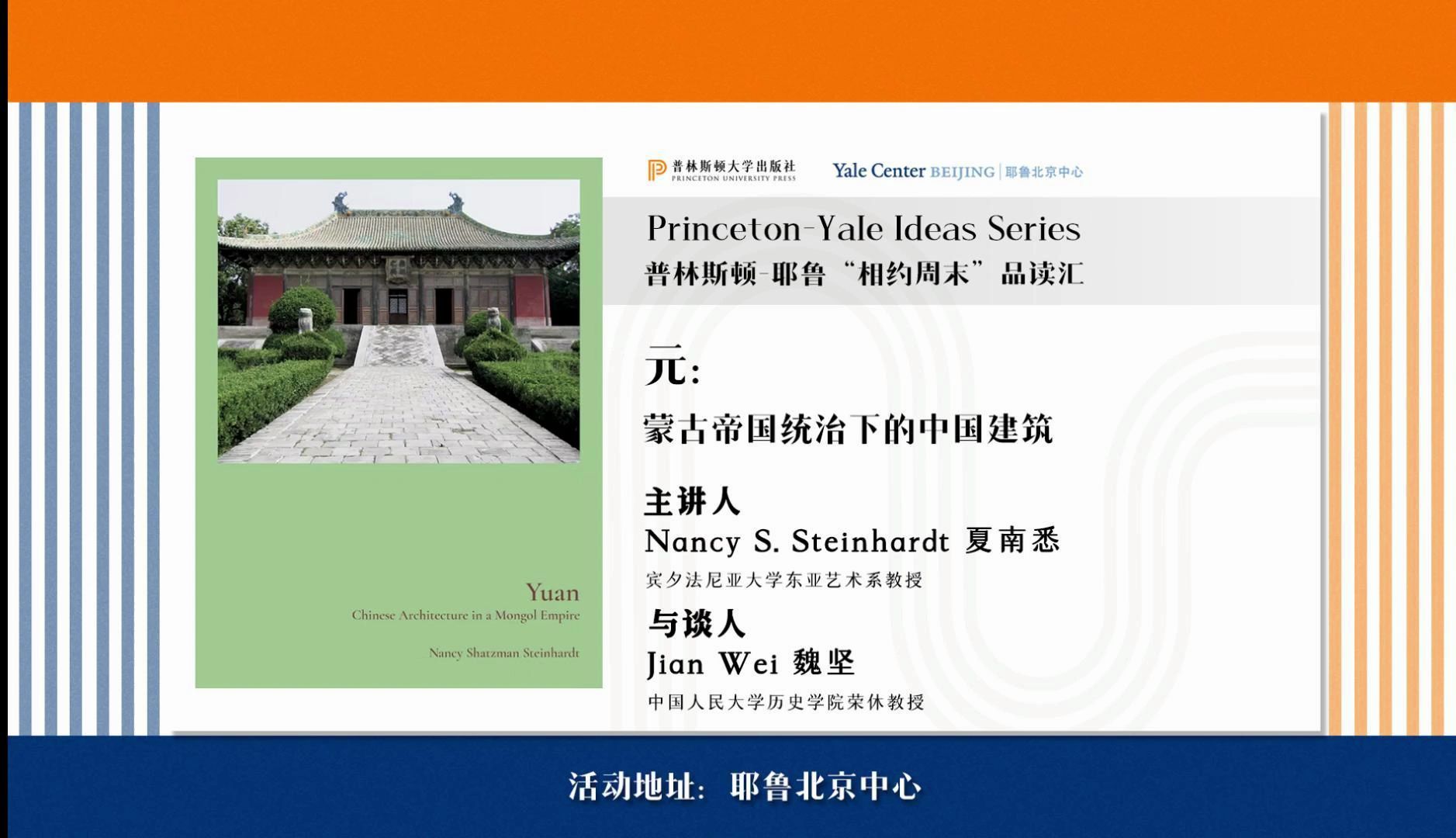
字幕摘录
| 时间 | 英文 | 中文 |
|---|---|---|
| 0:04 | Good evening everyone, especially to our distinguished speakers, Professor Nancy Steinhardt and Professor | 大家晚上好,特别是我们尊敬的演讲者南希·斯坦哈特教授和教授 |
| 0:11 | 魏ian. | |
| 0:13 | Welcome to this Princeton and Yale ideas series event held at the Yale Center of Beijing, | 欢迎来到普林斯顿和耶鲁大学 在北京耶鲁中心举办的系列活动 |
| 0:21 | but also online, being live streamed over Princeton University Press's WeChat channel | 在普林斯顿大学出版社的微信频道上直播 |
| 0:27 | and Yale Center of Beijing's Weibo channel. | 和耶鲁中心北京微博频道. |
| 0:30 | Welcome to everyone who are here in person and also online. | 欢迎各位亲临现场, |
| 0:36 | Just a bit of the Yale Center, about the Yale Center, in case you're not familiar, we were | 只是有点耶鲁中心, 关于耶鲁中心, 如果你不熟悉,我们是 |
| 0:41 | founded in 2014, so around 10 years ago, as Yale University's only university-wide center | 作为耶鲁大学唯一的全大学中心 |
| 0:48 | outside of its U.S. campus. | 在美国校园外 |
| 0:50 | So it also functions as an embassy for its 15, actually now 14 schools. | 因此,它也作为一个大使馆运作 15,实际上现在14所学校。 |
展开字幕全文(1883 条)
| 序号 | 英文 | 中文 |
|---|---|---|
| 1 | Good evening everyone, especially to our distinguished speakers, Professor Nancy Steinhardt and Professor | 大家晚上好,特别是我们尊敬的演讲者南希·斯坦哈特教授和教授 |
| 2 | 魏ian. | |
| 3 | Welcome to this Princeton and Yale ideas series event held at the Yale Center of Beijing, | 欢迎来到普林斯顿和耶鲁大学 在北京耶鲁中心举办的系列活动 |
| 4 | but also online, being live streamed over Princeton University Press's WeChat channel | 在普林斯顿大学出版社的微信频道上直播 |
| 5 | and Yale Center of Beijing's Weibo channel. | 和耶鲁中心北京微博频道. |
| 6 | Welcome to everyone who are here in person and also online. | 欢迎各位亲临现场, |
| 7 | Just a bit of the Yale Center, about the Yale Center, in case you're not familiar, we were | 只是有点耶鲁中心, 关于耶鲁中心, 如果你不熟悉,我们是 |
| 8 | founded in 2014, so around 10 years ago, as Yale University's only university-wide center | 作为耶鲁大学唯一的全大学中心 |
| 9 | outside of its U.S. campus. | 在美国校园外 |
| 10 | So it also functions as an embassy for its 15, actually now 14 schools. | 因此,它也作为一个大使馆运作 15,实际上现在14所学校。 |
| 11 | Throughout the year, every two days or so, we host events such as these, where we convene | 整个一年,每两天左右,我们主办这样的活动,我们在那里召开 |
| 12 | academics and leaders from all sectors to discuss on the most interesting, cutting-edge | 学术界人士和各部门领导人将讨论最有趣、最先进的 |
| 13 | topics in the world. | 世界上的话题。 |
| 14 | And today, we are so delighted to be working on this event in collaboration with the Princeton | 今天,我们很高兴能与普林斯顿大学 合作举办这次活动 |
| 15 | University Press's Beijing office to talk about Professor Nancy Steinhardt's new book, | 大学出版社北京办事处谈南希·施泰因哈特教授的新书, |
| 16 | Yuan, for the Yuan Dynasty in China, Chinese Architecture in a Mongol Empire. | 元,为中国元朝,蒙古帝国的中国建筑. |
| 17 | And we're also delighted to have Professor Wei Jian, Professor Meredith from Redmond University | 我们也很高兴有魏健教授,雷蒙德大学的梅雷迪思教授 |
| 18 | to give a commentary in Chinese as a counterpoint to this discussion. | 以中文发表评论作为这一讨论的反点。 |
| 19 | This talk is the third lecture of the Princeton Yale Ideas series, and I would really love to | 这次演讲是普林斯顿耶鲁思想系列的第三次演讲,我很想 |
| 20 | thank the Princeton University Press Beijing office team, as well as the Yale Center Beijing | 感谢普林斯顿大学出版社北京办事处团队以及耶鲁中心北京办事处 |
| 21 | team, for bringing these fresh, new and interesting ideas to the Beijing and Chinese audience. | 给北京和中国观众带来新鲜、新颖和有趣的想法 |
| 22 | Today's event will go as follows. | 今天的活动如下。 |
| 23 | I'm welcoming everyone and delivering some short opening remarks and introducing the | 欢迎各位,并致开幕词 |
| 24 | speakers. | 发言者。 |
| 25 | Later, we will have Professor Steinhardt talk about her book, and then Professor Wei will | 后来,我们让斯坦哈特教授谈她的书 然后魏教授 |
| 26 | be providing commentary in Chinese. | 提供中文评论。 |
| 27 | Afterwards, we will have a Q&A session, folks joining online, and folks at the venue at | 之后,我们将有一个 QQA会话, 网友加入, 和人们在现场 |
| 28 | Yale Center Beijing, you're welcome to raise your hands, both physically and virtually, | 北京耶鲁中心 欢迎你举起手来 无论是身体上还是实际上 |
| 29 | to get your questions answered. | 让你的问题得到答案。 |
| 30 | So a bit of an introduction about the two professors today. | 所以今天对两位教授做了一些介绍。 |
| 31 | Professor Nancy Steinhardt is one of the foremost experts on Chinese architectural history. | 南希·施泰因哈特教授是中国建筑史上最重要的专家之一. |
| 32 | She is the Professor of East Asian Art and Curator of Chinese Art at the University of | 她是东亚艺术教授和中国艺术的守护者 |
| 33 | Pennsylvania, where she has taught since 1982. | 宾夕法尼亚州,她从1982年开始在那里执教. |
| 34 | She received her PhD at Harvard and was a junior fellow at Harvard. | 她在哈佛获得博士学位,并在哈佛大学担任初级研究员. |
| 35 | Professor Steinhardt is an author or co-editor of many different books and volumes about | Steinhardt教授是许多不同书籍和书卷的作者或共同编辑。 |
| 36 | Chinese architectural history, including Chinese Traditional Architecture, Chinese Imperial | 中国建筑史,包括中国传统建筑,中华帝国 |
| 37 | City Planning, Liao Architecture, Chinese Architecture Reader in Traditional Chinese | 城市规划 辽建筑 传统汉语中国建筑阅读器 |
| 38 | Culture, Chinese Architecture and the Bozar, Chinese Architecture in an Age of Turmoil | 文化,中国建筑与博扎尔,涡轮时代的中国建筑 |
| 39 | 200 to 600, the Chinese Mosque, Chinese Architecture, 12 Lectures, China and Architectural | 200至600,中国清真寺,中国建筑,12个讲座,中国与建筑 |
| 40 | History, the Borders of Chinese Architecture, and the book that's the subject of today's | 历史,中国建筑的疆界,以及今天的论著. |
| 41 | talk, Yuan, Chinese Architecture in the Mongol Empire and More Than 100 Articles. | 谈,袁,蒙古帝国的中国建筑与百篇以上. |
| 42 | She has also won many teaching and writing and book awards, including the Distinguished | 她还赢得了许多教学、写作和书籍奖,包括杰出的 |
| 43 | Teaching of Art History Award from the College of Art Association. | 艺术协会学院艺术史奖教学. |
| 44 | The Provost Award for Distinguished PhD Teaching and Mentoring from Penn. | 宾夕法尼亚州杰出博士教学和导师奖。 |
| 45 | And in 2021, she won the Alice David Hitchcock Book Award from the Society of Architectural | 而在2021年,她获得了建筑学会颁发的爱丽丝·大卫·希区柯克图书奖. |
| 46 | Historians for Chinese Architecture History. | 中国建筑史历史学家. |
| 47 | Following Professor Steinhardt's presentation, we're grateful to have Professor Jianwei | 斯坦哈特教授发言后,我们感激有建威教授 |
| 48 | to comment and reflect on Professor Steinhardt's presentation. | 对斯坦哈特教授的演讲进行评论和反思. |
| 49 | Professor Wei Jian is Professor Emeritus of History at Renmin University of China, | 魏健教授是中国任民大学历史荣誉教授, |
| 50 | where he also serves as Director of the Institute of Northern Ethnic Archaeology | 并担任北方民族考古研究所所长 |
| 51 | and Head of the Department of Archaeology and Museology. | 并担任考古和博物馆学系主任. |
| 52 | He is currently a Distinguished Professor at Minzu University of China and the Director | 现任中国民祖大学杰出教授,院长. |
| 53 | of the Institute of Frontier Archaeology. | 边境考古研究所。 |
| 54 | He has led over 80 archaeological excavations, including that at Yuan Shangdu in Inner Mongolia, | 他领导了80多次考古发掘,包括在内蒙古的袁翔都, |
| 55 | which was designated a UNESCO World Heritage Site in 2012. | 2012年被列为联合国教科文组织世界遗产. |
| 56 | To date, he has published many academic monographs and more than 180 papers and research | 迄今为止,他出版了许多学术专著和180多篇论文和研究. |
| 57 | reports on his topic of expertise. | 关于他的专门知识的报告。 |
| 58 | Without further ado, let's welcome Professor Steinhardt to give her presentation on the | 别再说了,欢迎斯坦哈特教授介绍 |
| 59 | book. | 书。 |
| 60 | Thank you very much. | 谢谢 |
| 61 | Thank you. | 谢谢 |
| 62 | Thank you, Carol, for that very kind introduction. | 谢谢你,卡罗尔, 非常好的介绍。 |
| 63 | And thank you, everyone who has come tonight or this morning to hear about Yuan architecture. | 感谢大家今晚或今天上午 来了解袁建筑 |
| 64 | The book that I'm going to talk about deals with the architecture of a period of approximately | 我要谈的书 是关于一个时期的建筑 |
| 65 | 150 years from the death of this man, Genghis Khan in 1227 through the fall of the Yuan | 从这个人去世150年,成吉思汗于1227年,元朝灭亡. |
| 66 | dynasty to the Ming dynasty in 1368. | 1368年诏归明朝. |
| 67 | This is the age of Kublai Khan. | 这是忽必烈汗的时代. |
| 68 | This is the age of his also the age of Marco Polo. | 这也是他同时也是马可波罗的时代. |
| 69 | By the end of the 13th century, the empire forged by Genghis and enlarged by his sons | 到了13世纪末,成吉思建立的帝国 由他的儿子们扩张 |
| 70 | and his grandsons would be and remains the largest empire ever achieved in Eurasia. | 他的孙子们将会是 并且仍然是欧亚最大的帝国 |
| 71 | It was also the first time in history when China was part of a much larger empire, | 这也是中国历史上第一次 成为更大的帝国的一部分 |
| 72 | and that empire was not ruled by someone of Chinese descent. | 而那个帝国 并没有被一个中国血统的人统治 |
| 73 | As the 12th century turned into the 13th century, that is around the year 1200, | 随着12世纪变成13世纪,也就是1200年左右, |
| 74 | at least 12 polities, you see them on the map, populated the area that you see here | 至少12个政体,你在地图上看到它们, 居住着你在这里看到的地区 |
| 75 | from Siberia through Korea, including China and as far west as the Black Sea. | 分布于西伯利亚经韩国,包括中国以及最西部至黑海等. |
| 76 | In that year, circa 1200, the man who would become Genghis Khan was about 38 years old. | 当年,大约1200年,成为成吉思汗的人约38岁. |
| 77 | Before he died in 1227 in Ningxiahui, so he dies right around here, Genghis would engage | 在1227年他死在宁夏淮阴之前 所以他死在这附近 成吉思会介入 |
| 78 | in battle and conquer and unite most of the people in the region you see on the map. | 在战斗中,征服和团结地图上看到的地区的大多数人。 |
| 79 | He would unite the Mongols, the Tartars, the Karyat, the Merkut, the Namun, the Unga, the | 他将团结蒙古人,鞑靼人,卡里亚特人,默库特人,纳蒙人,恩加人, |
| 80 | Kyrgyz, the Khwarazm, the Karakytai, the Karakhanid, the Kipchak, the Western Xia, | 吉尔吉斯人 赫瓦拉兹姆人 卡拉基泰人 卡拉哈尼德人 基普查克人 西夏人 |
| 81 | the Jurchen, and of course Song China. | 当然还有宋中国 |
| 82 | When Genghis dies just one quarter of the way into the 13th | 成吉思死时只有1/4路进入13号 |
| 83 | century, this city, Zhongdu, that is the Jin Dynasty city, would have fallen to the Mongols, | 世纪,此城,崇都,即晋朝城,必降于蒙古,...... |
| 84 | Karakytai over here would fall, Western Xia would fall, and Khwarazm, which is over here, | 卡拉基泰会在这里坠落 西夏会沦陷 赫瓦拉兹姆会在这里 |
| 85 | would also fall. | 也会掉下去的 |
| 86 | These are the historical facts, but the narrative around them is often exaggerated | 这些是历史事实,但周围的叙述经常被夸大 |
| 87 | and glorified by images like this and the narrative that grows around it. | 并被这种画面和周围成长的叙事所颂扬. |
| 88 | So let's take this statement. | 所以,让我们做这个陈述。 |
| 89 | The Mongols first saw cities on horseback. | 蒙古人最早看到城市骑马. |
| 90 | This clear and direct | 这清楚而直接 |
| 91 | statement does not carry the meaning that the Mongols stormed across the grasslands until they | 蒙古人冲过草原直到他们 |
| 92 | came to a walled city, which they leveled to the ground, whose booty they took and whose population | 来到一个城墙,他们把城墙夷为平地,他们的战利品和居民, |
| 93 | they slaughtered or enslaved, even though a scene that this describes or a scene like the one you | 他们屠杀或奴役, 即使一个场景 描述或场景喜欢你 |
| 94 | see on the screen often illustrates a statement like that. | 屏幕上经常显示这样的说法。 |
| 95 | The statement is not even true if we | 如果我们 |
| 96 | soften it to the Mongols first encountered Chinese walled cities in the conquest of sedentary people | 软化它给蒙古人 第一次遇到中国城墙 征服定居的人 |
| 97 | to their south. | 他们的南方。 |
| 98 | The true statement is long before the plowed fields or granaries or armories came | 真正的声明是在耕田、粮仓或军火库来之前很久的 |
| 99 | into view, the Mongols saw ceramic tile roof eaves, carved stone, and occasionally pagodas. | 进入观光中,蒙古人看到了陶瓷砖瓦屋顶的叶片,雕刻的石刻,偶尔还有佛塔. |
| 100 | If no longer attached to buildings or parts of larger complexes, they saw them amid ruins like | 如果不再附属于建筑物或更大的建筑群的一部分,他们就会在废墟中看到这些建筑群。 |
| 101 | this. | 这个 |
| 102 | They saw them inside standing walls. | 他们看见他们站在墙上 |
| 103 | The 12th and 13th century peoples of Mongolia, | 12世纪和13世纪蒙古人民, |
| 104 | from who rose the leaders and the shapers of the Mongol empire, surely first saw architecture on | 从谁升起蒙古帝国的领袖和造型者, |
| 105 | horseback, but they saw it right in Mongolia. | 马背,但他们在蒙古看到它。 |
| 106 | They saw it here. | 他们在这里看到了 |
| 107 | They saw remains of cities built by | 他们看到一些城市的残骸 |
| 108 | Liao. | 辽国. |
| 109 | They saw remains of architecture built by Uyghurs in Xinjiang. | 他们看到了新疆维吾尔人建造的建筑遗迹. |
| 110 | They saw remains of | 他们看到尸体 |
| 111 | architecture built by Western Xia in Namong, and they saw, perhaps, remains like this, | 由西夏在南宫建造的建筑 他们可能还是这样 |
| 112 | if not in Tongwan, then remains of walls in the north from as early as the 5th century, | 如果不是在东关, 那么从5世纪开始, 北部的墙壁遗迹, |
| 113 | maybe even from earlier. | 也许更早的时候 |
| 114 | They saw roof tiles. | 他们看见屋顶瓦片。 |
| 115 | They saw pieces of ceramic, and | 他们看到了陶瓷片,和 |
| 116 | it's through all of this that we understand this period not as a clash of civilization, | 正是经过这一切,我们理解这个时期 不是文明的冲突, |
| 117 | but as a movement of the Mongol south and a decision about what to build. | 但作为蒙古人的南下运动 以及决定要建造什么 |
| 118 | Yes, the Mongols definitely destroyed cities, some of Asia's most magnificent cities. | 是的,蒙古人绝对摧毁了城市, 一些亚洲最宏伟的城市。 |
| 119 | They destroyed Bukhara and Samarkand and Rae and Hamadan and Maraga and Gurgunj | 他们摧毁了布哈拉、撒马尔罕、雷、哈马丹、马拉加和古尔贡杰 |
| 120 | and Mirv and Nishapur and Bamyan, but they also rebuilt many of those cities, sometimes using | 以及米尔夫、尼沙普尔和巴米扬,但他们也重建了许多这些城市,有时使用 |
| 121 | old building parts. | 旧建筑部件。 |
| 122 | One of the things that I tried to do in this book is rely only on facts | 我在这本书中试图做的一件事 就是只依靠事实 |
| 123 | or on excavated evidence. | 或根据挖掘出来的证据。 |
| 124 | Fortunately, there is a tremendous amount of remaining | 幸运的是,还有大量的剩余 |
| 125 | physical evidence, buildings like this. | 实物证据 像这样的建筑物 |
| 126 | There is, in fact, a remarkably comprehensive history | 事实上,有一个非常全面的历史 |
| 127 | of extant architecture in and around China from the period of Mongolian rule. | 从蒙古统治时期起,中国境内和周边现存建筑的建筑。 |
| 128 | There are dozens | 有几十个 |
| 129 | of cities and towns. | 城市和城镇。 |
| 130 | There are hundreds of wooden buildings, and there are buildings in other | 有数百座木制建筑,还有其他建筑 |
| 131 | materials. | 材料。 |
| 132 | For instance, buildings I just showed you, buildings in other materials such as these. | 比如,我刚刚给你看的建筑, 建筑中的其他材料,如这些。 |
| 133 | There are paintings of buildings and paintings of parts of buildings, many of which, and I'll | 有建筑的绘画和部分建筑的绘画,其中很多,我会 |
| 134 | show you this this morning, many of which have fairly reliable facts. | 今天上午给你们看,其中许多有相当可靠的事实。 |
| 135 | There are, in fact, | 事实上,有 |
| 136 | some excellent paintings of buildings. | 一些优秀的建筑画作。 |
| 137 | There are the buildings that people have turned to | 有的建筑 人们已经转向 |
| 138 | to say, well, Chinese architecture really changed under Mongol rule. | 可以说,在蒙古人的统治下,中国建筑真的发生了变化. |
| 139 | We'll look at these also. | 我们也会看看这些 |
| 140 | The book examines them also, and I will show you how they become part of the building tradition. | 这本书也研究了它们, 我会告诉你它们是如何成为建筑传统的一部分。 |
| 141 | There is rock-carved architecture from the period of Mongolian rule, and there are a few very | 蒙古统治时期就有石刻建筑,也有少数建筑非常古老. |
| 142 | unusual buildings. | 不寻常的建筑。 |
| 143 | I call them anomaly buildings, buildings that are almost unique in the history | 我称之为异常建筑 历史上几乎独一无二的建筑 |
| 144 | of Chinese architecture, and there are also buildings in Korea and in Japan and in Iran. | 还有韩国、日本和伊朗的建筑。 |
| 145 | But I start with maps. | 但我从地图开始。 |
| 146 | I start with maps because it's an efficient way to lay out the land | 我从地图开始,因为它是一个有效的方法 铺设土地 |
| 147 | and to show that Chinese map makers were very aware of this dynasty called Yuan and very able | 并显示中国的地图制作者非常了解这个叫做袁的王朝,并且非常有能力 |
| 148 | to locate in their maps places like the capital Dadu or Shandu. | 在他们的地图位置,如首都达杜或山都。 |
| 149 | I start with the great capitals. | 我从伟大的首都开始。 |
| 150 | I'm not talking about them this morning. | 我今早不是在谈论他们 |
| 151 | These cities are very well known, but I do certainly | 这些城市是众所周知的,但我当然知道 |
| 152 | discuss them in the book just as a point of reference. | 在书中讨论它们只是作为参考。 |
| 153 | The city that Kublai built as his | 忽必烈所建的城市作为他的 |
| 154 | great capital Dadu or pronounced at the time Dadu was 28,600 meters in perimeter. | 大都城达杜,或者在达杜时被宣布 周长28600米 |
| 155 | This actually is more than six times the perimeter of the wall of Kharkhorum, | 这其实是哈尔霍伦城墙的六倍多 |
| 156 | the first capital in Mongolia, and it is more than two and a half times the outer wall | 外墙的两倍半以上 |
| 157 | of Shandu. | 山东人 |
| 158 | That's the capital that it will come up again. | 那是它会再次出现的首都 |
| 159 | This is where the Xanadu of Coolridge's | 这是凉岭的山都 |
| 160 | poem, and then there is the fourth capital. | 诗,然后有第四大都城。 |
| 161 | These will all come up a little bit later. | 这些都会在稍晚的时候出现。 |
| 162 | But they've all been studied. | 但他们都被研究过了 |
| 163 | They're all on the map. | 他们都在地图上。 |
| 164 | 所以在这里,Khulin或Kharkhorum, | |
| 165 | here, Shandu, Sokholin, Shandu, Dadu, of course, right here, and Zhongdu, the short-lived capital, | 这里,山都,索克荷林,山都,达都,当然,就在这里,还有短命的首都钟都, |
| 166 | right here. | 在这里。 |
| 167 | But there are many cities. | 但有许多城市。 |
| 168 | There are more than 30 cities, and they are all built, | 有30多个城市,它们都是建造的, |
| 169 | rebuilt, are used by the Mongols, and you see just from these plans. | 重建后,被蒙古人使用,你们从这些计划中可以看见。 |
| 170 | This morning I'm showing | 今天早上我要展示给大家看 |
| 171 | more color illustrations than black and white, but you see wall inside wall. | 比黑白的更多彩色插图,但你看墙内的墙. |
| 172 | You see the capital | 你看见首都了 |
| 173 | I形或Gong形计划. | |
| 174 | You see long streets, and you see layout that includes palatial | 你可以看到漫长的街道,你可以看到布局 包括古老的 |
| 175 | architecture. | 结构。 |
| 176 | So here's where all these places are. | 所以这里就是这些地方。 |
| 177 | In fact, each of the cities labeled on this map | 事实上,每个城市都标注在这个地图上 |
| 178 | was a city that was used by the Mongols, and each one comes up at least in small part | 曾经是蒙古人使用的一个城市 每个城市至少都有一小部分 |
| 179 | in the first part of the book. | 在书的第一部分。 |
| 180 | The maps were a challenge. | 地图是一个挑战。 |
| 181 | You see on the screen how I decided | 你看到屏幕上我是如何决定的 |
| 182 | to do them. | 做他们。 |
| 183 | In part, what you're seeing is that cities clustered during the Yuan dynasty. | 部分可见元朝时期的城市群. |
| 184 | So a | 这么说 |
| 185 | cluster here, this is in Waimeng, cluster here around Shandu. | 这里,这里是怀明,这里是山都 |
| 186 | This is here, I'm in Ningxia, | 在这里,我在宁夏 |
| 187 | and here I'm in Xian, and Beijing, Daidu, of course, is over here. | 我在西安,北京,大都,当然在这里。 |
| 188 | But after talking about | 但是,经过谈论 |
| 189 | cities, and as I said, we'll be looking mainly in color, the second part of the book looks at | 城市,正如我所说,我们主要看颜色, 书的第二部分看 |
| 190 | what the Mongols saw as they came to China. | 蒙古人来到中国时所看到的 |
| 191 | I think it's very important, one of the facts, | 我认为这很重要 其中一个事实 |
| 192 | to look at what the Mongols themselves would have seen that could have impacted them. | 看看蒙古人自己会看到什么 可能影响到他们。 |
| 193 | And here I think is the most complicated map that I show in this book, locations of pre-1250 | 在这里,我想这是最复杂的地图 我显示在这本书, 位置前1250 |
| 194 | cities and buildings where the Mongols were that we knew that they saw. | 蒙古人所看到的城市和建筑 |
| 195 | So you take this, | 所以你拿着这个 |
| 196 | you see this detail, and here's the detail, and here are the details, and I had a graduate student, | 你看这个细节 这是细节 这是细节 我有一个研究生 |
| 197 | architect draw these for me. | 建筑师帮我画这些 |
| 198 | It takes some time to look, but you can see that the Mongols used | 这需要一些时间来寻找, 但你可以看到,蒙古人使用 |
| 199 | cities and a few of them well-known, the city that the Jin used as their capital beneath Beijing | 城邑和其中几个名城,金人用来作为北京城下的首都 |
| 200 | today under Daidu, but also cities that are today in Russia, city in Heilongjiang, and this one is | 今在大都之下,但今俄罗斯之城市,黑龙江之城,此亦是. |
| 201 | also in Russia. | 也在俄罗斯 |
| 202 | So I do look at the Jin somewhat, and I look at important Song and Jin buildings. | 所以,我确实看一些锦衣卫,我看重要的宋楼和锦楼. |
| 203 | I look at them, I look at the buildings that I select from Song and Jin for two purposes. | 我一看他们,一看从宋江和晋江中挑选的建筑,有两个目的. |
| 204 | One, to show that yes, the architecture that the Mongols built, an example of it is behind me on | 一,为了证明是的,蒙古人建造的建筑,其典范在我身后 |
| 205 | the screen right now, draws from Chinese architecture, but more importantly, I show that it uses the | 现在的屏幕,来自中国的建筑, 但更重要的是,我显示它使用 |
| 206 | Chinese building standards. | 中国建筑标准. |
| 207 | And so what do I mean by this? | 我这是什么意思? |
| 208 | These are the two grandest buildings | 这是两座最宏伟的建筑 |
| 209 | that the Mongols built, Qiyang, Beiyuan, Miao, Dunning, Dian, and the Yongle Gong, | 蒙古人建造了齐阳,北y,密,邓宁,迪安,永乐贡 |
| 210 | this is the Sanqing Dian of Yongle Gong. | 这是永乐宫的三清堂 |
| 211 | These are by Chinese definition Diantong. | 这些是中国人定义的Dianton. |
| 212 | So I select | 所以我选择 |
| 213 | my pre-UN buildings so that I can show in the book that the building standards of China are very much | 我的前联合国建筑 这样我就能在书中证明 中国的建筑标准非常高 |
| 214 | used in the UN dynasty. | 用于联合国王朝. |
| 215 | So I turned to Yingzhal Fosher, and yes, well, this is very simple, | 于是我转而谈到英哲·福舍尔 是的 这很简单 |
| 216 | that Diantong is a big hall. | 迪安东是个大大厅 |
| 217 | But when I go through building parts, which I also don't do tonight, | 但当我经过建筑部分, 我今晚也不做, |
| 218 | but I do in the book, I show the use of Diantong. | 但我在书里说,我展示 使用迪安东。 |
| 219 | I also look at literary descriptions of buildings | 我还研究了建筑的文学描述 |
| 220 | when they exist. | 当它们存在的时候 |
| 221 | But in the end, I rely mostly on archaeological evidence, | 但归根结底 我主要依靠考古证据 |
| 222 | because sometimes texts are written by people who did not see buildings. | 因为有时文字是由没有看到建筑物的人写的. |
| 223 | is one, it's by someone who was living in the south and used records to describe | 是一个,是一个住在南方的人 用记录来描述 |
| 224 | Yuan Daidu, but Xiaoxuan did see the UN capital, and this is the text that he wrote, the Gu Gongyi | 袁大都,但小八确实看到了联合国首都, 这是他写的文字,顾贡义 |
| 225 | he came and he saw what survived of Kublai Khan city before it was destroyed to make way | 他来了,看到忽必烈汗城里幸存下来的东西 在它被摧毁之前 |
| 226 | for the Ming dynasty. | 为明朝. |
| 227 | Excellent reconstructors using those texts have proposed what the palaces | 使用这些文字的优秀重建者 提出了宫殿中的东西 |
| 228 | of Daidu might have looked like. | 戴都可能看起来像 |
| 229 | This is a signature Fushinian reconstruction that shows | 这是富士尼重建的标志 |
| 230 | the Daming Palace complex. | 大明宫建筑群 |
| 231 | But looking at the description of the Daming Palace complex, | 但从大明宫建筑群的描述来看 |
| 232 | we can turn to one of the two Diantong, one of the two grand halls, and so this is Baiyuan Miao, | 我们可以转向两个Diantong之一, 两个宏伟的大厅之一, 所以这是Baiyuan苗, |
| 233 | the Dunning Hall, and we can read the description that goes, Daming Hall was raised on, | 邓宁大厅,我们可以读到 描述去,达明大厅 升起, |
| 234 | excuse me, a high platform with a stairway in front of it. | 对不起,一个高台,前面有楼梯 |
| 235 | Okay, this is Dunning Dian. | 好吧,这是邓宁甸。 |
| 236 | I'm reading the description of the Daming Hall. | 我读大明堂的描述. |
| 237 | A marble balustrade carved with figures of dragons and phoenixes surrounded the hall. | 一个大理石瓦路贸易雕刻有龙和凤凰图案,围绕大厅. |
| 238 | Each vertical post of the balustrade rested on an owl, a sea dragon-like creature. | 巴鲁斯特贸易的每个垂直位置 都依靠一只猫头鹰,一种类似海龙的生物。 |
| 239 | So | 这么说 |
| 240 | balustrades, the creature. | 巴鲁斯贸易,生物。 |
| 241 | He mentions the dragons in the panels. | 他提到面板上的龙。 |
| 242 | They don't survive here, | 他们不能在这里生存 |
| 243 | but excavated from Yuan Daidu. | 却从袁代都掘出. |
| 244 | You do have a panel with the dragon. | 你确实有龙的面板 |
| 245 | These are the sea dragon | 这些是海龙 |
| 246 | headed pieces that have been found not just at the remains of Daidu, but in Xiangdu and in | 不仅在大都的遗骨上 而且在西安都和 |
| 247 | and Karakoram as well. | 还有卡拉科拉姆 |
| 248 | Let me keep going with this description. | 让我继续这个描述。 |
| 249 | Every exterior pillar of the | 每一个外部支柱 |
| 250 | hall was decorated with raised flowers, golden dragons, and clouds on top of which were carved | 堂内装饰着高耸的花朵,金龙,上面的云彩雕刻 |
| 251 | decoration. | 装饰。 |
| 252 | Here I have to go to the Song Dynasty. | 在这里,我必须去宋朝. |
| 253 | To find those dragons around pillars, I have to go | 为了找到柱子周围的龙,我得走了 |
| 254 | to the Song Dynasty. | 至宋朝时. |
| 255 | But then the text tells us a pair of dragons coiled in the center of the | 但文字告诉我们一对龙环绕在中央 |
| 256 | ceiling. | 上限。 |
| 257 | And here I'm back in Qiyang, Dunning Dian. | 今又复居贵阳,邓宁甸. |
| 258 | I'm looking at coiling dragons. | 仰视叠龙. |
| 259 | Golden and red | 金色和红色 |
| 260 | mullion windows with gold leaf attached to the intervening spaces was found on all four sides | 在四边都发现了带有金叶的木银窗 |
| 261 | of the hall. | 大厅。 |
| 262 | And so the mullion windows found on the four sides of the hall, here Dunning Dian, | 大厅四边的木银窗 邓宁·迪安 |
| 263 | and here I'm at Yonglu Gong, Sanqing Dian. | 我在这里,在永乐贡,三清甸。 |
| 264 | In the book, because I'm writing in English and I'm | 在书中,因为我用英语写作,我 |
| 265 | always writing for a reader who may not have a lot of background, I also explain that in the Yuan | 总是为一个没有太多背景的读者写文章 我也解释一下在袁文中 |
| 266 | dynasty, two sets of brackets between those on top of columns is standard. | 朝代,柱子上方的两套括号是标准的. |
| 267 | And this is part of | 这是一部分 |
| 268 | the evolution of the bracket set from the Renze Gong to just one inter-kilometer bracket to many | 从任泽功到一公里的括号 演变成很多 |
| 269 | in the 18th century. | 在18世纪。 |
| 270 | And then I can turn to a very casually painted mural from Qirfong, from a tomb in | 然后,我可以翻到一个非常随意的壁画 从齐尔丰, 从一个坟墓在 |
| 271 | Qirfong. | 齐尔丰. |
| 272 | Pillar, pillar, one, two bracket sets. | 支柱,支柱,一,两个括号套. |
| 273 | Pillar, pillar, two bracket sets. | 柱子 柱子 两个括号 |
| 274 | The evolution of | 发展变化 |
| 275 | Chinese architecture and the criteria for a Yuan building very much is followed. | 中国建筑与元代建筑的标准非常遵循. |
| 276 | And I also explain | 我也解释 |
| 277 | during this part of the book, as I'm getting ready to look at actual wooden buildings, where the Yuan | 在书的这一部分, 因为我正在准备看 实际的木制建筑, |
| 278 | set sits in the evolution, the fact that the bracket set is about a sixth of the total height | 设定在进化中, 括号集大约是总高度的六分之一 |
| 279 | from ground level to top, and that there are artificial pieces, pieces that are not functional, | 从地面到顶端, 并且有 人造的碎片, 片段没有功能, |
| 280 | that are used in the bracket set. | 用于括号中的。 |
| 281 | And so back here at Yonglu Gong, Sanqing Dian, we see those | 所以回到永乐贡,三清甸,我们看见那些 |
| 282 | artificial pieces. | 人工块. |
| 283 | We can see them in a sarcophagus as well. | 我们可以在石棺里看到它们 |
| 284 | Now I move into the | 现在我搬进 |
| 285 | timber frame hall, which is one of the most important parts of the book. | 木框厅,是书中最重要的部分之一. |
| 286 | And so we start at | 所以我们开始 |
| 287 | the top, Diantong, and then I move to buildings that are most eminent to buildings that are | 戴安东,然后我搬去那些 最著名的建筑 |
| 288 | somewhat less eminent. | 不太显眼 |
| 289 | The simple hip roofs, and I move to the hip gable roofs. | 简单的臀部屋顶, 我移动到臀部的可盖屋顶。 |
| 290 | And of course, | 当然 |
| 291 | at some point, I have to explain most eminent roof is a hip roof. | 有些时候,我必须解释一下 最著名的屋顶是臀部屋顶 |
| 292 | Then we go to hip gable. | 然后我们去臀部Gable。 |
| 293 | But when there are the decorative pieces on the top, more eminent than this. | 但当顶部有装饰品时,比此更为突出. |
| 294 | Then we move | 然后我们行动 |
| 295 | in eminence to the overhanging eaves. | 以高傲的乳头发誓, |
| 296 | So here with the decoration, here just with the eaves | 所以这里有装饰,这里有树枝 |
| 297 | themselves, and I explain that pavilions take on their own architectural features. | 我解释,展馆拥有自己的建筑特色。 |
| 298 | This is then what I do. | 这就是我要做的 |
| 299 | This is how I've decided to organize timber frame buildings. | 这就是我决定组织木材框架建筑的方式。 |
| 300 | So that we looked at the Diantong at Yonglu Gong, and at Qiyang Beiyuan Miao. | 故以永路贡,Q阳北y苗,观其丹东. |
| 301 | Then we look at the | 然后我们看看 |
| 302 | next rank of building. | 下一个建筑等级。 |
| 303 | Now I move still to the next rank of building, the building with the hip | 现在,我仍然移动 到下一阶的建筑, 建筑的臀部 |
| 304 | and the gable. | 和吉布尔。 |
| 305 | And then I move just to overhanging gables. | 然后,我只移动到 超载的吉布斯。 |
| 306 | And then I am able to talk about other | 然后,我可以谈论其他 |
| 307 | features of architecture that are exclusive to the Yuan dynasty. | 元朝独有的建筑特色. |
| 308 | One of them is the Jianju, | 其中一个是建州人 |
| 309 | or the elimination of pillars from the inside of a building. | 或从建筑物内部消除柱子。 |
| 310 | And so you have this here. | 你在这里有这个 |
| 311 | I don't | 我没有 |
| 312 | illustrate any Ming buildings in the book. | 说明书中的任何明建筑。 |
| 313 | But for point of reference, by the Ming dynasty, | 但以明朝为参考. |
| 314 | the complete column grid is very much in place, 1424. | 1424年,整个列网非常到位 |
| 315 | So there is something Yuan. | 所以,有东西袁。 |
| 316 | And yes, | 没错, |
| 317 | person can recognize the features of a Yuan building from this book. | 人可以从这本书中识别出一幢袁楼的特征. |
| 318 | But I'm always looking | 但我总是在寻找 |
| 319 | to show in this chapter, the Yingsao Fasher is used in a wooden building in the Yuan dynasty. | 在本章中,英绍法希尔号用于元朝的一座木制建筑. |
| 320 | So here I'm looking at the Tadao from Yingsao Fasher. | 我在这里看着来自法希尔的塔多 |
| 321 | Here I'm looking at the Tadao from a Yuan | 我在这里看着一个元的塔多 |
| 322 | dynasty residential mansion in Daidu. | 戴都王朝民宅. |
| 323 | And here's a line drawing. | 这是一张线条图 |
| 324 | And here I see it in a painting. | 我从画里看到了 |
| 325 | So you can see the kinds of material I'm using to confirm a text when I have a text to use. | 所以,你可以看到我用什么材料来确认一个文本 当我有一个文本来使用。 |
| 326 | I've just mentioned painting. | 我刚刚提到画。 |
| 327 | I think a lot of you know that the kind of painting I was describing | 我想你们很多人都知道 我描述的那种画 |
| 328 | is called Jiahua, translates as ruled line painting. | 叫做"佳华",译作"统治线画". |
| 329 | In fact, in Mongolia, from fairly early | 事实上,在蒙古,从很早就 |
| 330 | in the Yuan period, possibly as early as the time of Genghis, at this site, a ruler was found. | 元朝时期,可能早在成吉思时代,在此地发现了一个统治者. |
| 331 | So | 这么说 |
| 332 | rulers are very much in use in Mongolia during the Yuan dynasty. | 统治者在元朝时期在蒙古国使用甚多. |
| 333 | Other pieces of wood and other | 其他木头和其他 |
| 334 | examples where wall painting can confirm what's been excavated. | 例如墙壁画可以证实 已经挖掘出来的东西。 |
| 335 | You saw this already. | 你已经看到了。 |
| 336 | Relief panels. | 救济小组。 |
| 337 | Here I'm at Yonggu Gong, Xuan Yang Dian excavated in Daidu, Ho Ying Fong. | 今吾在永固贡,X阳帝在大都发掘,何英芳. |
| 338 | I'm looking at this door | 我看着这扇门 |
| 339 | with this latticing. | 带着这根绳子 |
| 340 | I see it right here. | 我看到它在这里。 |
| 341 | So I start in the north and then I move to the south | 所以我从北边开始,然后搬到南边 |
| 342 | and I use only four buildings. | 我只用了四栋楼 |
| 343 | It's always necessary to select. | 总是有选择的必要. |
| 344 | There are more than | 还有很多 |
| 345 | 300 Yuan dynasty wooden buildings that survived. | 幸存的300座元朝木楼. |
| 346 | So I look at the main ones in the southeast | 所以,我看看 在东南部的主要 |
| 347 | at Yanfu Su and at Zhenru Su today and an older picture of it. | 在延福秀和今天的禅鲁秀 以及更古老的照片 |
| 348 | I note the use of curved beams and | 我注意到使用曲线束和 |
| 349 | other longer curved beams in the southeast. | 其他较长的弯曲梁 在东南部。 |
| 350 | I talk about Tianning Su's main hall. | 谈天宁秀才主堂. |
| 351 | But I'm always | 但我总是 |
| 352 | selecting so that there are among these 300, more than 300, probably wooden buildings, | 选择这样,在这300,300多, 可能是木制建筑, |
| 353 | many that I didn't include. | 有很多,我没有包括。 |
| 354 | If it were a book about the Song dynasty, I might have been able | 如果这是一本关于宋朝的书,我也许可以 |
| 355 | to include almost everything, but not true. | 几乎包括一切,但不是真实的。 |
| 356 | So these are buildings that I've studied in my | 这些建筑是我研究过的 |
| 357 | many trips up and down the Fun River and Shanxi. | 多次上下游游乐江和山西. |
| 358 | They're not in the book and this is the interior | 他们不在书里 这是内部 |
| 359 | of two of them not in the book. | 其中有两个人不是在书中。 |
| 360 | I decide to talk about kind of the mainstream, the standard | 我决定谈谈主流的标准 |
| 361 | architecture that's not Diantong and not associated with China's most important buildings | 与中国最重要的建筑无关的建筑 |
| 362 | 从汉 Chong. | |
| 363 | So it's a chance to talk about this fantastic city, Han Chong, used by officials, | 因此,这是一个机会 谈论这个神奇的城市,汉崇, 被官员使用, |
| 364 | not by emperors. | 不是皇帝们干的 |
| 365 | And I talk about Tingtong or Tingtong from there. | 我从那里谈到廷顿格或廷顿格。 |
| 366 | These buildings are | 这些建筑是 |
| 367 | in the book and these buildings are discussed in the book. | 这些建筑在书中讨论。 |
| 368 | And I also discuss a few buildings | 我也讨论过几栋楼 |
| 369 | from Sichuan and one from Yunnan in the book. | 出自四川,书中云南一人. |
| 370 | So these buildings are in the book. | 所以这些建筑都在书中. |
| 371 | In all, | 总之, |
| 372 | I discuss about 50 of the 300 or so buildings. | 我讨论大约300栋建筑中的50栋 |
| 373 | And I talk about architecture in other materials, | 我在其他材料中谈到建筑 |
| 374 | both in stone and in metal. | 无论是石头还是金属 |
| 375 | And then I move at the very end of the book, but I show the material | 然后我在书的结尾移动, 但我展示了材料 |
| 376 | here to architecture in Korea that follows the Chinese building standards. | 在这里,韩国建筑符合中国建筑标准。 |
| 377 | So these three | 所以这三个 |
| 378 | buildings are contemporary with Yuan dynasty in Korea. | 建筑在韩国与元朝相近. |
| 379 | And I talk about a few Japanese buildings, | 我谈论一些日本建筑, |
| 380 | very specific type that are also built contemporary with Yuan China. | 非常具体的类型,也是与袁中国一起建造的. |
| 381 | So as I said, | 所以,正如我说的, |
| 382 | I start with Diantong, then I moved to Tingtong, and then I moved to smaller buildings. | 我从迪安东开始,然后搬到廷顿格,然后搬到较小的建筑. |
| 383 | And for | 还有为了 |
| 384 | my examples of smaller buildings, I use houses. | 我比较小的建筑 我用房子 |
| 385 | This is the oldest house in China. | 这是中国最古老的房屋. |
| 386 | It is from | 这是从 |
| 387 | the Yuan dynasty. | 元朝官员. |
| 388 | And I look at stages. | 我看着阶段。 |
| 389 | And the stages sometimes have very fantastic ceilings. | 阶段有时有非常奇妙的天花板。 |
| 390 | Some of the stages I don't include. | 有些阶段我不包含。 |
| 391 | I might mention them, but I don't include them. | 我可能会提到他们, 但我不包含他们。 |
| 392 | These | 这些 |
| 393 | are not illustrated in the book. | 在书中未显示。 |
| 394 | But in all right now, it's believed there are 24 stages just in | 但是现在,人们相信有24个阶段 |
| 395 | Shaanxi province. | 陕西省志. |
| 396 | And so that's how I moved to talk about small architecture and buildings | 所以我搬来谈小建筑 |
| 397 | with plans like this. | 有这样的计划。 |
| 398 | Then I moved to tombs. | 后来迁居墓园. |
| 399 | So I've select about 30 tombs from the many | 我选了30个墓 |
| 400 | that I could include as just as illustrations, these two drawings and this drawing to show | 我可以把这两幅画和这张画 都和插图一样 |
| 401 | the tombs are primarily but not exclusively one chamber. | 墓穴主要但并非只有一个房间。 |
| 402 | That chamber can be circular, | 那间屋子可以是圆形的 |
| 403 | it can be hexagonal, can be octagonal, and sometimes there are more interesting tombs. | 它可以是六边形的,可以是八边形的,有时还有更有趣的墓穴. |
| 404 | And this is where I again look underground and look at murals in part because I'm interested in | 我再次从地下看壁画 部分是因为我感兴趣 |
| 405 | murals in part because they live in the book. | 壁画部分是因为生活在书中. |
| 406 | And sometimes there is architecture in the murals, | 有时壁画里还有建筑 |
| 407 | sometimes important architecture that shows you the way that a painter replicated | 有时重要的建筑 让你知道画家复制的方式 |
| 408 | the grains of wood. | 木质的谷物。 |
| 409 | Sometimes there are ceilings that show features that would have hung in silk, | 有时天花板会显示 本来会挂在丝绸上的特征 |
| 410 | but now are put into the ceiling itself. | 但是现在被放进天花板上 |
| 411 | And then there are a few unusual tombs, | 还有几个不寻常的坟墓 |
| 412 | this one in Beijing, a few unusual features in brick tombs. | 这个是北京的 砖石墓中的一些不寻常的特征 |
| 413 | That's all discussed in the section | 都在本节讨论过 |
| 414 | on tombs. | 在坟墓。 |
| 415 | And then in my discussion of the smaller architecture, I look at a few sarcophaguses | 然后我在讨论较小的建筑时 看了几个石棺 |
| 416 | and pieces of sarcophaguses. | 和石棺的碎片。 |
| 417 | This was excavated by Wei Jian in Chengdu. | 这是魏建在成都发掘的. |
| 418 | And then I moved to the | 后来我搬到了 |
| 419 | part of the book that I think that readers might find the most interesting. | 这本书的一部分 我认为读者可能会发现最有趣的。 |
| 420 | And so I'm going to | 所以我会 |
| 421 | spend more time now, from now till the end, looking at some of the unusual buildings. | 现在花更多的时间, 从现在到最后, 看一些不寻常的建筑物。 |
| 422 | And I choose this because when I first thought about Yuan and when people think about Yuan, | 我选择这个是因为当我第一次想到袁和人们想到袁的时候, |
| 423 | they're always looking for something that shows the Mongols were there and many Chinese were there | 他们总是在寻找一些东西 显示蒙古人和许多中国人在那里 |
| 424 | as well. | 临Τ |
| 425 | These are mosques. | 这些是清真寺。 |
| 426 | These are considered China's four oldest mosques. | 这些被认为是中国最古老的四座清真寺. |
| 427 | This one has a lot | 这个有很多 |
| 428 | of rebuilding. | 重建计划。 |
| 429 | It's an old site, but it's not as old. | 旧址,但未及旧址. |
| 430 | And if you've never looked at a Chinese | 如果你从未看过中国人 |
| 431 | mosque, these are also pictures from them. | 清真寺,这些也是他们的照片。 |
| 432 | If you notice Persian, then you know you're at a mosque. | 如果你注意到波斯语, 那么你知道你在清真寺。 |
| 433 | But if you take away the placard, you see that yes, Chinese building is very much the system. | 但是,如果你拿掉牌匾,你就会看到,是的,中国建筑就是这个系统。 |
| 434 | I'm going to talk about three of them this morning. | 我今早要谈三个人 |
| 435 | So I start here at the Huaishangse, | 所以我从怀山开始 |
| 436 | the mosque that glorifies or about the flourishing of the sage. | 赞美圣贤兴盛的清真寺 |
| 437 | Shang refers to | 阿翔说 |
| 438 | 默罕默德(英语:Muhammad). | |
| 439 | This mosque is well known because of its minaret. | 这座清真寺因其尖塔而得名. |
| 440 | The minaret is called Guangta. | 尖塔名为广塔. |
| 441 | The first important fact, and it's a fact, not a feature, of bringing foreign architecture into | 第一个重要事实,它是一个事实,而不是一个特征, 将外国建筑引入 |
| 442 | China is that it has to become part of the Chinese system. | 中国是必须成为中国制度的一部分. |
| 443 | So the word ta, which is a word for pagoda, | 塔这个词是宝塔的词 |
| 444 | becomes used for a minaret. | 变成一个尖塔。 |
| 445 | And yes, this defines it as a non, it is definitely a non-Chinese | 是的,它被定义为非中国人,它绝对是非中国人 |
| 446 | structure. | 结构。 |
| 447 | It's tall. | 其身高贵. |
| 448 | Some people think one of its functions was a lighthouse and that that's the | 有些人认为它的功能之一是灯塔,这就是 |
| 449 | reason that it was called Guang. | 故名为广. |
| 450 | Others say this is just the brightness of the faith. | 其他人说这只是信仰的光明。 |
| 451 | Now I don't | 现在我没有了 |
| 452 | have a label. | 有个标签。 |
| 453 | So take a moment to look at these plans. | 所以,花点时间看看这些计划。 |
| 454 | Which is the mosque? | 哪个是清真寺? |
| 455 | Well, you saw that | 你看见了 |
| 456 | minaret. | 摩纳瑞特。 |
| 457 | This, of course, is the minaret in the mosque. | 当然,这是清真寺的尖塔。 |
| 458 | But other than that, you have a gate. | 但除此之外,你还有门 |
| 459 | You have a T-shaped approach. | 你有一个T形的方法。 |
| 460 | Think about Beijing. | 考虑北京. |
| 461 | Daidu had a T-shaped approach. | 戴都有T形的方法. |
| 462 | Also, | 还有, |
| 463 | you have a large yuatai, large platform, and you have a building. | 你有一个大型的yuatai, 大型的平台, 你有一个建筑。 |
| 464 | This is a building from | 这是一栋从 |
| 465 | the Liao Jin period in Datong, Shanhuazhou. | 辽金时期在香花州大通. |
| 466 | And so you have buildings with yuatai and you have, | 所以你有建筑 与优泰,你有, |
| 467 | of course, the courtyard. | 当然,庭院。 |
| 468 | This is the second feature that tells you it's a mosque. | 这是第二个告诉你这是一座清真寺。 |
| 469 | This is | 这是 |
| 470 | the mikhrab that points to Mecca in the west. | 指向西面麦加的密克拉布 |
| 471 | So to enter a person has to walk along the corridor | 所以,进入一个人必须沿着走廊走 |
| 472 | or walk outside and then come inside. | 或者走出去然后进来 |
| 473 | But this plan is a Chinese plan. | 但这个计划是中国的计划. |
| 474 | It's not to conceal the | 这不是隐藏 |
| 475 | fact that this is a mosque. | 这是一座清真寺 |
| 476 | The Guangta projected 37 meters high above the low built environment. | 广田号预计高37米,高于低建筑环境. |
| 477 | It is because to be constructed in China, it has to become part of the Chinese system. | 正是因为要在中国建设,它必须成为中国制度的一部分. |
| 478 | So part of the Chinese system. | 因此是中国制度的一部分. |
| 479 | This is what it looks like today. | 这就是今天的样子 |
| 480 | And this is rebuilding. | 这是重建。 |
| 481 | A lot of rebuilding occurred in the 1930s. | 大量重建发生在1930年代. |
| 482 | The second mosque that I showed this morning, | 我今天早上展示的第二座清真寺 |
| 483 | Fenghuangsu, in the city of Hangzhou. | 凤焕苏,位于杭州市. |
| 484 | 凤凰 Phoenix(学名:Phycho phonix)为 with科 bird属的鸟类,与 city城有关. | |
| 485 | You note here three domes. | 你在这里记着三个圆顶。 |
| 486 | Yes, three domes. | 是的,三个圆顶。 |
| 487 | This is a picture from a book. | 这是一本书上的照片 |
| 488 | I couldn't have taken this one myself. | 我不可能亲自拿走这个 |
| 489 | Large central dome and two smaller ones, | 大中央穹顶和两个较小的穹顶, |
| 490 | and perhaps shaped like a phoenix. | 也许形状像凤凰 |
| 491 | Right here, behind this building, right here, right here | 这儿,这栋楼后面,这里,这里 |
| 492 | would be the mikhrab, the indicator of Mecca. | 将会是麦加的标志 |
| 493 | What do we have inside? | 我们里面有什么? |
| 494 | Well, we have the honeycomb | 我们有蜂窝 |
| 495 | squinches that are associated with Islamic architecture. | 与伊斯兰建筑相关的立柱. |
| 496 | If they look to you like bracket | 如果他们看你像括号 |
| 497 | sets, yes, there's definitely, they don't derive from bracket sets, but a builder knew how to make | 套装,是的,肯定有, 它们不是来源于括号套装, |
| 498 | this kind of cornice. | 这种玉米片。 |
| 499 | This is what it looks like inside today. | 这就是今天里面的样子。 |
| 500 | So here is how the builders, | 所以这里是建造者如何, |
| 501 | craftsmen who are Chinese are imitating mukharnas. | 工匠都是中国人 模仿穆哈纳人 |
| 502 | But the three domes, there are famous three dome | 但三个圆顶,有著名的三个圆顶 |
| 503 | buildings that were constructed before this mosque. | 在这座清真寺之前建造的建筑物。 |
| 504 | One is the Daxiongbao Dian at Baoguose, | 其中一个是宝玉山大宗宝鼎 |
| 505 | and one is Yonggogong Sanqing Dian, the central dome being the most important. | 其中一个是龙冈三清 中央穹顶是最重要的 |
| 506 | As for the name Phoenix, there was at least one other Phoenix hall in East Asia. | 至于凤凰城的名称,东亚至少有另外一座凤凰城厅. |
| 507 | In Japan, | 在日本的时候 |
| 508 | the famous Phoenix hall in Uji built earlier than the Phoenix mosque, but it takes on the | 乌吉的著名凤凰厅比凤凰清真寺建得更早 但是它要紧 |
| 509 | shape of a phoenix, and perhaps this was intended to imitate a phoenix building. | 这也许是为了模仿凤凰大楼 |
| 510 | This is the most interesting, I think, of the Yuan dynasty mosques. | 我认为,这是元朝清真寺中最有意思的. |
| 511 | It's had a lot of rebuilding. | 它经历了许多重建。 |
| 512 | The entry gate is dated 1799. | 入门日期为1799年. |
| 513 | The mosque has been moved. | 清真寺已经搬走了。 |
| 514 | It's not considered one of the four oldest, | 它不被认为是四个最古老的, |
| 515 | but what I'm about to show you dates from the 14th century, before the fall of the Mongols. | 但我要给你们看的是14世纪 蒙古人倒台之前 |
| 516 | It's in Qinyang, in Henan. | 位于秦阳,河南. |
| 517 | These roof tiles, well, here we have Persian, but the roof tiles | 这些屋顶瓦片,我们这里有波斯,但屋顶瓦片 |
| 518 | are Chinese technique, and amid Chinese roof tiles, and now we're inside the mosque. | 是中国的技法, 在中国的屋顶瓦片, 现在我们在清真寺里。 |
| 519 | There's nothing here that says to you anything except the interior of a Chinese building. | 这里除了中国建筑的内部外,没有什么能告诉你的. |
| 520 | It is a very, very long building. | 这是一个非常,非常长的建筑。 |
| 521 | You can see that from the side and in plan, and you can also see | 你可以从侧面和计划中看到, 你也可以看到 |
| 522 | that pillars are eliminated. | 柱子被消除。 |
| 523 | This is standard for the Yuan dynasty, so that if someone wants | 这是元朝的标准 如果有人愿意 |
| 524 | to open space so that there's enough room for people to worship on the floor, | 打开空间 以便有足够的空间 人们在地板上崇拜, |
| 525 | this is Chinese building practice. | 这是中国的建筑实践 |
| 526 | Again, this is the interior. | 再说一遍,这是内部 |
| 527 | These are five putsoa bracket sets, | 这些是5个插座 |
| 528 | but this is the reason that it's so interesting. | 但这就是为什么它是如此有趣。 |
| 529 | I'm looking at this feature here. | 我在看这个 |
| 530 | This is a fan, | 这是一个粉丝, |
| 531 | of course. | 当然 |
| 532 | I'm looking at this feature. | 我看着这个特色。 |
| 533 | I'm calling it cicada belly. | 我把它叫做Cicada肚皮。 |
| 534 | If that's not familiar | 如果这不熟悉 |
| 535 | to you, here's the Chinese. | 敬你 这是中国人 |
| 536 | This is chandu, and before this, chandu exists at Baoguose. | 这是香杜,在这之前,香杜就存在于宝雁. |
| 537 | Chandu is explained in Yingshao Fasher, and one of the very few early wooden buildings | 香都在英绍法希尔被解释 也是为数不多的早期木制建筑之一 |
| 538 | where it survives anywhere in China is at the mosque I just showed you. | 它在中国任何地方生存的地方 就是我刚才告诉你的清真寺 |
| 539 | How about the famous white pagoda? | 名白宝塔如何. |
| 540 | How does that become part of the Chinese building system? | 这如何成为中国建筑体系的一部分?. |
| 541 | Yes, it stands very tall, something like 50 meters. | 是的,它非常高,大概50米。 |
| 542 | It is definitely the kind of pagoda | 这绝对是宝塔 |
| 543 | that was used in Tibet before the Mongols came to China. | 蒙古人来中国之前,在西藏使用过 |
| 544 | As the story goes, Kublai asked his advisor | 忽必烈问了他的顾问 |
| 545 | Pogspa to give him some guidance in building a temple for the practice of Tibetan Buddhism | 波格斯帕在兴建藏传佛教寺庙方面给他一些指导 |
| 546 | in his capital, and Pogspa introduced him to Aniga, born in Nepal, who had already built a | 波格斯帕将他介绍给在尼泊尔出生的阿尼加,他已经建造了一个 |
| 547 | monastery, had already built monasteries for Tibetan Buddhism in Tibet, and Kublai meets Aniga | 寺院已经为西藏的藏传佛教建造寺院 忽必烈与阿尼加相遇 |
| 548 | already in 1262. | 已经是在1262年。 |
| 549 | He meets him in Changdu, but construction doesn't begin that early. | 他在昌都与他相遇,但建设并没有那么早开始. |
| 550 | It's only in the year 1270, after Kublai is already in Daidu, the construction begins in a | 1270年,忽必烈在大都之后 才开始兴建 |
| 551 | large way in 1267. | 在1267号公路上 |
| 552 | Kublai is already doing some building in 1263. | 忽必烈在1263年已经做了一些建筑. |
| 553 | He tells Aniga he wants to build | 他告诉Aniga他想建 |
| 554 | this building. | 这栋楼 |
| 555 | What does Kublai do before he builds? | 忽必烈在建馆前做什么? |
| 556 | And by the way, the technique of using plaster | 顺便说一句,使用石膏的技术 |
| 557 | to cover a building and to make it circular, that's in place. | 盖住一栋大楼,并把它变成圆形,即已到位。 |
| 558 | Builders in China know how to do this. | 中国的建设者知道如何做到这一点。 |
| 559 | When Kublai chooses his site, he determines the extent of the site by a practice known as | 当忽必烈选址时,他通过一种称为" Kub"的实践来确定遗址的范围. |
| 560 | siding by bow shot. | 以弓射为边. |
| 561 | This was used in Mongolia, both inner and outer Mongolia, to determine how | 这在蒙古,内蒙古和外蒙古都被用来确定 |
| 562 | much land a certain lord might get. | 很多土地 某位领主可能得到。 |
| 563 | So Kublai himself stands there and shoots in one direction | 所以忽必烈自己站在那里朝一个方向开枪 |
| 564 | and shoots in the other. | 并射击在另一个。 |
| 565 | That's how the extent of the White Pagoda monastery is determined, | 白塔寺院的修行范围是这样确定的, |
| 566 | but it has to be put in a Chinese building plan. | 但必须放进中国建筑计划 |
| 567 | This isn't Tibet, this is China. | 这不是西藏,这是中国。 |
| 568 | And so a hall is | 所以一个大厅 |
| 569 | built in front of it, and it becomes part of a configuration that traces to the sixth century | 在它前方建造的, 它成为一个结构的一部分 追溯到6世纪 |
| 570 | in China. | 在中国。 |
| 571 | 517, Yongning Si, Gate, Pagoda, Buddha Hall, Korea, Nongsa, sixth century, Gate, Pagoda, | 517年,永宁西,城门,宝塔,佛堂,朝鲜,农萨,六世纪,城门,宝塔, |
| 572 | Buddha Hall, Lecture Hall, Japan, Shitennoji, 593, Gate, Pagoda, Buddha Hall. | 佛堂,日本讲堂,什滕诺吉,593号门,佛塔,佛堂. |
| 573 | Here the Pagoda is | 宝塔在这里 |
| 574 | behind the gate, but by the Ming dynasty, these buildings are even post-Ming, they didn't stand | 门后,但到了明朝,这些建筑连明后都站不住脚 |
| 575 | in the Yuan dynasty. | 元朝时. |
| 576 | I can't confirm that this is what it looked like in the Yuan dynasty. | 我无法证实这是元朝时的样子. |
| 577 | By the | 依据 |
| 578 | Ming dynasty, it becomes the pagoda that's enclosed in Chinese architectural space. | 明朝,它成为中国建筑空间所包围的佛塔. |
| 579 | The system is somewhat comparable to what happens to the Guangta inside of a mosque. | 该体系与一座清真寺内部的广塔事件有些相似. |
| 580 | So until today, the pagoda is within a Chinese courtyard setting, but this perhaps is the more | 所以直到今天,宝塔还在中国的庭院里, 但也许这更多 |
| 581 | interesting comparison. | 有趣的比较。 |
| 582 | This is Yongwe Gong. | 这是永威贡 |
| 583 | Here you can see the three halls, the most important | 在这里,你可以看到三个大厅,最重要的 |
| 584 | one with the hip roof. | 一个有臀部的屋顶。 |
| 585 | Here's a plan from a Difangzhi. | 这是迪方志的计划 |
| 586 | 这个Difangzhi发生在1812年, | |
| 587 | but the main hall, whether it's a Diantang or whether it's a Ta, is enclosed in courtyard space | 但主厅,无论是Diantang还是Ta, 被围在庭院空间 |
| 588 | inside a large built environment, and the same system is in practice for other foreign architecture. | 在大型建筑环境中,其他外国建筑实际上也有同样的系统。 |
| 589 | So this is the Beitang, built in the 18th century, rebuilt more recently with two | 所以这是18世纪建造的贝当, 最近重建了两个 |
| 590 | steely pavilion in the front, enclosed in the architectural space of Chinese courtyards. | 正面为钢筋混凝土陈列馆,内嵌中国庭院建筑空间. |
| 591 | So yes, I'm showing you buildings that confirm that the Mongols built in China, | 所以是的,我给你们看看那些能证实蒙古人在中国建造的建筑, |
| 592 | but that construction is always encompassed by Chinese architectural space, and there are a few | 但建筑总是被中国建筑空间所覆盖, 并且有少数 |
| 593 | other white pagodas in China. | 中国其他白塔. |
| 594 | I talk about them in the book, and sometimes the Mongols return | 我在书里提到过,有时候蒙古人会回来 |
| 595 | and make their mark in very early sites. | 并在早期的地方做标记。 |
| 596 | So this is Gansu Binglingse, | 这是甘肃宾格林斯 |
| 597 | where there's architecture that dates to the fifth century, and this pagoda is carved during | 这里有建筑可以追溯到五世纪 这座塔建于五世纪 |
| 598 | the Yuan dynasty at the Binglingse. | 元朝在宾林塞. |
| 599 | How about the observatory? | 天文台怎么样? |
| 600 | This is a building that scholars have | 这栋建筑是学者们拥有的 |
| 601 | been interested in for a very long time because we know that Muslim craftsmen came from Persia | 很久以来,我们一直很感兴趣 因为我们知道穆斯林工匠来自波斯 |
| 602 | to build here. | 在这里建造。 |
| 603 | We are in Henan Dengfeng, near the sacred central peak. | 我们在河南登峰 靠近神圣的中央峰 |
| 604 | The site surely is chosen | 地点肯定是被选中的 |
| 605 | because of the sacred central peak. | 因为神圣的中央峰。 |
| 606 | Well, the privilege of building an observatory | 建造天文台的特权 |
| 607 | is a privilege of Chinese kingship, rulership. | 是中国国王的特权,统治者 |
| 608 | The ruler, we're told, in the Zhou dynasty, | 统治者,我们被告知,在周朝, |
| 609 | has the privilege of setting the calendar. | 拥有确定日历的特权。 |
| 610 | That's why he needs an observatory. | 这就是为什么他需要一个天文台。 |
| 611 | There are remains | 有遗骨 |
| 612 | of spirit altars that were climbed to look at the stars and make predictions from the Han dynasty. | 以及汉朝的预言 |
| 613 | So now we come to Kublai's time, and again there's a text that talks about the process | 现在我们来到忽必烈的时间, 和再次有一个文本 谈论过程 |
| 614 | of building this observatory. | 建造这个天文台。 |
| 615 | I translate this as the text for granting the seasons, | 我把这译作"季刊"的文字 |
| 616 | or how to set the calendar. | 或如何设置日历。 |
| 617 | So the text is written 1280, but 1279 is when the observatory in | 因此,文本是写1280, 但1279是当天文台在 |
| 618 | Dengfeng first is constructed. | 邓丰先建. |
| 619 | And these two men are very influential, Liu Bingzhong. | 而这两人影响很大,刘炳忠. |
| 620 | I didn't | 我没有 |
| 621 | talk about it this morning, but Liu Bingzhong, Kublai's advisor, is the man who gave him the | 但忽必烈的顾问刘炳忠 是他给他的 |
| 622 | designs for his capitals Daidu and Xiangdu. | 设计他的首都大都和X都 |
| 623 | The famous engineer, Guo Shoujing, was involved in | 著名工程师郭寿京参与 |
| 624 | construction of his observatory, certainly in Beijing, but probably the one in Dengfeng also. | 建造他的天文台,当然是在北京, 但可能是邓丰的天文台。 |
| 625 | In fact, Shousha Li tells us the names of the builders in the observatory, and we can find out | 事实上,Shousha Li告诉我们天文台的建筑工的名字,我们可以发现 |
| 626 | about them. | 关于他们。 |
| 627 | Wang Xun had mathematical ability. | 王玄有数学能力. |
| 628 | Zhang Yi was a diviner, and he's implicated | 张仪是神仙,他被牵连 |
| 629 | in a murder, and he's eventually executed. | 他最终被处死 |
| 630 | Xu Hong is a scholar. | 徐宏为学者. |
| 631 | He's a Confucian scholar, | 他是一位儒家学者, |
| 632 | but he retools in order to have a place in the government rather than a worse outcome that could | 但是他为了在政府中占有一席之地 而不是为了更糟糕的结果 |
| 633 | have happened to a scholar in the Yuan dynasty. | 发生在元朝的一位学者身上 |
| 634 | Zhang Wenqian had served Kublai since the 1240s. | 张文q自1240年代起就为忽必烈服务. |
| 635 | We don't know much about him. | 我们不太了解他 |
| 636 | Yang Gongyi met Kublai in the 1270s at Xiangdu, and he was involved | 杨贡义在1270年代在X都结识忽必烈,参与其中. |
| 637 | in the use of astronomical instruments, and Chen Ding was an official who had participated | 在天文仪器的使用中,陈鼎是一位曾参与过天文仪器工作的官员. |
| 638 | in calendar reform for the southern Song dynasty. | 在南宋王朝的历法改革中. |
| 639 | Now I bring in these names. | 现在我带来了这些名字。 |
| 640 | These names continue to come up in literature about the Yuan dynasty by people who are seeking | 这些名字在文献中不断涌现出来 有关元朝的人物 |
| 641 | to show that foreign influences came into China. | 来证明外国势力进入中国 |
| 642 | Foreigners came to China. | 外国人来中国. |
| 643 | These are people with | 这些人... |
| 644 | foreign names, but I can find you, and you can find people who say Yehei Dier was the architect | 外国名字,但我可以找到你, 你可以找到的人 谁说叶平戴尔是建筑师 |
| 645 | of Daidu. | 戴都的遗迹 |
| 646 | He was not the architect of Daidu. | 他不是大都的建筑师. |
| 647 | Liu Bingzhong designed Daidu. | 刘炳忠设计了戴都. |
| 648 | Daidu is a Chinese | 大都是中国人 |
| 649 | palace inside a Chinese city, the palace inside the city, but Yehei Dier worked on | {\fn华文楷体\fs16\1cHE0E0E0}一座中国城市的宫殿 {\fn华文楷体\fs16\1cHE0E0E0}但是叶平·迪尔在工作 |
| 650 | the design under the direction of other people, and each of these people worked on building | 设计在其他人的指导下, 这些人每个人都在建造 |
| 651 | projects in China. | 中国的项目。 |
| 652 | Names can be foreign. | 名字可以是外来的. |
| 653 | People can be foreign. | 人能异类. |
| 654 | That doesn't mean that foreign | 这不代表外国 |
| 655 | building is occurring. | 正在建造中。 |
| 656 | These are the two people who were most involved in the observatory in Daidu, | 这两位是台都天文台最活跃的 |
| 657 | the two who came from the west. | 二从西来者. |
| 658 | One is Nasser al-Din. | 一个是纳赛尔·丁 |
| 659 | He worked for Manka, Kublai's older brother, | 他为忽必烈的哥哥曼卡工作 |
| 660 | and he also worked for Kublai's younger brother, Hulegu, who moves west and sets up the Mongol | 他还为忽必烈的弟弟胡列古工作,胡列古向西移动,建立蒙古国. |
| 661 | dynasty in Iran, the Ilkhanate. | 伊朗王朝,伊尔汗国. |
| 662 | He has biographies only in western sources, but Jamal al-Din, | 他的传记只在西方来源, 但贾迈勒丁, |
| 663 | who also had been an astronomer at Maraga, has a biography in Yuanxia. | 他也是马拉加的天文学家 在元夏有传记 |
| 664 | His name in Yuanxia is | 他在元霞的名号 |
| 665 | Jamal al-Din, and he brought astronomical instruments to China from the west, not these, | Jamal al-Din 他从西方带给中国的天文仪器 不是这些 |
| 666 | but these are examples of the kinds of instruments that he brought, and two other names are mentioned. | 这些都是他带来的工具的例子, 并提到另外两个名字。 |
| 667 | I haven't seen pictures of them. | 我没有看到他们的照片。 |
| 668 | I just put in this picture. | 我刚放进这张照片里 |
| 669 | One man, Shams al-Din, dies in 1322. | 1322年,沙姆斯丁一人去世. |
| 670 | He came with training in math and astronomy, and Mir Muhammad also came with training from | 他接受了数学和天文学培训,Mir Muhammad也接受了来自 |
| 671 | the observatory in Iran. | 在伊朗的天文台。 |
| 672 | The question, of course, that people want to answer is did the Mongols | 当然,人们想要回答的问题是蒙古人是否 |
| 673 | themselves contribute to setting the calendar or to astronomical observations? | 本身有助于设定日历或天文观测? |
| 674 | Well, the Mongols | 额,蒙古人 |
| 675 | did use the 12-animal cycle. | 用了十二动物循环 |
| 676 | The Mongols did have folk cosmology already in the 12th century. | 蒙古人早在12世纪就有民间宇宙学. |
| 677 | Probably it was learned from China. | 可能是从中国学来的 |
| 678 | That actually can't be proved, but what can be proved is that | 这实际上无法证明 但可以证明的是 |
| 679 | this man, Yeluch Yutsai, who had served the gene and then later served Genghis and later served | 这个人,Yeluch Yutsai, 他曾经为基因服务,后来为成吉思服务,后来服务 |
| 680 | Genghis's son and successor Ugedei, had predicted a lunar eclipse in the city of Samarkand, | 成吉思的儿子和继任者乌盖代 在撒马尔罕市预言了月食 |
| 681 | and he met Genghis at around this time. | 这时候他遇到了成吉思 |
| 682 | Genghis knew that he was an astronomer. | 成吉思知道自己是天文学家. |
| 683 | He took him | 他带走了他 |
| 684 | to be part of his entourage. | 成为他的随从 |
| 685 | Samarkand did not look like this in the 13th century, | 撒马尔罕在13世纪时不是这样的 |
| 686 | but you can recognize it as what Samarkand looked like today. | 但你可以认出来 撒马尔罕今天的样子 |
| 687 | The observatory is not built until | 观测台要到 |
| 688 | the time of Kublai, and it's again Liu Bingzhong, the person who has instructed Kublai in so many | 忽必烈时代,又是刘炳忠, 曾指示忽必烈如此之多的人 |
| 689 | other practices, who comes to him and says, you're the emperor. | 其他练习,谁来到他 并说,你是皇帝。 |
| 690 | It's your obligation, | 这是你的义务, |
| 691 | but also your privilege to build an observatory and to set the calendar, and Liu dies in 1274, | 也是你建立天文台和制定日历的特权 刘在1274年去世 |
| 692 | but the project nevertheless continues. | 但该项目仍在继续。 |
| 693 | In Yuanxia and in Xuxiuli, observatory is called | 在元夏和徐西里,天文台被称为 |
| 694 | Gaobiao, and that's very important, tall nomen. | 高彪,这很重要,高大的诺曼人。 |
| 695 | I'll show you the nomen in just a second. | 我一会儿就给你看那些无名小卒 |
| 696 | This is what the observatory in Dongfeng looks like. | 东风的天文台就是这样 |
| 697 | It has three crucial features. | 它有三个关键特征。 |
| 698 | One is this | 一个是这个 |
| 699 | crossbar. | 交叉栏。 |
| 700 | The purpose of the crossbar is only to put up the biao, or the nomen. | 十字栏的目的只是把biao,或Nomen挂起来. |
| 701 | It has to be | 一定要这样 |
| 702 | perpendicular, and the reason it has to be perpendicular is that the rays of the sun | 直立的, 和原因 它必须是直立的 是太阳的射线 |
| 703 | come and cross this bar and then shine somewhere on the third part, part one, the bar, part two, | 穿过这个酒吧,然后在第三部分,第一部分,第二部分, |
| 704 | the nomen, shine on the projection, and the place where the sun's rays are cast is recorded, | 诺曼人,闪耀在投影上, 以及太阳射线被记录的地方, |
| 705 | and that's how the calendar is set. | 日历就是这样设定的。 |
| 706 | Where did this Gaobiao stand? | 这个高彪站在哪里? |
| 707 | Well, here is the Gaobiao. | 这是高彪号 |
| 708 | So here's one of the buildings of the observatory. | 因此这里是天文台的一座建筑. |
| 709 | Here's the Gaobiao. | 此是高宝. |
| 710 | The Gaobiao | 高彪号 |
| 711 | is one, and on the other side is one of the astronomical instruments that had come | 是其中之一 在另一边是天文仪器 |
| 712 | originally from Iran, but it's put into Chinese architectural complex. | 原产于伊朗,但被投入中国建筑群. |
| 713 | It's very similar to the | 和那个... |
| 714 | large building and two-side pavilions. | 大型建筑和两侧展厅。 |
| 715 | This is the famous pavilion of the revolving sutra cabinet, | 这是著名的展厅 旋转的苏特拉柜, |
| 716 | and not so different from a generic kind of structure. | 和一般的结构没什么不同 |
| 717 | This is Shanhua-se that I compared | 这是我比较的香华诗 |
| 718 | the Huaxiang-se to. | 华夏人 |
| 719 | So here's the structure, and here, as I said, we have our Gaobiao, | 所以,这里的结构, 在这里,正如我说的, 我们有我们的高比奥, |
| 720 | and we have our other instrument. | 我们有我们的另一个工具。 |
| 721 | So look at Longxing-se, large pavilion at the back, | 所以看看后面的大亭子龙兴 |
| 722 | 亭,a. | |
| 723 | This is the plan where we have this structure. | 这就是我们这个结构的计划。 |
| 724 | Nothing about it, | 没什么 |
| 725 | unusual as it looks, was beyond the ability of Chinese builders for a full thousand years, | 超乎寻常的,在一千年里,中国的建筑商都无法胜任 |
| 726 | more than that, before the Gaobiao was constructed. | 不仅如此,在高彪建造之前 |
| 727 | People knew how to build in brick and build | 人们知道如何用砖块建造 |
| 728 | ceilings like this in the Western Han dynasty, and they knew how to build pagodas and they knew | 这样的天花板在西汉王朝, 他们知道如何建造佛塔,他们知道 |
| 729 | how to build arches and would continue to after the Mongols fell in the 14th century. | 如何建造拱门,并在14世纪蒙古人沦陷后继续建造. |
| 730 | So what about the observatory in Iran? | 那伊朗的观测站呢? |
| 731 | It's right here at Maraga. | 就在马拉加 |
| 732 | It is in western Iran, | 它位于伊朗西部, |
| 733 | northwestern Iran. | 伊朗西北部. |
| 734 | Well, Nasser al-Din, when he was here, before he came to Daidu, | 纳赛尔・丁,他来戴都之前 |
| 735 | brought this man, Bar-Hebreus, to build a library at the observatory. | 带了这个男人,巴 -希布鲁斯, 在天文台建造一个图书馆。 |
| 736 | This is the first very | 这是第一次 |
| 737 | important fact. | 重要事实。 |
| 738 | Hulagu Khan, Kublai's younger brother, the man who becomes in charge of the | 呼拉固汗,忽必烈的弟弟,开始掌管 |
| 739 | Muslim rulers in Iran, the man who is in charge of building Maraga, this man is his advisor, | 伊朗的穆斯林统治者 负责建造马拉加的人 这个人是他的顾问 |
| 740 | and once he's in Maraga and begins to build an observatory, he has a library which comes from | 一旦他在马拉加 开始建造天文台 他有一个图书馆 来自 |
| 741 | another city in Iran, and then he builds a school. | 在伊朗的另一个城市, 然后他建造了学校。 |
| 742 | Now, the observatory in Dongfeng included a school | 现在,东风的天文台 包括一所学校 |
| 743 | for education in math and science, and it also included a large library, especially a library | 包括一个大型图书馆,特别是图书馆 |
| 744 | of math and science. | 数学和科学 |
| 745 | The observatory in Maraga included a school. | 马拉加的天文台包括一所学校. |
| 746 | China has had schools, | 中国有学校 |
| 747 | whether therefore the Shaolin monks, and I put in this picture because it's near Dongfeng, | 少林僧侣,我放进这张照片 因为它靠近东风 |
| 748 | or a school where during recess children come outside and have art class. | 或学校,在休学期间,孩子会外出上艺术课。 |
| 749 | Schools have been | 学校一直 |
| 750 | parts of large building complexes, not just monasteries, but observatories in China for | 大型建筑群的一部分,不只是修道院,还有中国的天文台 |
| 751 | centuries. | 几个世纪了 |
| 752 | Before the Mongols came to Iran and built the observatory, schools were separate. | 在蒙古人来到伊朗并建造天文台之前,学校是分开的. |
| 753 | Schools of higher learning were called madrasah. | 高等学府被称为伊斯兰学校。 |
| 754 | They were associated with mosques, | 他们与清真寺有关, |
| 755 | but not with other functions, but once Maraga was built, the observatory had a hospital, | 但不是其他功能, 但一旦马拉加建成, 天文台有一个医院, |
| 756 | a library, two madrasah, and a mausoleum. | 一个图书馆,两个伊斯兰学校,和一个陵墓。 |
| 757 | In fact, higher education was part of this building | 事实上,高等教育是这座建筑的一部分 |
| 758 | complex. | 复杂。 |
| 759 | In 1970, or in the 70s, the site was first excavated, and this plan was drawn by | 1970年,或70年代,该遗址首次出土,这个计划由L. |
| 760 | an archaeologist in Iran, and the building that we're most interested in is this circular | 一个伊朗的考古学家, 我们最感兴趣的建筑是这个循环 |
| 761 | structure. | 结构。 |
| 762 | This is an air view. | 这是空中风景 |
| 763 | I haven't been here. | 我没有来过这里 |
| 764 | I took it off the web. | 我把它从网上。 |
| 765 | This is the | 这是 |
| 766 | observatory, and this is what I know from the site. | 观测台,这是我从现场知道的。 |
| 767 | So in 1950, an American who was studying | 所以在1950年 一个正在学习的美国人 |
| 768 | in Iran came here, and he writes that there was a crack in the dome, intentional, an opening so | 他写道 穹顶有裂缝 有意的 开口 |
| 769 | that the sun's rays could come inside, but these are newer pictures. | 太阳的射线可以进来, 但这些是新的图片。 |
| 770 | This is from a colleague of | 这是来自一位同事 |
| 771 | mine who was here in the 1970s, and it did have the structure in front, so there's no gaobiao. | 20世纪70年代我在这里, 而且它确实有结构 在前面,所以没有gaobiao。 |
| 772 | There's no metal crossbar. | 没有金属横杠. |
| 773 | In all likelihood, the system of making an observatory, | 极有可能, 制作一个观测台的系统, |
| 774 | the architecture of the observatory, probably came from China. | 天文台的建筑 可能来自中国 |
| 775 | It can't be proved, | 无法证明 |
| 776 | but as to the question of influence of Iran and Iranian astronomy in China in the Yuan dynasty, | 但关于伊朗和伊朗天文学在中国元朝的影响问题, |
| 777 | at least two scholars of Islamic science, Willie Hartner and Aidan Sa'ili, | 至少两位伊斯兰学学者,威利·哈特纳和艾丹·萨伊利, |
| 778 | argue that Jamaluddin was neither a great astronomer nor erudite, and Hartner says | 哈特纳说 |
| 779 | Chinese astronomy did not undergo any essential change through its contact with Islamic | 中国的天文学没有通过与伊斯兰教的联系而发生任何根本的变化 |
| 780 | science. | 科学。 |
| 781 | Now, the Chinese calendar is transmitted to Iran, and there is a text in Persian called | 现在,中国历代历代历代历代历代历代历代历代历代历代历代历代历代历代历代历代历代历代历代历代历代历代历代历代历代历代历代历代历代历代历代历代历代历代历代历代历代历代历代历代历代历代历代历代历代历代历代历代历代历代历代历代历代历代历代历代历代历代历代历代历代历代历代历代历代历代历代历代历代历代历代历代历代历代历代历代历代历代历代历代历代历代历代历代历代历代历代历代历代历代历代历代历代历代历代历代历代历代历代历代历代历代历代历代历代历代历代历代历代历代历代历代历代历代历代历代历代历代历代历代历代历代历代历代历代 |
| 782 | which explains how to use it, which explains how to use it. | 它解释了如何使用, 它解释了如何使用。 |
| 783 | Instruments for observing the heavens definitely came from Iran to China, | 观察天空的仪器肯定是从伊朗到中国的 |
| 784 | but these are objects and I've mentioned people who traveled. | 但这些是物品 我提到过旅行的人 |
| 785 | Changes in the system for observing the heavens probably did not take place. | 观察天的系统可能没有改变。 |
| 786 | It's much more likely that under Mongol rule, | 在蒙古人的统治下 |
| 787 | the Chinese system for observation and the construction of the observatory went to Iran. | 中国的观测和天文台的建造系统也去了伊朗。 |
| 788 | So here you see what seems to be a similarity, but of course, | 所以,你在这里看到什么 似乎是一个相似的, 但当然, |
| 789 | we don't have the Gaobiao or the metal crossbar. | 我们没有高彪和金属横杠 |
| 790 | Now this building, I think some of you know that I've been interested in this building for a very | 我想你们中有些人知道 我对这栋建筑很感兴趣 |
| 791 | long time in Jiangbei, Guiyuan. | 长于江北,桂uan. |
| 792 | There are various interpretations of it. | 对它有各种解释。 |
| 793 | I believe it is a Muslim mausoleum. | 我相信这是一座穆斯林陵墓 |
| 794 | You're about to see why. | 你即将看到原因。 |
| 795 | It is of the architectural type that's nicknamed Dome on Square. | 它属于建筑类型,在广场上被昵称为穹顶. |
| 796 | These are two buildings from a distance. | 这是两座远处的建筑 |
| 797 | It was photographed and studied by at least one American in the first decade of the 20th century. | 它在20世纪前十年中被至少一位美国人拍摄和研究. |
| 798 | He took this picture so you can see that this all has been restored, | 他拍下这张照片是为了让你看到这一切已经恢复了 |
| 799 | but this part was their imitation bracket set or pure ornament for a long time. | 这部分是他们长期模仿的装饰品 |
| 800 | To make a point that I've made earlier about other buildings, | 说出我之前关于其他建筑的看法 |
| 801 | but here I make it. | 但在这里,我做到了。 |
| 802 | Nothing that you see here was beyond the capability of Chinese builders. | 你在这里看到的一切都超出了中国建筑商的能力。 |
| 803 | I am not suggesting that Xioding Sita was an influence. | 我不是说西塔是影响 |
| 804 | I'm just making the point that a four-sided building with decoration on the outside and a dome | 我只是说一个四边形的建筑 外立面有装饰和穹顶 |
| 805 | is something Chinese builders could make. | 这是中国建筑商能做的 |
| 806 | Again, we have a text. | 同样,我们有一个文本。 |
| 807 | This is an 18th century text. | 这是一个18世纪的文本。 |
| 808 | The Kobe Santinger talks about this building. | 神户桑廷格谈这栋建筑. |
| 809 | It gives dimensions that are the same. | 它赋予了相同的维度。 |
| 810 | It says that it is brick-faced, cubicle, and 13 meters high, 10 meters square at the base, | 上面写着是砖面,平面,高13米,底部10米 |
| 811 | with the semi-circular dome rising from the center of a flat roof. | 半圆形穹顶从一个平坦的屋顶中央升起. |
| 812 | It calls it several names in this text. | 它在这个文本中称之为几个名字。 |
| 813 | One is Xu Zhuangluo, comb, and makeup tower. | 一是许崇露,梳,妆楼. |
| 814 | Well, that's a reference to a Liao dynasty empress dowager | 这是辽朝的女祭司 |
| 815 | who had these lands after she became a widow. | 她成为寡妇后 拥有这些土地 |
| 816 | This is not a Liao building. | 这里不是辽楼. |
| 817 | The same text calls it Xiliang Ting, West Kuo Pavilion. | 同文称西梁亭,西郭亭. |
| 818 | This is an example of what we've already seen. | 这是我们已经看到的例子。 |
| 819 | Unusual building with a dome. | 不寻常的建筑与穹顶。 |
| 820 | Chinese have to give it a name to make it part of the Chinese system. | 中国人必须给它起个名字才能使它成为中国制度的一部分. |
| 821 | Well, Luo and Ting are what are used. | 好吧,罗和丁是用来。 |
| 822 | This is the front. | 这是前面。 |
| 823 | This is the back. | 这是后面。 |
| 824 | The inside is four-sided, then it becomes eight-sided, and then there's a dome. | 内部为四面体,然后变成八面体,然后有圆顶. |
| 825 | These almost certainly are imitation bracket sets, but I've shown you this already. | 这些几乎肯定都是模仿的套装 但我已经给你们看过了 |
| 826 | There's this convergence of the bracket set and mukarnas in building corners. | 建筑角落的括号和木卡纳的交汇处 |
| 827 | People did not know what this was until it was excavated. | 人们直到挖掘出来才知道这是什么。 |
| 828 | It was excavated very early in the 21st century. | 它在21世纪早期就被发掘出来. |
| 829 | One male and two females are buried there. | 一雄二雌葬于此. |
| 830 | The male had silk garments there in a museum on site. | 那男的在现场的博物馆里有丝绸服装 |
| 831 | Muslims are not buried in silk garments. | 穆斯林不葬于丝绸服装中. |
| 832 | They accept royal Muslims, but they would not be buried in silk garments. | 他们接受皇家穆斯林,但不会被埋葬在丝绸服装中. |
| 833 | They would have this kind of mausoleum above them. | 他们上面有这种陵墓 |
| 834 | Other dome-on-square structures built probably during the Mongol period, one in Karakoto, | 其他圆顶平面结构 可能建于蒙古时期 卡拉科托 |
| 835 | and this one in Amali or Huaqiang in Xinjiang built in 1363 for a descendant of Genghis Khan | 而这个在新疆的阿玛利或华强,建于1363年,是为成吉思汗的后裔. |
| 836 | who does convert to Islam. | 他确实皈依了伊斯兰教。 |
| 837 | So 1356, 1363, this one in Bukhara, this one in Xinjiang. | 于是1356年,1363年,这个在布哈拉,这个在新疆. |
| 838 | There's no question that this is the mausoleum of a Muslim. | 这无疑是穆斯林的陵墓. |
| 839 | Architecturally, the building tells us this is what it is, | 从建筑角度来说,这座建筑告诉我们它是什么, |
| 840 | but whose it is and why it's built here need to be explained, and so there is an explanation. | 但是它是谁,为什么在这里建造 需要解释,所以有解释。 |
| 841 | The building type traces actually even one century earlier than the tomb of the Samanid, | 建筑类型实际上比萨马尼德人的坟墓早一个世纪 |
| 842 | but this structure is the archetypical dome-on-square. | 但是这个结构是典型的圆顶在平方 |
| 843 | By the way, roofed ceramic tile decoration has been found in Guiyuan. | 顺便说一句,在桂园发现了屋顶陶瓷瓷砖装饰. |
| 844 | It's not as many colors as the decoration used in Xinjiang or in Bukhara, | 不像新疆或布哈拉使用的装饰 |
| 845 | but it was decorated on the front, | 但它在前面装饰, |
| 846 | and this is the mausoleum of another one of Genghis's sons. | 这是成吉思的另一个儿子的陵墓 |
| 847 | This is in Kazakhstan, and he also was a Muslim, so these are the three Chinese buildings. | 这是在哈萨克斯坦,他也是一个穆斯林, 所以这些是中国的三座建筑。 |
| 848 | Whose mausoleum is it? | 是谁的陵墓? |
| 849 | The best interpretation, not my own but one I believe, | 最好的解释,不是我自己的,而是我相信的 |
| 850 | is that it belonged to a man named Ananda. | 是属于一个叫阿南达的人的 |
| 851 | Ananda is Kublai Khan's grandson. | 阿南达是忽必烈汗的孙子. |
| 852 | Kublai's son Timur is his successor. | 忽必烈的儿子帖木儿是他的继任者. |
| 853 | Timur dies without a son who can take on the throne. | 帖木儿死后,没有儿子能够登基. |
| 854 | Timur's sons, Timur's grandsons would like to take the throne. | 帖木儿的儿子帖木儿的孙子帖木儿想登基. |
| 855 | Haishan, who will rule, and his younger brother Ayur Bawarda, who will begin ruling after him. | 将统治的海山,以及他的弟弟阿尤尔·巴瓦达(Ayur Bawarda),他之后将开始统治. |
| 856 | Mangala is a grandson of Kublai. | 曼伽拉是忽必烈的孙子. |
| 857 | Mangala is a son of Kublai. | 曼伽拉是忽必烈的儿子. |
| 858 | Mangala's son is Ananda. | 曼伽罗的儿子是阿南达. |
| 859 | I have no pictures of them. | 我没有他们的照片。 |
| 860 | Their apanage was on Xihuangfu, | 他们在西汉福上 |
| 861 | and actually an Arabic magic square was excavated in on Xihuangfu. | 并且实际上一个阿拉伯魔法广场 在西汉福上被挖掘出来。 |
| 862 | But Ananda, although he had a Buddhist name, was a Muslim. | 但阿南达虽然有佛教名字,却是一个穆斯林. |
| 863 | He converted, and for perhaps because he was Muslim, | 他皈依了 也许因为他是穆斯林 |
| 864 | perhaps because it was possible to execute him, | 也许因为有可能处死他 |
| 865 | Haishan executes Ananda and becomes the next Khan of China. | 海山处决阿南达,成为中国的下一个汗国. |
| 866 | So it goes Kublai and then Timur and then Kublai's great-grandson Haishan. | 于是忽必烈继位,帖木儿继位为忽必烈的曾孙海山. |
| 867 | Now, where is this Guiyuan? | 这个桂园在哪里? |
| 868 | Guiyuan is right around here near Zhongdu. | 桂园就在钟都附近 |
| 869 | We had Helin, we had Xiangdu, we have Daidu. | 我们拥有赫林,我们拥有仙都,我们拥有大都. |
| 870 | In 1307, when Haishan becomes the emperor, | 1307年,当海山成为皇帝时, |
| 871 | he decides that he needs another capital, | 他决定他需要另一个资本, |
| 872 | a place where he can stop on his journey between Xiangdu and Daidu. | 在那里,他可以停止他的旅程 在X度和代都。 |
| 873 | He begins to build this city, the fourth capital, | 他开始建造这座城市,第四座首都, |
| 874 | and then he dies in 1311 and there's no more construction there. | 1311年他死了 在那里已经没有建筑了 |
| 875 | But by placing himself here, | 但通过把自己安置在这里, |
| 876 | he asserts his power in this place, | 他在这里坚持他的力量, |
| 877 | and he then kind of deflects power from this man, Ananda, | 然后,他使这个叫阿南达的人失去权力, |
| 878 | who has the mausoleum, this is what it looks like today, | 谁有陵墓, 这是今天的样子, |
| 879 | open tourist site in this area. | 该地区开放旅游景点。 |
| 880 | So where are the Mongols? | 那么蒙古人呢? |
| 881 | There are a few places where probably Mongols were present and built. | 有几个地方可能存在和建造蒙古人. |
| 882 | This is a contender, but maybe not. | 这是一个竞争者,但也许不是。 |
| 883 | This is in Zhenglanqi, Yangxun Miao, | 这是郑兰琪,杨松苗 |
| 884 | where there were four mounds with statues of stone men. | 那里有四座山丘 上面有石人雕像 |
| 885 | They've all been taken down. | 他们都被打倒了 |
| 886 | The statues at one time were at Xiangdu. | 雕像一度位于 都. |
| 887 | And they are part of a lineage of what are called stone men or shuran | 他们属于石人或须兰的家族 |
| 888 | that are built across Mongolia long before the period of Mongol rule. | 早在蒙古统治时期之前就已建成 |
| 889 | This is one from Mongolia. | 这是来自蒙古的一个。 |
| 890 | It doesn't have as much deep sculpture on it | 上面没有那么深的雕塑 |
| 891 | as the ones that are from the Xiangdu area. | 作为来自 都地区的 |
| 892 | There are also some of them that have been found in Russia. | 也有部分在俄罗斯被发现. |
| 893 | But the ones that were built, | 但那些建造, |
| 894 | the ones that were moved from Yangxun Miao | 从阳松苗迁来的 |
| 895 | have very deep relief sculpture, | 有很深的解脱雕塑, |
| 896 | very much in the manner of Chinese marble sculpture | 非常喜欢中国大理石雕塑 |
| 897 | of the kind that was used at Daidu. | 那种在大都用过的 |
| 898 | People have wondered if these were statues of the Khans. | 人们怀疑这些是不是可汗的雕像. |
| 899 | That raises a question that I turn to. | 这就提出了一个问题。 |
| 900 | I will try to finish quickly. | 我会试着快点完成 |
| 901 | I think I'm out of time, | 我想我没时间了, |
| 902 | but I'll try to finish in about five minutes. | 但我会在五分钟内完成 |
| 903 | This raises the question of whether or not | 这提出了是否 |
| 904 | the Khans portrayed themselves. | 可汗们描绘了自己 |
| 905 | And it's believed they did not. | 相信他们没有 |
| 906 | This Yangxun Miao, at least part of it, | 这个杨松苗,至少其中一部分 |
| 907 | is believed to be a shrine to a Kipchak, | 被认为是基普查克的神社, |
| 908 | whose name was El Tamur. | 他叫艾尔·塔穆尔 |
| 909 | You see the statues in a museum at Xiangdu. | 在 都的博物馆里看到雕像. |
| 910 | Another site where the Mongols may have had an impact | 蒙古人可能产生影响的另一个地点 |
| 911 | is Arjai, | 是阿尔杰, |
| 912 | Mongol name are known also as Baiyan Miao, | 蒙古语名也称白彦苗,. |
| 913 | in Namong, a site with about 100 caves | 在南宫,一个有100个洞穴的地方 |
| 914 | and 26 sculptures of pagodas on the outside, | 和外面的26个佛塔雕塑, |
| 915 | 25 of them Tibetan style. | 其中藏文风格25种. |
| 916 | And this cave 28 is a central pillar cave | 这个洞穴28是中心柱洞 |
| 917 | with the murals that you see here. | 这里的壁画 |
| 918 | Those murals should remind you of murals | 这些壁画应该能让你想起壁画 |
| 919 | from the period of Mongolian rule | 蒙古统治时期 |
| 920 | or relief sculpture, Zhu Yongguan, Fei Lai Feng. | 或救济雕塑,朱永宽,飞来凤. |
| 921 | Inside this cave is this painting. | 洞穴里有这幅画 |
| 922 | This addresses the question of | 这涉及到: |
| 923 | did the Mongols ever portray themselves? | 蒙古人有没有画过自己? |
| 924 | And in particular, | 特别是, |
| 925 | did Genghis ever allow himself to be painted? | 成吉思曾经允许自己被画过吗? |
| 926 | One interpretation is that this is Genghis, | 一种解释是 这是成吉思 |
| 927 | and this is wife and two daughters | 这是妻子和两个女儿, |
| 928 | and his four sons and his followers | 他的四个儿子和顺从者, |
| 929 | and Buddhist priests, | 和佛教徒, |
| 930 | and that this is a shrine to Genghis. | 这是成吉思的神迹 |
| 931 | But paintings like this are also at Arjai. | 但是这样的画也出现在Arjai. |
| 932 | This painting is believed to be later, | 这幅画被认为是后来, |
| 933 | and some people think, | 有些人以为, |
| 934 | and I think it's a convincing idea, | 我认为这是一个令人信服的想法, |
| 935 | that it was actually during the Ming dynasty | 其实是在明朝时期 |
| 936 | at the time of Altankhan | 在阿尔坦坎时期 |
| 937 | that this and this was painted, | 这个和这个是画的, |
| 938 | that Genghis himself would not have been painted | 成吉思本人不会被画 |
| 939 | during his lifetime. | 在他的一生中, |
| 940 | But yes, we have this site | 但是是的,我们有这个网站 |
| 941 | that does show a presence of the Mongols. | 这确实表明蒙古人的存在。 |
| 942 | Genghis, in fact, dies fairly close to this site. | 事实上,成吉思离这个地点很近 |
| 943 | I end in Iran, so this is now my last site. | 我到伊朗了,所以这是我最后的地点。 |
| 944 | And I am back in Maraga. | 我又回到马拉加了 |
| 945 | I will show it to you on the map. | 我会在地图上给你看的 |
| 946 | So the observatory is on flat ground | 所以观测台在平地上 |
| 947 | at the top of a hill, | 在山顶上, |
| 948 | and below it are caves. | 它下面是山洞。 |
| 949 | So I'm up here in Maraga, | 所以我在马拉加 |
| 950 | and I'm about to be in Zanjan. | 我即将在赞詹。 |
| 951 | That's my final site. | 这是我的最后网站。 |
| 952 | The Maraga caves were studied by a Frenchman in 1934 | 1934年法国人研究了马拉加洞穴 |
| 953 | who drew this plan. | 谁画了这个计划。 |
| 954 | This is later excavation. | 这是后来的挖掘。 |
| 955 | This shows what the one cave site looks like, | 这显示了一个洞穴遗址是什么样子的, |
| 956 | the cave site at Maraga. | 在马拉加的洞穴遗址。 |
| 957 | There is a second cave site, | 还有第二个洞穴 |
| 958 | also in the vicinity, | 在附近的时候, |
| 959 | called the Mihri cave temples are Imamzada Masum. | 被称为米赫里洞穴的神庙是伊曼扎达马苏姆. |
| 960 | And you're noticing the number of domes. | 你注意到穹顶的数量了 |
| 961 | So we have the two cave sites. | 所以有两个洞穴 |
| 962 | And this is what they look like inside. | 这就是他们内心的样子。 |
| 963 | There are strong arguments that Buddhists were in Iran | 有强烈的论点认为 佛教徒在伊朗 |
| 964 | and were building Buddhist caves | 建造了佛教洞穴, |
| 965 | up to the time of Mongols | 直至蒙古时代 |
| 966 | and then the conversion to Islam. | 然后是皈依伊斯兰教。 |
| 967 | Some people believe these caves were used for mythorism, | 有些人认为这些洞穴被用于神话 |
| 968 | that is, for the ancient Roman religion. | 也就是古罗马的宗教 |
| 969 | To me, they have many of the features of Buddhist caves. | 对我来说,它们有许多佛教洞穴的特点. |
| 970 | These are right below the observatory. | 这些就在天文台下面 |
| 971 | But this is where I end. | 但我到此为止 |
| 972 | In Zanjan, at a site called the R, | 在Zanjan, 一个叫做R的遗址, |
| 973 | that's been known, again, known, studied, | 众所周知,再次,已知,研究, |
| 974 | and published by Europeans since the early 20th century. | 并自20世纪初由欧洲人出版. |
| 975 | And this relief has been published | 而这个解脱已经发表 |
| 976 | since the 1950s at least. | 至少从1950年代开始 |
| 977 | And it's nicknamed the VR dragon. | 并被昵称为VR龙. |
| 978 | There was a landslide. | 发生山体滑坡. |
| 979 | This area opened up. | 这片区域开辟了。 |
| 980 | And here's the dragon. | 则此龙. |
| 981 | And I'll show you the same picture again. | 我再给你看一张同样的图片。 |
| 982 | This side has never been published. | 这个方面从未出版过. |
| 983 | But we're told that there are two sculptures of dragons at this site. | 但是我们被告知,这个地点有两个雕塑的龙. |
| 984 | This is a reconstruction. | 这是一个重建。 |
| 985 | Some people think it was an outdoor mosque. | 有些人认为这是户外清真寺. |
| 986 | That's kind of unusual, but it does have a niche here. | 这是一种不寻常的,但它确实有一个特殊的地方在这里。 |
| 987 | And so the dragon would be here and here. | 所以龙会在这里和这里。 |
| 988 | So here is one. | 因此这里有一个。 |
| 989 | And here, again, is my picture. | 这里,再次是我的照片。 |
| 990 | Here's the other one. | 这是另一个。 |
| 991 | Why would there be two dragons | 怎么会有两条龙 |
| 992 | on either side of an approach to the end of this site? | 在两边 接近这个网站的尽头? |
| 993 | So this is the only pictures I can find. | 我只能找到这些照片。 |
| 994 | This is later, earlier. | 这是后来,更早。 |
| 995 | It's the same dragon. | 同为龙. |
| 996 | I wonder if someone who has now come into Iran | 不知道现在进入伊朗的人 |
| 997 | at the time of Mongol rule is building a cave site | 在蒙古统治时期 正在建造一个洞穴遗址 |
| 998 | and is aware that there are supposed to be a dragon and a tiger, | 并意识到有 应该是龙和老虎, |
| 999 | one on the east and one on the west, | 一个在东方,一个在西方, |
| 1000 | and maybe mixes them up or maybe thinks they're both dragons. | 也许把他们混在一起 也可能认为他们都是龙 |
| 1001 | I, of course, can't prove this. | 我当然不能证明这一点。 |
| 1002 | But Iran does come into this book at the end | 但伊朗确实在这本书的结尾 |
| 1003 | because the Mongols were in Iran | 因为蒙古人在伊朗 |
| 1004 | and the Mongols from China surely had an impact on the observatory. | 和来自中国的蒙古人 肯定对天文台产生了影响。 |
| 1005 | So the history of Yuan architecture in the year 2024, | 至此,元建元元年(2024年)的建元历史,...... |
| 1006 | the history that I've tried to narrate, | 我试图叙述的历史, |
| 1007 | was very different from the history | 和历史大不相同 |
| 1008 | that someone could have written 20 or perhaps even 10 years ago. | 可能有人写在20年甚至10年前 |
| 1009 | Field work in every province of China as well as in Mongolia continues. | 中国各省以及蒙古的实地工作仍在继续。 |
| 1010 | And it's that field work that's made it possible to write this book. | 而正是这个实地的工作才得以写出这本书. |
| 1011 | I anticipate that the extraordinary buildings, | 我预计这些非凡的建筑, |
| 1012 | Dunningdian, the observatory, the white pagoda, | 邓宁甸,天文台,白塔, |
| 1013 | will remain important even in 2050. | 即使在2050年,仍将是重要的。 |
| 1014 | I think it's unlikely that that kind of grand architecture | 我觉得这种宏伟的建筑不太可能 |
| 1015 | is yet to be uncovered. | 尚未发现。 |
| 1016 | It's possible that there will be more white pagodas in Tibetan style. | 藏族风格的白塔可能还会有更多的白塔. |
| 1017 | It's possible there will be more rock-carved cave chapels. | 可能还会有更多的石刻洞穴小堂. |
| 1018 | It's possible there will be another stage. | 可能还有另一个阶段 |
| 1019 | But I think it's unlikely that those kinds of discoveries | 但我认为这些发现不太可能 |
| 1020 | will change the history that I've tried to… | 将改变我曾经试图... |
| 1021 | I've talked about this morning and that I talk about in the book. | 今早我讲过书里讲过的 |
| 1022 | Deeper studies certainly may reveal some stele and may change some dates. | 更深入的研究当然会揭示一些板块,并可能改变一些日期。 |
| 1023 | Research in Korea may identify additional 13th or 14th century buildings. | 韩国的研究可能会发现更多13或14世纪的建筑. |
| 1024 | A Yuan tomb might tell us new things. | 一个袁公墓可能告诉我们新的东西。 |
| 1025 | If another ritual site like Yangchun Miao is found, | 如果找到另一个像杨春苗这样的祭祀场所 |
| 1026 | that will require an addition to a book like this. | 这需要增加一本这样的书。 |
| 1027 | And if the tombs of the Khans are ever found in Mongolia, | 如果在蒙古发现了可汗的墓穴 |
| 1028 | that will require a change also. | 这还需要改变。 |
| 1029 | Some of the questions posed about Yuan architecture 40 or 50 years ago | 元代四五十年前提出的一些问题 |
| 1030 | were, did the Yehe-Diar build the Daidu? | 是耶和华建造大都吗? |
| 1031 | Those thoughts can be laid to rest. | 这些想法可以安息。 |
| 1032 | We know that Chinese craftsmen or Chinese ideas of architecture dominated. | 我们知道中国工匠或中国建筑思想占主导地位. |
| 1033 | We know that the architecture that the Mongols patronized | 我们知道,蒙古人支持的建筑 |
| 1034 | during the Yuan dynasty, with only a very few exceptions, | 元朝时期,除了极少数例外, |
| 1035 | was Chinese architecture and it is the physical evidence that proves it. | 是中国的建筑,是实物证据证明它。 |
| 1036 | Thank you for listening. | 谢谢你的聆听 |
| 1037 | I'm sorry that I went over time. | 对不起,我过去的时间。 |
| 1038 | Thank you so much, Professor Sterner. | 非常感谢,斯特纳教授 |
| 1039 | It's truly fascinating. | 这真的很有趣。 |
| 1040 | Now let's invite Professor Wei to provide his comments and insights. | 现在请魏教授提出自己的意见和见解. |
| 1041 | Thank you very much, Professor Sterner, for this very interesting lecture. | 非常感谢你,斯特纳教授, 这次非常有趣的演讲。 |
| 1042 | Because in China, | 因为在中国 |
| 1043 | there is a lot of research on Liao Jingyuan archaeology, | 辽金银川考古研究很多 |
| 1044 | especially on the architecture of the Yuan dynasty, | 特别是元朝的建筑, |
| 1045 | and the research on architecture. | 和关于建筑的研究。 |
| 1046 | At present, we don't have such a detailed book | 目前我们没有这么详细的书 |
| 1047 | and a comprehensive introduction. | 和全面介绍。 |
| 1048 | I think Professor Sterner's 300 pages of this academic book | 我觉得斯特纳教授的300页 这本学术著作 |
| 1049 | was sent to me a few days ago. | 几天前被送来给我的 |
| 1050 | I don't understand English. | 我不懂英语 |
| 1051 | My students will understand later. | 我的学生以后会明白的 |
| 1052 | But I understand the pictures there. | 但我了解那边的照片 |
| 1053 | Because most of the things in it, | 因为里面的大部分东西 |
| 1054 | about 90% or more, I should be able to understand. | 大约90%或更多, 我应该能够理解。 |
| 1055 | Some of them are made by myself, made by myself. | 有些是我自己做的,有些是我自己做的。 |
| 1056 | Some of them I have seen before. | 其中一些我以前见过。 |
| 1057 | For example, the Harahering in Mongolia, | 例如,蒙古的哈拉哈林人, |
| 1058 | the Shu Zhanglou in Zhangbei that I just mentioned, | 我刚刚提到的张北的舒章卢 |
| 1059 | the place where I worked in the Second World War, | 在第二次世界大战中我工作的地方, |
| 1060 | and the Yuan Shaodong, which I have been doing for 20 years. | 和袁绍东,我做了20年。 |
| 1061 | Now it is a world heritage. | 现在,它是世界遗产。 |
| 1062 | I am very familiar with these things, | 我非常熟悉这些东西, |
| 1063 | and I am very fortunate to have an academic progress. | 我很幸运能有学术进步 |
| 1064 | So I think Professor Sterner's book, | 所以我认为斯特纳教授的书 |
| 1065 | or today's lecture, | 或者今天的演讲, |
| 1066 | I think it is the first research on architecture, | 我想这是关于建筑的首次研究, |
| 1067 | the architecture of the Yuan dynasty and the history of architecture. | 元朝建筑与建筑史. |
| 1068 | Research, from a research perspective, | 从研究角度看, |
| 1069 | we have to explore the types of architecture, | 我们必须探索建筑的类型, |
| 1070 | and its characteristics, | 及其特点, |
| 1071 | and the relationship between them. | 他们之间的关系。 |
| 1072 | This is amazing. | 这是惊人的。 |
| 1073 | You know, in terms of types, | 你知道,在类型方面, |
| 1074 | there are so many, | 有这么多, |
| 1075 | you know, ancient cities, | 你知道,古老的城市, |
| 1076 | the capital of the Yuan dynasty, | 元朝的都城(今河北省 县),,元朝时设置的府. |
| 1077 | the city of Luzhou, | 卢州市, |
| 1078 | a little smaller, | 有点小, |
| 1079 | temples, | 诸寺, |
| 1080 | and the sacrifice of the dead. | 和牺牲死者。 |
| 1081 | Like the Yangqu Temple I just mentioned, | 就像我刚才提到的杨库寺 |
| 1082 | I discovered it in 1992. | 我在1992年发现的. |
| 1083 | Those statues are so beautiful. | 这些雕像真美 |
| 1084 | That is a very high place. | 这是一个非常高的地方。 |
| 1085 | I have been to most museums in the United States. | 我去过美国大多数博物馆 |
| 1086 | Including the murals of the Yuan dynasty, | 包括元朝的壁画,...... |
| 1087 | including the mazhar in Huocheng, Xinjiang. | 包括新疆呼和浩特的马扎尔. |
| 1088 | I have been there too. | 我也去过那里 |
| 1089 | I have been there. | 我去过那里。 |
| 1090 | It is very impressive. | 令人印象深刻。 |
| 1091 | The text on the top, | 上面的文字, |
| 1092 | at that time we thought it was Arabic, | 当时我们以为是阿拉伯语 |
| 1093 | but it was actually Iranian. | 但它实际上是伊朗人。 |
| 1094 | So a lot of things are our, | 所以很多事情是我们的, |
| 1095 | today our Chinese scholars, | 今天我们的中国学者 |
| 1096 | there are still some places that have not been studied deeply. | 还有一些地方尚未深入研究。 |
| 1097 | And Professor Xia | 还有夏教授 |
| 1098 | has done such a deep study. | 已经做了如此深入的研究。 |
| 1099 | I know him very well, | 我对他很了解 |
| 1100 | because in the past, | 因为在过去, |
| 1101 | we often read some, | 我们经常读一些, |
| 1102 | I actually used to be a sweeper, | 我曾经是个扫荡者 |
| 1103 | a merchant, | 一个商人, |
| 1104 | and later I did it later, | 后来我做了它, |
| 1105 | because I ran into something and did something. | 因为我遇到了一些事情,做了一些事情。 |
| 1106 | The more I did it, the later I did it. | 我越做,我越晚做。 |
| 1107 | Especially in the Yuan Dynasty, | 尤其在元朝, |
| 1108 | for the past few decades, | 过去几十年, |
| 1109 | you have to take a look at the things in the Liaojing. | 你得看看辽京城内的东西 |
| 1110 | So in the school, | 所以在学校里 |
| 1111 | what the student wants to do, | 学生想做什么 |
| 1112 | you have to do with him. | 你和他有关 |
| 1113 | It is not that I want to set up what he wants to do. | 这不是我想安排他想要做的事。 |
| 1114 | Look at what they are interested in. | 看看他们感兴趣的是什么 |
| 1115 | This way, | 这边 |
| 1116 | you can find a lot of things about the Liaojing Yuan. | 你能找到很多关于辽京袁世凯的事 |
| 1117 | And as far as the Liaojing Yuan is concerned, | 而至辽京元人. |
| 1118 | it is also our current China, | 也是我们的中国 |
| 1119 | this late period, | 这晚期, |
| 1120 | the late period of Chinese history, | 中国历史晚期, |
| 1121 | to China's history, | 对中国的历史, |
| 1122 | to China's so-called multi-ethnic state formation today, | 对今天中国所谓的多民族国家建制, |
| 1123 | we are talking about the common sense today. | 我们今天谈论的是常识。 |
| 1124 | From this point of view, | 从这个角度看 |
| 1125 | I think it is very, very important. | 我认为这是非常重要的。 |
| 1126 | Professor Xia Nanxi did a very good job in this area. | 霞南西教授在这方面表现很好. |
| 1127 | He is very familiar with our materials, | 他对我们的材料很熟悉 |
| 1128 | very deep in his research. | 他的研究非常深入 |
| 1129 | And he has a lot of interesting views. | 他有很多有趣的观点。 |
| 1130 | So I think in this regard, | 因此我认为,在这方面, |
| 1131 | we as Chinese scholars, | 作为中国学者, |
| 1132 | the academic world of China, | 中国的学术界, |
| 1133 | should express our deep gratitude to Professor Xia Nanxi. | 应该对夏南西教授深表感谢 |
| 1134 | In this regard, | 在这方面, |
| 1135 | we should be very serious about his academic achievements. | 我们应该认真对待他的学术成就 |
| 1136 | There is no high or low academic level. | 没有高低的学术水平。 |
| 1137 | We can discuss it. | 我们可以讨论一下 |
| 1138 | In some places, | 在一些地方, |
| 1139 | what is right is right. | 正确是对的。 |
| 1140 | What is wrong, | 发生什么事了? |
| 1141 | with the progress of the situation, | 随着局势的发展, |
| 1142 | with the constant discovery of new information, | 随着不断发现新的信息, |
| 1143 | there may be some new things. | 可能会有一些新的东西。 |
| 1144 | Professor Xia Nanxi has been self-sufficient for so many years, | 霞南西教授这么多年 已经自给自足了 |
| 1145 | and has been progressing. | 并一直在取得进展。 |
| 1146 | A while before the epidemic came in 2019, | 2019年疫情来袭前一段时间, |
| 1147 | I was holding a very large international academic conference at the People's University. | 当时我在人民大学召开非常大规模的国际学术会议. |
| 1148 | The next day after the conference, | 会后第二天 |
| 1149 | I went to Pennsylvania | 我去宾夕法尼亚州 |
| 1150 | to attend the new production of the Mongolian High School, | 参加蒙古中学的新制作, |
| 1151 | Zhongshiji Archaeological Museum. | 钟石寺考古博物馆. |
| 1152 | I went there on behalf of China. | 我代表中国去了那里。 |
| 1153 | There was also a professor at the Yandong Institute, | 燕东学院也有教授 |
| 1154 | and a Mongolian professor. | 和一个蒙古教授 |
| 1155 | We are all very familiar with each other. | 我们都非常熟悉对方。 |
| 1156 | We went together to attend his conference. | 我们一起去参加他的会议 |
| 1157 | I think he is constantly advancing these aspects, | 我认为他一直在推动这些方面, |
| 1158 | these aspects of research. | 研究的这些方面。 |
| 1159 | And if we look at the history of China, | 如果我们看看中国的历史 |
| 1160 | we are in the 20th and 40th centuries. | 我们在20世纪和40世纪。 |
| 1161 | We all know that China is in the 20th and 40th centuries. | 我们都知道,中国是在20世纪和40世纪。 |
| 1162 | Very good. | 很不错。 |
| 1163 | But can the 20th and 40th centuries | 但20世纪和40世纪可以 |
| 1164 | record all the Chinese history? | 记录所有中国历史? |
| 1165 | It can't. | 无法. |
| 1166 | In the early days of history, | 在历史的早期, |
| 1167 | I guess you can't say that. | 我想你不能这么说 |
| 1168 | You definitely can't do it. | 你绝对不能这样做。 |
| 1169 | In the past, in the history of history, | 历代进士名录. |
| 1170 | it was called the three generations of Gu Bakao, | 是古巴考三代的后裔, |
| 1171 | that is, the things after Xia Shangzhou were not done. | 也就是说,夏翔州之后的事情没有完成. |
| 1172 | Because there was a text | 因为有条短信 |
| 1173 | that was recorded in the Simaqian, | 那本经是记载在西马迦人中的, |
| 1174 | and it was written clearly. | 写得很清楚 |
| 1175 | Otherwise, | 否则 |
| 1176 | many things in the 20th and 40th centuries, | 许多东西 在20世纪和40世纪, |
| 1177 | which we found in the archaeological world, | 我们在考古界发现的 |
| 1178 | were not there in the 20th and 40th centuries. | 在20世纪和40世纪都不存在 |
| 1179 | I once asked a very famous historian, | 我曾经问过一个非常有名的历史学家 |
| 1180 | I said, | 我说, |
| 1181 | why is there so many things in China's literature? | 中国的文学为什么有这么多东西?. |
| 1182 | We want to know that they are not there. | 我们想知道他们不在那里。 |
| 1183 | For example, | 举例来说, |
| 1184 | you say the chest, | 你说胸口, |
| 1185 | what does the chest look like? | 胸部长什么样? |
| 1186 | No. | 没有 |
| 1187 | What does Elushan look like? | 埃卢山长什么样? |
| 1188 | No, Elushan is fat. | 不 埃卢山很胖 |
| 1189 | He can do the red dance. | 他能跳红舞 |
| 1190 | What does he look like? | 他长什么样子? |
| 1191 | What kind of hair? | 什么样的头发? |
| 1192 | What kind of eyes? | 什么样的眼睛? |
| 1193 | Color, right? | 颜色,对不对? |
| 1194 | Then I said, why? | 我说,为什么? |
| 1195 | This historian was very proud to tell me, | 这个历史学家非常自豪地告诉我, |
| 1196 | that history book is called the Chang's Book. | 那本史书叫做"昌书" |
| 1197 | The Chang's Book is not necessary to say, | 张氏之书不必说, |
| 1198 | but if you want to read it, | 但如果你想读它, |
| 1199 | you will find that it is indeed like this. | 你会发现,它确实是这样的。 |
| 1200 | Changes in dynasty, | 朝政之变, |
| 1201 | war, | 战争, |
| 1202 | long-lasting city, | 长城, |
| 1203 | war, | 战争, |
| 1204 | rebellion, | 叛乱, |
| 1205 | all these things. | 这一切 |
| 1206 | Then how did the harem grow? | 那后宫怎么长的? |
| 1207 | Who jumped into the well? | 谁跳井? |
| 1208 | These things are recorded. | 这些东西被记录下来。 |
| 1209 | So, | 这么说 |
| 1210 | it is possible that this kind of Chang's Book | 这种张氏的书,有可能 |
| 1211 | also created the development of archaeology later. | 也创造了后来考古学的发展. |
| 1212 | Because we have left some survival opportunities, | 因为我们留下了一些生存的机会 |
| 1213 | we have the opportunity to | 我们有机会 |
| 1214 | look for things that are not in the history history books. | 寻找史书上没有的东西 |
| 1215 | So I said, | 所以我说, |
| 1216 | archaeology has countless potentials. | 考古学有无数的潜力. |
| 1217 | Especially like Professor Xia Nanxi, | 特别是夏南西教授 |
| 1218 | building archaeology is too difficult. | 建筑考古学太难了 |
| 1219 | You know Liang Shicheng, right? | 你认识梁世诚吧? |
| 1220 | You know that now in Beijing University, | 你知道现在在北京大学 |
| 1221 | there is an archaeology department, | 有一个考古部门, |
| 1222 | there is also an archaeology department, | 还有一个考古部门 |
| 1223 | which does ancient building research. | 它做古建筑研究。 |
| 1224 | There is one in Nanjing University. | 南京大学设有一所. |
| 1225 | Many universities have no archaeology major. | 许多大学没有考古学专业. |
| 1226 | It's too difficult. | 太难了 |
| 1227 | You can't draw if you know how to draw. | 如果你知道如何画画,就无法画画. |
| 1228 | It's very difficult. | 这很困难 |
| 1229 | Of course, building structures, | 当然,建筑结构, |
| 1230 | construction works, | 建筑工程, |
| 1231 | these things make you very difficult. | 这些事让你很难受 |
| 1232 | But what Wu Yunhui said is, | 但吴云辉说: |
| 1233 | building this thing | 建造这个东西 |
| 1234 | in the process of similar development, | 在类似发展进程中, |
| 1235 | can leave us exactly these things. | 可以离开这些东西 |
| 1236 | Ancient village, | 古老的村庄, |
| 1237 | isn't ancient history a building? | 古代历史不是建筑吗? |
| 1238 | Right? | 对吧? |
| 1239 | You have the world's five eight, | 你有世界的五八个, |
| 1240 | the country's seven brothers, | 全国七兄弟 |
| 1241 | all these things, | 所有这些事情, |
| 1242 | aren't they all buildings? | 他们不都是建筑吗? |
| 1243 | Isn't the Great Wall a building? | 长城不是建筑吗? |
| 1244 | Including the temple we talked about today, | 包括我们今天说的神庙 |
| 1245 | the hall, the building, the palace, | 大厅 大楼 宫殿 |
| 1246 | all of them are buildings. | 他们都是建筑 |
| 1247 | So I think these things, | 所以我认为这些东西, |
| 1248 | from this, | 从这里, |
| 1249 | to make a book, | 做一本书, |
| 1250 | to discuss the origin and development | 讨论起源和发展 |
| 1251 | is very important to our academic research today. | 对我们今天的学术研究非常重要 |
| 1252 | We are going to talk about a lot of things today, | 我们今天要谈很多事情 |
| 1253 | talk about democratization, | 谈论民主化, |
| 1254 | talk about characteristics, | 说到特征, |
| 1255 | talk about common groups. | 谈论共同群体。 |
| 1256 | You don't have these materials, | 你没有这些材料, |
| 1257 | you can't explain the problem. | 你无法解释问题 |
| 1258 | So a lot of times, | 所以很多时候, |
| 1259 | we will see a lot of people on the Internet, | 我们会看到很多人在互联网上, |
| 1260 | some people say this, | 有人说, |
| 1261 | say that, for example, | 比如说, |
| 1262 | simply put, | 随便说说 |
| 1263 | this is very popular in Sanxingdui, right? | 这在三星都很受欢迎吧? |
| 1264 | When Sanxingdui was established in 1985, | 1985年三兴都伊成立时. |
| 1265 | Sanxingdui was responsible for Sanxingdui's work. | 三兴杜鹃负责三兴杜鹃的工作. |
| 1266 | A business leader told me, | 一个商业领袖告诉我, |
| 1267 | we are going to name a new archaeological culture. | 我们要命名一个新的考古文化。 |
| 1268 | What is it called? | 叫什么来着? |
| 1269 | Sanxing Zhenwu Culture. | 三兴振武文化. |
| 1270 | What is it? | 这是什么? |
| 1271 | He said, | 他说, |
| 1272 | Sanxing means Sanxingdui, | 桑辛是指桑辛杜伊语 |
| 1273 | Zhenwu means Zhenwu year. | 禅武是指禅武年号. |
| 1274 | These two things are almost the same age. | 这两件事几乎是同年龄的. |
| 1275 | We want to make them an archaeological discovery, | 我们要让他们成为考古发现 |
| 1276 | and then name an archaeological culture. | 然后命名一个考古文化。 |
| 1277 | Now, in 1985, | 现在,在1985年, |
| 1278 | I participated in the National Archaeological Command. | 我参加了国家考古指挥部. |
| 1279 | The command knew two students from Chengdu, | 司令部认识两个来自成都的学生 |
| 1280 | who were a little older than me. | 比我大一点。 |
| 1281 | After they went back, in 1986, | 他们回去后,在1986年。 |
| 1282 | they dug Sanxingdui, | 他们挖了三星斗, |
| 1283 | dug the first pit and the second pit. | 挖了第一个坑和第二个坑。 |
| 1284 | It was published in 1987. | 1987年出版. |
| 1285 | After it was published, | 出版之后, |
| 1286 | because these two people, | 因为这两个人, |
| 1287 | I guess it's hard to count their names, | 我猜很难算出他们的名字 |
| 1288 | for this, | 为此, |
| 1289 | to create a nameplate, | 以创造名牌, |
| 1290 | the nameplate is Ba Shu Er Chen. | 名牌是巴舒二陈 |
| 1291 | Both of them are called Chen, Ba Shu Er Chen. | 两人被称为陈,巴舒二陈. |
| 1292 | But later, | 但后来, |
| 1293 | that was because of the basic construction. | 那是因为基本建筑。 |
| 1294 | After all eight pits were discovered, | 发现八座坑后 |
| 1295 | the six pits were added, | 增加了六个坑, |
| 1296 | and Sanxingdui looked like a fool. | 桑辛杜伊看起来像个傻瓜 |
| 1297 | But there are many people who say other things. | 但有许多人会说别的事情。 |
| 1298 | Like the people of Aiji, | 像爱治的人一样 |
| 1299 | how did they grow up? | 他们是怎么长大的? |
| 1300 | Short-sighted. | 短视. |
| 1301 | You only see that | 你只看到这个 |
| 1302 | something special represents its local culture. | 一些特殊的东西代表着当地的文化 |
| 1303 | Did you see the other things in there? | 你看到里面的其他东西了吗? |
| 1304 | There are a lot of things | 有很多东西 |
| 1305 | that are almost the same as An Yang's little head. | 和安杨的小脑袋差不多 |
| 1306 | This is the charm of考古学. | 这是QQ的魅力。 |
| 1307 | It needs to be a combination. | 它需要是一个组合。 |
| 1308 | It needs to see the basic situation, | 它需要看到基本情况, |
| 1309 | including the things related to the building. | 包括与大楼有关的东西 |
| 1310 | It's all about Sanxingdui, | 都是为了三星斗 |
| 1311 | and the thing in Jin Sha's hand. | 还有金沙手中的东西 |
| 1312 | What is it holding? | 它是什么东西? |
| 1313 | You can't see it, can you? | 你看不见,是吗? |
| 1314 | I said, is it holding an elephant tooth? | 我说,它握着象牙吗? |
| 1315 | Jin Sha discovered a few tons of elephant teeth. | 金沙发现几吨大象牙齿. |
| 1316 | Where does the elephant tooth come from? | 大象牙从何处来. |
| 1317 | It doesn't look like anything. | 外观无相. |
| 1318 | Trade or war? | 贸易还是战争? |
| 1319 | These things left us | 这些东西离开了我们 |
| 1320 | an infinite imagination. | 无限的想象力 |
| 1321 | It needs to be opened little by little. | 它需要一点点的打开。 |
| 1322 | It's not like the British invented the English language. | 不像英国人发明了英语. |
| 1323 | It's all nonsense. | 胡说八道. |
| 1324 | There are too many nonsense things. | 有太多的废话。 |
| 1325 | And there are a lot of nonsense professors. | 并且有许多无稽之谈的教授. |
| 1326 | But what kind of professor are these professors? | 但是这些教授是什么样的教授? |
| 1327 | I don't know what kind of professor they are. | 我不知道他们是什么样的教授。 |
| 1328 | They say whatever they want to say. | 随所欲说. |
| 1329 | But based on the basic information, | 但根据基本信息, |
| 1330 | there are too many nonsense things. | 太多废话了 |
| 1331 | I think below, | 我觉得下面, |
| 1332 | I really like the professor Danaiji. | 我真的很喜欢达奈吉教授 |
| 1333 | I really want to praise him. | 我真的想称赞他 |
| 1334 | He's really amazing. | 他真的很厉害 |
| 1335 | A lot of Chinese people can't do it, but he can. | 不少中国人办不到,但他能办到. |
| 1336 | I went to visit his museum, and it was really great. | 我去参观他的博物馆, 这真的很棒。 |
| 1337 | The meeting was also very good. | 这次会议也非常好。 |
| 1338 | The epidemic has been going on for three years, and I can't get out of the door. | 疫情持续三年,我无法走出大门. |
| 1339 | I haven't been able to do a lot of things. | 亦无量劫. |
| 1340 | To organize such an event | 组织这样的活动 |
| 1341 | for the Chinese general public, | 为中国公众, |
| 1342 | everyone can see it in other places in the world. | 每个人都可以在世界上其他地方看到它。 |
| 1343 | I think it's a very good thing. | 我觉得这是件好事 |
| 1344 | Don't open your life. | 不要打开你的生活。 |
| 1345 | And it solves the problem. | 亦能解诸烦恼. |
| 1346 | I sent it to me yesterday. | 我昨天寄给我的 |
| 1347 | I sent this link to some of my students. | 我把这个链接发给我的一些学生。 |
| 1348 | I'll show you. | 我给你看 |
| 1349 | I also want to talk about a few questions. | 我还要谈谈几个问题。 |
| 1350 | I want to talk about the problems in today's lecture. | 我想谈谈今天讲座中的问题。 |
| 1351 | I want to talk about my views. | 我想谈谈我的观点。 |
| 1352 | For example, | 举例来说, |
| 1353 | today we talked about the capital. | 今天我们谈的是首都 |
| 1354 | You can see the original four capitals. | 汝能见最初四大都城. |
| 1355 | In the early 1235, | 在1235年初,我们... |
| 1356 | Wok Tai, the son of Cheng Qishan, | 吴泰,程Q山之子, |
| 1357 | took over the city of Harahuling in Mongolia. | 治所在今蒙古哈拉胡林市. |
| 1358 | In 1924, | 1924年(民国16年),任,州刺史. |
| 1359 | the Soviet Union was established. | 苏联成立. |
| 1360 | That city was published later. | 那座城市后来出版. |
| 1361 | A few years later, | 数年后, |
| 1362 | I sent it to a student of mine. | 我寄给一个学生 |
| 1363 | I think that city is an incomplete city. | 我认为那座城市是一个不完整的城市. |
| 1364 | I can't say more. | 不可多说. |
| 1365 | Simply put, | 简而言之, |
| 1366 | later in 1256, | 后来在1256年, |
| 1367 | when the Mongolian army was in the south, | 当蒙古军队在南方的时候, |
| 1368 | in the southern part of the Mongolian grasslands, | 在蒙古草原南部, |
| 1369 | the Mongolian highlands, | 蒙古高原, |
| 1370 | in the present-day Inner Mongolia, | 在当今内蒙古, |
| 1371 | the正蓝旗 of the West Leningrad Alliance, | 西列宁格勒联盟 |
| 1372 | the opening was built. | 开工了 |
| 1373 | Why do I say that? | 我为什么这么说? |
| 1374 | It was later the capital. | 当时是后来的首都. |
| 1375 | Because at the beginning, | 因为一开始 |
| 1376 | they didn't take it as a capital. | 他们不把它当作首都。 |
| 1377 | Because Hu Bilie was still a king. | 因为胡比莉还是个国王. |
| 1378 | He was not the emperor. | 他不是那个皇帝 |
| 1379 | He didn't dare to build a capital. | 他不敢建都城. |
| 1380 | He didn't think of building a capital. | 他没有想到要建一座首都. |
| 1381 | In 1250, Liu Bingzhong, | 1250年,刘炳忠. |
| 1382 | the famous Liu Bingzhong, | 著名的刘炳忠, |
| 1383 | designed the capital and the capital. | 设计了首都和首都。 |
| 1384 | He built the city of Xuandi in three years. | 咸丰三年(1860年)建X迪城. |
| 1385 | 三年建 city城. | |
| 1386 | The capital was named Kaiping. | 首都被命名为开平. |
| 1387 | Kaiping was built there. | 开平建于此. |
| 1388 | In 1260, | 1260年,进士出身. |
| 1389 | after Hu Bilie ascended the throne, | 在胡比莉登上宝座之后 |
| 1390 | Hu Bilie was a great man. | 胡比莉是个好人 |
| 1391 | He had a very powerful strategy. | 他有一个非常强大的策略。 |
| 1392 | He said, you can't just be a Mongolian Khan. | 他说,你不能只做一个蒙古汗. |
| 1393 | You have to be the emperor of the traditional Chinese dynasty. | 要成为中国传统王朝的皇帝. |
| 1394 | So he set up a year called the Central Plain. | 于是他设立一年,称为"中央平原". |
| 1395 | The first year of the Yuan Dynasty was called the Central Plain. | 元朝初年称中原. |
| 1396 | In 1260, the Central Plain was unified. | 1260年,中原统一. |
| 1397 | It was very powerful and very political. | 它非常强大,非常具有政治性。 |
| 1398 | After 11 years, | 过了11年 |
| 1399 | it was only in 127 that the Yuan Dynasty was established. | 至127年,元朝才建立. |
| 1400 | It lasted for 8 years. | 它持续了8年。 |
| 1401 | The Central Plain lasted for 4 years. | 中央平原持续了4年. |
| 1402 | Then the Central Plain lasted for 7 years. | 随后中央平原持续了7年. |
| 1403 | In the fifth year, the Central Plain was changed to Zhiyuan. | 贞观五年,中原改为知州. |
| 1404 | Zhiyuan lasted for 8 years. | 知y延八年. |
| 1405 | In 127, it was extended. | 127年,扩建. |
| 1406 | Then in 1311, | 后来在1311年, |
| 1407 | the Central Plain was built in Yuan Wu. | 中央平原始建于元武. |
| 1408 | During this period, | 在此期间, |
| 1409 | the Central Plain was built in Dazhu. | 中部平原建于达兹胡. |
| 1410 | I don't mean Dazhu. | 不指达须. |
| 1411 | It lasted for a long time. | 它持续了很长一段时间。 |
| 1412 | It lasted for more than 10 years. | 它持续了10多年. |
| 1413 | It was built on the basis of Jingzhongdu. | 建于静中道的基础上. |
| 1414 | Today, we've talked about the capital of the capital. | 今讲京城府. |
| 1415 | The capital of Dazhu was put up. | 达兹胡首府被立. |
| 1416 | In this process, | 在这个过程中, |
| 1417 | it was explained that the northern ethnic group | 据解释,北部族裔群体 |
| 1418 | continued to the south. | 继续南下。 |
| 1419 | After entering the Central Plain, | 进入中央平原后, |
| 1420 | they had to learn the etiquette of the Central Plain. | 他们必须学习中原的礼仪 |
| 1421 | Including the buildings of the capital, Dazhu, | 包括首都达须的建筑, |
| 1422 | they were built according to the construction | 这些建筑是按建筑建造的 |
| 1423 | of the palace since the Song Dynasty. | 自宋朝以来的宫殿 |
| 1424 | But I mean, | 但我想说, |
| 1425 | the construction of the palace since the Song Dynasty | 自宋朝以来宫殿的建造 |
| 1426 | was really applied to the architecture. | 被真正应用于建筑。 |
| 1427 | It was applied to the capital and the big city. | 它被应用于首都和大城市. |
| 1428 | It was the beginning of the Yuan Dynasty. | 当时是元朝初期. |
| 1429 | I didn't do a lot of research. | 我没有做很多研究。 |
| 1430 | But I saw a lot of things | 但我看到很多东西 |
| 1431 | that the Song Dynasty couldn't do. | 宋朝无法做到 |
| 1432 | And the Yuan Dynasty did exactly that. | 而元朝正是这样做的. |
| 1433 | And the Yuan Dynasty | 还有元朝 |
| 1434 | was connected to the wall of the Central Plain. | 与中原的城墙相连 |
| 1435 | The roads were connected. | 道路相连。 |
| 1436 | So the technology of the Yuan Dynasty was the most developed. | 因此元朝的技术最发达. |
| 1437 | Don't just see the Mongolian soldiers of the Yuan Dynasty | 别只见元朝的蒙古兵 |
| 1438 | fighting, | 战斗, |
| 1439 | the construction of the Yuan Dynasty, | 建元朝时,, |
| 1440 | just see the killing of the road. | 只见路被害. |
| 1441 | And don't see the communication and the development of this technology | 也不要看到通讯和科技的发展 |
| 1442 | You see, the original city is the north-south. | 你看,原来的城市是南北朝的. |
| 1443 | Do you know that? | 你知道吗? |
| 1444 | The previous cities are all to the northwest. | 前诸城皆西北. |
| 1445 | Because the ancient north is the northwest. | 因古北为西北. |
| 1446 | You have to look at the history records. | 要看历史记录. |
| 1447 | From the north to the south, | 从北到南 |
| 1448 | in fact, from the west to the east. | 事实上 从西到东 |
| 1449 | Because its defense | 因为它的辩护 |
| 1450 | is not the same as our defense today. | 和我们今天的防御不同 |
| 1451 | There are a lot of things like that. | 众生种种如来. |
| 1452 | What I want to say is | 我想说的是 |
| 1453 | the four capital cities built by the Yuan Dynasty | 元朝修建的四大都城 |
| 1454 | to the capital of the Yuan Dynasty is an excessive capital. | 至元朝的都城为过度都城. |
| 1455 | Later, the capital of the Song Dynasty was added to the outside city. | 后来,又将宋朝的都城增设为外城. |
| 1456 | It is an incomplete capital city. | 这是一个不完整的首都。 |
| 1457 | And the capital city is the most complete capital city. | 而都城则是最完整的都城. |
| 1458 | That is Ganzao, | 这是甘佐, |
| 1459 | Yinzhao, and Fashi. | 殷绍,与费希. |
| 1460 | And the upper capital city is a kind of | 而上首府城市是一种 |
| 1461 | combination of Mongolian culture and Han culture. | 蒙古文化与汉文化的结合. |
| 1462 | To Shangjing, to Karakorin, | 去翔京 去卡拉科林 |
| 1463 | it is even more a grassland capital city. | 它更是一个草原首都。 |
| 1464 | It was built on the base of the Huihu Battalion. | 建于惠溪营基地. |
| 1465 | When we built the capital city, | 当我们建造首都时, |
| 1466 | in the last year of 1311, | 在1311年的最后一年, |
| 1467 | Yuan Wuzhong built it for three years. | 元武宗建安三年(548年),改 it州置. |
| 1468 | If it didn't work, | 如果没用的话 |
| 1469 | the capital city would be destroyed. | 将摧毁首都 |
| 1470 | The capital city didn't work. | 府城不通. |
| 1471 | At that time, | 当时, |
| 1472 | the business had to be done together. | 生意必须一起做 |
| 1473 | I said, no, | 我说,不, |
| 1474 | it would affect the upper capital city. | 这会影响上首府 |
| 1475 | It would be troublesome if there was only one wall left in the capital city. | 如果在首都只剩下一堵墙,那就麻烦了。 |
| 1476 | So I think | 所以我觉得 |
| 1477 | for a capital city, | 为了一个首都, |
| 1478 | for a kind of construction, | 一种建筑, |
| 1479 | it would be possible for the development of our country's system | 发展我国的制度是可能的 |
| 1480 | to gradually be complete, | 逐渐完成, |
| 1481 | otherwise we wouldn't be able to do anything. | 否则我们什么都做不了 |
| 1482 | Some people say, | 有人说, |
| 1483 | the upper capital city and the capital city are on the same line. | 上首府城与上首府城同线. |
| 1484 | It's impossible. | 这是不可能的。 |
| 1485 | If you look at the map, | 如果你看地图, |
| 1486 | if you look at the map, | 如果你看地图, |
| 1487 | it's on the same line. | 这是在同一条线上。 |
| 1488 | If you want to say something, say something. | 如果你想说点什么,就说点什么。 |
| 1489 | If you look at the map, | 如果你看地图, |
| 1490 | what I want to say is, | 我想说的是, |
| 1491 | when the capital city system was implemented in the Yuan Dynasty, | 当元朝实行都城制时, |
| 1492 | it was different from the previous Liao state. | 与前辽国不同. |
| 1493 | Although they were all from the north, | 虽然他们都来自北方 |
| 1494 | they were mainly from Yongwu. | 他们主要来自永武 |
| 1495 | Liao Dynasty, the Wujing, | 辽朝,武则天, |
| 1496 | Liao Dynasty, the Wujing was in Beijing. | 辽朝,武则天在京. |
| 1497 | When Liao Dynasty, the Wujing was in Beijing, | 辽朝时,武则天在北京, |
| 1498 | Beijing was in Nanjing. | 北京当时在南京. |
| 1499 | But it was not the main capital city. | 但不是主要首都。 |
| 1500 | Nanjing, Xijing, | 南京,西京, |
| 1501 | Xijing is a commercial city. | 西京为商城. |
| 1502 | It was not a capital city. | 这不是一个首都。 |
| 1503 | So until today, | 所以,直到今天, |
| 1504 | the time when Beijing was built, | 北京建城的时候 |
| 1505 | it was not set in Nanjing. | 在南京没有设置 |
| 1506 | Liao Dynasty was set in Nanjing, | 辽朝时设置于南京, |
| 1507 | but it was not the beginning of the construction of Beijing. | 但这不是北京建设的开始 |
| 1508 | It was set in the capital city of Beijing. | 设于北京市. |
| 1509 | The Hailing dynasty, Ashihhe, | 海灵王朝,阿希希 |
| 1510 | went to the Heilongjiang Harbin, | 去黑龙江哈尔滨 |
| 1511 | moved its capital city to Beijing, | 将首都迁往北京 |
| 1512 | called the capital city, | 被称为首都, |
| 1513 | in 1153. | 在1153年时 |
| 1514 | Until today, it is 870 billion. | 到今天为止,是8 700亿。 |
| 1515 | At that time, Beijing was the beginning of the capital city. | 当时北京是京城的起点. |
| 1516 | Otherwise, Xi'an, Luoyang, | 否则,西安,洛阳, |
| 1517 | it would have been thousands of years. | 这将是几千年。 |
| 1518 | Beijing was about 870 years old. | 北京时年约870岁. |
| 1519 | It was early enough. | 已经很早了 |
| 1520 | But I think this is a very appropriate perception. | 但我认为这是一个非常恰当的认识。 |
| 1521 | In 870 years, | 870年间 |
| 1522 | it was considered a central capital city. | 它被认为是一个中心城市。 |
| 1523 | The Hailing king was killed later. | 海灵王后来被杀. |
| 1524 | This person was very powerful. | 这个人非常强大。 |
| 1525 | He was originally the emperor. | 他最初是皇帝. |
| 1526 | After his death, | 在他死后,我发现... |
| 1527 | he abolished the emperor's name. | 他废除了皇帝的称号. |
| 1528 | It was called the Hailing king. | 时名为海宁王. |
| 1529 | In the future, | 将来 |
| 1530 | the Yuan Dynasty was largely established. | 元朝基本建立. |
| 1531 | I don't have to say that. | 我不必这么说 |
| 1532 | Because of this situation, | 由于这种情况, |
| 1533 | it was a city-building capital city. | 那是一座城市建设的首都 |
| 1534 | But if you forget, | 但是如果你忘记 |
| 1535 | I was talking about Liao Jingyuan just now. | 刚才我讲的是廖锦gy |
| 1536 | Liao Jingyuan is also a very important person. | 廖锦gy也是一个非常重要的人. |
| 1537 | He built the Wujing in Liao. | 他在辽国建武京. |
| 1538 | Shangjing, Zhongjing, | 盛京 钟京 |
| 1539 | Lingcheng, | 灵城 |
| 1540 | 和Balingyouqi在这个地区。 | |
| 1541 | What is the Wujing called? | 武则天叫什么? |
| 1542 | 40 Nabo. | 40纳波. |
| 1543 | What is 40 Nabo? | 40纳波是什么? |
| 1544 | Spring, summer, autumn, and winter. | 春夏秋冬. |
| 1545 | Go to different locations. | 去不同的地点。 |
| 1546 | In fact, the Bishu is different. | 其实比丘人不同. |
| 1547 | It is not the same as the Qing Dynasty's Bishu. | 与清朝的"比修"不同. |
| 1548 | That is to work. | 这是工作。 |
| 1549 | To connect foreign envoys, | 为了联系外国特使, |
| 1550 | to bring troops. | 带部队来 |
| 1551 | There is everything. | 万事俱备 |
| 1552 | It is a city-building capital city. | 这是一个城市建设的首都。 |
| 1553 | To put it simply, | 简单地说, |
| 1554 | Nabo is a city-building city. | 纳博是一个城市建设城市. |
| 1555 | 40 Nabo, spring, summer, autumn, and winter. | 40纳博,春夏秋冬. |
| 1556 | Liao Jingyuan did the same. | 辽真宗也这样做了. |
| 1557 | Jing is also the Wujing. | 静亦是武则天. |
| 1558 | In fact, in the early days of Mongolia, | 事实上,在蒙古初期, |
| 1559 | to the time of Wokotai, | 至武泰时, |
| 1560 | to the time of Meng Gehan, | 至孟革汉时, |
| 1561 | in the era of Hu Bilai's brother, | 在胡必来兄弟时代, |
| 1562 | before 1260, | 在1260年之前, |
| 1563 | 1251 ascended to 1260, | 1251年升为1260年, |
| 1564 | and died. | 却死了 |
| 1565 | This period is also 40 Nabo. | 这个时期也是40纳博. |
| 1566 | In Mongolia, | 蒙古国, |
| 1567 | there are four Ligong. | 有四里贡. |
| 1568 | All of them. | 一切众生. |
| 1569 | Only when Hu Bilai started, | 只有胡比来开始 |
| 1570 | he occupied the southern part of Mongolia, | 他占领了蒙古南部, |
| 1571 | and later entered Beijing, | 后来进入北京 |
| 1572 | he found that he wanted to be a Chinese emperor, | 他发现自己想当中国皇帝 |
| 1573 | instead of 40 Nabo, | 而不是40纳博, |
| 1574 | in such a nomadic state. | 在这样的游牧国家。 |
| 1575 | So he changed it to two cities, Xiongxin, | 所以他把它改成了两个城市,Xiongxin, |
| 1576 | Dazhou and Shaozhou. | 达州及绍州. |
| 1577 | Just go to one place. | 只要去一个地方。 |
| 1578 | Spring to autumn, | 从春到秋 |
| 1579 | autumn to Dazhou. | 秋至达州. |
| 1580 | In fact, Hu Bilai does not live in Beijing. | 实际上,胡比来并不居住在北京. |
| 1581 | He lives in Yanqing. | 住延庆. |
| 1582 | It is cool there. | 这儿很酷 |
| 1583 | I am now in Beijing, | 我现在在北京 |
| 1584 | I will not be able to live until June or July. | 我到六七月才能活着 |
| 1585 | Why? | 为什么? |
| 1586 | It is too hot. | 太热了 |
| 1587 | It is in the north, high above. | 位于北部,高处. |
| 1588 | So the development of this situation, | 因此,这个情况的发展, |
| 1589 | we call it from Xingguo to Chengguo in academic research. | 在学术研究上,我们称之为从兴国到成国. |
| 1590 | Xingguo is 40 Nabo. | 兴国四十纳波. |
| 1591 | Chengguo is the city of Dazhou. | 成古为达州城. |
| 1592 | A doctor who graduated a few years ago, | 几年前毕业的医生 |
| 1593 | wrote such a thesis. | 写了这么一篇论文 |
| 1594 | It is very good. | 这是非常好的。 |
| 1595 | These things, | 这些东西, |
| 1596 | in terms of architecture, | 在建筑方面, |
| 1597 | is a very good example. | 这是一个很好的例子。 |
| 1598 | In addition, there are some situations, | 此外,还有一些情况, |
| 1599 | I mentioned some. | 我提到了一些。 |
| 1600 | For example, | 举例来说, |
| 1601 | the most typical in these works, | 这些作品中最典型的 |
| 1602 | I said the meaning of the construction of construction. | 我说建设的意义. |
| 1603 | Gongzi construction. | 贡齐建筑. |
| 1604 | It is the character Gongzi in Chinese characters. | 是中国人物中的角色贡齐. |
| 1605 | What does it mean? | 这是什么意思? |
| 1606 | A late king and a late queen. | 先王后后王后. |
| 1607 | There is a palace in front. | 前面有个宫殿 |
| 1608 | A palace in the back. | 后一宫中. |
| 1609 | Between the palace and the palace, | 在宫殿和宫殿之间 |
| 1610 | there is a corridor in the middle. | 中间有个走廊 |
| 1611 | This is called Gongzi construction. | 这被称为贡齐建筑. |
| 1612 | It is a complete central building. | 这是一座完整的中央建筑。 |
| 1613 | And this kind of thing in the capital of Yuan Shangdu, | 而元翔都府之类. |
| 1614 | I dug it for 13 years. | 我挖了13年,我把它挖出来 |
| 1615 | I can see it clearly. | 我看得出来 |
| 1616 | But at the same time, | 但与此同时, |
| 1617 | there is a central building, | 有一个中央建筑, |
| 1618 | there is a central building. | 有一个中央大楼。 |
| 1619 | Which side is big and empty? | 哪一边又大又空? |
| 1620 | Why? | 为什么? |
| 1621 | Dazhou. | 达州人. |
| 1622 | That's why I said it was an excessive building. | 所以我才说那是个过度的建筑 |
| 1623 | So when Yuan Shangdu wrote that thesis, | 所以当袁尚度写论文时 |
| 1624 | I said it must be written like this. | 我说必须这样写 |
| 1625 | Of course, later, | 当然,以后 |
| 1626 | it was known as Marco Polo, | 它被称为马可波罗, |
| 1627 | which promoted it. | 推动它。 |
| 1628 | Even later, | 即使后来 |
| 1629 | Tu Wei Liu used Yuan Shangdu, | 杜魏刘用袁尚都,...... |
| 1630 | Canada, | 加拿大 |
| 1631 | to name it. | 来命名它。 |
| 1632 | It has an impact on world culture. | 这对世界文化产生了影响。 |
| 1633 | Including a lot of this hotel, | 包括这家酒店的大部分 |
| 1634 | some big, | 有点大 |
| 1635 | it's called Dream Garden. | 名为梦园. |
| 1636 | Just move to Canada. | 搬到加拿大来 |
| 1637 | I went to Australia to tell people, | 我去澳大利亚告诉人们, |
| 1638 | you give me fruit wine every day. | 你每天都给我果酒 |
| 1639 | I don't want to drink it. | 不饮. |
| 1640 | I want to drink some white wine. | 我想喝点白酒 |
| 1641 | Find me a bottle of white wine. | 给我找瓶白酒 |
| 1642 | After opening it, it's still fruit wine. | 开后仍为果酒. |
| 1643 | White grape wine. | 白葡萄酒(原变种). |
| 1644 | But there is a very famous wine | 但这里有很出名的酒 |
| 1645 | called Shangdu on it. | 给翔都打电话了 |
| 1646 | Very interesting. | 非常有趣,你觉得呢? |
| 1647 | It has an impact on world culture. | 这对世界文化产生了影响。 |
| 1648 | Of course, there are other problems in it. | 当然,其中还有其他问题。 |
| 1649 | Except for what I just said, | 除了我刚才说的话 |
| 1650 | about the problem of Zhongzhou County. | 关于ong县问题. |
| 1651 | In fact, | 事实上, |
| 1652 | the Zhongzhou County in Mingqing, | 明清时ong州县人, |
| 1653 | the Zhongzhou County in Gonggong, | 贡贡的ong州县人, |
| 1654 | is it now, | 现在 |
| 1655 | this Zhongzhou County in Gonggong, | 贡贡的这个忠州县 |
| 1656 | the Zhongzhou County in the Yuan Dynasty, | 元朝时属ong州郡,. |
| 1657 | there may be some problems. | 可能有些问题 |
| 1658 | For example, | 举例来说, |
| 1659 | the Duanhong Bridge in the southernmost part, | 最南端的杜安洪桥 |
| 1660 | I saw that there was only half of the bridge left. | 我看到桥只剩下一半了 |
| 1661 | The only place in Gonggong that was wrong, | 贡贡中唯一错的地方 |
| 1662 | where did the other half go? | 另一半去了哪里? 那边? |
| 1663 | It's gone. | 不见了 |
| 1664 | Of course, someone wrote a article saying | 当然,有人写了一篇文章 |
| 1665 | that the Zhongzhou County may have been | 钟州郡可能是 |
| 1666 | over 200 years old. | 200多岁。 |
| 1667 | I think it may not be exactly the same. | 我认为这可能并不完全一样。 |
| 1668 | But it's not far from here. | 但离这里不远. |
| 1669 | So the Yuan Dynasty has done a lot of | 所以元朝已经做了很多 |
| 1670 | a lot of work in this area. | 在这一领域做了很多工作。 |
| 1671 | In addition, just now, | 此外,刚才, |
| 1672 | Professor Xia Naixi mentioned the book store, | 夏乃西教授提到书店 |
| 1673 | the Zhangbei Gu Yuan Book Store. | 张北古元书店. |
| 1674 | At that time, | 当时, |
| 1675 | the people of Zhangbei went to the Yuan Dynasty | 张北人去元朝 |
| 1676 | to see what I found. | 看看我发现了什么。 |
| 1677 | After seeing it, | 看过之后 |
| 1678 | they said that there was no Han Baiyu | 他们说没有汉白玉 |
| 1679 | in the book store. | 在书店。 |
| 1680 | It's not as good as the Yuan Zhongdu in Zhangbei. | 与张北的袁崇杜不相如. |
| 1681 | I heard them chatting. | 我听到他们聊天 |
| 1682 | I said, where are you from? | 我说,你来自哪里? |
| 1683 | They said Zhangbei. | 他们说张北. |
| 1684 | Come, come, come, don't go tomorrow. | 来,来,明天别去 |
| 1685 | I'll arrange it for you. | 我会帮你安排的 |
| 1686 | I'll take you to see it from the Yuan Dynasty tomorrow. | 明日从元朝引见. |
| 1687 | I don't understand. | 我不懂,我不懂你说什么 |
| 1688 | After seeing it, | 看过之后 |
| 1689 | they took me to see their Zhongdu. | 他们带我去见他们的忠度 |
| 1690 | I went to see it. | 我去看过 |
| 1691 | After seeing it, | 看过之后 |
| 1692 | there was no clear evidence of success or failure in Zhongdu. | 在ong都没有明显的成败证据. |
| 1693 | But | 不过 |
| 1694 | they took me to see the book store. | 他们带我去看书店 |
| 1695 | What is the book store? | 书店是什么? |
| 1696 | It's called the Empress Dowager's Book Store. | 名为太后书店. |
| 1697 | It's called Xiao Yanyan, | 这叫小燕燕 |
| 1698 | the mother of Yan Lulongxu, | 颜鲁龙旭的母亲, |
| 1699 | the one who established the Chanyuan Zhi Meng. | 建立香严智门者. |
| 1700 | Such a woman is very powerful in history. | 这样的女人在历史上是非常强大的. |
| 1701 | She is related to Wu Zetian. | 她和吴泽甸有关 |
| 1702 | I said, this place, | 我说,这个地方, |
| 1703 | when I saw the building on the map, | 当我在地图上看到那栋建筑时 |
| 1704 | the five-star, | 这五星, |
| 1705 | the square, | 广场, |
| 1706 | and the Chinese gate, | 和中国的大门, |
| 1707 | I said, this is a Yuan Dynasty building. | 我说,这是一座元朝建筑. |
| 1708 | They wrote a book store. | 他们写了一个书店。 |
| 1709 | Why did I say it was a Yuan Dynasty building? | 为什么我说那是一座元朝建筑? |
| 1710 | Because the tomb of the Yuan Dynasty | 因为元朝的墓志 |
| 1711 | next to the Chengquan in Yuan Shangdu | 在袁翔都的成泉旁边 |
| 1712 | was underground. | 曾经是地下的 |
| 1713 | But the shape of the dug-out building | 但挖掘出来的建筑形状 |
| 1714 | is the same as that of the Yuan Dynasty. | 与元朝一样. |
| 1715 | Even the temple inside | 里面的神庙也一样 |
| 1716 | is square at the bottom, | 其下为正方, |
| 1717 | and round at the top. | 和圆在顶部。 |
| 1718 | How did the square turn into round? | 广场怎么变成圆形的? |
| 1719 | There is a flag on the corner. | 转角有面旗 |
| 1720 | It's exactly the same. | 亦复如是. |
| 1721 | I said, this is a Yuan Dynasty building. | 我说,这是一座元朝建筑. |
| 1722 | You should investigate it. | 你应该调查一下 |
| 1723 | As a result, | 结果, |
| 1724 | there were several around it. | 周围有几个人 |
| 1725 | It just collapsed. | 它刚刚崩溃了。 |
| 1726 | Then they surrounded the wall. | 然后他们包围了墙 |
| 1727 | There was a camp, | 有一个营地, |
| 1728 | a camp, and a camp. | 营,营也. |
| 1729 | Finally, this place was discovered. | 终于发现了这个地方 |
| 1730 | It was discovered by more than 20 or 30 workers. | 由二三十多名工人发现. |
| 1731 | It was a Yuan Dynasty building. | 原为元朝建筑. |
| 1732 | I said, this is very good. | 我说,这是非常好的。 |
| 1733 | The people in the past | 过去的人 |
| 1734 | wrote whatever they wanted. | 写他们想要的。 |
| 1735 | But from the shape of the building, | 但从建筑的形状来看, |
| 1736 | from the shape of the building, | 从建筑物的形状, |
| 1737 | it turned into a Yuan Dynasty building. | 改为元朝建筑. |
| 1738 | Of course, there are some other questions. | 当然,还有其他一些问题。 |
| 1739 | I just mentioned that | 我刚刚提到 |
| 1740 | there is a picture, | 有张照片, |
| 1741 | the picture of Erzai Shikong. | 额尔蔡世康之照. |
| 1742 | It's a picture of Chengquan Shihan's family. | 成昆师汉家照. |
| 1743 | From Chengquan Shihan's seat in the middle, | 从程泉 师汉中座. |
| 1744 | sitting next to a lady, | 坐在女士旁边 |
| 1745 | there were two over there, | 那边有两个 |
| 1746 | and four sons over there. | 那边还有四个儿子 |
| 1747 | When I looked at it, | 当我看着它, |
| 1748 | I thought, this is more like Chengquan Shihan's story. | 我想,这更像是成昆史汉的故事. |
| 1749 | I was right. | 我是对的。 |
| 1750 | At first, it was posted on my memorial album. | 起初,它发布在我的纪念专辑上. |
| 1751 | It was written by someone. | 是有人写的 |
| 1752 | But I was always suspicious of this thing. | 但我一直怀疑这件事 |
| 1753 | Later, in the first ten years, | 后来,在头十年里, |
| 1754 | 我带学生去Erzai Shikong | |
| 1755 | to investigate a few times, | 调查几次, |
| 1756 | and then I found that it was definitely wrong. | 然后我发现这绝对是错误的。 |
| 1757 | That Shikong was facing north and south. | 那石孔正对南北. |
| 1758 | After entering from the south door, | 从南门进入后 |
| 1759 | there were two rear walls. | 有两个后墙 |
| 1760 | Then there were three doors and a roof. | 后有三门一顶. |
| 1761 | All of them were western-style murals. | 均为西式壁画. |
| 1762 | I won't go into details. | 我不会说细节 |
| 1763 | All of them were western-style murals. | 均为西式壁画. |
| 1764 | Only the painting at the entrance | 只有入口的画 |
| 1765 | was completely different from those paintings. | 和那些画完全不同 |
| 1766 | Obviously, these two paintings | 很明显,这两幅画 |
| 1767 | were damaged by rainwater. | 被雨水损坏。 |
| 1768 | Then they were repainted. | 后被重新喷漆. |
| 1769 | You can tell by looking at their history. | 你看看他们的历史就知道了 |
| 1770 | During the Lin Danhan period, | 林丹汉时期, |
| 1771 | during the Beiyuan period, | 北洋时期, |
| 1772 | after entering the Ming Dynasty, | 进入明朝后, |
| 1773 | a picture of Chengquan Shihan's family, | 程泉世汉一家的照片 |
| 1774 | such a precious painting, | 如此珍贵的画, |
| 1775 | can be painted in the lowest place | 可以画在最低位置 |
| 1776 | in the world. | 在这个世界。 |
| 1777 | It's a mess. | 乱成一团. |
| 1778 | It's not a big deal. | 非大义也. |
| 1779 | Later, we wrote an article. | 后来,我们写了一篇文章。 |
| 1780 | We think that the painting | 我们认为这幅画 |
| 1781 | 是从晚期的erzai Shikong时期。 | |
| 1782 | There is a painting of the Ming Dynasty | 有一幅明朝画 |
| 1783 | living in the local Mongolia. | 居住在当地蒙古. |
| 1784 | The Yuan Dynasty can't reach the Yuan Dynasty. | 元朝不能达到元朝. |
| 1785 | So this is what we think | 这就是我们的想法 |
| 1786 | about these issues gradually. | 关于这些问题,逐步。 |
| 1787 | There are a lot of these things. | 这些东西很多 |
| 1788 | The Nanqian of Hai Lingwa | 海灵华的南琴 |
| 1789 | that I mentioned just now, | 我刚刚提到的, |
| 1790 | including in the north, | 包括北部, |
| 1791 | because Professor Xia Naixin is a Liao Jingyuan, | 因为夏乃新教授是辽金家的 |
| 1792 | so the cities in the Liao Dynasty, | 故辽朝诸城, |
| 1793 | Liao Shangjing, Liao Zhongjing, | 廖翔京,廖忠j, |
| 1794 | Jin Shangjing, | 晋翔京 |
| 1795 | the Jinzhongdu in Beijing, | 北京的晋中都 |
| 1796 | and Xijing, the Datong, | 和西京,达东人, |
| 1797 | there are a lot of buildings | 这里有很多建筑 |
| 1798 | that can be left in this process. | 可以在这一进程中留下。 |
| 1799 | Including some Buddha towers. | 包括一些佛塔. |
| 1800 | These things, | 这些东西, |
| 1801 | our work these years | 这些年我们的工作 |
| 1802 | can be done slowly. | 慢慢来 |
| 1803 | For example, I found that | 例如,我发现 |
| 1804 | now we see that the tower | 现在我们看到塔 |
| 1805 | is basically a circle | 基本上是一个圆 |
| 1806 | We call it the Buddha. | 我们称之为菩萨. |
| 1807 | That is, the Buddha is hooked. | 即是菩萨迷. |
| 1808 | That's the style called the Buddha style. | 这就是所谓的佛法风格. |
| 1809 | Look at the white tower in the north sea. | 观北海白塔. |
| 1810 | Can it be the same? | 能一样吗? |
| 1811 | But you have to see that | 但你必须看到这一点 |
| 1812 | the tower in the west, | 塔在西面, |
| 1813 | the lower west, etc. | 下西边等. |
| 1814 | are different. | 不一样 |
| 1815 | The tower base is different. | 塔基不同. |
| 1816 | The tower body is different. | 塔身虽异. |
| 1817 | The tower fork is different. | 塔叉虽异. |
| 1818 | And in fact, | 事实上, |
| 1819 | the location of them is also different. | 它们的位置也不同。 |
| 1820 | My elementary school | 我的小学 |
| 1821 | was in a Lama temple. | 在喇嘛庙里 |
| 1822 | Lama temple in Qing Dynasty. | 清朝的喇嘛庙. |
| 1823 | His tower was placed | 他的塔楼被安置 |
| 1824 | on both sides of the hall. | 在大厅两侧。 |
| 1825 | 左右 and. | |
| 1826 | And the temple in the west | 和西边的庙宇 |
| 1827 | is behind the room. | 房间后面 |
| 1828 | Behind the temple. | 庙后. |
| 1829 | So it's completely different. | 故其义完全不同. |
| 1830 | These things all need to be studied. | 这些都是需要研究的。 |
| 1831 | Everyone from the shape and composition, | 从形状和组成, |
| 1832 | we can identify his age. | 我们可以确认他的年龄 |
| 1833 | After slowly gaining experience, | 在慢慢积累经验后 |
| 1834 | more importantly, his layout. | 更重要的是他的布局 |
| 1835 | Why is it like this? | 为什么这样? |
| 1836 | Why is it like that? | 为什么这样? |
| 1837 | That day I had a meeting in Xinjiang | 那天我在新疆开会 |
| 1838 | a few days ago. | 几天前,我看见了 |
| 1839 | There was a private collector. | 有一个私人收藏家。 |
| 1840 | Their leader took me there. | 他们的领袖带我去了那里。 |
| 1841 | Look at the sugar card. | 看那张糖卡 |
| 1842 | I borrowed a lot of sugar cards in Inner Mongolia. | 我在内蒙古借了很多糖卡. |
| 1843 | I've never borrowed such a big sugar card. | 我从来没有借过这么大的糖卡。 |
| 1844 | I said, this sugar card, | 我说,这个糖卡, |
| 1845 | I'll just ask you | 我问你 |
| 1846 | how much this thing costs. | 这东西要多少钱? |
| 1847 | He said, this one is 10 million. | 他说,这个是1000万。 |
| 1848 | It scared me to death. | 它吓死我了。 |
| 1849 | There's another one that's a little smaller. | 又有少许小者. |
| 1850 | The sugar card is also bigger than what I borrowed. | 糖卡比我借的还要大 |
| 1851 | It's all made of green pine stones | 都是绿松石做的 |
| 1852 | and horse brains and other jade stones. | 马脑和其他玉石 |
| 1853 | It's made a little bigger than the millet. | 比小米大一点. |
| 1854 | It's a little smaller than the rice grain. | 比稻谷稍小. |
| 1855 | It's as big as a millet. | 如小米大'. |
| 1856 | It's a live thing that is tied up. | 这是活物被绑起来。 |
| 1857 | I think these things are studied | 我想这些东西是研究过的 |
| 1858 | in the period of the Liaojingyuan period. | 辽金时期. |
| 1859 | In terms of this architectural form, | 就这种建筑形式而言, |
| 1860 | it's a combination of his research. | 这是他研究的结合 |
| 1861 | It may be better for our future research. | 这对我们未来的研究可能更好。 |
| 1862 | I think I've said a lot, too. | 我也说了很多 |
| 1863 | In short, Professor Xia Nanxi's lecture is very good. | 简言之,夏南西教授的讲演非常出色. |
| 1864 | I have to read this book carefully when I go back. | 我回去的时候一定要仔细阅读这本书 |
| 1865 | There are some chapters that I can let the students translate. | 有些章节我可以让学生翻译。 |
| 1866 | There are some places where we can do some translations. | 有些地方我们可以做一些翻译。 |
| 1867 | This is good for our future research. | 这对我们未来的研究有好处。 |
| 1868 | There are continuous... | 有连续的... |
| 1869 | We call it civil-civilization. | 我们称之为文明。 |
| 1870 | We need to know something about the West. | 我们要了解西方 |
| 1871 | We especially need to know the views of Western scholars. | 我们尤其需要了解西方学者的观点. |
| 1872 | I think Professor Xia Nanxi is a Western person. | 我觉得夏南西教授是西方人 |
| 1873 | He has a lot of views, a lot of ideas. | 他有许多观点,很多想法. |
| 1874 | It's very close to us. | 它非常接近我们。 |
| 1875 | A lot of places may have pushed our research. | 很多地方可能已经推动了我们的研究。 |
| 1876 | It may be helpful for us to work more seriously in the next step. | 下一步更认真地开展工作也许是有益的。 |
| 1877 | Otherwise, we won't be able to do it well. | 否则,我们就不能做得好. |
| 1878 | I respect Professor Xia Nanxi and learn from him. | 我尊敬夏南西教授,向他学习. |
| 1879 | We will work harder in the future. | 我们将在今后更加努力地工作。 |
| 1880 | I also welcome him to come to China. | 我还欢迎他来中国。 |
| 1881 | Go to the place he likes to see and walk around. | 去他喜欢看的地方走走 |
| 1882 | I can arrange it, no problem. | 我可以安排,没问题。 |
| 1883 | Okay, thank you. | 好的 谢谢 |
该视频共有字幕 1891 条。解锁更多字幕为会员功能,请移动到 价格